Ruminations

Blog dedicated primarily to randomly selected news items; comments reflecting personal perceptions

Monday, December 05, 2022

Shifting Demographics

"The dramatic growth of the non-religious [has resulted in the U.K. becoming] almost certainly one of the least religious countries on Earth."
"One of the most striking things about these results is how at odds the population is from the state itself."
"No state in Europe has such a religious setup as we do in terms of law and public policy, while at the same time having such a non-religious population."
Andrew Copson, chief executive, Humanists U.K.

"[The data is] not a great surprise [but does represent a challenge to Christians to work more diligently promoting their faith]."
"We have left behind the era when many people almost automatically identified as Christians, but other surveys consistently show how the same people still seek spiritual truth and wisdom and a set of values to live by."
Archbishop of York Stephen Cottrell, Church of England
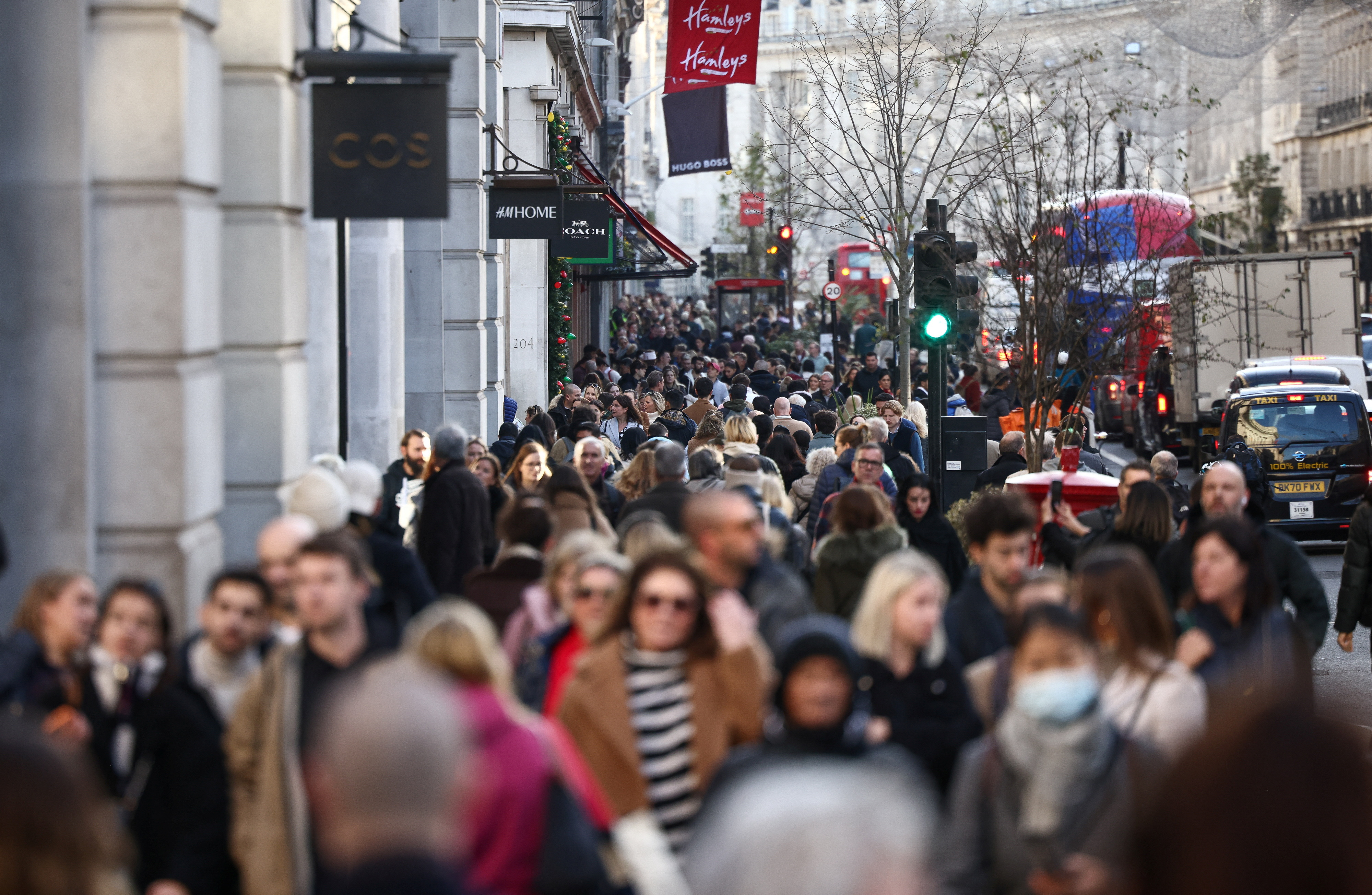
Shoppers head to the Black Friday sales in London
People walk along regent Street during the Black Friday sales in London, Britain, November 25, 2022. REUTERS/Henry Nicholls
 
According to the most recent census out of the United Kingdom, fewer than fifty percent of England's and Wales/s population feel themselves to be identified as Christian. This marks the first time ever that a mere minority of the population of the U.K. registers as faithful to the official, traditional religion of the nation. 

In the decade since the last census, Britain, according to figures from the 2021 census released on Tuesday, has become less religious and evidently less 'white' as well, data released by the Office for National Statistics indicate. On the day of the 2021 census about 45.2 percent of the population of England and Wales considered themselves Christian. Marking a reduction from 59.3 percent ten years earlier. 

The population demographic identified as Muslim rose to 6.5 percent from 4.9 percent of the total. While 1.7 percent identified as Hindu, an increase from 1.5 percent. Over one in three people -- some 37 percent -- claimed no religious faith, marking an increase from 25 percent in 2011. Census data is taken separately for Scotland and Northern Ireland.

Campaigners for secularism suggest that the newly identified shift away from religious devotion is due a reconsideration of the manner in which religion is entrenched in British society. In particular the U.K-. funded Church of England schools. And the fact that Anglican elites sit in in the Upper Chamber of Parliament, along with the long-established position of the British Monarch titled "defender of the faith" and supreme governor of the church.

In addition, back in 2011, 85 percent of the population of England and Wales identified as white s opposed to the current number so doing, at 82 percent.
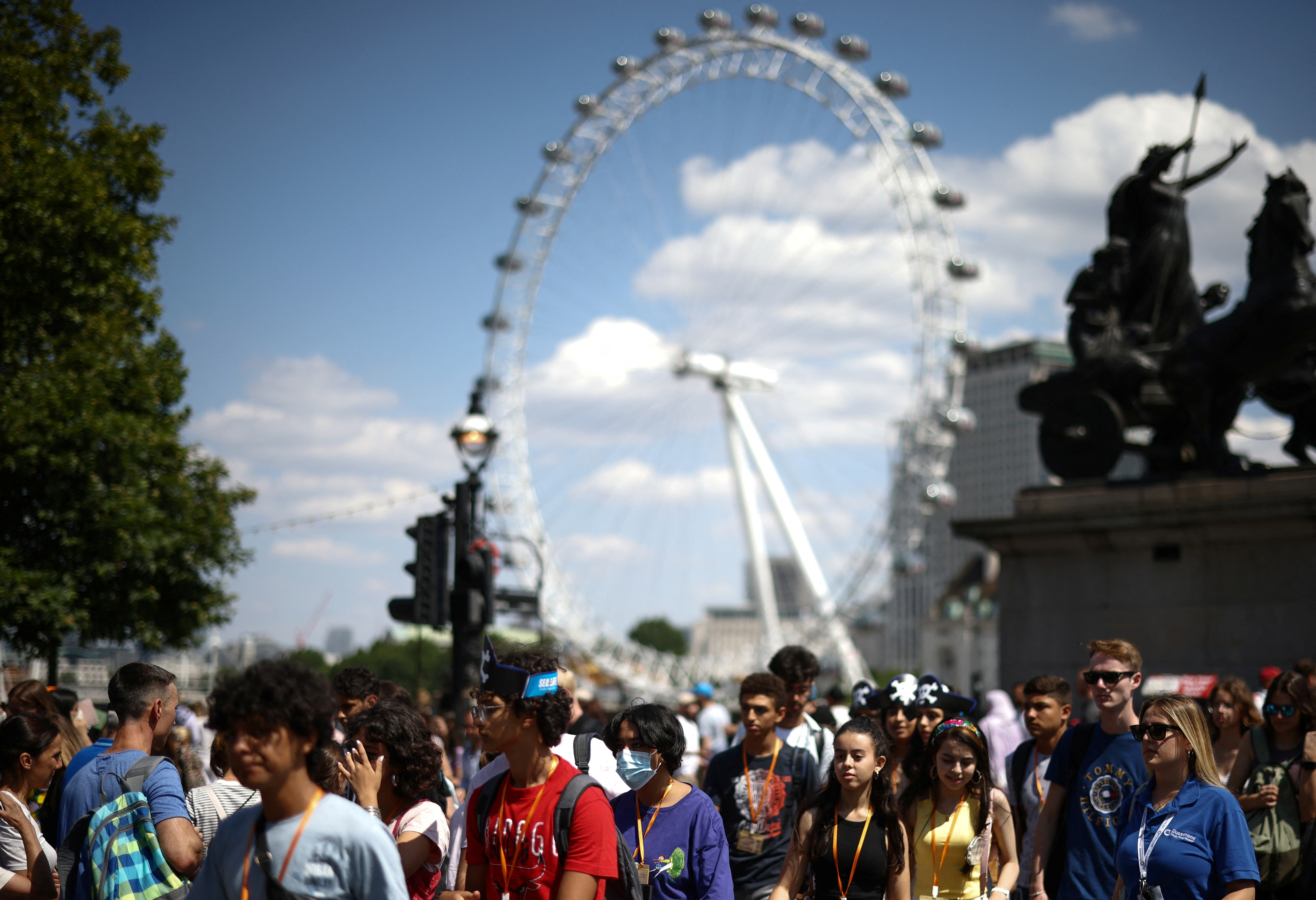
People walk over Westminster Bridge in London
People walk over Westminster Bridge in London, Britain, July 29, 2022. REUTERS/Henry Nicholls

Labels: , , , ,

Wednesday, November 10, 2021

In Mortal Danger? Here, We Can Help...

"I spent two- to six-hour blocks with the injured caver and chatted to him most of the time."
"Fair credit to the guy. He is a fit guy, and he is incredibly resilient."
Dr. Brendan Sloane, British Cave Rescue Council
 
"[The man was] an experienced, fit caver. [His fall was just] incredibly unlucky, a matter of putting his foot in the wrong place at the wrong time [when something moved out from under]."
"All the odds were against the caver, but his mental powers properly got him through. He was in an awful lot of pain to begin with, until we could get the drugs to him."
"I'm absolutely impressed to no end how the teams worked together. A lot of them didn't know each other and had never worked together before."
"And the fact they pulled this off, I'm absolutely thrilled."
Peter Francis, member, South Wales Caving Club (SWCC) 
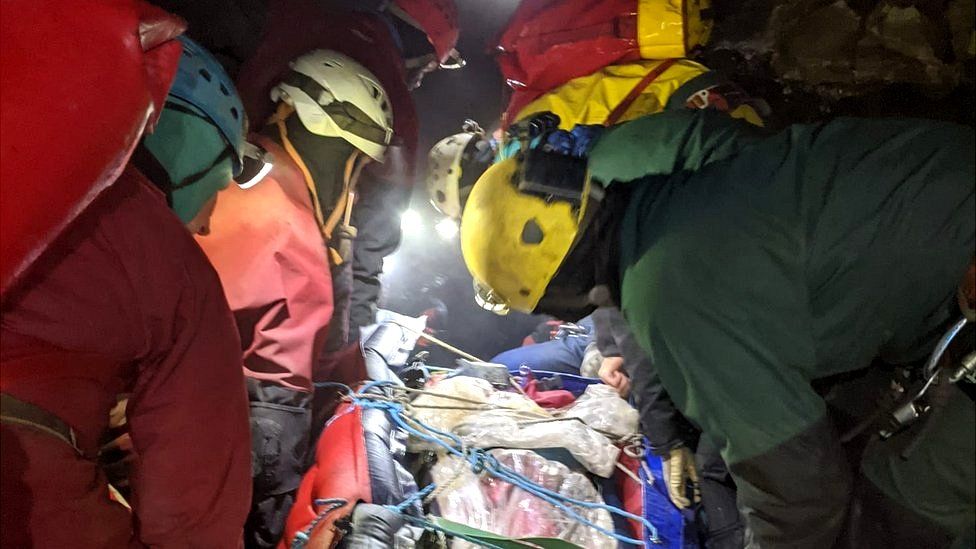
Pictures of the rescue inside the cave
Hundred of volunteers worked in shifts to move the casualty to safety   SMWCRT
 
They did 'pull it off', a tedious, strenuous, dangerous rescue by rescue teams spelling one another for hours on end, to get an experienced, but experience-unfortunate caver to safety and hospitalization. It took two days for the mission to complete, with about 250 specialist rescuers committed to make it a success. Thought to be in his 40s, an experienced caver took a disastrously wrong step just after noon this past Saturday.

He was caving in Ogof Ffynnon Ddu not far from a hamlet named Penwyllt (it is Wales, after all), located northeast of Swansea, Wales. He sustained a broken jaw, broken leg and spinal damage. All of which spelled a physical inability to do anything to extract himself from his situation. Just holding on in those circumstances would have represented a feat of mental and physical strength and courage; the will to survive.

Now in hospital in Swansea, the medics there report him in good condition. It was the following Monday when rescuers succeeded in bringing him out of his dilemma at about 7:45 p.m. Emergency services had been alerted by a fellow caver, resulting in specialist cave and mountain rescuers from across the United Kingdom responding. About ten of the fifteen rescue teams in the British Isles sent their personnel to give assistance; providing stretcher carrier support, preparing routes, and delivering supplies.

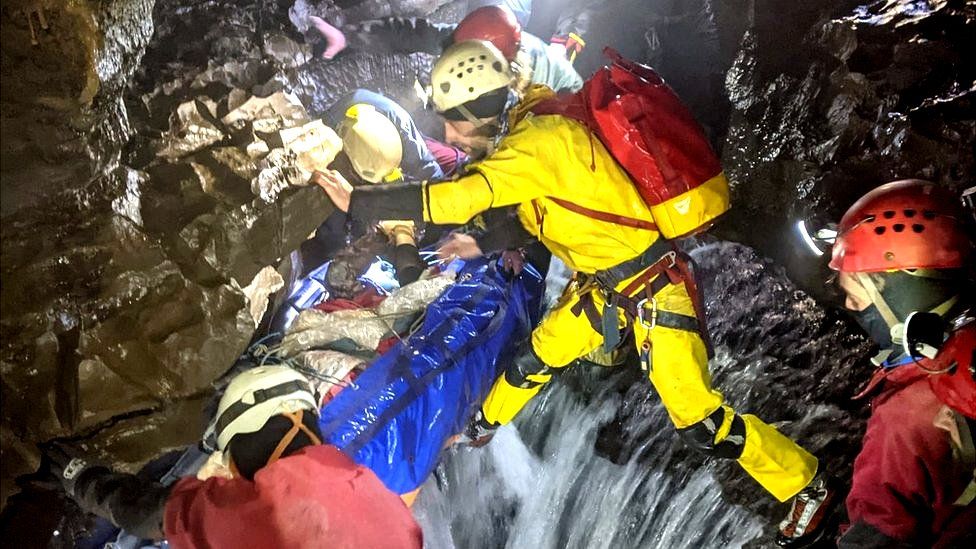
From underground, working in shifts, some 70 people helped to carry the severely injured man with a stretcher; not always horizontally, but of necessity vertically as well, in manoeuvering many narrow passages. According to the SWCC, there are about 61 km of passages leading to huge chambers, unique geological formations, yawning chasms and thunderous river passages within the cave system. 

Once lifted to the surface the caver, cheered by rescuers, was helped place him into a cave-rescue Land Rover, then transported down to a waiting ambulance. No air ambulance helicopter was able to make the trip and land, given the prevailing foggy, wet conditions to the Brecon Beacons. Near the cave entrance dozens of rescuers were huddled for warmth, drinking hot liquids, while teams set off from SWCC HQ up the mountain to the cave entrance, spelling their colleagues, some of whom had been below ground for 12 hours at a time.

The Cave of the Black Spring system (Ogof Ffynnon Ddu), is one of the deepest, most complex such systems in the U.K. requiring a permit from the SWCC to gain access. It took close to 55 hours, representing the longest, time-consuming and no doubt stressful, cave rescue undertaken at any time in Wales: the man "was a mile or two underground in an awkward place", Mr. Francis reported to the news media.

Some caves in Wales are 275 metres below ground, stretching over 50 kilometres; described as "intestinal". The Ogof Ffynnon Ddu cave system is the third longest in Wales. High-risk cavers run a one in 3,332 chance of dying, according to the Startcaving.com web site.
"We often say in caving that an hour of caving equates to ten hours of carrying a stretcher."
"The main point is that the amount of effort that goes into training our rescuers really pays off for an instance like this."
Gary Evans, South and Mid Wales Cave Rescue Team
Pictures from inside the cave during the rescue
Rescuers move the casualty through the cave system  SMWCRT

Labels: , ,

 
()() Follow @rheytah Tweet