Ruminations

Blog dedicated primarily to randomly selected news items; comments reflecting personal perceptions

Friday, December 16, 2022

Warning: Handle With Care

"It makes me feel sick. What on earth were the teachers thinking?"
"It would not be appropriate to give this kind of play the green light for schoolchildren at any time, least of all on the eve of Yom Kippur [Solemn Jewish Day of Atonement]."
Parent of Jewish pupil at Millfield School, Somerset, England

"The play is critically acclaimed and has been performed in many schools over the last 25 years. It deals with shocking historical events and is intended to educate about manipulation and intolerance."
"However, we should not have staged this play. Regardless of the good intentions, nobody should ever be encouraged to role play such actions."
"We are sorry for the hurt that has been caused and we have changed our approach to vetting performances significantly so that this will never happen again."
"[I] personally investigated the matter and offered an apology to the students. They were not asked to delete these images."
Gavin Horgan, headmaster, Millfield School

Pupils at elite public school Millfield perform Hitler salutes during a play about the Fuhrer
 
Form 6 students at a 'public' (private) boarding school in Britain were treated to a one-man play about Adolf Hitler. At the conclusion of the play they performed a Nazi salute: "Heil Hitler!". Some of the students took photographs of the results showing pupils laughing and performing the Sieg Heil salute while looking at a Swastika flag, and facing the actor who wrote the play and who says he set out to teach young people how easily people can be manipulated and led into racist beliefs.

If that was the goal, it appears to have gone somewhat awry. Rather than being horrified at the outcome of the fascist Third Reich's leader's having drawn the world into a global conflict meant to elevate Nazi Germany to sole world power status, and on the way eliminating the lives of six million Jews, among them hundreds of thousands of children just like the student observers, the students came away from the experience somewhat elevated.

With the exception of at least the Jewish students among them who know their history rather well. and who returned home to inform their parents of what had occurred as a learnable moment at a school where the annual fees hit $75,000 to achieve a well-rounded education for questing minds. Britain's current defence secretary Ben Wallace, is an alumni of the school.

Some parents, alerted by their children with respect to the staged play, complained to the school administration. One parent pointed out that the one-man play had taken place mere hours before the holiest day of the Jewish calendar Yom Kippur. Pupils themselves complained to the headmaster. Pupils, it seems were not informed beforehand of the content of the play, meant to transport an audience "in a journey into themselves facing their own intolerance and gently coaxing an understanding of the mindset of a nation that could allow such a man to take control", reads the play's author's website.

The Scotsman has described the play as "terrifying, searing, transfixing". It was performed in over 20 countries. George Santayana's "Those who cannot remember the past are condemned to repeat it", was cited as being inspirational for  the playwright, Pip Utton. And it is his intention to continue performing his play in schools. His play, he emphasized modestly, "is recognized as one of the most important anti-racism, anti-intolerance plays of the past 25 years".
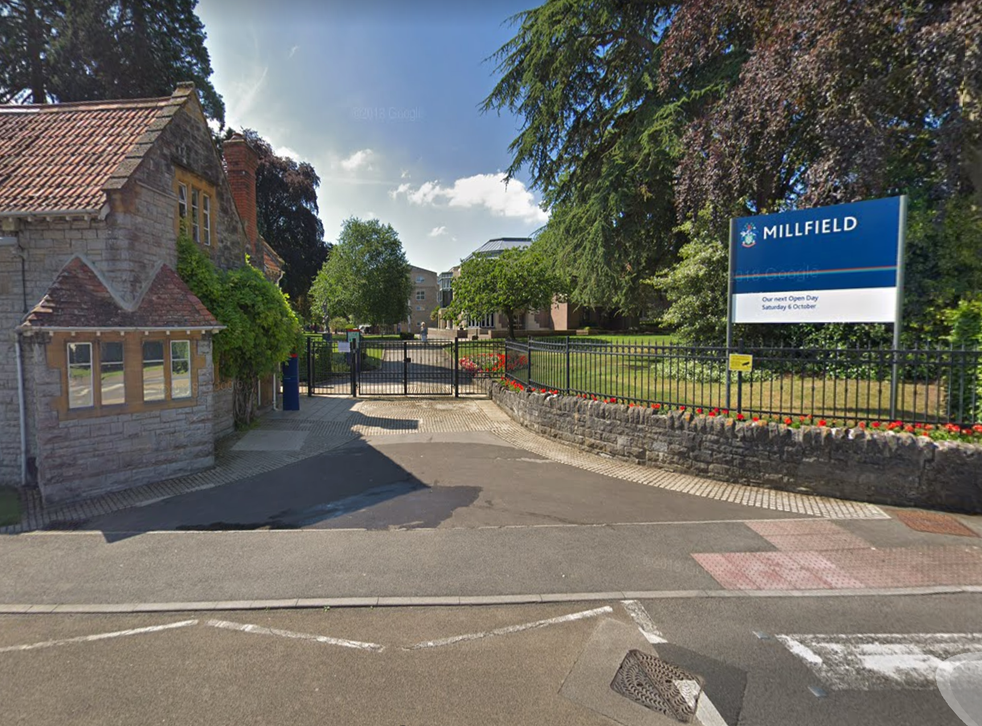
 
<p>Students were told to delete footage and images from the event</p>

Students were told to delete footage and images from the event    (Google Maps)

"[I] manipulated [pupils into performing the salute as part of an attempt to educate them and was in no way attempting to glorify that horrible, horrible salute."
"I said I wanted them to perform a special show of gratitude by raising their right arms in the air, then bring their hand down to clap their knee."\
"As their hands went up I told them, 'it seemed to work in Berlin'. I was in no way attempting to glorify that horrible, horrible salute. The point was to show how people can be manipulated and how easy it is."
"Believe me, it is shocking for me to see it happen."
Pip Utton, solo performer, producer, Hitler one-man play

Labels: , , , ,

Monday, December 05, 2022

Shifting Demographics

"The dramatic growth of the non-religious [has resulted in the U.K. becoming] almost certainly one of the least religious countries on Earth."
"One of the most striking things about these results is how at odds the population is from the state itself."
"No state in Europe has such a religious setup as we do in terms of law and public policy, while at the same time having such a non-religious population."
Andrew Copson, chief executive, Humanists U.K.

"[The data is] not a great surprise [but does represent a challenge to Christians to work more diligently promoting their faith]."
"We have left behind the era when many people almost automatically identified as Christians, but other surveys consistently show how the same people still seek spiritual truth and wisdom and a set of values to live by."
Archbishop of York Stephen Cottrell, Church of England
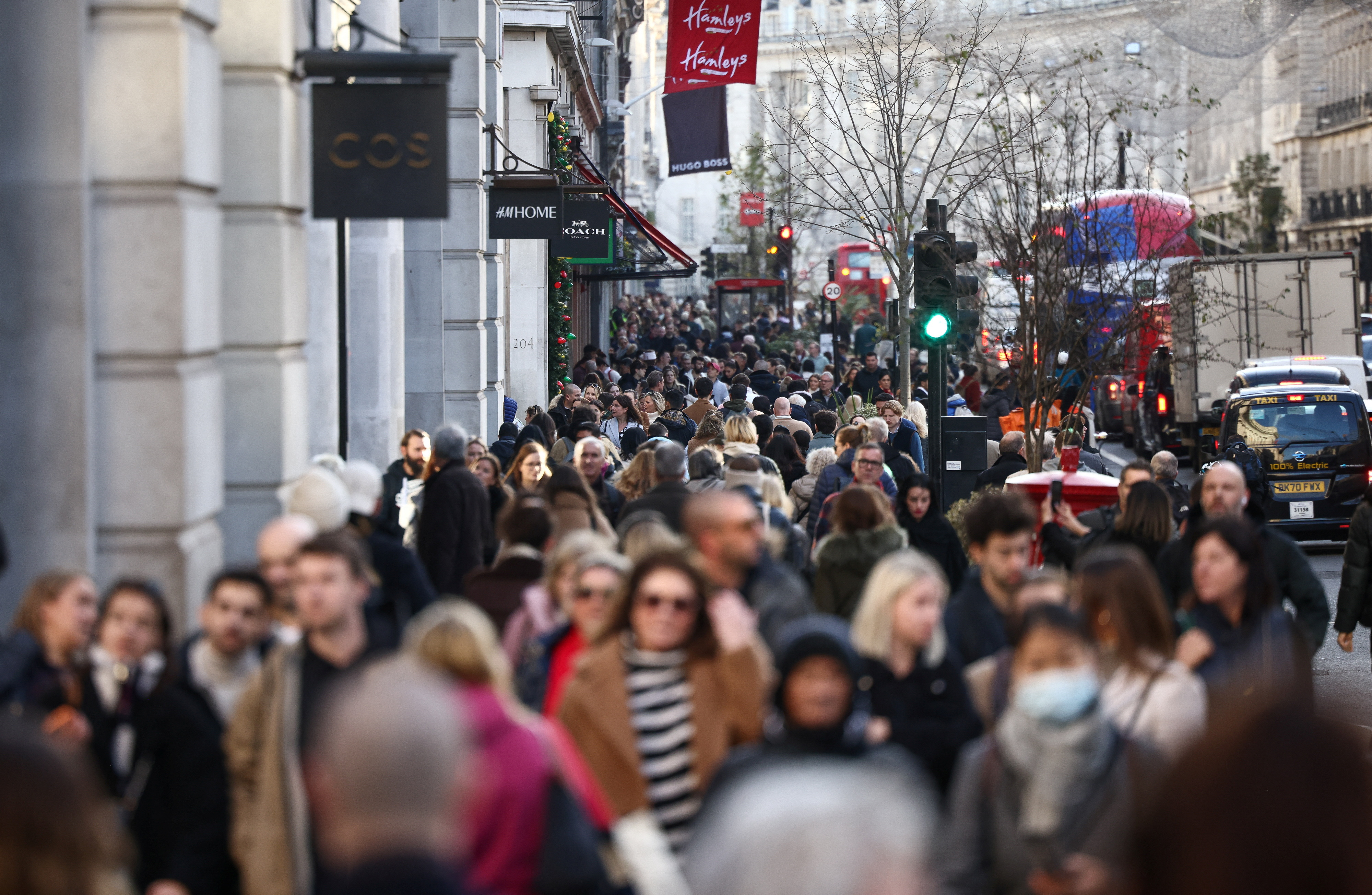
Shoppers head to the Black Friday sales in London
People walk along regent Street during the Black Friday sales in London, Britain, November 25, 2022. REUTERS/Henry Nicholls
 
According to the most recent census out of the United Kingdom, fewer than fifty percent of England's and Wales/s population feel themselves to be identified as Christian. This marks the first time ever that a mere minority of the population of the U.K. registers as faithful to the official, traditional religion of the nation. 

In the decade since the last census, Britain, according to figures from the 2021 census released on Tuesday, has become less religious and evidently less 'white' as well, data released by the Office for National Statistics indicate. On the day of the 2021 census about 45.2 percent of the population of England and Wales considered themselves Christian. Marking a reduction from 59.3 percent ten years earlier. 

The population demographic identified as Muslim rose to 6.5 percent from 4.9 percent of the total. While 1.7 percent identified as Hindu, an increase from 1.5 percent. Over one in three people -- some 37 percent -- claimed no religious faith, marking an increase from 25 percent in 2011. Census data is taken separately for Scotland and Northern Ireland.

Campaigners for secularism suggest that the newly identified shift away from religious devotion is due a reconsideration of the manner in which religion is entrenched in British society. In particular the U.K-. funded Church of England schools. And the fact that Anglican elites sit in in the Upper Chamber of Parliament, along with the long-established position of the British Monarch titled "defender of the faith" and supreme governor of the church.

In addition, back in 2011, 85 percent of the population of England and Wales identified as white s opposed to the current number so doing, at 82 percent.

People walk over Westminster Bridge in London
People walk over Westminster Bridge in London, Britain, July 29, 2022. REUTERS/Henry Nicholls

Labels: , , , ,

Monday, November 09, 2020

Securing The Global Future Food Supply

How local knowledge can help us to protect our planet
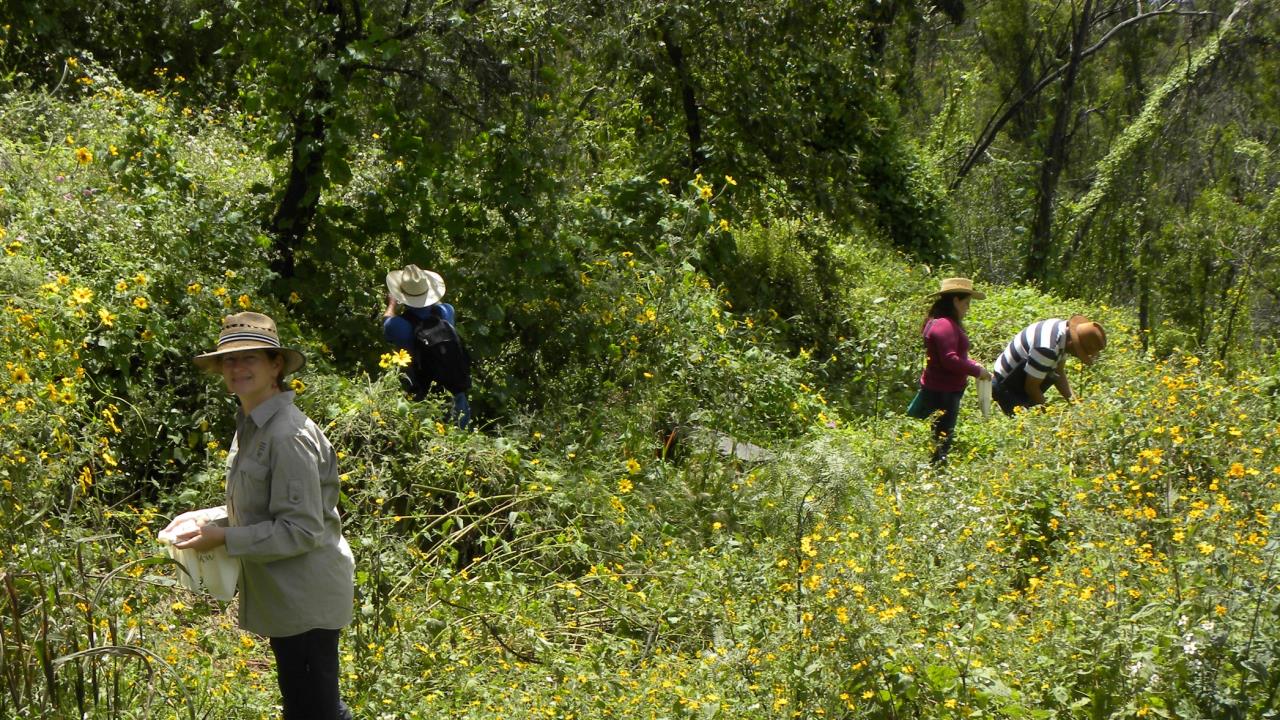
Dr Tiziana Ulian (left) is Plant Ecologist at the Royal Botanic Gardens, Kew.

"From a single bean, you can obtain milk. You can obtain oil. And you can grind the bean and obtain flour, which can be really useful for baking. The potential of this plant is really incredible."
"[Its tubers] are full of water ... which is really good for the species to be able to grow in very dry environments, like in southern Africa in the Kalahari Desert."
"This is really a very scary idea [the world's dependence on only 15 crops]. We are relying on just these 15 plants while the biodiversity there is really wide."
"We shouldn't just focus on a small number of species. Not just for conservation, but it will also help our health and our food security for future generations."
"Biodiversity is essential to food security and nutrition. Not only at the local level but at the global level. And it's important to get to know and use this biodiversity -- this diversity of edible plants and edible fungi. But we also shouldn't forget the wealth of traditional knowledge about their uses and practices."
"I think it's important to have a holistic view. By using this diversity, we can have a sustainable agriculture and at the same time, help protect the environment to deliver its ecosystem services. Because it's not just the food."
Tiziana Ulian, senior research leader, Natural Capital and Plant Health department, Royal Botanical Gardens, Kew 
Millennium Seed Bank solar panels
The Millennium Seed Bank hides an underground collection of over 2.4 billion seeds from around the world, banking them to conserve them for the future.
 
Fully ninety percent of energy intake worldwide emanates from 15 food crops. Over half the global population [just over four billion] rely on maize, rice and wheat as staples. Kew scientists and their collaborators have identified no fewer than 7,039 edible plant species in the course of their research. "We keep discovering new plants every year, so there is the potential that this number can grow more and more."

The morama bean is but one of almost one hundred plant species that Dr.Ulian and her group of researchers based at the Millennium Seed Bank in rural Sussex, England have identified as holding potential for "future-proofing" global food systems. The 2020 report of Kew's State of the World's Plants and Fungi representing a collaboration of 210 researchers in 42 countries, titled "Unlocking plant resources to support food security and promote sustainable agriculture" has been published in the journal Plants, People, Planet.

The morama bean is large and smooth, a chestnut colour and is a multi-purpose food source holding out promise as a future food source. It is well-adapted to harsh conditions as a native of the arid savannahs of southern Africa where it is widely eaten, with a flavour similar to that of roasted cashew nuts. It is used in various forms; milled into powder for porridge and drinks or boiled along with maize meal. 
 
Of the total plants identified only 417 are in current use as food crops, leaving thousands of "overlooked and underutilized plants", some of which may have been grown in the past, but fallen out of favour; others locally known, not globally. Some may be uncultivated plants collected from the wild.
 
A scientist in the Millennium Seed Bank vault
The Millennium Seed Bank safeguards wild plant diversity. ©RBG Kew
 
The Millennium Seed Bank represents a collection of over 2.4 billion seeds, the world's largest cache of seeds from wild plants. "We carry out the research to look at the germination requirements, how to propagate [them] and how to unlock their use", explained Dr.Ulian. "Our research efforts are into understanding the diversity of wild species out there that can feed for the world." A collaborator in Botswana has aided the MSB's work on the morama bean by collecting seeds. 

Once the researchers developed their list of edible plants to be included in their 2020 report, they then distinguished close to one hundred "future foods" with the use of their collective experience rather than depending on an algorithm to select species from across the globe, highlighting five of the one hundred edible plants for the report:
  •  the morana bean;
  • akkoub, eaten as a vegetable in the eastern Mediterranean and Middle East; fried with olive oil and garlic, pickled, or folded into omelettes;
  • fonio, a wild grass species growing in West Africa, "a potential staple food" high in iron, calcium and several essential amino acids;
  • pandanus, a drought-resistant coastal tree that grows from Hawaii to the Philippines and produces fruit and leaves with a variety of uses;
  • chaya, a shrub with "highly nutritious" leaves and shoots native to Mexico's Yucatan Peninsula. 
 
Millennium Seed Bank at Wakehurst
Seeds stored at Kew's Millennium Seed Bank, Wolfgang Stuppy © RBG Kew
 
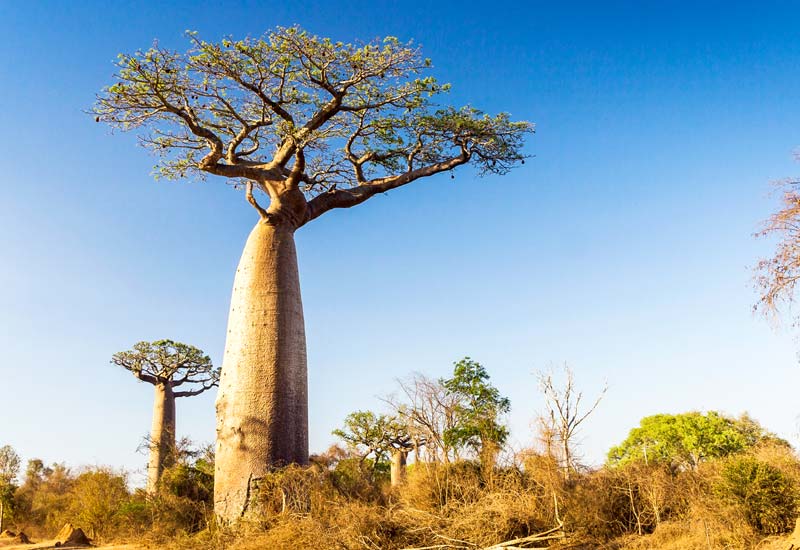
Food insecurity and obesity are two challenges facing humanity, points out Dr.Ulian. "When we talk about food security, it's not only about quantity but also it's the quality of the food." The researchers looked at the edible plants' other uses; 70 percent are medicinal as well as edible; close to 60 percent can be used for materials (e.g., in construction); and 40 percent have environmental uses (e.g., enrich the soil). The baobab, "an iconic, charismatic plant" from Madagascar, northwestern Australia and various parts of the African continent, epitomizes the versatility researchers look for.
 
The fruit and seeds of the baobab are eaten locally; the white pulp is used medicinally to treat fevers and diarrhea, and the bark used to produce clothing, paper and rope. Local traditions associate with such crops of the future should be recognized, looking to their future uses as global food, points out Dr.Ulian.

The Baobab Tree:Africa's Iconic "Tree of Life"
Aduna, The Baobab tree, Africa's iconic "Tree of Life"

Labels: , , , , , ,

 
()() Follow @rheytah Tweet