Ruminations

Blog dedicated primarily to randomly selected news items; comments reflecting personal perceptions

Monday, August 21, 2023

Miracle Drug? No

"This could all be not a real issue, but when you're talking about perioperative aspiration that can cause death, I think we need to act out of an abundance of caution."
"Urgent and high quality research [needs to be done to figure out what the problem is, if any]."
"The reason why people come to the operating room fasted is for an important reason: we want the stomach to be empty to reduce the chance of aspiration."
"[The drugs are of] potential enormous public health importance [taking into account staggering rates of obesity and Type 2 diabetes]."
"[If there is a] legitimate [link between the weight loss drugs and suicidal ideation] it is undoubtedly rare."
Dr. Philip Jones, professor of anesthesiology, Mayo Clinic
Deputy editor-in-chief Canadian Journal of Anesthesia

"[My concern is that the] vigorous  advertising on U.S. television that shows Ozempic users happily doing yoga or playing pickle ball [could obscure the fact that they're] serious medications with a variety of possible side-effects."
"It's not a miracle drug as so many social media sites claim. There are no miracles in science."
Dr. Joe Schwarcz, director, Office for Science and Society, McGill University
Whether they're plastered over streetcars or displayed at Toronto Blue Jays games, advertisements for Ozempic — a diabetes drug that's increasingly being used for weight loss — seem to be everywhere.

Over 3.5 million prescriptions to the value of close to $1.2 billion were dispensed in Canada in 2022 for Ozempic. It is so popular as a weight-loss drug that its manufacturer, Novo Nordisk, announced a temporary shortage of its one milligram Ozempic injection pen for the Canadian market to commence late August and continue to early October; the global supply constraints and increased demand for the product as a guaranteed money-maker for the pharmaceutical company. 

With the growing popularity of these drugs, reports of possible adverse reactions are emerging. Among them recent stories including a possible increased risk of "gastroparesis", a condition affecting nerves and muscles of the stomach, and as well, suicidal ideation in users. Experts feel no evidence exists of cause-and-effect relationships. Should there be a "legitimate" link between weight loss drugs and suicidal ideation "It is undoubtedly rare".

https://media-cldnry.s-nbcnews.com/image/upload/t_fit-1240w,f_auto,q_auto:best/rockcms/2023-08/230801-ozempic-wegovy-suicidal-thoughts-cs-5e778a.jpg
A small number of people who have taken Ozempic have reported developing suicidal thoughts. Chelsea Stahl / NBC News; Getty Images

The drugs are typically taken through once-weekly injections of a pre-filled pen. The medication works partially through delaying gastric emptying, where food remains in the stomach longer before it reaches the intestines, and thus having the effect of making people feel well fed for a longer period of time. The issue of pulmonary aspiration, leading to pneumonia, respiratory distress and possibly death has arisen as a concern among American and Canadian anesthesiologists, as a "signal of concern".

Which is to say, a potentially life-threatening complication for patients undergoing surgery; the risk specifically of such patients regurgitating stomach contents under sedation, and inhaling food into their lungs. A smattering of case reports and small observational studies have arisen relating to patients taking Ozempic or related drugs among whom significant amounts of food remained in their stomachs while under anesthesia, even after 18 hours of fasting.

In a recently published editorial, Dr. Philip Jones who joined he Mayo Clinic recently, following 20 years at Western University, recommend along with his co-authors, that people taking the drugs for weight loss consider halting them for a three-week period prior to undergoing sedation. Three weeks appears to be how long a time it would take for the  body to clear 90 percent of the pharmaceuticals.

These drugs are in the class known by the name glucagon-like peptide-1 (GLP-1) receptor agonists, which mimic a natural hormone serving to delay transit of food through the stomach. Semaglutide is the active ingredient in Ozempic and Wegovy. For over 15 years, semaglutide has been used in the treatment of diabetes. The drug decreases appetite at  higher doses by affecting the brain's hunger centres, and slowing "gastric emptying".
 
According to Dr. Jones and his colleagues' editorial published in the Canadian Journal of Anesthesia, the "gastric emptying" effect explains the common complaints of nausea, diarrhea, vomiting and other gastro-related issues with use of the drug. It is that very delayed gastric emptying that may pose a serious threat to surgery patients "by increasing the risk of pulmonary aspiration of regurgitated gastric contents" they wrote.

The drug is undergoing an assessment as well, by Health Canada, as to whether there is any association between the GLP-1 class and increased risk of thoughts of suicide or self-harm.Drug regulators in the United States and United Kingdom along with the European Medicines Agency launched similar probes. The European agency last month stated it is in the process of analyzing some 150 reports of possible cases of self-injury and suicidal thoughts in people taking GLP-1 receptor antagonists, that include Ozempic, Wegovy and Saxenda.

In addition to which, some reports have surfaced about severe gastroparesis -- paralysis of the stomach where the muscles of the stomach fail to move normally. Contractions become weaker and slower than what is required to digest food and propel it through the digestive tract. A Louisiana patient who used Ozempic for a year before switching to a newer, related drug in July claims to have suffered excessive vomiting from gastroparesis to the extent that her teeth fell out.

A long, white box, with the word Ozempic written in blue on the front side, sits on top of a blue cylinder.
Ozempic, which is used to treat Type 2 diabetes and obesity, is among medications containing GLP-1 receptor agonists that are under review by Health Canada over concerns of suicide risk. (Joel Saget/AFP/Getty Images)
"Patient safety is of utmost importance to Novo Nordisk and we take all reports about adverse events from use of our medicines very seriously."
"Our team is continuously monitoring the safety profile of our products and collaborating closely with health authorities to ensure patient safety information, including adequate information on side-effects, are included in the product monograph."
"[We] remain confident in the benefit risk profile [of our drugs]."
Kate Hanna, director of communications, Novo Nordisk Canada

Labels: , , , , ,

Friday, March 03, 2023

The Chronicity of Obesity

image
"You hear people talking about it -- 'I'm so much happier now, because I'm free'."
"Planning your day around food, that's a lot of brain space. It's frustrating, and exhausting."
"[Semaglutide has to be used in conjunction with a reduced calorie diet. It does not melt fat.] It helps you eat properly. The drug helps you sustain caloric restriction on whichever diet you want to be on -- keto, intermittent fasting, Mediterranean, or just plain old healthy heating."
"I'm not talking about [someone] who is five pounds too high. People living with obesity -- excess adipose tissue that's causing disease -- have a genetic condition that drives their eating behaviurs."
"That genetic condition will never change. All this medication does is mask that genetic behaviour."
"If you had excess weight, you may have fat in your face. You lose the weight; the face goes to where it would have been had you never had that excess weight in the first place."
Dr. Sean Wharton, obesity medicine specialist, adjunct professor, McMaster University, Hamilton, York University, Toronto

"While we cannot discern whether the [prescription] was written for diabetes or for off-label use, the growing numbers may reflect the potential for use as anti-obesity medication for long-term weight management."
Madeline Gareau, spokeswoman, IQVIA CompuScript
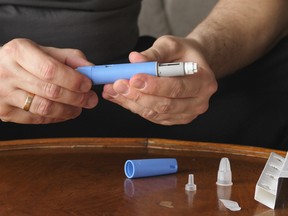
Both Ozempic and its sister drug, Wegovy, are once-weekly injections using pre-filled pens that are injected into bellies, thighs or arms.
A new weight-loss sensation is revolving around off-label use of an approved diabetes drug for adult-onset, Type II non-insulin-dependent diabetics. Ozempic, brand name for semaglutide, the drug that lowers blood-sugar levels, for people who are not diabetic has proven to be an invaluable assist in helping control food cravings, hunger and eating. Ozempic and its sister drug, Wegovy have proven to be extremely effective as weight-loss agents.  "I think it's a breakthrough", said Dr. Wharton.

The drug, however, does not 'cure' the health condition that leads to obesity. Anyone who believes in its efficacy based on the results will be advised that a life-long partnership with the drug will be a necessary commitment to lose weight and to keep it off. Remove oneself from the drug therapy, and in time the condition reasserts itself, the excess weight returns. Both Ozempic and Wegovy are now social media megastars. A Tiktok video featuring the  #ozempic hashtag has been viewed 600 million times.

Image result for obesity
Not officially approved for weight loss, Ozempic is prescribed by doctors who may recommend it "off label" for weight management. Wegovy containing a somewhat higher dose of semaglutide was approved in 2021 by Health Canada for weight loss specifically. It is produced by Novo Nordisk, but not yet launched in Canada. Both drugs are once-weekly injections with the use of pre-filled pens, injected into thighs, arms or stomach areas.

University of Toronto endocrinologist Daniel Drucker, helped discover GLP-1, an endogenous hormone "meaning we make it ourselves after we eat food", noted Dr. Wharton. In a trial with close to 2,000 adult subjects published in the New England Journal of Medicine, those taking semaglutide lost on average 15 percent of body weight following 68 weeks of treatment. In the semaglutide group the change in average body weight came to 15.3 kg as opposed to 2.5 kg in the placebo group.

The movement of food through the gut is slowed by the drug. Among the most commonly reported side-effects, are nausea and diarrhea, most of a mild-to-moderate effect, subsiding with time. Vomiting, constipation and stomach pain can also occur as side-effects. As for serious side-effects they can include inflammation of the pancreas or gallbladder or kidney problems. There is a warning on the Ozempic box from Health Canada of semaglutide's potential to cause a type of thyroid cancer.

Some users of the drug also lose desire for alcohol consumption, according to The New York Times. "It's certainly something that I've heard many patients say, usually in a positive way", commented the chief scientific and medical officer of the American Diabetes Association.  There is a widespread belief that semaglutide affects the brain's mesolimbic system "the hedonic part of the brain, where you want more than what you need to sustain yourself", explained Dr. Wharton. 

Researchers found that one year after ceasing once-weekly semaglutide injections, people  regained two-thirds of their weight loss -- in a study co-authored by Dr. Wharton. The researchers wrote that findings "confirm the chronicity of obesity and suggest ongoing treatment is required to maintain improvements in weight and health".

There were other diet-pill enthusiasms, like fen-phen -- when the fenfluramine-plus-phentermine regimen had to be stopped in 1997, when it discovered that the combination caused serious heart valve conditions.Another drug, Merida, a top-selling weight-loss drug in Canada, was withdrawn from the market related to an increased risk of heart attack, stroke and cardiovascular death.

"Is there going to be a problem 15 years from now, 30 years from now? I don't know. But we're not seeing any [safety] signals." There is an individual risk-benefit ratio that people must come to terms with. Semaglutide has been prescribed to millions of people with Type 2 diabetes for 15 years "without any adverse effect profile", Dr. Wharton concluded.

Medical News Today

Labels: , , , ,

 
()() Follow @rheytah Tweet