Ruminations

Blog dedicated primarily to randomly selected news items; comments reflecting personal perceptions

Monday, July 13, 2026

China's Love for 'Harmony' and Dread of 'Splitism

"It [Beijing's new 'ethnic unity' law] risks deepening restrictions on freedoms of language, education, practice of religion, culture, expression and assembly [of minorities in China]."
"[Eight human rights experts stated that the law could have] serious implications for Tibetans, Uyghurs and Mongolians]."
Volker Turk,  United Nations High Commissioner for Human Rights
https://assets.cfr.org/images/t_cfr_3_2/f_auto/w_1920/v1774557490/2026-03-12T091549Z_1536925380_RC2V2KA7ME2Y_RTRMADP_3_CHINA-PARLIAMENT-ETHNICLAW/2026-03-12T091549Z_1536925380_RC2V2KA7ME2Y_RTRMADP_3_CHINA-PARLIAMENT-ETHNICLAW.jpg
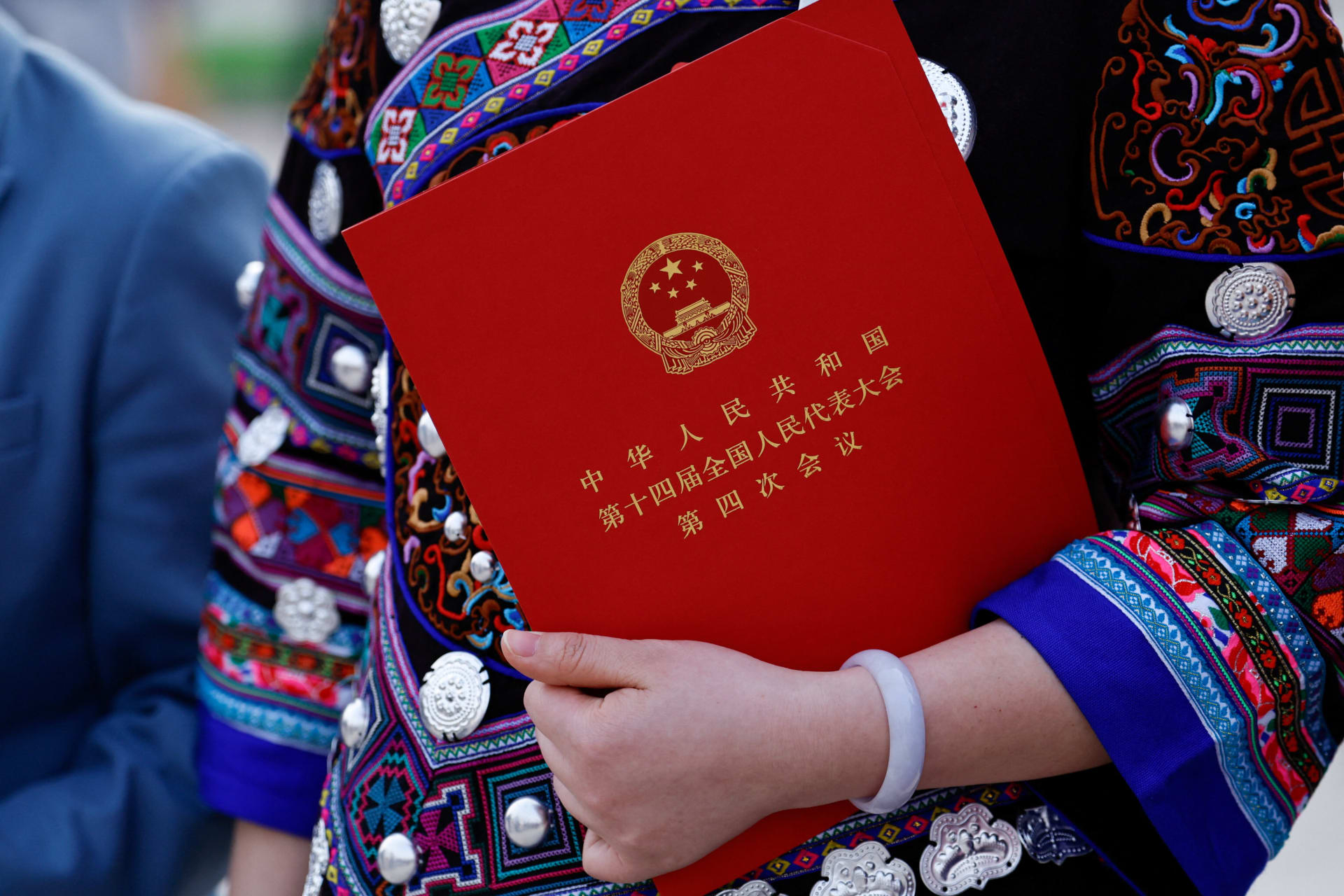
A delegate in ethnic minority costume holds a document following the closing session of the National People’s Congress (NPC) at the Great Hall of the People in Beijing, China March 12, 2026. REUTERS/Tingshu Wang
 
"This new law is the culmination of a policy trajectory that has been building for over a decade, dating back to the 2014 Central Ethnic Work Conference. Under Xi, Beijing is steering away from the post-1949 legal framework of nominal ethnic autonomy (albeit under tight Party control) imported from the Soviet Union. In its place, officials have steadily been pivoting towards what scholars have termed “second-generation ethnic policies”—an aggressive assimilationist approach that emphasizes a common Chinese national identity over accommodation of ethnic differences. Provincial and municipal authorities across China have enacted a wave of local “ethnic unity and progress” regulations in recent years, such as those in Xinjiang (2015) or Inner Mongolia (2021). The new national legislation elevates this approach to the level of a national statute governing all of China."
"The new law’s core concept is captured in the term zhulao (铸牢) – to “forge” or “cast” metal – and its instruction that “forging the communal consciousness of the Chinese nation” is core to the Party’s ethnic policies.  As James Leibold has pointed out, this phrasing reflects a hardening of Beijing’s political line under Xi Jinping – explicitly written into the Party’s Charter at the 19th Party Congress in 2017 – aimed at “melting” subnational and ethnic identities into a shared collective one."
Council on Foreign Relations  
China is in the throes of a wide-ranging propaganda campaign in the promotion and defence of its new "ethnic unity" law, a prime target of critics who contend that this law will continue to add to undermining the rights of Tibetans, Uyghurs and other minorities in the vast country where Han Chinese predominate. With this new law Beijing has granted itself sweeping powers in pursuit of groups and individuals living overseas viewed by the Chinese Communist Party as undermining national unity. It is these groups, claims Beijing that incite ethnic division, and not China's strict totalitarian laws.
 
Beijing watchers have been alerted to the potential of Chinese authorities seeking to accuse activists living abroad of crimes that would merit Beijing authorities' intimidation of those it suspects, to force them to repatriate to China with the knowledge that their family members back in China will become vulnerable to 'special notice' that could degenerate into arrest. Alternatively those who are suspect would become subject to extradition requests back to China, of the host country.
 
China's vice minister of justice, Hu Weilie, blames criticism of its new unity law legislation on "distorted interpretations" by Western media. The law, he emphasized, effective from July 1 is "legitimate, legal, necessary", fully in line with international norms. Guo Jiakun, a spokesmen for China's Foreign Ministry, singled out the United States and European Union for "maliciously slandering" China's policies. 
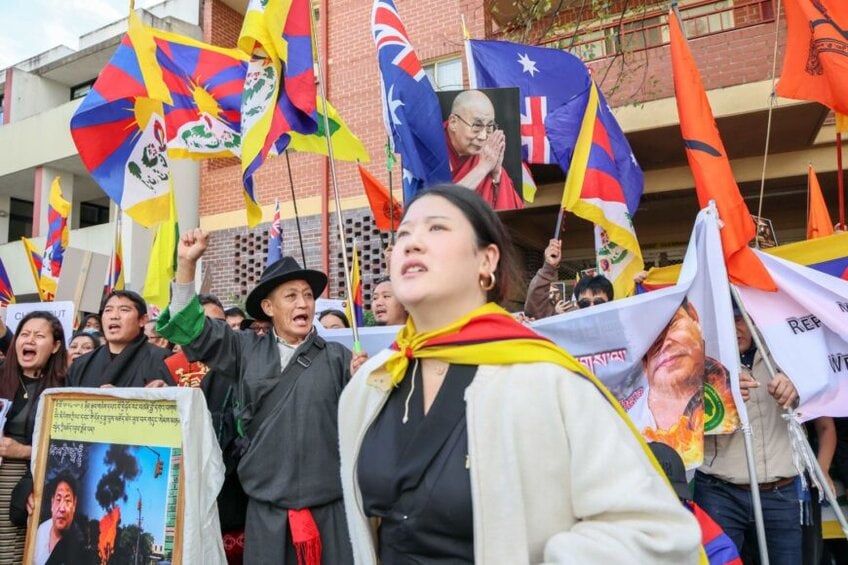
 
https://cdn.shortpixel.ai/spai/w_848+q_glossy+ret_img+to_auto/www.article19.org/wp-content/uploads/2026/07/Tibetans-protest-ethnic-unity-law-Reuters-MT1SIPA000CFCOS8-870x580.jpg
Free Tibet protest against China’s Ethnic Unity law and in honour of activist Pawo Lobga Rangzen, Chinese Consulate General, Camperdown, Australia, 8 July 2026. Credit: Alexandra Buxbaum/Sipa USA
 
The Chinese Communist Party under the leadership of President Xi Jinping has become increasingly sensitive to any criticism regarding treatment of ethnic minorities. The imposition of heavy crackdowns on such groups, targeting Tibetans in particular, to erode the influence of the Dalai Lama in Tibet and the Uyghurs, a Muslim Turkic minority in Xinjiang province, should be immune, according to Beijing from foreign interference.
 
According to Chinese government authorities, the new legislation will protect the traditions of all of the 56 officially recognized ethnic groups in China. While in point of fact, assimilation is the goal the new law is meant to achieve, for the minority groups to be swallowed whole into the culture of the majority Han Chinese. The state-operated Global Times published an editorial accusing "some Western countries and media outlets" of maligning China's ethnic policies. These reactions from outside sources "amount to nothing more than one-sided rhetoric". 
 
Restrictions on the use of Mongolian in local schools in Inner Mongolia prompted widespread protests in 2020. With this new legislation, any acts that "undermine ethnic unity or create ethnic divisions" among Chinese people inside or outside of China and requires all of Chinese society to participate in the mission of ethnic integration are banned. Mandarin Chinese is mandated as the sole language of school instructions as well as in official communication. Parents are ordered by the legislation to "educate and guide children to love the Chinese Communist Party". 
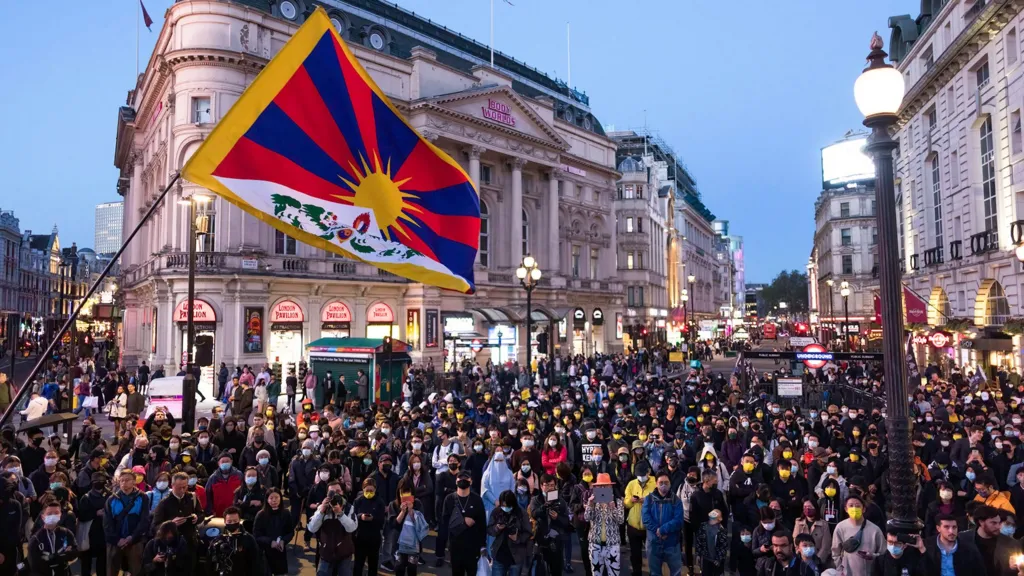
 
https://ichef.bbci.co.uk/news/1024/cpsprodpb/402f/live/a86f4bf0-74a8-11f1-8e1d-bbbb1017d210.jpg.webp
Protesters in London's Piccadilly Circus gather in support of Tibet   Getty Images
 

Labels: , , , , , ,

Wednesday, December 16, 2020

China Maximizing Its WorkForce

"This evidence underlines why businesses must urgently end all sourcing from the region, and why governments must ban imports from the region."
"There are no arguments for delay."
Chloe Cranston, Anti-Slavery International campaign group

"Some minorities may exhibit a degree of consent in relation to this process, and they may benefit financially."
"However ... it is impossible to define where coercion ends and where local consent may begin."
Adrian Zenz, author, Center for Global Policy report, Washington
 
"In all, ASPI’s research has identified 82 foreign and Chinese companies potentially directly or indirectly benefiting from the use of Uyghur workers outside Xinjiang through abusive labour transfer programs as recently as 2019: Abercrombie & Fitch, Acer, Adidas, Alstom, Amazon, Apple, ASUS, BAIC Motor, Bestway, BMW, Bombardier, Bosch, BYD, Calvin Klein, Candy, Carter’s, Cerruti 1881, Changan Automobile, Cisco, CRRC, Dell, Electrolux, Fila, Founder Group, GAC Group (automobiles), Gap, Geely Auto, General Motors, Google, Goertek, H&M, Haier, Hart Schaffner Marx, Hisense, Hitachi, HP, HTC, Huawei, iFlyTek, Jack & Jones, Jaguar, Japan Display Inc., L.L.Bean, Lacoste, Land Rover, Lenovo, LG, Li-Ning, Mayor, Meizu, Mercedes-Benz, MG, Microsoft, Mitsubishi, Mitsumi, Nike, Nintendo, Nokia, Oculus, Oppo, Panasonic, Polo Ralph Lauren, Puma, SAIC Motor, Samsung, SGMW, Sharp, Siemens, Skechers, Sony, TDK, Tommy Hilfiger, Toshiba, Tsinghua Tongfang, Uniqlo, Victoria’s Secret, Vivo, Volkswagen, Xiaomi, Zara, Zegna, ZTE. Some brands are linked with multiple factories."
Australian Strategic Policy Institute
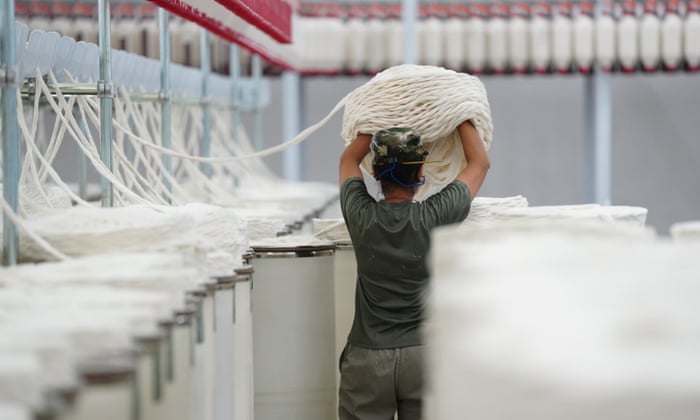
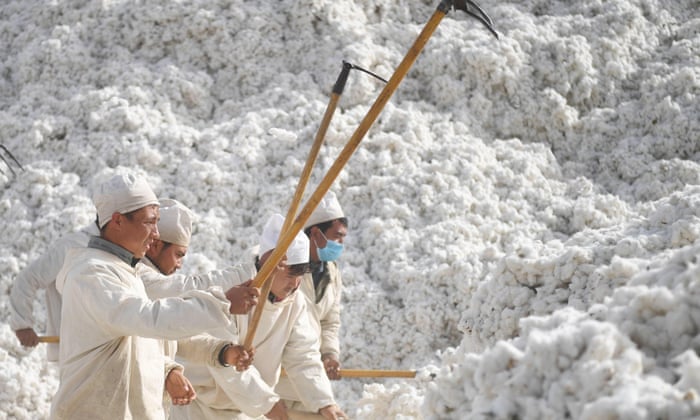
The coalition says workers face ‘vicious retaliation’ if they tell the truth about their employment conditions. Photograph: VCG/Getty Image

Hundreds of thousands of ethnic Uyghurs along with other minority groups are being forced to pick cotton by hand, according to a U.S.based think-tank, in a report that has triggered calls on governments to ban cotton imports from the Xinjiang region of China. Roughly eleven million ethnic Uyghurs call the huge western Chinese Province their ancestral home, where they produce 85 percent of China's cotton, representing 20 percent of global supply, linked to worldwide fashion brands. 

The report emphasizes the likelihood of a major proportion of cotton from Xinjiang was "tainted with forced labour". To which China's foreign ministry responds, in dismissing the allegations: "Helping people of all ethnic groups secure stable employment is entirely different from 'forced labour." According to spokesperson Wang Wenbin close to three million people in the region have been lifted out of poverty; a claim difficult to challenge or to dispel.
 
Workers at a cotton factory in Awat county, in China’s Xinjiang region. Photograph: Xinhua/Alamy
 
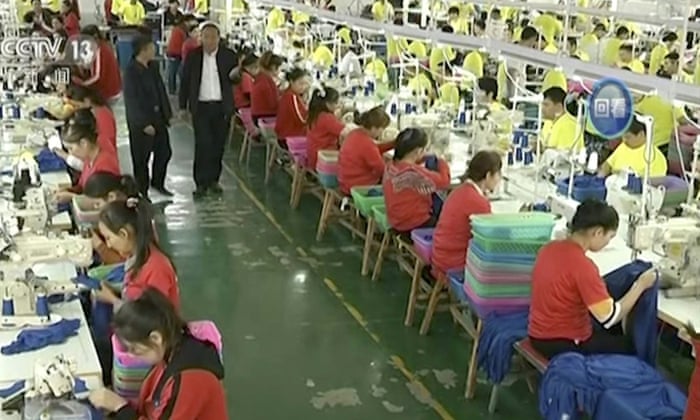
There have been undeniably, long-standing concerns within the international community over reports of a million people from Muslim minorities detained in camps situated in Xinjiang where they have undergone re-education workshops, and are then assigned to work in textile factories. The camps themselves, explains China in its defense, to an outraged world are vocational training centres and their purpose is that of fighting extremism. In other words, without China's official intervention to re-educate Uyghurs, they become terrorists.

The ILO [International Labour Organization] lists 11 indicators of forced labour. Relevant indicators in the case of Uyghur workers may include:

  • being subjected to intimidation and threats, such as the threat of arbitrary detention, and being monitored by security personnel and digital surveillance tools
  • being placed in a position of dependency and vulnerability, such as by threats to family members back in Xinjiang
  • having freedom of movement restricted, such as by fenced-in factories and high-tech surveillance
  • isolation, such as living in segregated dormitories and being transported in dedicated trains
  • abusive working conditions, such as political indoctrination, police guard posts in factories, ‘military-style’ management, and a ban on religious practices
  • excessive hours, such as after-work Mandarin language classes and political indoctrination sessions that are part of job assignments.
Australian Strategic Policy Institute
The Muslim world appears to tacitly agree for there have been no questions emanating from any Muslim country over the allegations, and no protests directed toward China from Muslim sources that usually speak up against prejudice targeting those faithful to Islam elsewhere in the world, just as there was little interest from the same sources in the plight of Rohingya Muslims in Myanmar.
 
Yet according to the Center for Global Policy, Chinese government documents and media reports indicate some 570,000 people, representing three Xinjiang regions, have been sent to pick cotton through a coercive labour program meant to target ethnic minority groups -- adding that the true figure ensnared in slave labour conditions was certain to be higher than that stated by several hundred thousand.
"In March 2020, the Australian Strategic Policy Institute (ASPI) published a report Uyghurs for sale: ‘Re-education’, forced labour and surveillance beyond Xinjiang, which identified 83 foreign and Chinese companies as allegedly directly or indirectly benefiting from the use of Uyghur workers outside Xinjiang through potentially abusive labour transfer programs."
"ASPI estimates at least 80,000 Uyghurs were transferred out of Xinjiang and assigned to factories in a range of supply chains including electronics, textiles, and automotives under a central government policy known as ‘Xinjiang Aid’. The report identified 27 factories in nine Chinese provinces that are using Uyghur labour transferred from Xinjiang since 2017."
"ASPI reached out to the 83 brands to confirm their relevant supplier details. Where companies responded before publication, they have included their relevant clarifications in their report."
"Business & Human Rights Resource Centre invited Abercrombie & Fitch, adidas, Amazon, BMW, Gap, H&M, Inditex, Marks & Spencer, Nike, North Face, Puma, PVH, Samsung and UNIQLO to respond; the[y responded]. We invited Apple, Esprit, and Fila to respond; they did not. L Brands sent its response after publication of our Weekly Update, in October 2020."
Business & Human Rights Resource Centre

In this undated video footage run by China’s CCTV, Muslim trainees work in a garment factory at the Hotan Vocational Education and Training Centre in Hotan, Xinjiang. Photograph: AP Video 


Labels: , , , ,

 
()() Follow @rheytah Tweet