Ruminations

Blog dedicated primarily to randomly selected news items; comments reflecting personal perceptions

Wednesday, August 12, 2026

Colombia's Natural Disaster --- Digging Out

"We are trying to get everyone out alive."
"One of the rescuers asked anyone trapped to whistle, and someone whistled back."
"They pulled out a man and a baby, but the wife is still in there."
"A lot of people have come, with supplies, with food, helping the firefighters, helping the people."
Andres Felipe Mejia, Cali volunteer 
 
"Let's remember that Colombia is full of active fault lines."
"The question isn't whether it can happen again. The question is rather when an earthquake of similar magnitude will occur at another of Colombia's seismic sources." 
Rodrigo León Loya, seismologist, geosciences professor, University of the Andes 
 
"There are many damaged buildings, collapsed buildings, people trapped and fatalities; the quake felt here was very severe."
"What has happened here in my country has been very hard and very sad."
"[My immediate family is safe, but] we are saddened by the loss of life." 
Sarria, Cali taxi driver  
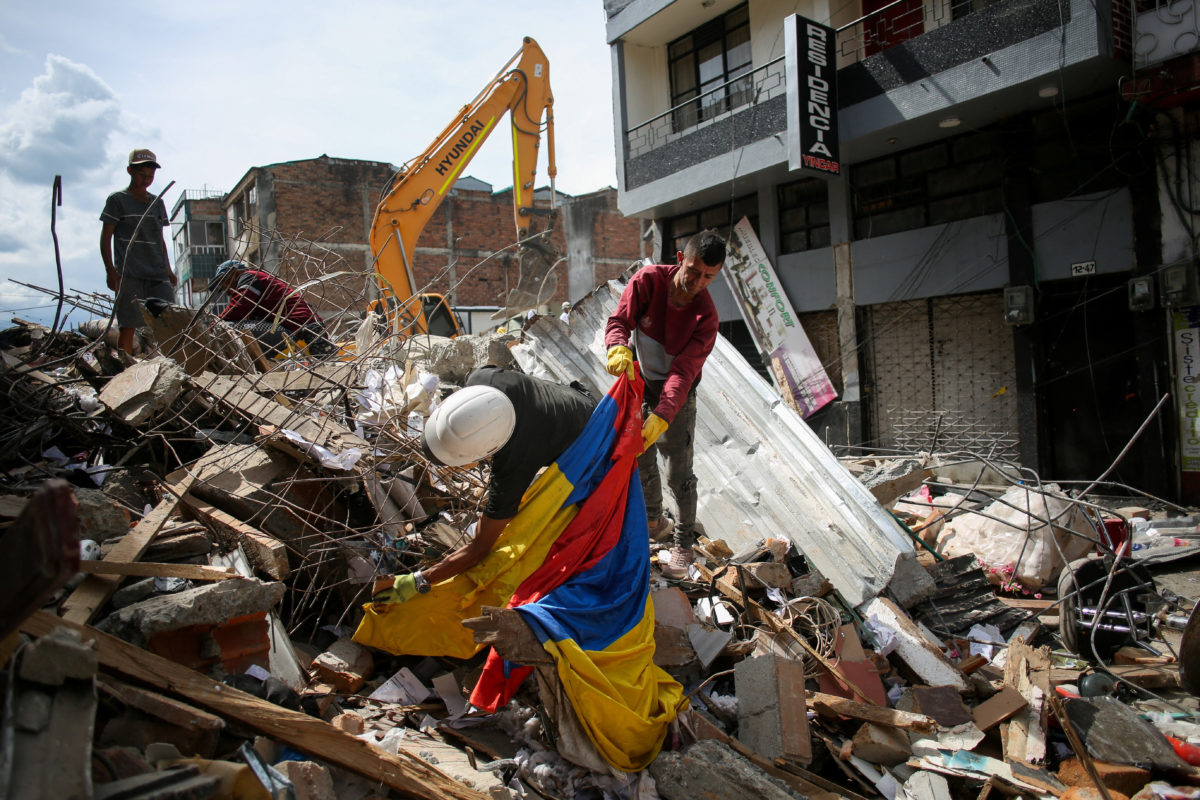
https://d3i6fh83elv35t.cloudfront.net/static/2026/08/2026-08-12T162550Z_275830068_RC22XMAIYWZB_RTRMADP_3_COLOMBIA-QUAKE-1200x800.jpg
PBS News
 
"Local communities were already facing armed conflict and high levels of poverty long before the ground began to shake. Chocó, at the epicenter of the quake, is the poorest region in the country."
"We are deeply concerned that today’s natural disaster will make the needs on the ground even steeper as people lose access to health care and other essential services."
Nicole Kast, International Rescue Committee director for Colombia, Venezuela and Ecuador  
Volunteers in Colombia cleared rubble by hand as they worked through the night Monday, into Tuesday hunting for survivors of an earthquake that left at least 181 people dead, destroying over 100 homes and office buildings. Several cities were struck across Colombia's coffee-growing region and Pacific belt on Monday at 7:34 a.m. Structures toppled, towers swayed and roof tiles tumbled to the ground. There was a reported 100 aftershocks.
 
The hardest hit was Pereira, a city of 500,000 residents. Residents attempted to navigate dark streets with the help of flashlights, searching the ruins of shops and offices in a six-storey building. "It's so sad to see the whole city like this, knowing that there may still be people alive under there" 25-year-old Juana Marin said, joining dozens of other volunteers to clear the rubble.
 
According to the U.S. Geological Survey, this was the country's strongest earthquake in a century, as well as being one of its deadliest natural disasters.The mayors of major affected cities issued a joint statement to announce that at last count 181 people had been killed, with over 2,595 others injured. 
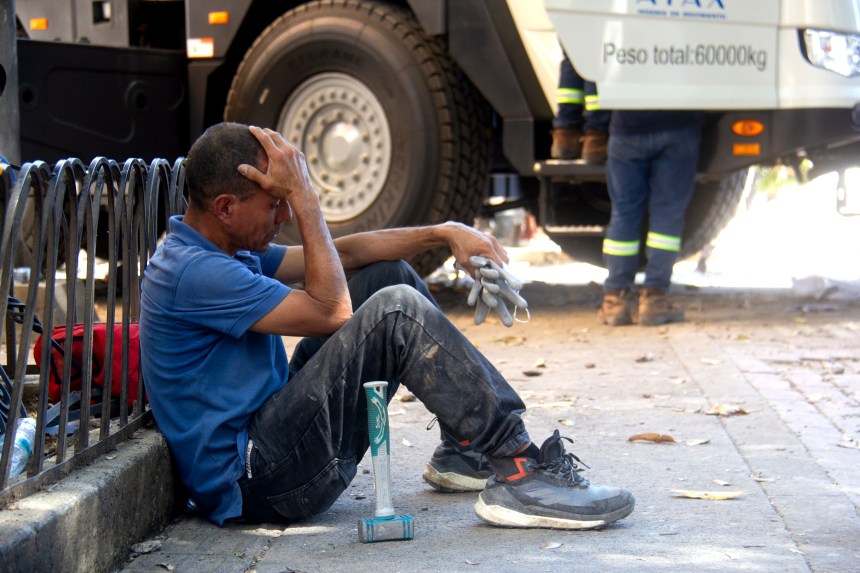
 
https://media-cldnry.s-nbcnews.com/image/upload/t_fit-860w,f_auto,q_auto:best/rockcms/2026-08/260811-colombia-4-rs-7c2f24.jpge
A man rests near the site of earthquake damage in Pereira on Monday.  Alexis Munera / Anadolu via Getty Images
 
 A state of emergency was declared by newly-elected Colombian President Abelardo de la Espriella, while vowing to oversee a concerted rescue effort. He was mobilizing "the entire military and police apparatus", deploying engineers, rescue workers and search dogs. Rescue volunteers went to work with picks, basic tools and their bare hands in Cali in a desperate bid to find survivors. Human chains were formed to expeditiously and safely remove bricks and masonry. Work was halted every few minutes so the rescuers could listen for signs of life from anyone trapped within the rubble. 
 
Red alerts were declared Monday in hospitals in five Colombian cities, while a nighttime curfew was declared in Cali. "It felt like the end of the world -- cars and motorcycles driving the wrong way, everyone searching for their loved ones", explained Nelson Moreno, a volunteer rescue worker. In the capital Bogota crowds rushed out into the streets still clad in pyjamas. 
 
The 7.4 magnitude quake and its initial powerful aftershock of 5.0 was felt across Colombia, and also felt in neighbouring Ecuador and Panama. The quake, at a depth of 110 kilometres, was likely caused by movement along a deep fault within the Nazca tectonic plate, according to experts at the U.S. Geological Survey.  
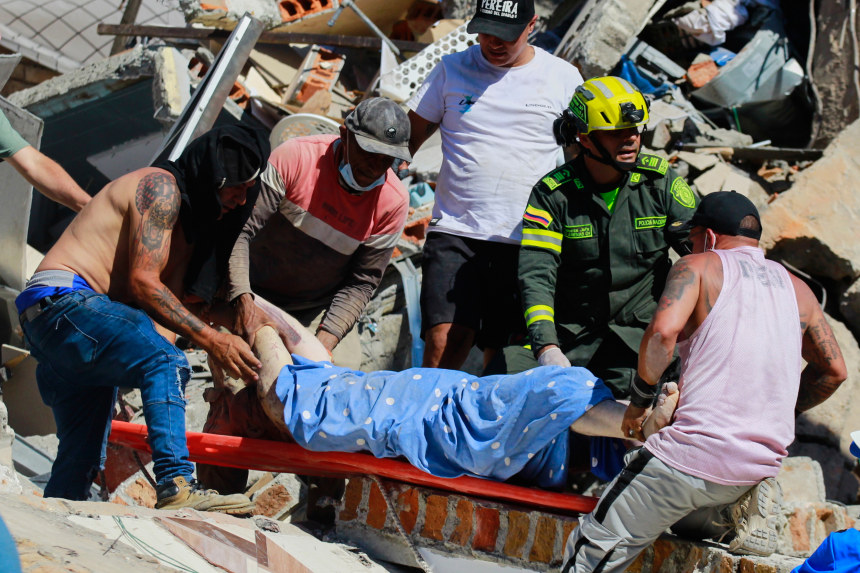
 
https://media-cldnry.s-nbcnews.com/image/upload/t_fit-860w,f_auto,q_auto:best/rockcms/2026-08/260811-colombia-5-rs-3e3b39.jpg
Residents and police carry a survivor pulled from the rubble after an earthquake struck Pereira, on Monday.   Miguel Angel Lopez / AP
 
"There are towns where people have lost everything, where people have died, where homes have been destroyed."
"We don’t have a full panorama of the damage, but we know it’s been massive."
"[The government’s response has so far been] concentrated in the capital, [authorities were flying the wounded from Quibdo to hospitals in the city of Medellín]."
Sterling Palacios, a regional environmental leader 
 

Labels: , , , ,

Tuesday, September 02, 2025

Afghanistan Earthquake : "Children are Under the Rubble"

"Children are under the rubble. The elderly are under the rubble. Young people are under the rubble."
"We need help here. We need people to come here and join us. Let us pull out the people who are buried."
"There is no one who can come and remove dead bodies from under the rubble."
Nurgal district resident
 
"I was half-buried and unable to get out."
"My wife and two sons are dead, and my father is injured and in hospital with me."
"We were  trapped for three to four hours until people from other areas arrived and pulled me out."
Sadiqullah, resident of Maza Dara area, Nurgal
 
"[The death toll had risen to at least 800 with more than 3,500 injured; most casualties were in Kunar]."
"Helicopters reached some areas but road travel was difficult]."
"There are some villages where the injured and dead haven't been recovered from the rubble, so that's why the numbers may increase."
Zabihullah Mujahid, chief spokesman, Taliban 
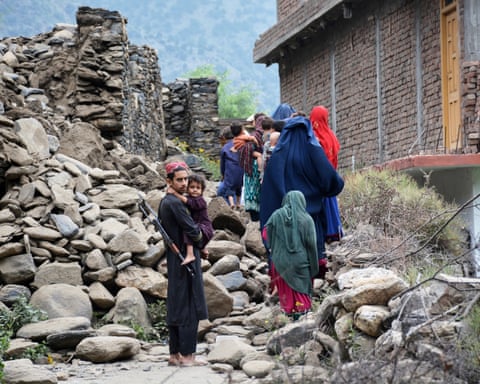
A man holds a child as a line of others pick their way through rubble
Residents walk by a house destroyed by the earthquake in Maza Dara, Kunar province, Afghanistan. Photograph: Wahidullah Kakar/AP

By Tuesday, following the Sunday tremblor, the death toll from a major earthquake in eastern Afghanistan passed 1,400 on Tuesday, with over 3,000 people injured. "We cannot afford to forget the people of Afghanistan who are facing multiple crises, multiple shocks, and the resilience of the communities has been saturated," said Indrika Ratwatte, the UN's resident co-ordinator for Afghanistan, urging the international community to step forward. "These are life and death decisions while we race against time to reach people." 
 
In desperate times of natural disasters, people living remotely in areas where access is difficult and made more so by conditions wrought by an earth upheaval, people are left to their desperate attempts to give aid to those among them unfortunate enough to be caught in the destruction of a shallow earthquake. Eastern Afghanistan teetered under the shock of a 6.0 magnitude quake, late Sunday. Before outside rescue assistance could arrive, locals were frantically trying to dig victims out from the rubble, moving it by hand.
 
According to one resident in Nurgal district where the quake hit villages in Kunar province not far from the city of Jalalabad, his entire village had been destroyed. The quake, hitting before midnight, was centred 27 kilometers east-north-east of Jalalabad, at an eight-kilometre depth. More damage tends to ensue with quakes of shallow depth. Aftershocks that followed the original quake, add to the panic and fear and ongoing danger and damage. 
 
https://i.cbc.ca/ais/e999e05e-cce3-46d4-b0fe-8648adb37c65,1756833664362/full/max/0/default.jpg?im=Crop%2Crect%3D%280%2C0%2C1280%2C720%29%3BResize%3D620
An earthquake of magnitude 5.5 shook southeastern Afghanistan on Tuesday, sparking fears of further destruction almost two days after a large quake in the same region killed more than 1,400 people and injured thousands more. CBC News
 
Rescuers were seen in footage, taking injured people from collapsed buildings on stretchers, placing them into helicopters. Most casualties from the quake were located, according to the Taliban government's spokesman Zabihullah Mujahid, in Kunar. Pakistan felt the quake as far as its capital, Islamabad, although no reports of casualties or damage have come out of Pakistan. 
 
Eastern Afghanistan communities are located in remote areas, within the mountainous landscape. Roads have been blocked and people are unable to communicate, while aid workers are forced to walk four or five hours before reaching  survivors. Rescue flights have operated out of Nangarhar Airport to  transport the rescued injured to hospitals for emergency care.
 
Low-rise constructions, of concrete and brick are hugely susceptible to earthquake damage, as are the homes constructed with mud bricks and wood. That they are poorly built, makes them more susceptible to damage. Homes were seen to collapse by one survivors, accompanied by the sounds of people screaming for help. Sadiqullah described being wakened by a deep boom he took for the warning signals of an approaching storm.
 
Once awake, he rushed to his children's sleeping quarters and was able to bring three of them to safety. On the cusp of returning to bring the remainder of his family out of danger, the room he was in collapsed on top of him. It felt, he explained, as though the entire mountain was shaking. Medical teams from Kunar, Nangarhar and the national capital Kabul, arrived in the area finally. 
 
A health ministry spokesman, Sharafat Zaman, explained further that many areas had been unable to report casualty figures, and "the numbers were expected to change as deaths and injuries are  reported".  Sherine Ibraham, country director for the aid agency, described entire roads and communities cut off from accessing nearby towns or hospital. "Although we have been able to act fast, we are profoundly fearful for the additional strain this will have on the overall humanitarian response in Afghanistan", he stated. 
 
 
https://i.cbc.ca/1.7622953.1756827036!/fileImage/httpImage/image.jpg_gen/derivatives/4x3_1180/2232653605.jpg?im=Resize%3D1180
A deadly earthquake in northeastern Afghanistan has killed more than 1,400 people and injured at least 3,000, according to the Taliban. Afghan volunteers and Taliban security personnel transfer the injured to a military helicopter in the Mazar Dara village of Nurgal, a district of Kunar province on Monday. (Wakil Kohsar/AFP/Getty Images)
 
In a statement by the International Federation of the Red Cross and Red Crescent Societies, immediate needs include search and rescue support, emergency health care and medical supplies, food, clean water, and restoration of road access to reach isolated communities. In October of 2023 a magnitude 6.3 earthquake had hit Afghanistan, with strong aftershocks following. An estimated 4,000 people died in that quake, according to the Taliban.
 
Now, according to the International Rescue Committee, Sunday's earthquake in Afghanistan was expected to "dwarf the scale of the humanitarian needs" that the 2023 disaster had caused. 
 
https://dims.apnews.com/dims4/default/4721483/2147483647/strip/true/crop/6000x4000+0+0/resize/800x533!/format/webp/quality/90/?url=https%3A%2F%2Fassets.apnews.com%2Fec%2Fb1%2F4877cb881423cc3fee569eddcb65%2F4f7913beced5493f91da0545b95942af
Civil defense workers, locals, and army soldiers prepare to evacuate injured victims of an earthquake that killed hundreds and destroyed numerous villages in eastern Afghanistan, in Mazar Dara, Kunar province, Monday, Sept. 1, 2025. (AP Photo/Hedayat Shah)
 

Labels: , , , , , ,

 
()() Follow @rheytah Tweet