Ruminations

Blog dedicated primarily to randomly selected news items; comments reflecting personal perceptions

Tuesday, September 02, 2025

Afghanistan Earthquake : "Children are Under the Rubble"

"Children are under the rubble. The elderly are under the rubble. Young people are under the rubble."
"We need help here. We need people to come here and join us. Let us pull out the people who are buried."
"There is no one who can come and remove dead bodies from under the rubble."
Nurgal district resident
 
"I was half-buried and unable to get out."
"My wife and two sons are dead, and my father is injured and in hospital with me."
"We were  trapped for three to four hours until people from other areas arrived and pulled me out."
Sadiqullah, resident of Maza Dara area, Nurgal
 
"[The death toll had risen to at least 800 with more than 3,500 injured; most casualties were in Kunar]."
"Helicopters reached some areas but road travel was difficult]."
"There are some villages where the injured and dead haven't been recovered from the rubble, so that's why the numbers may increase."
Zabihullah Mujahid, chief spokesman, Taliban 
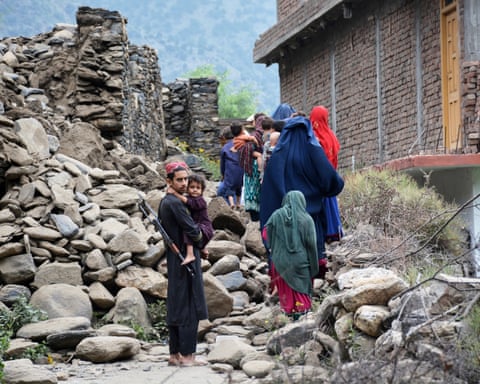
A man holds a child as a line of others pick their way through rubble
Residents walk by a house destroyed by the earthquake in Maza Dara, Kunar province, Afghanistan. Photograph: Wahidullah Kakar/AP

By Tuesday, following the Sunday tremblor, the death toll from a major earthquake in eastern Afghanistan passed 1,400 on Tuesday, with over 3,000 people injured. "We cannot afford to forget the people of Afghanistan who are facing multiple crises, multiple shocks, and the resilience of the communities has been saturated," said Indrika Ratwatte, the UN's resident co-ordinator for Afghanistan, urging the international community to step forward. "These are life and death decisions while we race against time to reach people." 
 
In desperate times of natural disasters, people living remotely in areas where access is difficult and made more so by conditions wrought by an earth upheaval, people are left to their desperate attempts to give aid to those among them unfortunate enough to be caught in the destruction of a shallow earthquake. Eastern Afghanistan teetered under the shock of a 6.0 magnitude quake, late Sunday. Before outside rescue assistance could arrive, locals were frantically trying to dig victims out from the rubble, moving it by hand.
 
According to one resident in Nurgal district where the quake hit villages in Kunar province not far from the city of Jalalabad, his entire village had been destroyed. The quake, hitting before midnight, was centred 27 kilometers east-north-east of Jalalabad, at an eight-kilometre depth. More damage tends to ensue with quakes of shallow depth. Aftershocks that followed the original quake, add to the panic and fear and ongoing danger and damage. 
 
https://i.cbc.ca/ais/e999e05e-cce3-46d4-b0fe-8648adb37c65,1756833664362/full/max/0/default.jpg?im=Crop%2Crect%3D%280%2C0%2C1280%2C720%29%3BResize%3D620
An earthquake of magnitude 5.5 shook southeastern Afghanistan on Tuesday, sparking fears of further destruction almost two days after a large quake in the same region killed more than 1,400 people and injured thousands more. CBC News
 
Rescuers were seen in footage, taking injured people from collapsed buildings on stretchers, placing them into helicopters. Most casualties from the quake were located, according to the Taliban government's spokesman Zabihullah Mujahid, in Kunar. Pakistan felt the quake as far as its capital, Islamabad, although no reports of casualties or damage have come out of Pakistan. 
 
Eastern Afghanistan communities are located in remote areas, within the mountainous landscape. Roads have been blocked and people are unable to communicate, while aid workers are forced to walk four or five hours before reaching  survivors. Rescue flights have operated out of Nangarhar Airport to  transport the rescued injured to hospitals for emergency care.
 
Low-rise constructions, of concrete and brick are hugely susceptible to earthquake damage, as are the homes constructed with mud bricks and wood. That they are poorly built, makes them more susceptible to damage. Homes were seen to collapse by one survivors, accompanied by the sounds of people screaming for help. Sadiqullah described being wakened by a deep boom he took for the warning signals of an approaching storm.
 
Once awake, he rushed to his children's sleeping quarters and was able to bring three of them to safety. On the cusp of returning to bring the remainder of his family out of danger, the room he was in collapsed on top of him. It felt, he explained, as though the entire mountain was shaking. Medical teams from Kunar, Nangarhar and the national capital Kabul, arrived in the area finally. 
 
A health ministry spokesman, Sharafat Zaman, explained further that many areas had been unable to report casualty figures, and "the numbers were expected to change as deaths and injuries are  reported".  Sherine Ibraham, country director for the aid agency, described entire roads and communities cut off from accessing nearby towns or hospital. "Although we have been able to act fast, we are profoundly fearful for the additional strain this will have on the overall humanitarian response in Afghanistan", he stated. 
 
 
https://i.cbc.ca/1.7622953.1756827036!/fileImage/httpImage/image.jpg_gen/derivatives/4x3_1180/2232653605.jpg?im=Resize%3D1180
A deadly earthquake in northeastern Afghanistan has killed more than 1,400 people and injured at least 3,000, according to the Taliban. Afghan volunteers and Taliban security personnel transfer the injured to a military helicopter in the Mazar Dara village of Nurgal, a district of Kunar province on Monday. (Wakil Kohsar/AFP/Getty Images)
 
In a statement by the International Federation of the Red Cross and Red Crescent Societies, immediate needs include search and rescue support, emergency health care and medical supplies, food, clean water, and restoration of road access to reach isolated communities. In October of 2023 a magnitude 6.3 earthquake had hit Afghanistan, with strong aftershocks following. An estimated 4,000 people died in that quake, according to the Taliban.
 
Now, according to the International Rescue Committee, Sunday's earthquake in Afghanistan was expected to "dwarf the scale of the humanitarian needs" that the 2023 disaster had caused. 
 
https://dims.apnews.com/dims4/default/4721483/2147483647/strip/true/crop/6000x4000+0+0/resize/800x533!/format/webp/quality/90/?url=https%3A%2F%2Fassets.apnews.com%2Fec%2Fb1%2F4877cb881423cc3fee569eddcb65%2F4f7913beced5493f91da0545b95942af
Civil defense workers, locals, and army soldiers prepare to evacuate injured victims of an earthquake that killed hundreds and destroyed numerous villages in eastern Afghanistan, in Mazar Dara, Kunar province, Monday, Sept. 1, 2025. (AP Photo/Hedayat Shah)
 

Labels: , , , , , ,

Wednesday, August 23, 2023

Deathly Suspense and Timely Rescue

"I had heard stories about miracles, but I saw a miraculous rescue happening with my own eyes."
"We suddenly felt a jolt, and it all happened so suddenly that we thought all of us are going to die."
"They were telling us don't worry, help is coming,"
"We cried, and tears were in our eyes, as we feared the cable car will go down."
Osama Sharif, 15, rescued schoolboy
 
"I thought I was the smallest and I would die before anyone. I had no hope when I did not see any help and failed the attempt till 4pm [….]"
"I became hopeful when the army rescued Irfanullah and I lost hope again when it became dark and the army halted heli operations. I regained hope when a local man rescued the second boy."
Ibrar Ahmed, 13
 
"After four hours, the first military helicopter hovered over our heads and he tried his best but it did not succeed."
"The second heli returned with no success as well. It made me very worried that helicopters were not succeeding and we will die soon."
"I was hell scared and all the children started screaming. We started holding each other as it kept dangling. I thought I was dead now."
Attualah, 16

"I could see death in front of my eyes."
"The wind pressure was too fast and the cable car was dangling and it had no doors from one side for over a year."
"Everyone was crying."
Rizwanullah, 15
 
"To be honest, no matter how I was making children calm and telling them we would survive, I did not see any chance that we would."
"It was a chaotic situation. But I was struggling to find ways and my phone saved us."
Gul Faraz, 24, local man
From left: Niaz, Attaullah, Usama, Ibrar Ahmed, Rizwanullah, Gul Faraz and Sher Nawaz, after their rescue.
From left: Niaz, Attaullah, Usama, Ibrar Ahmed, Rizwanullah, Gul Faraz and Sher Nawaz, after their rescue. Photograph: Shah Meer Baloch/The Guardian

Pakistan suffered a day of suspense praying for the rescue of six children and two adults on a makeshift chairlift that regularly transported people living in the area over a deep and wide ravine, that had suddenly malfunctioned, losing one of its guideropes, a cable that had broken, leaving the car dangling hundreds of metres above the canyon in a remote part of Pakistan. 

The passengers, in a routine method of transportation for the area and many others like it in geologically mountainous terrain where these makeshift chairlifts act as the sole means of travel and communication, became trapped early in the day on Tuesday. They were crossing a river canyon in Khyber Pakhtunkhwa province, Battagram district. The six children, all adolescents on the car, were on their way to school.
 
Military personnel are seen using ropes and harnesses carrying people to another location.
Pakistani military and local rescue workers bring people from the dangling cable car to safety using ropes and harnesses. (Pakistan Rescue Military/The Associated Press)
 
Nearby residents watched in horror as the cable car was suspended on its single cable, hoping it too would not break and send those clinging to it to certain death, as they awaited a government response that would bring the trapped people to safety. Throughout the country Pakistanis in their offices, shops, restaurants, homes and hospitals crowded around televisions in the grip of drama, clasping hope of rescue.

"Relieved to know that ... all the kids have been successfully and safely rescued", commented caretaker Prime Minister Anwaar-ul-Haq Kakar as he congratulated the military and other rescuers for that ultimate success of their endeavours. "Great team work by the military, rescue departments, district administration as well as the local people."

The rescue helicopters were  unable to fly after sunset, and it was feared that the wind created by the helicopter blades might further weaken the remaining cable. That concern resulted in rescuers shifting from an airborne rescue effort to an operation with high risks involving the use of one cable still intact to approach the car with the chairlift.

The commandos' rope was seen swaying in the wind against the mountainous landscape on footage played on television stations showing a child in a harness pulled to safety. Helicopter rescues in these circumstances described by an expert, are extremely delicate, emphasizing wind generated by helicopter blades threatening to weaken the remaining cable, it alone holding the car aloft.
 
The backs of dozens of people are shown in a mountainous area as they look up to watch a helicopter travelling through the area.
People watch as an army soldier slings down from a helicopter during the rescue mission. (AFP/Getty Images)
 
Most of the rescued children, handed over to their families burst into tears. "Everyone was praying for this moment" commented Nazir Ahmed, a senior police officer in the area where the rescue mission took place. Before the rescue was completed those on the stranded, swaying car were provided with food and water. Some of the trapped were enabled contact by cellphone with their families.

The cable cars are often poorly maintained to the extent that yearly people die or become injured while using them. They are a necessity in the region however, frequently used by villagers to get around the mountainous regions of Pakistan. After this heart-stopping episode that garnered the bated breath of the wider public, the president stated his intention that safety inspections be undertaken for the country's cable cars and chairlifts.

The group of eight, the two adults and six children, were marooned in those dangerous conditions for six hours, suspended precariously 350 metres above ground, even before the helicopters were dispatched after appeals were sent for an emergency response to a potentially deadly situation. In the event, the disaster management authority rose to the occasion.
 
Three children receive medical attention.
Youngsters who were trapped in a broken cable car receive first aid following their rescue, in Pashto village, a mountainous area of Battagram district in Pakistan's Khyber Pakhtunkhwa province, on Tuesday. (Nazir Mahood/The Associated Press)


Labels: , , , , , ,

Wednesday, March 01, 2023

Tik-Tok Tics

"Even professionals in the mental health community can miss it. Because we don't approach patients from the perspective that maybe they're fibbing."
"You get what you need emotionally just by reading an injury on a health-related website and then signing on to one of the tens if not hundreds of thousands of support groups dedicated to that illness."
"You don't have to act in real life. You just get all the attention you can possibly handle, because those groups are unconditionally supportive, at least to start."
"Everybody who's sick does want a little time and attention and care, and that's reasonable. It's only when it becomes willfully deceptive and emerges as a serious pattern of behaviour and an individual may feel, even to the person, compulsive or addictive, which are words they often use, do we worry about it being Munchausen syndrome."
"The limit is only a person's creativity and motivation and knowledge and anybody can become an expert in even rare medical conditions just by reading the Wikipedia entry for 20 minutes."
"There's also a certain kind of perverse cachet associated these days with having a mental illness, in that there's more sensitivity to the issue of mental illness and more awareness than there was when I started this work in 1990."
Dr.Marc Feldman, psychiatrist, University of Alabama
A person holds a cell phone with TikTok loading onscreen.
(cottonbro studio/Pexels)

A fairly new and growing phenomenon has been noted by psychologists, and that may just be because people are showing up in their offices in droves and they're seeing people presenting with mental-health disorders and Tourette's-like symptoms. This is not normal, and this abnormal situation is skyrocketing in numbers. Certainly there must be a cause. People are susceptible to communications, to hearing, seeing and delving into new peculiarities that ask for attention -- and replication.

Humans do this kind of thing from a tender, learning age. Even infants barely learning to walk love imitating gestures, occasionally very complex ones, repeatedly entertaining themselves and becoming proficient in mannerisms and dance steps to gain attention, applause and admiration. The invaluable three As we're always on the lookout for, as though emotionally starved of notice. Some of us are. There are those who are raised in households where parents are undemonstrative leaving children hungering for a human touch, a hug, a kiss, praise.

It can all be found -- emotional validation -- remotely, through the resource that has taken over our lives; the Internet and its vast communication network. A research paper in 2021 noted a video showing what it terms "TikTok tics" was viewed in a three-week period over 5.5 billion times. That's equivalent to 2/3 of the world's population. There is a belief among researchers that the young, mostly adolescent girls and young women, have been acquiring symptoms of a wide number of disorders from viewing posts on social media influencers who display symptoms.
 
https://images.wsj.net/im-418195/square
Kayla Johnsen, 17, in her bedroom in Sugar Land, Texas, says she began watching TikTok videos of people displaying tics shortly before she began experiencing them herself.
 
The phenomenon appears to have been initiated through the Tumblr site, then Instagram, and more recently TikTok. A wide variety of presenting issues have been recognized; gender dysphoria, depression, anxiety, attention-deficit hyperactivity disorder and eating disorders. Some teens are thought to be faking while others may have acquired genuine symptoms. Illnesses acquired through the Internet seems a modern incarnation of mass psychogenic illness.

Patients are showing up looking for treatment for tics associated typically with Tourette's syndrome, a neurological disorder. A paper published in Archives of Disease in Childhood made note of two tic specialty clinics at two London children's hospitals reporting a doubling in referral rates of children presenting with tics.

Psychiatry professor Dr. Andrea Giedinghagen indicates the increased number of cases with tics may represent a genuine portrayal of stress release, relating to the pandemic. According to Professor Gedinghagen's paper published in the journal Child Clinical Psychology and Psychiatry, Munchausen's by Internet is when a person assumes a sick role for the purpose of receiving support through the Internet. 

There is an example of a mass pschogenic illness other than the current one spread by social media, when people between the 14th and 17th centuries in Europe broke into fits of manic dancing. No obvious reason for this behaviour presented itself. Priests began performing exorcisms. There were people who danced themselves to death. There is a theory that it was a case of mass psychogenic illness originating in cult groups that spread the social contagion.

For a more modern explanation, one has only to look at how dominant online activities have become. Isolation caused by the pandemic drove more people to spend more time online. In the cohort of 28 subjects with an average age of 18.8 years, 93 percent showed coprolalia (obscene language) or copropraxia (obscene gestures) in expressing themselves. A way of 'acting out' to attract greater attention, perhaps.

Aidan wearing a knit sweater and sitting crouched on their bed with their hands clasped in front of them. Posters, drawings and other items are pinned to their bedroom wall, and the room is lit with a purple light.
Aidan, 18, developed involuntary tics after watching videos on TikTok posted by teenagers claiming to have Tourette’s syndrome. The New York Times
 
"While it is possible that these are all conversion phenomena, there is also some evidence -- though thus far only explicated in the lay press -- that these may be deliberately manufactured, or a form of factitious disorder."
"The only difference between [TikTok tics] and the medieval dancing plagues is that, thanks to the Internet, people no longer have to be in the same geographic space for that social contagion to spread."
"A lot of times there's an  assumption of malicious intent, which these folks don't have."
Dr. Andrea Giedinghagen, psychiatry professor, Washington University School of Medicine, St.Louis


Labels: , , , , ,

Thursday, May 28, 2020

Communication That Resonates and Informs on COVID

"We need to be wearing masks in public when we cannot social distance. It's really critically important."
"We have the scientific evidence of how important mask-wearing is to prevent those droplets from reaching others."
Dr.Deborah Birx, response co-ordinator, White House Coronavirus Task Force

"You have to convey that this is a serious issue and that people should take precautions. However, you don't want to make people feel fatalistic or hopeless."
"You want to make people feel like they have self-efficacy and you want to make them feel like what they do matters."
"If  you think the virus is very, very infectious, you're basically just saying to yourself, we're all going to get it anyway, why bother taking these annoying precautions?"
"People are already very misinformed about how infectious COVID-19 is. they already think it is far more infectious than it actually is."
"Just kind of going out in the media and saying, for example, that COVID is extremely infectious might upwardly bias people's estimates even more and induce more fatalism."
Jesper Akesson, managing director, The Behaviouralist Research Consultancy, U.K.


The findings of a new study emphasize that acutely warning people of the danger inherent in a virus that has proven to be extremely infectious with sometimes extremely serious outcomes, dulls their sense of self-responsibility to act rationally. When they are confronted with a dire warning emphasizing the danger of a widespread public menace like the SARS-CoV-2 virus, many people tend to believe there is nothing they can do to avoid it, they might just as well do nothing.

Image: Revelers celebrate Memorial Day weekend at Osage Beach of the Lake of the Ozarks, Missouri
Lake of the Ozarks, Mo., on May 23, 2020.Twitter/Lawler50 / Reuters
"This result [that people massively overestimate how infectious the disease is, believing the average person spread the disease to 28 other people] is consistent with previous studies that suggest individuals are likely to overestimate risks that are unfamiliar, outside of their control, inspire feelings of dread, and receive extensive media coverage."
Report on Study, British and American economists

One of the difficulties in communicating effectively to a concerned public details of a widespread public health issue is that people who tend to be readily alarmed will simply adopt a fatalistic attitude toward the situation. Steven Taylor, as a professor at the University of British Columbia has written of the psychology of pandemics and argues that governments, attempting to strike a balance between communicating to low anxiety and high anxiety sectors of their population face a difficult proposition.

On the one hand, low anxiety people respond to stark messaging while high anxiety people require a more gentle introduction to the seriousness of a disease that has laid waste to many countries' health systems and economies, and the need for their populations to react sensibly in self-protection for the greater good of the entire population. Strike the wrong communication note with the wrong audience and an effect completely at odds with the communication's intention is certain to emerge.

Case in point: in the United States where the death toll has surpassed 100,000 from COVID-19, the Memorial Day weekend signalling the start of summer in the United States, saw hordes of people  out sunbathing on beaches, fishing from boats, strolling on boardwalks and generally comporting themselves with scant attention to the warnings to continue social isolation. Coronavirus restrictions have been relaxed in all 50 states.

Beachgoers swarmed Indiana Dunes National Park in Porter Sunday.
Beachgoers swarmed Indiana Dunes National Park in Porter Sunday

In Illinois and New York, restaurants remain closed for in-person dining and hair salons remain closed, but in many southern states most businesses have opened, albeit with restrictions on capacity. A week earlier, a record number of new COVID-10 cases were reported in Alabama, Arkansas, Minnesota, North Dakota, New Hampshire, Maryland, Maine, Nevada, Utah, Virginia and Wisconsin, according to Reuters. There is uncertainty whether this has resulted from a second wave.

The United States has seen the highest number of cases reported in the world, at over 1.6 million. Forecasting models for potential deaths by June 1, reached the figure of the projected 100,000 mark well before the turn of the month. Many state governors and health officials have issued pleas to the public to wear masks in stores and in public, messages that have been received with resistance from some of the population, evidenced by social media full of videos of businesses turning angry customers refusing to wear face masks away from entry.

Packed beaches in Florida and other gulf states on the Memorial Day weekend, left authorities with little option but to break up the large gatherings. Parties elsewhere with people crowded into pools and clubs elbow-to-elbow, have been prominently viewed in videos posted on social media. A party at a club in Houston saw the city's mayor order firefighters across the metropolitan area to enforce social distancing rules.

During the study on communicating with the public over the presence of an infectious disease like COVID, the lead author, Jesper Akesson, acknowledged a feeling of encouragement that most participants were positively impacted by hearing expert information about the virus with some participants having chosen not to believe the information and half retaining their original beliefs at first. But as the study ended, most had revised their opinion in favour of the information given by health experts.

A large crowd enjoys the boardwalk in Ocean City on May 24.

Labels: , , , ,

Saturday, April 11, 2020

Virus Transmission-Enabling Touch-Screens

"[The virus was] more stable on plastic and stainless steel than on copper and cardboard, and viable virus was detected up to 72 hours after application to these surfaces."
"The longest viability of both viruses was on stainless steel and plastic; the estimated median half-life of SARS-CoV-2 was approximately 4.5 hours on stainless steel and 6.8 hours on plastic."
Neetje van Doremalen and team, National Institute of Allergy and Infectious Diseases, Montana

"Touching an object on a screen is a direct visual metaphor for the act of touching content itself, similar to touching an object in the real world, when compared to the more indirect touch of using a mouse or trackpad to control screen content."
"Merely imagining touching an object activates imagery processing, which in turn cues mental simulation of that object's behaviour; in essence, simulated or imagined touch generates effects highly similar to actual touch."
S.Adam Brasel, associate professor of marketing
James Gips (since deceased), computer scientist, assistive technologies
Boston College researchers
A person demonstrating how to clean a Drafting II touch table with cleaning spray.
Cleaning Ideum Touch Screens and Multitouch Tables to eradicate Coronavirus (COVID-19)

Touch-screen technology has it all; ease of contact, immediate response, emotional/sensual gratification, feeling of control, satisfying outcomes. They're everywhere from the pocket-handy little communication devices, ephones and a multitude of gadgets we're engaged with, to touchscreen kiosks used in hospitals, airports, and fast-food emporiums like McDonald's. You can arrange an edate, order hamburgers with all the fixings, respond to health questionnaires, check out of your public library, or the supermarket, no fuss.

It's efficient, it's reliable, it's 21st Century. And it's also, unfortunately, a great way for communicable diseases and even ordinary bacterium to transfer from someone else's unwashed, grimy hands to your own sanitized, scrupulously-clean hands. And never before has this been quite the issue as it now looms, when anywhere lurks the sinister novel coronavirus, ready to leap from surface to your interior, a nice cozy, moist and warm environment enabling it to replicate endlessly while making  you deathly ill.

Worse: dead. And even while it's been playing hell with your internal organs and congesting your respiratory tract, affecting your heart and blood pressure on the way to meeting your expiry date, it leaps from the factory-haven of your lovely, devastated interior to someone else's to begin the harrowing (for the victim) process all over again; repeat, and repeat.

Social distancing lines in operation on the floor and monitors reading “We’re open for takeaway orders only” are seen inside a McDonald’s restaurant in Birmingham in central England on the morning of March 21, 2020. JUSTIN TALLIS/AFP via Getty Images

Oh, of course, not just you. Anyone. Everyone. The old and the  young and all those between. Think playground equipment, think shopping carts, think gas nozzles, elevator buttons, door handles, park and airport seating arrangements, light switches, staircase rails, escalator rails, all touchy-feely, all potential harbours of the sinister novel coronavirus. So: be aware. Refrain from touching.

Not so fast. Because not so easy.

We touch because we instinctively reach out ... to inform ourselves, to steady ourselves, to conduct business, to play games (how many times is a tennis ball handled by all the players?) and because touching is inherent in the way we communicate. Given enough time the surfaces that have been smeared with the viral drops will clear themselves most certainly ... but until they do they are clear and present health threats.


Touch screen interfaces, according to consumer research, "can increase psychological ownership". Direct touch interface tends to increase the number of times people search websites. Modern commerce has been enhanced by the invention of touch-screen technology; the way it appeals to people, its ease of use and the satisfaction levels it conveys. So go ahead, in this age of viral infectious rates soaring with grave consequences, steel yourself to not touch that screen.

And while you're about it, don't touch anything else you cannot immediately disinfect. Much depends on it.

Labels: , , ,

Saturday, November 26, 2016

The BrainSCAN project

"It's an idea that is a little bit out there. [But] it's definitely in the category of things that would be awesome if true ... "
"It would open up a whole new window on the brain."
"We know that the photons are there, and photons are really good for sending signals. It would seem kind of natural for evolution to have found that, too."
Christoph Simon, Quantum physicist, University of Calgary

"It's obviously going to be controversial [the theory that the brain uses optics as a type of communication]."
"But that is good ... Controversy is good."
"It opens the possibility that you could shine light in one area and that light could be piped via the axons to another area ... and excite or inhibit other areas."
Ravi Menon, medical biophysicist, Western University
A human brain is displayed inside a glass box in Sao Paulo, Brazil.
MAURICIO LIMA/AFP/Getty Images      A human brain is displayed inside a glass box in Sao Paulo, Brazil.

What if? The current wisdom is that brain cells communicate through the auspices of electrical impulses, the bio-methodology whereby currents pass from neuron to neuron, instantly delivering messages from the brain to other parts of the body. Central command; our brains, in rapid-fire succession, blink out the coded messages for our heart to beat, our lungs to breathe, our muscles to respond to orders that our limbs be set into motion; limitless orders the body responds to in a fluid flow of command-and-respond.

At the University of Calgary, scientists there are theorizing the brain's capability of harnessing other communication powers, a system of communication based on light-reception: think fibre-optic network enmeshed with the brain to service and animate the mind. Through the use of modelling by computer the Calgary scientific team forward the idea in a journal article (see abstract below) of the plausibility that photons, fundamental particles of light, are able to zip about biological cables that link to parts of the brain.

The mystery of how nature has instructed groups of molecules to generate consciousness itself could possibly be unravelled and in the process enable science to become far more confidently familiarized with how the brain operates. Dr. Christoph Simon credits the idea having lodged in his thought processes upon discovering that specific brain cells -- along with some others elsewhere in the body -- produce photons through the process of normal metabolism.

Axons, the silk-threaded portion of nerve cells, which transmits signals to other cells, and their protective myelin sheath, could conceivably take on the mantle of "bio-photon" conductor. A biophysician from the university's oncology department joined Simon and his colleagues to develop a model which was used to test if there was physical potential for the axons to conduct light. Their observation concluded that it would.

Which does not quite prove that this is what is taking place. Still, a light communication protocol could conceivably transmit information tens of millions of times more efficiently than the electrical spark taking place between neurons, according to Dr. Simon. Of greater moment, such a system could permit for the transmission of quantum data, the basic underpinning of quantum theory taken from the world of atomic and sub-atomic particles where two places at the same time can exist containing two things at once.

The speculation represents a rather neat conception, that nature identified and acted upon the very same possibility that has now fixated Dr. Simon and his colleagues. The very thought that the mystery of how it is that the brain produces consciousness, an evasive riddle that researchers have thus far failed to solve, might be within reach of understanding, provoking additional curiosity. As is usual when a new scientific theory is proposed, there are doubters, and though outside experts find the theory interesting, they remain to be convinced.

The team has succeeded in demonstrating that it is entirely possible for axons to conduct light. But in view of the understanding that the brain's production of photons is "weak", the question lingers; is it actually using optics as a communication form, or is it not? The theoretical "light pipes", on the other hand, whether or not an optical communication network exists, could be research-useful in neurological structures or treatments, according to Dr. Menon.

Abstract

Possible existence of optical communication channels in the brain

Given that many fundamental questions in neuroscience are still open, it seems pertinent to explore whether the brain might use other physical modalities than the ones that have been discovered so far. In particular it is well established that neurons can emit photons, which prompts the question whether these biophotons could serve as signals between neurons, in addition to the well-known electro-chemical signals. For such communication to be targeted, the photons would need to travel in waveguides. Here we show, based on detailed theoretical modeling, that myelinated axons could serve as photonic waveguides, taking into account realistic optical imperfections. We propose experiments, both in vivo and in vitro, to test our hypothesis. We discuss the implications of our results, including the question whether photons could mediate long-range quantum entanglement in the brain. 
Sci Rep. 2016; 6: 36508.
Published online 2016 Nov 7. doi:  10.1038/srep36508
Logo of scirep

Labels: , , , ,

Thursday, July 09, 2015

When Brothers Help One Another

"Michael is a brother. He needs me just as much as I need him."
"That's not being fair to the dog [should the man dependent on its aid as a service dog commit suicide], not being fair to that partner who's stood beside me forever."
"When you can escape yourself for a minute, and stop being selfish and think about the things you have, in my world, it's that dog."
Sgt. 1st Class Matthew Bessler, Cody, Wyoming
Bonnie Jo Mount/ Washington Post
Bonnie Jo Mount/ Washington Post   Sgt. 1st Class Matthew Bessler and his brown Belgian Malinois Mike take a walk in Cody, Wyoming. Both suffer from PTSD since serving in Iraq, but now Mike is a service dog and they are helping each other heal.

They were partners in conflict, Matthew Bessler and 'Mike', the 52-pound brown Belgian Malinois who was trained by the military. They worked well together in Iraq, and the results were such that Sgt. Bessler was awarded two Bronze Stars. Their second tour, part of an elite Special Operations group in the most dangerous phase of the war in Iraq saw them spending every day and each night together, for an eight-month period.

Mike is no longer a combat dog. He is retired. And the military personnel who look after military dogs have concluded that combat canines too, can suffer from post-traumatic stress disorder. As it happened, Sgt. 1st Class Bessler also retired with the realization that his symptoms of post-traumatic stress disorder meant he would never return to combat. Matthew Bessler had applied to adopt Mike, and bring him home.
Michelle Siu for National Post
Michelle Siu for National Post   Many soldiers who worked with canine units during recent wars bring the dogs home afterwards, where they become service animals.

In his twenty-year career with the military in Special Operations, his expertise in engineering and intelligence-gathering had him dispatched to a variety of violent conflicts that the United States military was involved in; Somalia, Haiti, Bosnia, Iraq. The decorated Army Ranger understood that the trust and affection between himself and the combat dog was special and that connection could help them both recover from the extreme stress that exposure to a conflict environment left them with.

Matthew Bessler retired to his farm in Fountain, Colorado. Mike was billeted at the army's military kennels about 20 kilometres north of the farm, at Fort Carson. The required paperwork had been completed for adoption, and Matthew Bessler would rise at dawn daily and drive to Fort Carson to be with the dog who was refusing to eat unless his combat buddy was beside him.

"He won't work with anyone else. He's waiting for you to come back. Come pick up your dog", one of the Fort Carson dog trainers informed Bessler three weeks after they had both arrived back from Iraq to the U.S., and the adoption was finalized. That should have settled Mike down, but it didn't. He began chewing on rocks, crushing his teeth and his gums and part of his lip in nervous reaction to his condition.

Where before Mike was exposed to action on the war front, now it became a veterinary emergency installation where a veterinarian performed a number of surgeries to reconstruct Mike's nose and mouth. He was put on Prozac, becoming calmer, trusting again. But he needed something to focus on to distract him from his PTSD. The answer came as in his turn Matthew Bessler became increasingly traumatized as his own PTSD settled in.

The thought occurred that Mike could become a service dog; his service dog, to help him overcome the pathology that afflicted him. When the human of the duo becomes overstimulated and begins to panic Mike steps into the situation, walks into a quiet corner with his man, and waits out the stress; the close physical presence reducing anxiety as the hormone oxytocin is stimulated for both, aiding their mutual recovery.

The moodiness and the psychical pain can become overwhelming. And Matthew Bessler may begin to fantasize that suicide would release him from the demons that overtake his life periodically. Mike senses these crises and responds by climbing on Bessler, to ground him, so he is unable to do harm to himself, refusing to leave until the crisis has passed.

Sgt. 1st Class Matthew Bessler and his brown Belgian Malinois Mike (at top with black Labrador Ziva in Powell, Wyoming) were part of a canine tactical team with the 10th Special Forces Group. Their tours in Iraq led to post-traumatic stress, but soldier and dog have been helped by their deep connection.
Bonnie Jo Mount/ Washington Post    Sgt. 1st Class Matthew Bessler and his brown Belgian Malinois Mike (at top with black Labrador Ziva in Powell, Wyoming) were part of a canine tactical team with the 10th Special Forces Group. Their tours in Iraq led to post-traumatic stress, but soldier and dog have been helped by their deep connection.

Labels: , , , , ,

Wednesday, December 24, 2014

Freeing The Mind With Movement

"It is only ideas gained from walking that have any worth."
"[Being able to] walk in the mountains for seven or eight hours without a trace of weariness [enables philosophical composition]."
"The suppleness of my muscles has always been greatest when my creative energies were flowing most abundantly."
Friedrich Nietzsche, In Twilight of the Idols (1889)

"If I couldn't walk fast and far, I should just explode and perish."
Charles Dickens letter from Boulogne, France, 1850

"The only friend to walk with is one who so exactly shares your taste for each mood of the countryside that a glance, a halt, or at most a nudge, is enough to assure us that the pleasure is shared."
C.S. Lewis, Author of  The Chronicles of Narnia

"There is something about the pace of walking and the pace of thinking that goes together. Walking requires a certain amount of attention but it leaves great parts of the time open to thinking. I do believe once you get the blood flowing through the brain it does start working more creatively."
"Your senses are sharpened. As a writer, I also use it as a form of problem solving. I'm far more likely to find a solution by going for a walk than sitting at my desk and 'thinking'."
Geoff Nicholson, The Lost Art of Walking


It was observed of Steve Jobs who used the mind-clearing exercise of walking to tease his mind toward clarity and inspiration, that "Taking a long walk was his preferred way to have a serious conversation", as stated in the biography of Apple's co-founder, written by Walter Isaacson. Taking inspiration from a man whose inventive genius was an example to many others in the field, Facebook's Mark Zuckerberg is also credited with adopting the walking-to-think example.

Charles Darwin is reputed to have walked constantly along what he termed his "thinking path", a road called Sandwalk Wood located close to his home in southeast England. He developed a habit of three-45-minute walks each day; before breakfast, lunch, and the third post-prandially, in the early evening. His son attested to his father's rarely straying from the routine. And it was that routine he relied upon to aid him in finalizing his theory of natural selection and random mutation.


Ludwig van Beethoven, deaf at 40, had his own regimented routine that included regular walking. He would intersperse his composition time with swift forays out of doors to refresh his mind. Once his working day was completed, he would take long, solitary walks carrying with him a pencil and notepad to stroll the Viennese woods. There to find inspiration, then recording them. His sixth symphony the "Pastoral" is complete with woodwind sounds of various birds he heard during his rambles.

Henry David Thoreau, George Orwell, Thomas De Quincy, Constantin Brancuso, Bruce Chatwin and Vladimir Nabokov all indulged in walking to release themselves from the stress of life and work, allowing their minds to roam creatively, indulging their natural creativity and in the process enriching their originality, unleashed through the serenity and mind-wandering that captivated their inner consciousness, gifting society with the results.

And now researchers with Stanford University have validated the process of unleashing creativity through the act and art of walking. The study results, conducted by Marily Oppezzo and Daniel L. Schwartz, published in the Journal of Experimental Psychology resulted from an experiment where participants were tasked with undertaking Guilford's Alternative Uses Test.

This is a timed activity meant to measure creative thinking; while sitting, and alternatively while walking on a treadmill. The two researchers discovered that walking did indeed increase creativity for 82% of the research participants, with increases of output averaging 60%. The test evaluates the quantity of ideas, but also their quality; the originality of ideas and specificity of those ideas. Additional ideas were generated while walking, of a high quality; innovative and practical.

The advice of those who engage in walking is simply to go out and do it. The benefits endowed by so doing are just too numerous to overlook, from the simple enjoyment of exercising limbs, to the freedom to look about and appreciate a landscape, to the freeing of the mind while taking in prevailing clues of light, distance, fragrances and activities taking place all about; whether in an urban streetscape or a woodland landscape ramble, the results are manifold.


Human beings were not designed to sit for interminable hours at desks staring at computer screens and exercising their cerebral matter through forced communication without some manner of inspirational motivation interrupting the stagnation of movement and boredom. Walking does that, the ingestion of the scene through fresh air to stimulate the brain along with the physical momentum of striding along and appreciating the sensations that surround and impress.

From those stimulations come the urge to indulge in performing some measure of expression, for we are creatures meant to communicate, whatever the tools we use at our disposal; words, paint, sculpture, music, or dance.  

Labels: , , , ,

Saturday, May 17, 2014

Art And Science - And Debate

"There is no evidence that the hydraulic fracturing ... has resulted in any contamination or endangerment of underground sources of drinking water (USDW)."
"Moreover, given the horizontal and vertical distance between the drinking water well and the closest methane gas production wells, the possibility of contamination  or endangerment of USDWs in the area [Alabama] is extremely remote."
Carol Browner, EPA administrator [under Bill Clinton]; director of White House Office of Energy and Climate Change Policy [under Obama administration]

"Industry documents show that 6% of the wells leak immediately and that 60% leak over time, poisoning drinking water and putting the powerful greenhouse gas methane into our atmosphere. We need to develop truly clean energy not dirty water created by fracking."
Yoko Ono for Artists Against Fracking
Encana to invest $3.1B in Eagle Ford, double oil production
Workers tend to a well head during a hydraulic fracturing operation at an Encana gas well outside Rifle, in western Colorado.  Photograph by: Brennan Linsley , THE CANADIAN PRESS/AP
 
Well, that's settled then, it seems. The U.S. EPA, known for its rigorous research and reliability has lied repeatedly, assuring authorities in various American administrations that fracking is completely safe, when obviously it is not, because an environmental pressure group -- scads of environmental pressure groups -- faithfully practise their religion of environmentally passionate condemnation of energy extraction.

Fracking is a new term to most people. But it is anything but a new technology. It has been used for well over half a century in various states, and from all environmental, scientific reports that have been issued throughout that period of time there has never been one single documented issue that would support the contention that fracking "poisons" drinking water, through contaminating aquifers.

In 2012, Lisa Jackson, at that time head of the EPA informed a reporter that: "In no case have we made a definitive determination that the fracking process has caused chemicals to enter groundwater." The EPA "reviewed incidents of drinking water well contamination believed to be associated with hydraulic fracturing and found no confirmed cases that are linked to fracturing fluid injection into coalbed methane wells or subsequent underground movement of fracturing fluids."

Alabama regulators reviewed fracking activity on their own and the result they came up with was the same: "There have been no documented cases of drinking water contamination that have resulted from hydraulic fracturing operations to stimulate oil and gas wells in the State of Alabama." And in Alaska state researchers found: "There have been no verified cases of harm to groundwater in the State of Alaska as a result of hydraulic fracturing."

It doesn't end with just those two states. Kentucky too received landowner complaints about contaminated groundwater and when they conducted their research they concluded that: "In Kentucky there have been alleged contaminations from citizen complaints but nothing that can be substantiated." 

Michigan has thousands of fracked wells, yet investigations conducted there found "there is no indication that hydraulic fracturing has ever caused damage to groundwater or other resources in Michigan." The state's Office of Geological Survey claims never to have received one single complaint or allegation that fracking had affected groundwater "in any way".

"Though hydraulic fracturing has been used for over 60 years in Texas ... records do not reflect a single documented surface or groundwater contamination case associated with hydraulic frackturing" was the official word from that state. Since the Fifties drillers in South Dakota have been fracking for oil, and for gas since 1970, and yet the state reports: "No documented case of water well or aquifer damage by the fracking of oil or gas wells."

A  study conducted by the Ground Water Protection Council, comprised of state-level groundwater regulators, concluded in a 2011 report covering 15 years of activity where over 16,000 horizontal hydraulic-fracking shale-gas wells were used in Texas and Ohio that not "a single groundwater contamination incident resulting from site preparation, drilling, well construction, completion, hydraulic fracturing stimulation or production operations at any of these horizontal shale gas wells", was revealed.

Perhaps it should be further explained by looking at the verifiable fact that fracturing is occurring at an amazing depth, deep into the Earth; how does a mile or deeper sound? Then compare that to the depth of a typical well which sinks several dozen feet to a few hundred feet to reach an exceptionally deep water table. The Big Well in Greensburgh Kansas, dug by hand in 1887 has a depth of 109 feet; deep because of a deep watertable.

Water aquifers average around 500 feet below ground. And fracking takes place thousands of feet below the surface, between 6,000 and ten thousand feet underground. Quite the difference in depth ... leading to the obvious conclusion that contamination just isn't even remotely likely. For fracking fluid to enter the water table or to enter an aquifer it would have to flow upward through tons of rock.

Environmental scientists might take a break from time to time and turn their attention from precise scientific measurements of the environment to turning their hand to the arts. The kind of aesthetic activity that really pleases art-lovers, to offer an alternative to the art being churned out by those involved in Artists Against Fracking. If artists can so readily turn themselves into environmental investigators, why not scientists into artists?

Oh, wait ... the art is in the ability to persuade people that what they're witnessing is art. The science proves or disproves a theory turning it into observable fact. Funny world we inhabit.

Labels: , , , , ,

Thursday, April 03, 2014

RANDOM POSTS Canine Behaviour M- Canines and Humans
Patience 101- Canines and Humans

Patience 101- Canines and Humans

In my experience changing a dog’s unhealthy habits can be accomplished with more ease than changing a human’s unhealthy habits. Why? Is it because the dog is less intelligent than the human? In my estimation it is not that the dog is less intelligent.

A dog is generally more observant and therefore a more insightful communicator than an ‘untrained human’. Insight and observation are attributes that support logic. The lack of insight creates opportunity for confusion, emotion and chaos.

A dog will willingly accept another mode of behavior when true logic is offered whereas we humans – in our single minded fashion ‘doggedly’ reject logic in favour of our emotive state. A type of stubborn that does us little good. What we need instead is ‘good’ stubborn. For the purposes of this discussion we will call ‘good stubborn’ – patience.

A dog has plenty of patience -  to wait patiently for an opportunity, or to  persist with great determination.

On the other end of the spectrum, we humans are rapidly losing a sense of what patience truly represents.
As technology continues to evolve at an ever increasing rate we humans are facing a real challenge on many fronts – some of which directly affect our ability to understand and support the psychological well-being of our canine companions.

We are becoming less adept at perceiving and intentionally using all of our senses. This has a deleterious effect on our ability to effectively communicate. We are relying more and more on technology and less on our own senses to accomplish many normal daily functions. We spend less time on face-to-face communication – this trend certainly does not improve our face-to-face communication skills. Our desk-top and mobile devices perform ‘spell check’ for us. The internet allows us to look at a vast array of images and information during the course of a typical day. Our human brain is fluid in its ability to evolve along with us as we change the way we work and play in our daily lives. If you spend a sizable portion of your day using a technological device (computer, hand-held device, etc.) you gain skills but you also lose skills. What you gain is access to a wealth of images and information. What we lose is our attention span, and with that goes a loss of attention span and the ability to accurately observe and retain information. To gain back what we are losing and strike a healthy balance between what technology has to offer and what nature gave us to use  is of the utmost importance to maintaining healthy relationships with ourselves and with others.

“The single biggest problem with communication is the illusion that it has taken place” - George Bernard Shaw

Our sense of time is changing – what was once considered fast is now considered slow. Our sense of patience, our sense of being present in the moment is changing. We think of ten seconds as a long time, when in fact it is just a few seconds.

Misunderstanding, miscommunication, loss of patience, loss of perspective and falling victim to our default state creates a situation where the human and the dog end-up in conflict – this is reflected in the ever increasing number of dogs with behavioral problems.

Labels: , , ,

Sunday, October 27, 2013

Humour In Spycraft

"Would you like a real interview?" (Michael V. Hayden)

"I'm not a reporter." (Tom Matzzie)

"Everybody's a reporter." (Michael V. Hayden)

In the modern age of instant communications, the ubiquity of cellphones with their photograph-taking capabilities and their ready use of Twitter's accounts, everyone has become a reporter, a photographer, an instant news-taker and journalist. News rooms are now dependent on instant photography by onlookers at the scene of disasters or unusual events and natural phenomena to enhance their news stories with the punch of a picture speaking a thousand words.

In the instance of former National Security Agency chief Michael Hayden, casually speaking on his cellphone aboard an Amtrak train on its way to Newark, that was the lesson that was brought home to him with a punch of clarity. It might be assumed that someone of his experience and his presumed knowledge of human nature, might be aware that name-recognition and human curiosity might present as a problem.

He was, after all, on a public transportation conveyance, speaking of high-level intelligence matters in a normal tone of voice that carried over to surrounding seats, piquing the curiosity of others armed with the requisite tools of reportage. So that when Mr. Hayden spoke of President Barack Obama's Blackberry, modified to block the possibility of foreign eavesdropping (Angela Merkel, take note!), passenger Tom Matzzie pricked up his ears and began texting.

Recognizing just who Michael V. Hayden was, he tweeted: "Former NSA spy boss Michael Hayden on Acela behind me blabbing 'on background as a former senior admin official'". And, he added: "Sounds defensive." Mr. Matzzie, surprise, just happened to be a former Washington director of MoveOn.org.

He continued tweeting for another fifteen minutes as Mr. Hayden continued his blissfully oblivious dialogue with someone referred to as "Massimi". Mr. Matzzie experienced no difficulty putting the clues together; that the former national security agency chief was unloading to Time's national security reporter, Massimo Calabresi.

"Michael Hayden on Acela giving reporters disparaging quotes about admin. Remember, just refer as former senior admin." Mr. Matzzie breezily tweeted to his audience. His audience evidently included someone who took the trouble to alert Mr. Hayden, by the very same medium, evidently. Which spurred Mr. Hayden to complete his call and approach Mr. Matzzie.

After their brief question-and-answer (as above), they chatted amicably about the Fourth Amendment, prohibiting unreasonable searches and seizures, and NSA surveillance. And then the two posed together for a friendly photo.

"I didn't criticize the president. I actually said these are very difficult issues. I said I had political guidance, too, that limited the things that I did when I was director of NSA. Now that political guidance is going to be more robust." 

Yessir, Mr. LooseLips.

Labels: , , , ,

 
()() Follow @rheytah Tweet