Ruminations

Blog dedicated primarily to randomly selected news items; comments reflecting personal perceptions

Friday, January 14, 2022

COVID Infectivity : Time and Distance

"When you move further away, not only is he aerosol diluted down, there's also less infectious virus because the virus has lost infectivity [as a result of time]."
"People have been focused on poorly ventilated spaces and thinking about airborne transmission over meters or across a room."
"I’m not saying that doesn’t happen, but I think still, the greatest risk of exposure is when you’re close to someone,"
"It means that if I’m meeting friends for lunch in a pub today, the primary [risk] is likely to be me transmitting it to my friends, or my friends transmitting it to me, rather than it being transmitted from someone on the other side of the room."
Jonathan Reid, director, University of Bristol Aerosol Research Centre

"Airborne respiratory diseases are all transmitted the same way: pathogen is in tiny particles that we breathe out/give off when speaking."
They're small enough to stay in the air like smoke; you get more if you're closer but eventually the whole room is smoky."
Dr.Adam Squires, biophysical chemist, Bath University
A man receives a nasal swab during a test for Covid-19 at a street-side testing booth in New York on December 17, 2021.
A man receives a nasal swab during a test for COVID-19 at a streetside testing booth in New York on December 17, 2021.  ED JONES/AFP via Getty Images
A new study out of the University of Bristol indicates that coronavirus loses infectivity soon after being exhaled. At longer distances, it becomes less likely to be contagious. According to the study researchers, the viruse loses 90 percent of its contagion capacity twenty minutes following its airborne state. Most of the loss occurs in the initial five minutes of the virus reaching air circulation.

Insights into the manner in which the coronavirus travels across air will be of assistance in guiding future containment measures. The study reinforces the theory that the virus is mostly transmitted over short distances, supporting social distancing and mask wearing as a means by which infections can be curbed.

Viral particles, concludes the study, rapidly dry out once they leave the moist, carbon-dioxide-rich environment of the lungs, thus restraining their capacity to infect other people. A determining factor in how swiftly particles become deactivted was found to be air humidity. As an example, shower rooms produce a slower wind-down than does an office environment.

Below 50 percent, air humidity levels similar to the type of dry air found in offices, sees the virus lose half of its ability to spread, within a five-second period. Once humidity rises to 90 percent, similar to what pertains in a shower room, the viruses loses infectiousness more gradually; over half of particles remain contagious following a five-minute interval.

Air temperature, according to the study, has no impact on virus infectiousness. The study would disprove early laboratory studies concluding SARS-CoV-2 could persist for 24 hours on cardboard and several days on plastic and stainless steel, should study findings be confirmed. In the passage of two years' experience with the pandemic it may just be that handwashing and wiping processes resulted in limited impact on diminishing transmission.

Both the World Health Organization and the U.S. Centers for Disease Control, initially declared the virus to be transmitted principally through large droplets; now both accept the importance of of airborne spread in virus transmission. 

People with children sign up to receive rapid Covid-19 tests at a Long Beach Public Health Department testing site on January 10, 2022.
People with children sign up to receive rapid COVID-19 tests at a Long Beach Public Health Department testing site on January 10, 2022. 
PATRICK T. FALLON/AFP via Getty Images

Labels: , ,

Monday, October 11, 2021

Go Ahead, Touch That ... Stop! No Handshakes!

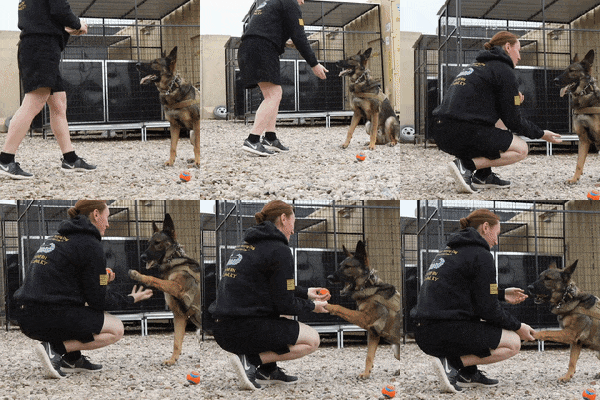
High Five Us Army GIF by GoArmy
Oh, wait, don't you know those early warnings and precautions about surface-touching (fomites) causing infection with COVID is passe? Well it is! Oh the pains we took to avoid touching anything, anything at all because in our early panic over the fast-spreading virus the rising hospitalizations and deaths, we were taught: do not touch your face, keep your hands away from mouth, eyes, nose. Wash your hands, wash them again and again. 

Wipe down the interior of your car, of kitchen surfaces. Don't touch the handlebar of the trolley at the supermarket, watch where you put your hands, don't handle anything you don't have to. WEAR A MASK! Watch out for contamination; picking up the virus through contaminated surfaces, spreading it. Wipe down with soapy water everything you bring into your home. Well, folks, all that has changed. It changed a while ago. Where've you been?

The SARS-CoV-2 virus causing COVID, you see, is passed through airborne droplets expelled from someone's mouth, their nose. Close contact, you see, will do it. You never know, unsymptomatic people are everywhere! Take care. Stay safe. Immobilize yourself, remain safe at home. Well, relax, science has proven that surface contamination is rare. But those instructions to leave a distance between you and someone else? Get used to it. Mask wearing? Don't leave home without it....

Fact is, when people are terrified as were populations the world over in the face of a global pandemic, instructions stick with them and the stigma attached to touching hard surfaces of all kinds remains uppermost in peoples' minds. We're informed by science that the fear of surface transmission was vastly overblown. But take notice: spread of infection is definitely linked to respiratory droplets. Take care who you decide to share a hug and a kiss with. But, there's more...

"Hand-to-hand contact isn't likely to be a major risk [for COVID-19 transmission, but coming in close to someone long enough to shake their hand is an issue, if the people involved aren't wearing high-quality masks that are properly fitted."
"Hands are gross. Touch may not matter so much for COVID19, but it almost certainly does for other serious viruses. The other reason is bacterial contamination. Most bacteria are harmless or beneficial. Our bodies are covered in bacteria, inside and out. But some types, associated with the two 'Fs' [food and feces] are very harmful. Between kitchen and bathroom, our hands can get dangerously dirty."
"I'm not a germaphobe, but I'm a real fan of hand sanitizer. If we shook hands less, we'd sure need it less, and we'd get sick less."
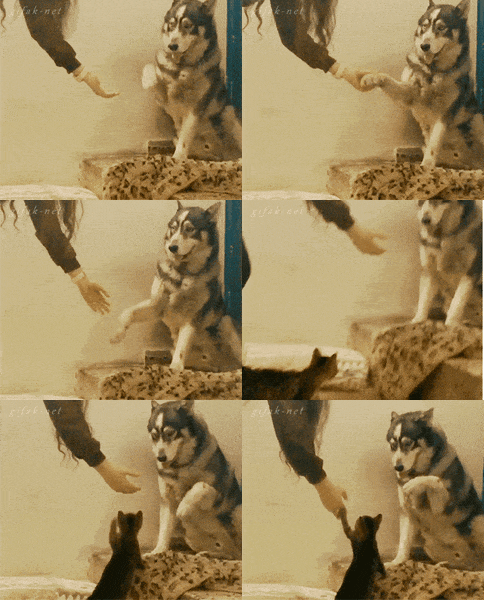
Cat Dog GIF

"Handshaking is a deeply embedded social ritual, but of course it's not universal. A lesser change, like knuckle-bumping, would be great.
"COVID-19 is unusually adaptable to different species, which is part of what makes it dangerous. That said, pet transmission does not seem to be very common at all. The main risk is bacterial contamination from whatever Rover might have stepped in recently."
Colin Purness, infection control epidemiologist, University of Toronto


Labels: , , , ,

 
()() Follow @rheytah Tweet