Ruminations

Blog dedicated primarily to randomly selected news items; comments reflecting personal perceptions

Monday, October 11, 2021

Go Ahead, Touch That ... Stop! No Handshakes!
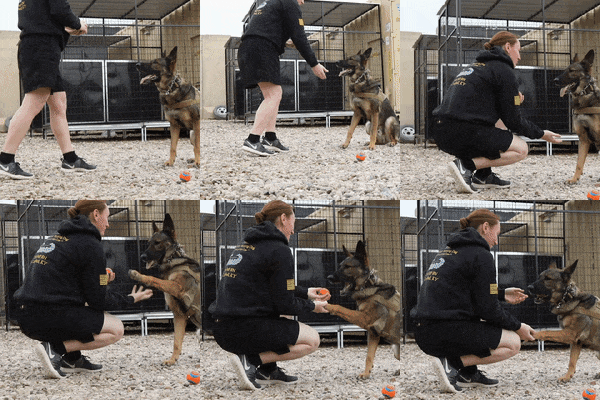
High Five Us Army GIF by GoArmy
Oh, wait, don't you know those early warnings and precautions about surface-touching (fomites) causing infection with COVID is passe? Well it is! Oh the pains we took to avoid touching anything, anything at all because in our early panic over the fast-spreading virus the rising hospitalizations and deaths, we were taught: do not touch your face, keep your hands away from mouth, eyes, nose. Wash your hands, wash them again and again. 

Wipe down the interior of your car, of kitchen surfaces. Don't touch the handlebar of the trolley at the supermarket, watch where you put your hands, don't handle anything you don't have to. WEAR A MASK! Watch out for contamination; picking up the virus through contaminated surfaces, spreading it. Wipe down with soapy water everything you bring into your home. Well, folks, all that has changed. It changed a while ago. Where've you been?

The SARS-CoV-2 virus causing COVID, you see, is passed through airborne droplets expelled from someone's mouth, their nose. Close contact, you see, will do it. You never know, unsymptomatic people are everywhere! Take care. Stay safe. Immobilize yourself, remain safe at home. Well, relax, science has proven that surface contamination is rare. But those instructions to leave a distance between you and someone else? Get used to it. Mask wearing? Don't leave home without it....

Fact is, when people are terrified as were populations the world over in the face of a global pandemic, instructions stick with them and the stigma attached to touching hard surfaces of all kinds remains uppermost in peoples' minds. We're informed by science that the fear of surface transmission was vastly overblown. But take notice: spread of infection is definitely linked to respiratory droplets. Take care who you decide to share a hug and a kiss with. But, there's more...

"Hand-to-hand contact isn't likely to be a major risk [for COVID-19 transmission, but coming in close to someone long enough to shake their hand is an issue, if the people involved aren't wearing high-quality masks that are properly fitted."
"Hands are gross. Touch may not matter so much for COVID19, but it almost certainly does for other serious viruses. The other reason is bacterial contamination. Most bacteria are harmless or beneficial. Our bodies are covered in bacteria, inside and out. But some types, associated with the two 'Fs' [food and feces] are very harmful. Between kitchen and bathroom, our hands can get dangerously dirty."
"I'm not a germaphobe, but I'm a real fan of hand sanitizer. If we shook hands less, we'd sure need it less, and we'd get sick less."
Cat Dog GIF

"Handshaking is a deeply embedded social ritual, but of course it's not universal. A lesser change, like knuckle-bumping, would be great.
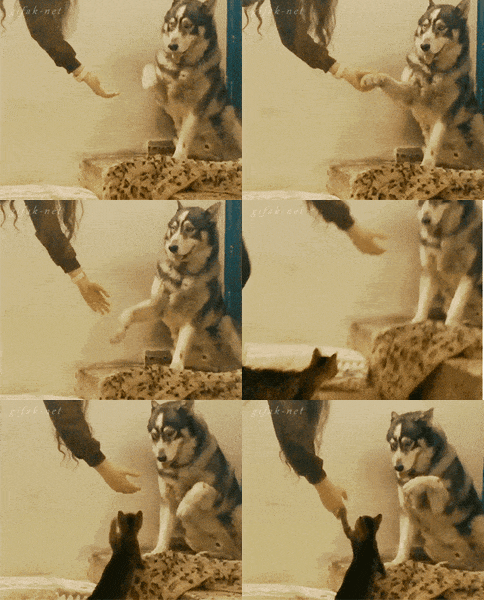
"COVID-19 is unusually adaptable to different species, which is part of what makes it dangerous. That said, pet transmission does not seem to be very common at all. The main risk is bacterial contamination from whatever Rover might have stepped in recently."
Colin Purness, infection control epidemiologist, University of Toronto


Labels: , , , ,

Friday, December 04, 2020

Acknowledging the Most COVID-Vulnerable

"There have been some deceitful and terrible things that have been done to our communities historically."
"As far as I'm involved, things of that sort are never going to happen [again]."
Arlen Dumas, grand chief, Assembly of Manitoba Chiefs

"The problem is trying to solve it [the history of medical experimentation imposed on First Nations by governments in Canada] in the middle of an emergency, in the middle of a pandemic, and trying to gain that trust."
"These solutions needed to start 20, 30, 50 years ago."
Ian Mosby, assistant professor, Ryerson University, Toronto

"It's not a game [trust of public health orders relating to vaccinations against COVID-19]."
"We need to take this serious[ly] and it is at a critical, critical junction."
Melanie MacKinnon, First Nations pandemic response team
Dr. James Makokis is a family physician in Kehewin First Nation. (Terry Reith/CBC)
 
The prairie provinces of Canada, Saskatchewan, Manitoba and Alberta are facing grim statistics in the number of COVID cases, hospitalizations and deaths. And hardest hit and most vulnerable among their population groups are First Nations people. In Manitoba to date, 45 First Nations people have died from COVID-19, mostly in the last few weeks with the average age of death 66, as opposed to age 83 for the overall population in Manitoba. An aboriginal boy under ten years of age died last weekend. 

There is an aura of distrust among Indigenous people in Canada for the sincerity of politicians, government leaders and the medical community, born of long association with those leaders having imposed on aboriginal groups medical experiments of questionable and often harmful proportions. Now Aboriginal leaders are facing a dilemma of their own, as are those of the medical community in persuading First Nations peoples that it is in their best interests to agree to being inoculated against COVID.
 
A gymnasium in Shamattawa First Nation has been set up with cots as the Red Cross helps the fly-in community amid surging COVID-19 numbers. As of Friday, there are 1,815 active COVID-19 cases among First Nations people in Manitoba. (Submitted by Eric Redhead)
 
At the First Nations COVID-19 Pandemic Response Co-ordination Team's online update last week Grand Chief Dumas had his work cut out for him explaining to his audience that such vaccination plans are universal, to be received by everyone as a general response within the entire population to guard against continued outbreaks that can only be achieved through mass inoculation. Indigenous leaders, he stressed, would simply not permit the types of experiments of the past to be repeated.

Social media pages for Indigenous communities are rife with negative comments and concerns over     COVID vaccines. COVID-19 health advice appears to many as perhaps just another way that central governments are conspiring to do harm to their native populations. Grand Chief Dumas allowed as how mistrust has been earned from the Indigenous community. His own family members have expressed their concerns that COVID-19 vaccine will turn out to be yet another experiment special to First Nations.

In Canada's history of scientists sponsored by the federal government or the government itself being involved in medical experiments on Indigenous people, many examples can be found in the historical record. Professor Mosby's research reveals the presence of a government-operated food experiment on aboriginal children suffering from deliberately imposed malnutrition during the 1940s. Milk rations were withheld for two years in one residential school while in another a special flour illegal for human consumption in Canada was used to feed Aboriginal children.

In the 1930s, Indigenous children were exposed to a tuberculosis vaccine trial in Saskatchewan. Indian Hospitals, revealed by research, were created for the express purpose of treating Indigenous populations with tuberculosis where medical experimentation of all kinds was carried out, pointed out Professor Mosby. Of more recent vintage have been lawsuits revolving around the forced sterilization of Indigenous women, and skin grafts performed on Inuit people.

According to Indigenous Services Canada, several days back 4,069 COVID-19 cases were identified on Canadian reserves. Infections of Indigenous people living both on and off reserve have surged in recent weeks in Manitoba. More severe outcomes accrue to First Nations people, according to the response team's data. In Manitoba alone there were over 1,713 active cases on and off reserves.

All of which add to the need to inoculate people most vulnerable to the dread effects of the coronavirus as soon as possible. First Nations leaders themselves across Canada are advocating for priority status for their communities when the vaccine becomes available for distribution around the turn of the new year.
 

"First and foremost … we come from that inherent and treaty right aspect, that Treaty Right to Health. In there, there's what we call the Medicine Chest Clause. When our ancestors signed treaties in the eighteen and nineteen-hundreds, that guaranteed us health and medicine chest supplies and services." 
"Obviously, the priority is that First Nations people are going to be safe and taken care of and live a long, happy, healthy life."
"Our First Nations communities have higher rates of diabetes, heart disease, asthma and other health conditions that put them at an even higher risk of serious complications or even life-threatening problems if they contract COVID-19."
"These elders and vulnerable community members must be the first to receive the COVID-19 vaccination. Every day they go without this vaccine, their lives and the lives of their [community's] most vulnerable are at exceptional risk."
"We need the vaccine [sent] directly to us. We don't need anybody else to deliver it for us - we can do it. We have the capacity, we have the knowledge, we have the manpower, and we're ready. We're ready to deliver once the vaccines become available."    
Chief Bobby Cameron, Federation of Sovereign Indigenous Nations
 

Labels: , , , ,

 
()() Follow @rheytah Tweet