Ruminations

Blog dedicated primarily to randomly selected news items; comments reflecting personal perceptions

Wednesday, August 19, 2020

"Quite Extraordinary. It really Is."

"Good. Grief. I was unprepared for the emotion ... It's quite extraordinary. It really is."                                                                                                                      "Think of it as a science experiment. This is cyborg territory, and I intend to be a human guinea pig to see just how far we can turn science fiction into reality."       "In a rather perverse way the future looks like it's going to be rather exciting. In a 'boys with their toys' sort of a way, potentially even a bit fun."                                 "When I email people who are locked in [through motor neuron disease], they say of all the faculties that they lost, speech was the worst, the most traumatic, the one that made them feel most disabled."                                                                         "It is impossible, even if they use text-to-speech ... They are not able to communicate their emotion."                                                                          "Growing up openly gay in the 70s taught me to think for yourself. I got very used to not feeling that I had to fit, because for a long time the world was telling me [I] really, really didn't fit."                                                                                          "After 40 years of breaking the rules, I'm still saying, 'let's not do it the way it's done before, let's do something different'."                                                                                Peter Scott-Morgan, 62, British scientist, Torquay, South Devon

"You can't help but be impressed by the way he wants to take control."  "I think this is groundbreaking and he is a pioneer."                                                                     Marie Wright, anesthesiologist
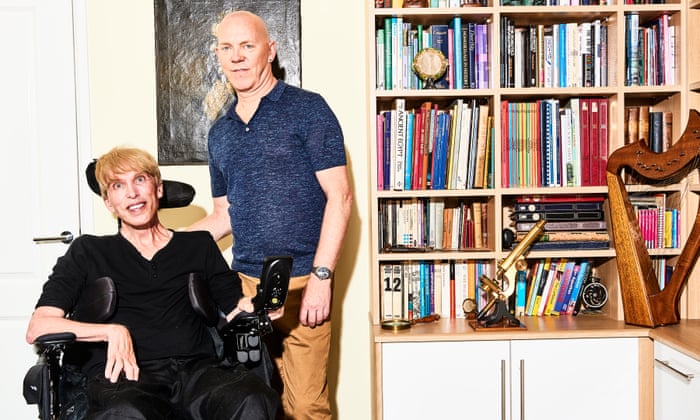
‘I’m just getting started’: Peter Scott-Morgan with his husband Francis. Photograph: Tom Jackson/The Observer

In 2017, British scientist Peter Scott-Morgan, 62, faced the challenge of his life when he was diagnosed with motor neuron disease, an incurable condition that would eventually freeze all of his physical capabilities, as it progressively destroys his motor neurons; walking, breathing, speaking, and swallowing would all eventually be compromised and he would become physically helpless; a sound mind in a destroyed body.

The process whereby signals from nerve cells in the brain transmit to cells in the brain stem and spinal cord and then on to muscles where upper motor neurons direct lower motor neurons to produce muscle movements dissipates, since when muscles no longer receive signals they weaken and deteriorate. No longer receiving signals from upper to lower motor neurons can lead to muscle stiffness (spasticity) and overactive reflexes, so voluntary movements become slow and difficult to the point where eventually walking or movement controls are absent.

This man with his master's in artificial intelligence and doctorate in robotics is determined to discover methods which would allow himself first and eventually others afflicted with MND to live after becoming "locked-in"; their minds alert, their bodies immovable. As far as he is concerned, Peter Scott-Morgan is on the way to becoming a new version of himself. He sees himself as a pioneer innovator paving the future for a breed of humans augmenting physical incapacity with the use of technology.

He envisions an exoskeleton encasing his upper body, allowing him superhuman strength -- with a mind-reading computer plugged directly into his brain to express his thoughts instantly, his paralyzed face replaced with a hyper-realistic avatar moving in time with a speech synthesizer. To that end, radical body alterations have already occurred. He "re-plumbed" his stomach in 2018, with three separate, high-risk surgeries; to insert a feeding tube into his stomach, a catheter in his bladder; a colostomy bag on his colon.
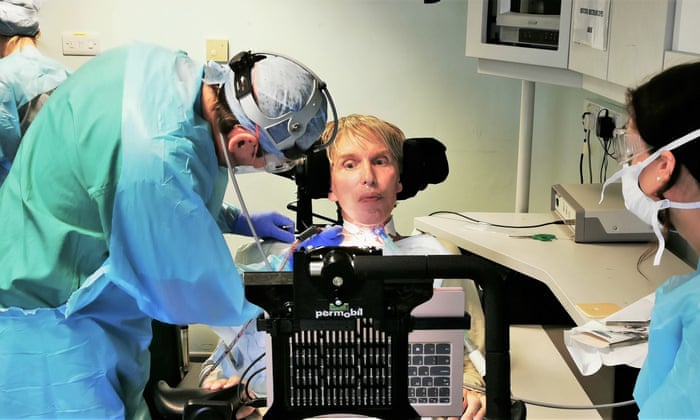
We can make things better for everyone with a disability’: undergoing research. Photograph: Channel 4

Each of those surgical procedures came with risks that might result in an acceleration of the MND progress. He had his esophagus and trachea separated last year through a laryngectomy to prevent saliva running into his lungs as paralysis moved toward his chest and throat. The process threatened the loss of his voice and its distinctiveness. A loss he feared and addressed by recording words and sentences -- assisted by scientists at Edinburgh-based CereProc. Recordings used to create a synthetic voice, sounding remarkably like his original.

A photo-realistic virtual avatar was designed to move its lips in synchrony with his speech, to provide facial expressions like laughter and surprise, coinciding with the conversation. The aid of the director of Anticipatory Computing at Imtel Labs, Lama Nachman helped to develop a plan to build the cyborg that would become Scott-Morgan with its own artificial intelligence. He would rely on the AI to provide instant response, the machine speaking for itself utilizing phrases learned from Scott-Morgan.

"I knew that with some focused hi-tech research it was quite possible to transform what it meant to have MND and if I took the right precautions then, rather than in two years, I had a good chance of living for another couple of decades."                 "I envisioned what realistically, with the right encouragement, could be done to change what it means to have extreme disability. Then I worked backwards to work out what would come first."                                                                                               Peter Scott-Morgan
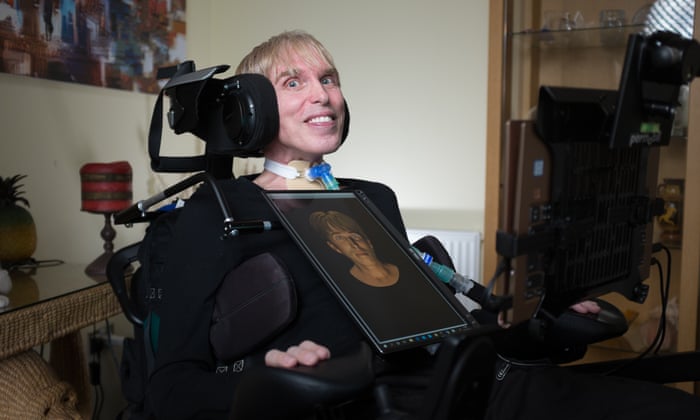
‘I knew that with focused hi-tech research it was possible to transform what it meant to have MND’: a chest screen reveals Peter’s emotions. Photograph: Channel 4

Labels: , ,

Wednesday, July 12, 2017

Techniques and Technology in Medicine

"[It -- a balloon catheter -- was] really designed to be used in nice surgery centers, with well-staffed, fancy operating rooms."
"[The] golden hour [following an injury is the time when doctors and medics must react]. That's where the margin to save lives is greatest."
Dr. Todd E. Rasmussen, former surgeon deployed in Iraq

"None of that [conventional hospital procedure where the balloon catheter is used by vascular surgeons] translates well into when all hell is breaking loose [in a war zone] and your patient is going to die in seven minutes."
David Spencer, president, Prytime Medical, ER-Reboa manufacturer
ER-REBOA

ER-REBOA Catheter for Emergency Occlusion of Aorta


Necessity, those steeped in the wisdom of the ages intone, is the mother of invention. And when Drs. Todd E. Rasmussen and Jonathan L. Eliason were desperate to save the lives of U.S. military members fighting in Iraq in 2006, they had the use of improved tourniquets and transfusion techniques to prevent their military patients from bleeding to death from catastrophic limb wounds as byproducts of battlefield action.

However, those advanced techniques did nothing whatever to help in emergencies like extreme bleeding in the abdomen or the pelvic area. They were vascular surgeons, and began work on the development of a new device to fill that obvious gap. Using the old device of a surgical-room balloon catheter as a guide, one whose design was specific to bleeding prevention in patients undergoing surgery on the aorta, they perfected their own device which they named the ER-Reboa.

It is now being used in some hospitals, gaining ground as its reputation is on the rise as a more reliable medical tool  than the older, larger, device requiring to be guided by X-rays. At NYC Health & Hospitals/Jacobi in New York City, director of Trauma and Critical Care Services Dr. Sheldon H. Teperman and vascular surgeon Dr. Aksim G. Rivera have been tutoring trauma surgeons in the use of this new device.

A woman, 60 years of age, had been hit and run over by a pickup truck, sustaining internal injuries so dire she almost died from internal hemorrhaging resulting from severe pelvic injuries. She was the first patient in the city that the new device was used for, by a Jacobi team. And her life was spared. In May, a high school student suffering internal hemorrhaging as a victim of a deliberate vehicle mow-down by a terrorist in Times Square, recovered thanks to the device, when transfusions failed to restore the equilibrium of blood loss.

The student had emerged from the attack with severe injuries to her legs, abdomen and pelvis. Her pulse skyrocketed, her blood pressure plunged. "She was about to go into cardiac arrest", noted trauma surgeon Dr. Marko Bukur. He immediately reached for an ER-Reboa catheter, punctured the student's thigh to thread a slim tube through her femoral artery then on to her aorta, the major artery carrying blood from heart to body. Injecting salt water, a balloon was inflated to block the aorta, cutting off circulation to pelvis and legs.

While above the balloon, blood flowed as it normally would to her brain, her heart, lungs and other organs. Reactively, her blood pressure rose, her heart showed down as the balloon halted the internal pelvic hemorrhaging. The resuscitative endovascular balloon occlusion of the aorta (Reboa) had done its work as it was meant to, as an "internal tourniquet". Dr. Bukur packed the damage area with gauze once the balloon was deflated, while another surgeon removed the student's ruptured spleen, her life saved.

The two former military surgeons had succeeded in creating a smaller, stripped-down version of the complex, large and awkward-to-use outside a well-equipped hospital operating theatre, one that could be manoeuvred swiftly into the aorta without the use of guiding X-rays, by general surgeons, emergency room doctors and even medics, since the last two represent those who are generally the first responders reaching people who are bleeding to death.

REBOA
Medgadget

Labels: , , ,

Monday, March 13, 2017

Choosing to Amputate

"What am I trying to save? Amputation is going to get me a new prosthetic that will have more range of motion than my actual [birth] ankle."
"I just put my leg on and walk, and it is on until I go to bed."
"That's it."
Adam Taylor, New York
Mr. Taylor and his wife, Christa, in Brooklyn. Credit Victor J. Blue for The New York Times
There are over two million Americans who have undergone amputations. In 2014 over four thousand amputations took place in New York City alone. A large proportion of amputations take place resulting from complications of diabetic neuropathy. Another 45 percent are required as a result of trauma; caused by a catastrophic accident of one kind or another, while fewer than 2 percent take place because of the effects of cancer.

Adam Taylor's experience was among that two percent. And his lifetime experience was that of a child, then a man for whom walking was unfailingly difficult. By the time he was a teen, gaping wounds appeared on his feet, the result of a rare skin disease called linear scleroderma. His right ankle was constricted from the buildup of scar tissue. A few years ago, the now-36-year-old was further struck, when a wound on his leg failed to heal.

And there, where the wound had appeared, cancer set in. He underwent surgery, which doctors assured him would destroy the cancer, only to discover post-surgery the cancer was still present. Two options were then presented to him; undergo reconstructive surgery, or opt for amputation of the leg. Before arriving at a decision Mr. Taylor did his own homework.

He came across amputees living positive lives who had learned to be agile in moving about with their prosthetics. He became aware that people no longer look for prostheses resembling a facsimile of their lost limbs, preferring instead the bionic-appearing prosthetic. And he listened to the doctors who  gave him various opinions on how deep into the muscle or bone the procedure to reconstruct his leg would go.

All agreed that recovery would require six months of bed rest before he could begin to learn to walk again. That was a best-case scenario, counting on the surgery succeeding in removing all of the cancer, and that no complications arose post-surgery with infections.

"He has suffered so much for so long -- 25 years -- that we didn't want any more huge surgeries that were maybes", his wife Christa, noted. The matter of choosing which direction to take was not without its own complications. One doctor refused outright to discuss the potential of amputation, while others spoke disparagingly of quality of life after amputation.

He had read a plethora of studies concluding that amputation and reconstruction both give those affected similar functionality and quality of life, though the impression he was left with was that amputation fails to appeal to doctors as a solution because they link it with failure to arrive at more desirable outcomes. An orthopedic oncologist at Memorial Sloan Kettering Cancer Center in New York performed the amputation for Mr. Taylor.

"I think", said Dr. Daniel E. Prince, "it [reluctance to amputate] comes from a little bit of the God complex in medicine. We think we can fix anything." But another complication had convinced Mr. Taylor that he should choose amputation when an M.R.I. confirmed the cancer had spread, and the chance that reconstruction would succeed was immeasurably reduced.

He thought of how difficult it had been for him to get around, walking, propelling himself forward, even before the advent of the cancer that later afflicted him. It had become a difficult challenge for him to walk ten blocks. Regardless of the possible success of the reconstruction surgery and the follow-up therapy, he would be left with the very same dilemma of difficulty in walking.

Nine months have passed since Mr. Taylor underwent the amputation. He wears the bionic-type prosthetic he preferred, and he's back on two feet, walking with far more ease than he had experienced in decades.

Jim Incledon/PA
Oscar and his bionic legs Credit: Jim Incledon/PA

Labels: , , , ,

 
()() Follow @rheytah Tweet