Ruminations

Blog dedicated primarily to randomly selected news items; comments reflecting personal perceptions

Tuesday, February 26, 2019

The Issue is the Tissue

Clayoquot Old Growth Forest    Photo: JSR
"Forests are too vital to flush away."
"None of their flagship at-home brands [Big Tissue manufacturers] contain recycled materials or alternative fibres, and each company misses other key commitments necessary to ensure their products do not come at the expense of the boreal forest."
Report: The Issue With Tissue

"The Canadian boreal forest is the largest intact forest in the world, holding immense value for Indigenous Peoples, species and the climate. It is home to over 600 Indigenous communities whose cultures have remained inextricably linked to the forest for millennia, and is habitat for iconic species like the boreal caribou, Canada lynx and American marten. In addition, the forest is critical in the fight against climate change, storing the carbon equivalent of nearly twice the world's recoverable oil reserves in its soil."
Natural Resources Defense Council, Eco Watch
  Marriott Basin   Photo: JSR
Canada's boreal forests are coming under threat as giant pulp and paper producers based in the United States, like Procter & Gamble, Georgia-Pacific and Kimberly Clark with their popular brands of toilet tissue their public relations machinery touts as 'soft' and 'strong' captivate the market. Brands like Charmin, Cottonelle, Brawny, Bounty, Kleenex, Angel Soft, Quilted Northern and Viva, familiar to anyone who shops for 'quality' products knows well.

Toilet tissue is regarded as a staple product everywhere and anywhere. Tissues produced from recyclable paper simply doesn't have the right luxury cachet. They do attract the environment-conscious hoping to be able to make a bit of a difference in personal responsibility to the environment by choosing brands that advertise their recycled products, but the finished product lacks the soft touch that consumers now demand.

We've come a long way since vegetable waste, lettuce leaves, corncob foliage, and pages torn out of mail-order catalogues were routinely used in outhouses. We're now accustomed to using the softest, gentlest tissues available in our bathrooms and won't hear of any products that fail to live up to those demanding standards. On the other hand, there are astonishing numbers involved in the use of such products.

The U.S. has a population of over 350-million people. Amazingly the use of toilet tissue by Americans is rated as close to three rolls weekly per person. Let that sink in. That kind of usage reflects nothing short of egregious waste, and a type of abuse of a natural resource, but a boon to the bottom line of the producers of the product where the industry can boast it receives $31-billion in revenues on an annual basis.

"We know that virgin fibre in tissue products is significantly preferred by consumers, and 'does the job' much more efficiently than recycled or non-wood products", states Damon Jones, vice-president, global communications at Procter & Gamble. So, in essence, the company is blameless where the waste and the rapacity of old growth forests for their pulp wood is concerned; they are simply filling a market demand in their niche.

Photo: JSR
Where recycled paper is used, he points out, is in the packaging and the inner cores; while, he stresses its wood fibre used in the manufacture of the tissue itself to consumers' preferred specifications, is sourced from responsibly-managed forests. Georgia-Pacific takes pains to point out that consumers look for softness and absorbency and those virtues can only be achieved with the use of virgin pulp. A spokeswoman added that the company she represents "takes steps to ensure that we are responsibly sourcing wood and wood fibre for our pulp, paper and wood products operations".

What has led Natural Resources Defense Council and Stand.earth, international non-profit environmental organizations which worked in tandem to produce the study to criticize manufacturers of tissue is the very issue of the monopolistic use of virgin fibre pulp, which is accessed for the most part from old boreal forests in Canada. Where their marketing campaigns have convinced consumers to use those very products which can only be produced from softwood (hardwoods are deciduous trees, softwoods are conifers).


On the other hand, if we're speaking responsibility, conservation and inattention, forestry sweeps culling old growth and specific natural resources irresponsibly is first and foremost the responsibility of the governments where forest sustainability is threatened, and in this instance it is the provincial and federal governments of Canada itself. Where stewardship of natural resources resides primarily and whose decision-making in agreeing to have its immense boreal forest system reduced should be first and foremost, in question....

Labels: , , , ,

Tuesday, November 20, 2018

Offending Conservation Methodology

Moose

"Parks Canada has a proven track record of effective ecosystem management and population reduction is only used in situations where it's absolutely considered necessary."
"We're going to take back all the results [of the reforestation and hunting pilot project], analyze and determine what the best approach might be to restore the boreal forest. Ultimately that's our goal."
"...No decisions have been made past 2018."
Rob Howey, Park conservation manager, Parks Canada
"Cost doesn't seem to be a huge issue as they've already spent close to $1-million killing moose."
"I believe killing an animal in a national park should be a last resort and it seems to me there are other options."
Rose Courage, northern Cape Breton craft shop owner

"From a Mi'qmaq point of view we're out there to provide and we're out there to share."
Clifford Paul, moose management coordinator, Unama'ki Institute of Natural Resources
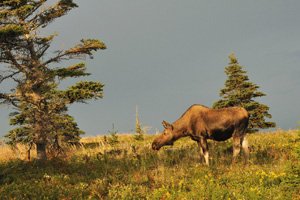
A moose forages in the Cape Breton Highlands National Park (Parks Canada)

Rose Courage was disturbed by what she viewed as two things gone very wrong in Cape Breton Highlands National Park, a forested nature preserve on Nova Scotia's east coast of Canada. First, that animals were being culled as a conservation measure; and second that an inordinate amount of tax dollars was being spent to expedite that cull in remote regions of the park. She felt that all avenues of possible solutions should have been explored and perhaps were not, although she was aware that one of her suggestions, fencing off vulnerable areas to browsing moose, is already being done.

Conservation authorities at Parks Canada had drawn the conclusion that the park was host to too many of the ungulates and their presence was harmful to the forest environment. Their choice menu is the browsing of new tree tips of balsam fir and spruce in the boreal forest, during spring growth, stunting the trees and eventually killing them, holding back forest growth when the purpose of conservation is to encourage the growth of strong and healthy trees.

It had been decided to launch a five-year program for reforestation named "Bring Back The Boreal Forest" which required a hunting component to enable the program to reach its goal. It began with a $1-million budget growing to a budget of $2.1-million. And most of that budget has been allocated to the hunting portion of the two-pronged program. A program which saw the 'harvesting' of 122 animals from a herd estimated in size at 1,800 since 2015. Parks Canada is satisfied with both the cost involved in achieving its goal and the early impressions of its success.
Moose: the largest living deer

The moose is the largest living deer. It affects the growth of the forest in the park by selectively browsing only certain species of trees.   Parks Canada

Preliminary results from a study carried out in the area demonstrated that twigs of balsam fir and spruce that had attracted moose showed a significant decrease in the number of trees being eaten, deprived of the opportunity to flourish. Roughly half of the twigs were consumed by moose four years ago; this year 90 percent of the new-growth twigs had been untouched, thus increasing the opportunity for the forest to regenerate.

Through access-to-information applications, Rose Courage is anything but impressed by what she had read with regard to the program and resulting research. Where Parks Canada has a total cost for the first three harvests at $731,000, accounting for 122 harvested moose, the costs typically consumed by travel and overtime for park wardens, helicopter flights into remote areas and the charges for airborne moose surveys, Rose Courage adds another $233,000 in policing as well as an additional $7,141 for overtime last fall.

Which brings the average cost related to the removal of every moose to a tad over $7,900. She feels there should be a focus on increasing the use of fenced enclosures to ensure that moose cannot gain access to vulnerable park areas as preferable to the intensive methods of hunting. Parks Canada flies Aboriginal hunters into the park, aids them in removing the carcass, and the food is then distributed to Mi'kmaq communities and food banks throughout Nova Scotia.

A balsam fir, severely browsed by mooseA balsam fir, severely browsed by moose   Parks Canada

Labels: , , , ,

 
()() Follow @rheytah Tweet