Ruminations

Blog dedicated primarily to randomly selected news items; comments reflecting personal perceptions

Monday, December 02, 2019

The Cure's The Dilemma

"We have replaced one problem with another. Bags for life have become bags for a week. When we go shopping, we should remember our bags like we remember our phones."
"After all this public awareness, we'd expect plastic consumption to drop in supermarkets, but it's actually increasing."
"It is clear from this data that many people are simply swapping 'single-use' plastic bags for these plastic bags for 'life'."
"The impact of this simple substitution is a major concern, given the significantly higher plastic content of bags for life."
Fiona Nicholls campaigner, Greenpeace U.K.

"It's shocking to see that despite unprecedented awareness of the pollution crisis, the amount of single-use plastic used by the U.K.'s biggest supermarkets [Tesco] has actually increased in the past year."
"Our survey shows that grocery retailers need to tighten up targets to drive real reductions in single-use packaging and items. We need to address our throwaway culture at [its] root through systems change, not materials change -- substituting one single-use material for another is not the solution."
Juliet Phillips, campaigner, EIA Ocean
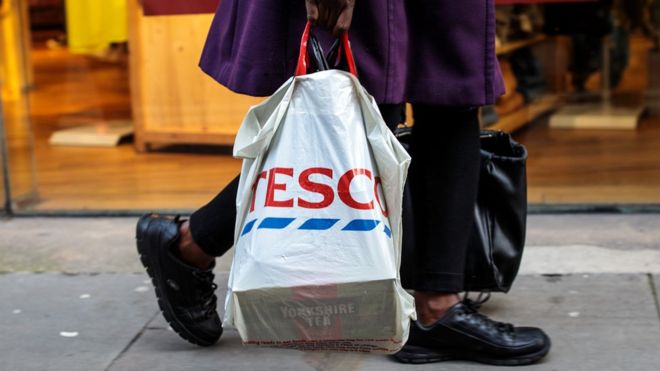
Shopper with a reusable plastic bag from Tesco
Sales of "bags for life" rose to 1.5bn last year as the amount of plastic used by supermarkets increased to 900,000 tonnes, Greenpeace research has found.  Getty Images
Single-use plastics are nothing if not convenient. That is, when the shopper is conveying purchases from shop to home. Once home, the bags are divested of their contents and tucked away somewhere handy for future use. Oh, not? Re-used in the kitchen as trash containers to be put out with the weekly municipal pick-up? Not really? Not viewed as handy and temporary containers of objects taken from point A to point B? Wrong again?! Right; they're crumpled into tight little balls and tossed into the trash. 

We're busy, can't spend valuable time thinking about how to reuse flimsy bags obviously meant for single use. Who are we, after all, to second-guess the intended use of a shopping emporium's disposable temporary convenience? Of course, rising shoppers' consciousness poked occasionally by environmentalists' cries of pained discovery when plastics are found in all their glory, infinitesimally small and intrusively ubiquitous in common public spaces and remote natural places alike, has resulted in little pinpricks of guilt; not only is human activity resulting in a changing climate, our sloppy habits are criminally littering our public living spaces and nature's most compelling landscapes.
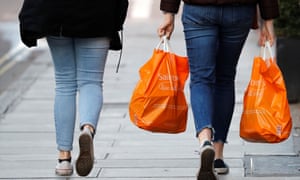
 
Bags for life
  Photograph: Tolga Akmen/AFP via Getty Images
Solution? Charge a nominal fee for each of those bags. Urge people to bring along more permanent bags and tell them they're helping the planet recover from humankind's egregiously destructive activities. Extol the virtues through public education campaigns of moving seamlessly toward the use of more permanent-type bags expressly designed for multiple, ongoing use. For the markets those bags remain valuable for their printed advertising on each 'permanent' bag, used over and over again potentially, as a permanent fixture.

The U.K. government had a brainstorm of an idea to wean its public off disposable bags to re-set their habits toward a permanent bag culture, "bags for life". Sturdy bags, re-usable, diminishing the "plastic footprint" of large supermarket chains, educating the public and doing a great public good in the process. All sweetness and light, until a published report by Greenpeace and the country's Environment Investigation Agency which revealed the move to be more fantasy than reality in its outcome.
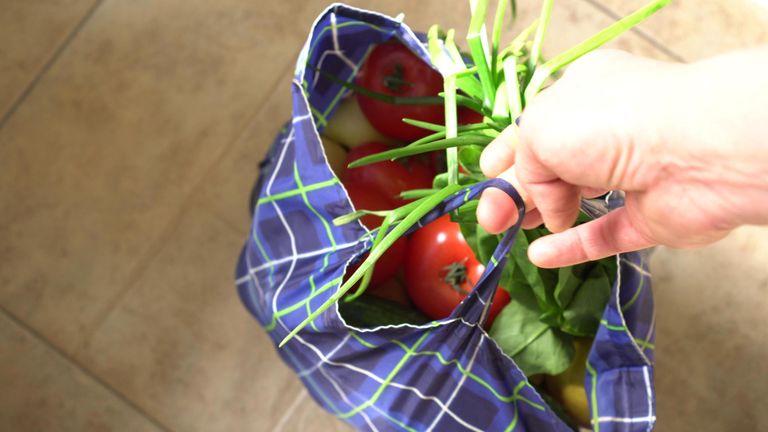
Supermarket bag for life
Sales of plastic "bags for life" rose 26% last year to 1.5 billion
It was revealed in the joint report that in 2019 ten enterprises reflecting Britain's largest grocery marketers have sold over 1.5 billion "bags for life", which calculates out to an average of 54 such bags per household in the nation. Topping off the 959 million "bags for life" sold last year in major supermarkets in Britain. 

The frozen food chain Iceland reported having sold 34 million "bags for life" this year representing a remarkable increase over the 3.5 million such bags sold the year before. "Typically,  you pay for these once and can return them for a free replacement when they wear out", went the cajoling, optimistic government line in its initial 2015 promotion campaign. The report, "Checking Out on Plastic II", however, found "bags for life" sold by the largest supermarkets in 2019 totalled close to 50,000 tons of plastic, over and above the more than 3,330 tons of single-use plastic bags.

According to the report, total plastic packaging in Britain's supermarkets came to 995,000 tons in 2018. A 80 percent reduction in bags circulated by the largest food retailers was seen in the wake of the plastic bag levy; unfortunately the "bag for life" sales managed to counter this effect, but to what degree is still not completely understood. Close to nine million tons of plastic are known to end up  every year in the ocean, according to Ocean Conservancy, the non-profit U.S. environmental group.

The U.K. Plastics Pact which the largest supermarket chains in Britain joined as an industry-wide initiative to "tackle the scourge of plastic waste", included a pledge to replace plastic packaging with reusable, recyclable or compostable materials. The environmental campaign group expressed its doubt such a move would result in a reduction of the plastic footprint of these companies. The truth being, according to Fiona Nicholls, supermarkets' and retail companies' performance in reducing their plastic footprint has been poorly realized.

MPs want a reduction in all types of single use packaging
Greenpeace and the Environmental Investigation Agency say more plastic is going on shelves than ever before


Labels: , , , , ,

Saturday, October 05, 2019

Egregious Waste Habits in Toilet/Sink Flushing

"We were all rather surprised to find that this Sidmouth fatberg was simply a lump of fat aggregated with wet wipes, sanitary towels and other household products that really should be put in the [garbage] bin and not down the toilet."
"Sidmouth is a small coastal community [in southwestern England] that is largely populated by retired people, so in a sense that explains it."
"This is not a hotbed of crime and drug-taking or anything like that. The microfibres we did find probably came from toilet tissue and laundry, and the bacteria were those we would normally associate with a sewer."
"It was my first time analyzing a fatberg, and when you smell it you think this is going to be the last time because the smell was honking. It was awful to do, it smelled gross."
Dr.John Love, professor of synthetic biology, University of Exeter
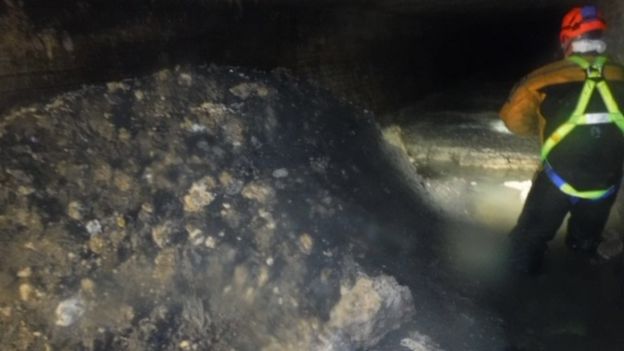
A sewer worker stands next to the "monster" fatberg
Sewer worker next to the fatberg    South West Water


In 2017, the world was introduced to the notoriety of urban fatbergs, greatly immense aggregations of household waste, along with cooking grease, whose size typically blocks sanitary sewage systems and cause an ungodly odour of fermenting rot. A 140-tonne fatberg was discovered in London's East End that year, and an 'autopsy' later conducted to determine what, exactly such a gigantic slug of discarded material might possibly consist of, aside from the suspected main ingredient; fat.

What was found was that the residents of London, similar to what residents of New York City were doing, were flushing condoms down the toilet, along with syringes and narcotics -- with the inclusion of cocaine and ketamine -- and all these forbidden objects which even the village idiot should be aware, have no place in a toilet being flushed through the sewer system, were lodged within that time-accumulated fat globule of monumental size.

More recently, a routine check by South West Water, an industrial sewage maintenance company managing the Sidmouth sewers (as well as 11,000 square kilometres of sewage lines throughout England), had a routine check done on the condition of its sewers last year. This is when it was revealed that a 64-metre-long fatberg was comfortably resting under the seaside town's seafront road, the Esplanade.

Its discovery set a removal operation into motion to dismantle the lump. Workers laboured for eight weeks to excavate the resulting 36 tanker loads of debris that comprised the fatberg, at a cost of $123,000. Sidmouth, it should be noted, has a population of merely 13,000 people who live there year-round. Its modest population size would never have registered as a potential site where such a fatberg could go undetected for so long.

"We wanted to learn as much as we could about it, how it was created and what it was made of", Andrew Roantree, South West Water's director of waste water, commented. Which led to four ten-kilogram lumps being extracted from the blockage and sent over to the nearby University of Exeter for scientists there to examine, by agreement. A ten-scientist team responded to the challenge, under the leadership of Dr. Love.

They melted down parts of the mass they had been put in charge of, carrying out a dissection, extracting and identifying the waste materials, and even extending the process to perform DNA sequencing. For obvious safety reasons, the researchers equipped themselves with stab-proof gloves and steel-capped boots for protection. Weeks of analysis led them to the conclusion that no dangerous bacteria or chemicals were present in the lumps.

What was present was a composition of domestic waste all glued together by home-cooking fats, dumped down the sink drain or the toilet. The contents of the fatberg reflected the makeup of the town's population; elderly retired people. Not that age fails to confer appropriate intelligence, or being retired should equate with both cognitive and physical decline or laziness, but in this instance it appears that both perceptions might be correct.

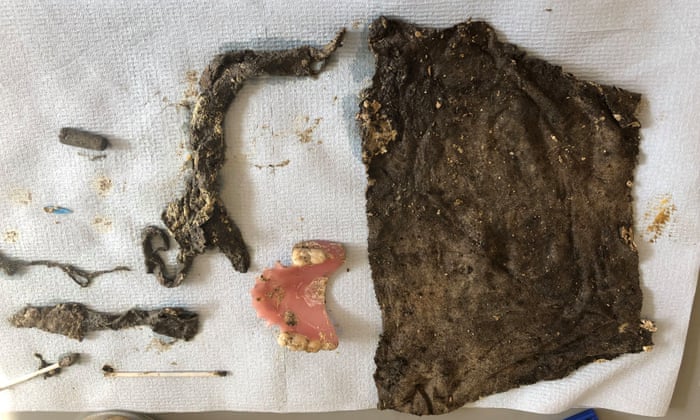
False teeth among the things found in the fatberg. Photograph: University of Exeter/PA

Within the massive, disgusting mess were wet wipes, oils, sanitary products, and surprise! a set of false teeth. Municipal authorities could be forgiven in assuming that most people are intelligent enough not to flush wet wipes, sanitary napkins and towels and elders' diapers or condoms of anything other than normal biological waste and toilet paper down the toilet, yet even so public education campaigns reminding people are often launched by necessity.

Sidmouth's disgustingly stomach-churning mess of a fatberg was longer than the Tower of Pisa. But great relief, right? It was found, and removed, and the event memorialized through publicity. Are the residents of Sidmouth any the wiser now? Actually, according to South West Water's director of waste water, Mr. Roantree, the sewer re-visited in the last few weeks was discovered to be hatching yet another fatberg.

Which the company plans to speedily address and remove before it takes any greater size. While they're at it, they should melt a portion of the fatberg to extract some of the odoriferous liquid to spray it over the homes whose toilets produce these messes, as a reminder to residents that this is their disgusting habit, to create these noxious substances, through indifference and neglect and outright stupidity. And through DNA analysis, identify to which of the households the dental set should be returned.
"Although we deal with around 8,500 blocked sewers every year, the Sidmouth fatberg was by far the largest discovered in our service history."
We wanted to learn as much as we could about it, how it was created and what it was made of to help us avoid further fatbergs in future."
"The results confirm our suspicions, that fat and non-flushable products such as wipes are the main culprits, and that fatbergs are a consequence of the individual and collective impact that our behaviour has on our environment."
"We will be using these results to help us educate, inform and change the behaviours of people in terms of what they are putting down the toilet and sink. That’s not just applicable to Sidmouth, but across our region."
Andrew Roantree, director of waste water, South West Water
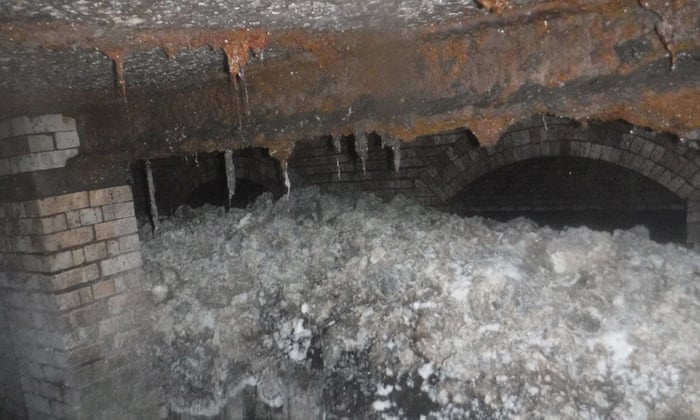
It took eight weeks for a team to remove the fatberg from the sewer after it was discovered a year ago. Photograph: South West Water/PA

Labels: , ,

Tuesday, February 26, 2019

The Issue is the Tissue

Clayoquot Old Growth Forest    Photo: JSR
"Forests are too vital to flush away."
"None of their flagship at-home brands [Big Tissue manufacturers] contain recycled materials or alternative fibres, and each company misses other key commitments necessary to ensure their products do not come at the expense of the boreal forest."
Report: The Issue With Tissue

"The Canadian boreal forest is the largest intact forest in the world, holding immense value for Indigenous Peoples, species and the climate. It is home to over 600 Indigenous communities whose cultures have remained inextricably linked to the forest for millennia, and is habitat for iconic species like the boreal caribou, Canada lynx and American marten. In addition, the forest is critical in the fight against climate change, storing the carbon equivalent of nearly twice the world's recoverable oil reserves in its soil."
Natural Resources Defense Council, Eco Watch
  Marriott Basin   Photo: JSR
Canada's boreal forests are coming under threat as giant pulp and paper producers based in the United States, like Procter & Gamble, Georgia-Pacific and Kimberly Clark with their popular brands of toilet tissue their public relations machinery touts as 'soft' and 'strong' captivate the market. Brands like Charmin, Cottonelle, Brawny, Bounty, Kleenex, Angel Soft, Quilted Northern and Viva, familiar to anyone who shops for 'quality' products knows well.

Toilet tissue is regarded as a staple product everywhere and anywhere. Tissues produced from recyclable paper simply doesn't have the right luxury cachet. They do attract the environment-conscious hoping to be able to make a bit of a difference in personal responsibility to the environment by choosing brands that advertise their recycled products, but the finished product lacks the soft touch that consumers now demand.

We've come a long way since vegetable waste, lettuce leaves, corncob foliage, and pages torn out of mail-order catalogues were routinely used in outhouses. We're now accustomed to using the softest, gentlest tissues available in our bathrooms and won't hear of any products that fail to live up to those demanding standards. On the other hand, there are astonishing numbers involved in the use of such products.

The U.S. has a population of over 350-million people. Amazingly the use of toilet tissue by Americans is rated as close to three rolls weekly per person. Let that sink in. That kind of usage reflects nothing short of egregious waste, and a type of abuse of a natural resource, but a boon to the bottom line of the producers of the product where the industry can boast it receives $31-billion in revenues on an annual basis.

"We know that virgin fibre in tissue products is significantly preferred by consumers, and 'does the job' much more efficiently than recycled or non-wood products", states Damon Jones, vice-president, global communications at Procter & Gamble. So, in essence, the company is blameless where the waste and the rapacity of old growth forests for their pulp wood is concerned; they are simply filling a market demand in their niche.

Photo: JSR
Where recycled paper is used, he points out, is in the packaging and the inner cores; while, he stresses its wood fibre used in the manufacture of the tissue itself to consumers' preferred specifications, is sourced from responsibly-managed forests. Georgia-Pacific takes pains to point out that consumers look for softness and absorbency and those virtues can only be achieved with the use of virgin pulp. A spokeswoman added that the company she represents "takes steps to ensure that we are responsibly sourcing wood and wood fibre for our pulp, paper and wood products operations".

What has led Natural Resources Defense Council and Stand.earth, international non-profit environmental organizations which worked in tandem to produce the study to criticize manufacturers of tissue is the very issue of the monopolistic use of virgin fibre pulp, which is accessed for the most part from old boreal forests in Canada. Where their marketing campaigns have convinced consumers to use those very products which can only be produced from softwood (hardwoods are deciduous trees, softwoods are conifers).


On the other hand, if we're speaking responsibility, conservation and inattention, forestry sweeps culling old growth and specific natural resources irresponsibly is first and foremost the responsibility of the governments where forest sustainability is threatened, and in this instance it is the provincial and federal governments of Canada itself. Where stewardship of natural resources resides primarily and whose decision-making in agreeing to have its immense boreal forest system reduced should be first and foremost, in question....

Labels: , , , ,

Monday, February 12, 2018

Technological Advancement, Superior Lifestyles, Environmental Disaster

"We have trace levels of pharmaceuticals and pharmaceutical metabolites in our drinking water -- that would not be covered under CEPA."
"I'm finding in surface waters chemicals that are in my TV. We have such a huge waste stream of electronic products that require handling because of their hazardous substances."
"The casing of your TV has flame retardants that migrate from your TV. You find it as house dust, you find it in air and surface waters ... You're typing at your computer [and] your hands are going to pick u a whole lot of flame retardants and plasticizers. Our clothes pick up chemicals. We wash them, and down the drain [it all goes]."
"[As for your cellphone], It emits a very small quantity. The problem is there are so many cellphones, so many electronics, so many floor polishes, so many cosmetics. Individually, tiny. Aggregate in a home, actually not so tiny. Put it together in a city, a whole lot more."
"[In the Great Lakes, the] up and coming contaminants arise from products and materials that we use as opposed to direct effluent discharges [from factories]. We have long shifted from the belching smokestack or the pipe spewing effluent ... but a lot of the provisions [of the law] are better suited to dealing with manufacturing and also with resource extraction [like mining]."
"For example we have so many car tires. The most abundant microplastics in the environment are very small fragments from tires. And as well we see antioxidants from tire debris in surface waters and the Great Lakes."
"I think those are incredibly difficult to regulate. One way is just to talk about the sheer amount of resources that we are using and that this has unsustainable implications. But it just doesn't receive any traction."
Miriam Diamond, pollution scientist, University of Toronto
Air circulating in the home contains more than 900 chemicals, including mould, which can increase a person's risk of developing heart disease, cancer and asthma
Air circulating in the home contains over 900 chemicals, including mould.

The House of Commons (Canadian Parliament) standing committee on environment and sustainable development recently set out to review Canada's federal law, the Canadian Environmental Protection Act (CEPA). This presented a large group of Canadian scientists involved in environmental sciences with a opportunity to put their heads together and draft a letter whose purpose was to present 87 considered recommendations that would in aggregate update, modernize and strengthen the CEPA.

Canada, like all countries in the developed world with strong economies that have embraced modern technologies in everyday life, faces the reluctantly-recognized reality that we have been catapulted into a world of technological convenience, and waste products resulting from those technologies. And although some of the environmental degradation occasioned by our wild embrace of the brave and the new have been tackled, the far greater consequences of our lavish use of materials, some of which have a deleterious effect on the environment, remain untouched.

Where once we envisioned pollution represented by a giant smokestack belching particulate matter into the atmosphere, or a factory heedlessly (and illegally) spilling waste into rivers, environmental degradation has become far more nuanced and infinitely more difficult to address. In Canada alone, with its 35-million population each and every member of society represents individual sources of toxic influence on the environment, a simple reality that few would ever think of, much less wish to be concerned about.

Our furniture off gassing, televisions or bathroom chemicals, cellphones -- all produce minute amounts of harmful substances that wash down drains and into lakes and rivers as we wash our hands, shower, use a dishwasher and do the laundry. And though scientists are grimly aware of this ongoing situation they cannot even hazard a guess as to the final outcome. That, in and of itself is extremely worrying to the informed scientific mind.

What Canadian researchers are convinced of, however, is that the current federal law though meeting the needs of its time when it was enacted in the 1990s, barely begins to address them at this juncture. Small amounts of toxic silver bleeds off motherboards, tantalum, cobalt, rare earth elements and other metals "for which toxicity is just becoming understood" are all involved, points out Dr. Diamond. A type of flame retardants commonly used in a variety of products represent another source of toxicity.


According to Dr. Diamond, environmental law and funding for research are based most frequently on known human health dangers, moving "away from true environmental protection and toward 'It's all about me', and human health". More intensive research is required on "the public good of clean air, clean water and clean soil", she emphasizes. Much, in the final analysis, depends on it.

Modern pollution — at least the toxic chemical kind — is smaller, more personal, from 35 million Canadians who are all individual sources of toxic bits that add up in the environment.  shironosov / Getty Images/

Labels: , , , ,

 
()() Follow @rheytah Tweet