Ruminations

Blog dedicated primarily to randomly selected news items; comments reflecting personal perceptions

Friday, October 24, 2025

COVID mRNA Vaccines a Survival Boost to Cancer Patients

"The implications are extraordinary -- this could revolutionize the entire field of oncologic care."
"We could design an even better nonspecific vaccine to mobilize and reset the immune response, in a way that could essentially be a universal, off-the-shelf cancer vaccine for all cancer patients."
"One of the mechanisms for how this works is when you give an mRNA vaccine, that acts as a flare that starts moving all of these immune cells from bad areas like the tumor to good areas like the lymph nodes." 
"If this can double what we're achieving currently, or even incrementally -- 5%, 10% -- that means a lot to those patients, especially if this can be leveraged across different cancers for different patients." 
Elias Sayour, UF Health pediatric oncologist, Stop Children's Cancer/Bonnie R. Freeman Professor for Pediatric Oncology Research
 
"Although not yet proven to be causal, this is the type of treatment benefit that we strive for and hope to see with therapeutic interventions -- but rarely do."  
"I think the urgency and importance of doing the confirmatory work can't be overstated."
Duane Mitchell, director, UF Clinical and Translational Science Institute 
Cancer Patients Lived Longer After COVID Shot
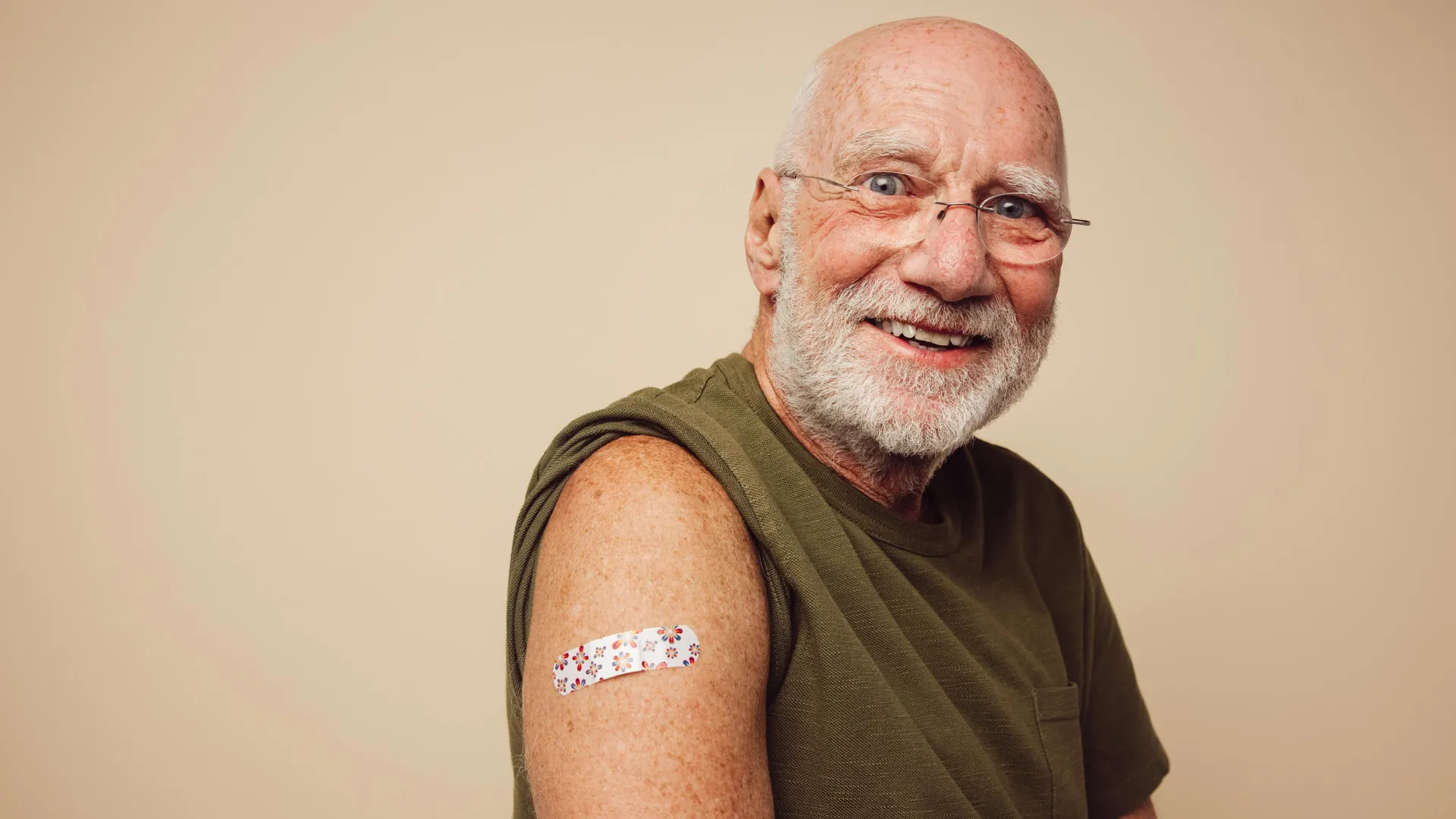
Receiving a COVID-19 mRNA vaccine near the start of cancer immunotherapy dramatically improved survival in advanced lung and skin cancer patients. The discovery hints at a new era of universal, immune-boosting cancer vaccines. Credit: Shutterstock
 
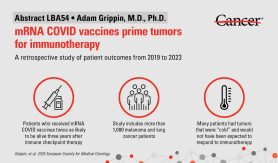
Visual graphic showing key trial data that is repeated in the article
"This data is incredibly exciting, but it needs to be confirmed in a Phase III clinical  trial."
"The COVID-19 mRNA vaccine acts like a siren and activates the immune system throughout the entire body, [including inside the tumour, where it] starts programming a response to kill the cancer." 
"We were amazed at the results in our patients." 
"We’re sensitizing immune-resistant tumors to immune therapy." 
Adam Grippin, radiation oncologist, MD Anderson Cancer Center, Houston, Texas 
 
During the COVID pandemic, COVID-19 vaccines rallied the human immune system to fight off the often-deadly virus. What those mRNA vaccines also did, it turns out, was to almost double median survival-length of cancer patients, as a new retrospective study points out, by researchers at the University of Texas MD Anderson Cancer Center, and the University of Florida, who published their findings recently in the journal Nature
 
Records of over a thousand patients who had begun approved immunotherapy for advanced non-small-cell lung cancer and melanoma (a type of skin cancer), comparing those who received coronavirus RNA vaccines against those who had not, comprised the backbone of the study.  The hope is that scientists    may develop a universal off-the-shelf vaccine for patients with various cancers, but the findings arrive at a difficult juncture for research into vaccines using messenger RNA. 
 
Those vaccines, with a single-stranded molecule instructs the immune system -- without infecting the body -- teaching cells to produce a harmless virus protein. The Operation Warp Speed program introduced by President Trump's first administration  saw scientists scramble to use the mRNA platform to develop vaccines in less than a year following detection of the Coronavirus, whereas such vaccine development can take up to 10 to 15 years in the development process.
 
The study scientists examined records of close to 900 patients with advanced lung cancer, to find that those who were inoculated with COVID-19 vaccines within 100 days of beginning cancer immunotherapy experienced median survival of 37.3 months in comparison with 20.6 months for those not vaccinated. Those patients whose melanoma had not spread, also showed improved median survival when vaccinated. 
 
The reason why mRNA vaccines proved so effective in awakening the immune system to the presence of cancer is not yet fully understood but it is hypothesized that it may be related to RNA's role in the evolution of life. "RNA preceded DNA evolutionarily, so cells don't like RNA from the outside world coming in", explained Elias Sayour, one of the paper's authors. 
 
A healthcare worker prepares a shot of the Pfizer COVID-19 vaccine in La Paz, Bolivia, Jan. 7, 2025. (AP Photo/Juan Karita, File)    
 

Labels: , , , ,

Tuesday, June 04, 2024

An Insecure Lab and Millions of Deaths Worldwide

https://nypost.com/wp-content/uploads/sites/2/2024/06/wuhan-institute-230227-01.jpg?resize=1536,1024&quality=75&strip=all
The Wuhan Institute of Virology, where the “risky” research was conducted with US funding. AFP via Getty Images
 
"The SARS-like virus that caused the pandemic emerged in Wuhan, the city where the world's foremost research lab for SARS-like viruses is located."
"Ultimately, a never-before-seen SARS-like virus with a newly introduced furin cleavage site, matching the description in the Wuhan Institute's Defuse proposal, caused an outbreak in Wuhan less than two years after the proposal was drafted."
"Not a single infected animal has ever been confirmed at the [Wuhan] market or in its supply chain. Without good evidence that the pandemic started at the Huanan Seafood Market, the fact that the virus emerged in Wuhan points squarely at its unique SARS-like virus laboratory." 
"Investigators have either failed to collect or report key evidence that would be expected if COVID-19 emerged from the wildlife trade."
"Whether the pandemic started on a lab bench or in a market stall, it is undeniable that U.S. federal funding helped to build an unprecedented collection of SARS-like viruses at the Wuhan Institute, as well as contributing to research that enhanced them."
"Advocates and funders of the Institute's research, including Dr. Fauci, should co-operate with the investigation to help identify and close the loopholes that allowed such dangerous work to occur."
"The world must not continue to bear the intolerable risks of research with the potential to cause pandemics."
Alina Chan, molecular biologist specializing in gene therapy and cell engineering, Broad Institute of MIT and Harvard

"Yes, China has the right to set their own policy."
"You believe this was appropriate containment if you want, but don't expect me to believe it."
"Moreover, don't insult my intelligence by trying to feed me this load of BS [that it would be sufficiently 'safe' with the work at Wuhan being undertaken by BSL-2 standards]."
U.S. Coronavirus expert Ralph Baric
https://nypost.com/wp-content/uploads/sites/2/2024/06/virologist-shi-zheng-li-left-83195996.jpg?resize=1536,950&quality=75&strip=all
Dr. Alina Chan concluded in her in-depth analysis of COVID-19’s origin that the deadly virus “most likely” escaped from a research lab in Wuhan, China. Future Publishing via Getty Images

Dr. Chan's guest essay appeared in the The New York Times' Sunday edition, with the title Why the Pandemic Probably Started in a Lab, at the very time that the United States' COVID-period chief epidemiologist is testifying before a Congressional Committee delving into the American response to the global pandemic that took countless lives before it settled in as a permanent, less threatening virus. The emergence of SARS-2 remains a mystery even while among a minority of scientists the belief is that COVID spread in humans contracted from infected animals.
 
Dr. Chan identifies the world's foremost virus research lab in Wuhan, China as the source of the pandemic, pointing out that the Wuhan Institute of Virology had been researching SARS-like viruses for at least a decade. The lead investigator at the Wuhan lab was Dr. Shi Zhengli, famous for her work with bats as carriers of viruses. Dr. Chan cites Dr. Shi's public speculation whether the outbreak might have emanated from her lab, when the pandemic began.
 
The Wuhan Institute had been collaborating with American partners the year before the outbreak, on creating viruses with defining features like SARS-CoV-2 that produced the COVID-19 virus.  A grant proposal for a research project named Defuse, aiming to create a SARS-like virus with a unique feature called a furin cleavage site enhancing infectiousness in humans was revealed in 2018. That is the very feature that SARS-CoV-2 has, with genetic data suggesting the feature was gained just prior to the pandemic.

What has long been known is that the Wuhan lab though high-security was not capable of containing an airborne virus infectious to the degree of the COVID-19 virus emanating from SARS-CoV-2. There are four recognized biosafety levels for labs working with live viruses; BSL 1 represents the lowest level of protection while BSL-4 is the most stringent. A scientist working at a BSL-3 laboratory in Taiwan became infected with the COVID virus two years into the pandemic. It seems that as a cost-saving measure the Wuhan lab was permitted to operate at a BSL-02 level.

The claim that the COVID-19 virus arose from contact with an infected animal at the Huanan Seafood Market in Wuhan is rejected by Dr. Chain who stated the claim "is not supported by strong evidence, in part because Chinese investigators assumed initially the market to be the source, so they overlooked potential evidence that would dispute the theory." Moreover, Chinese authorities blocked reporting of early cases that had no link to the market and destroyed some early patient samples.

https://nypost.com/wp-content/uploads/sites/2/2024/06/Virus_Outbreak_New_Data_13988-86c57.jpg?resize=1536,1026&quality=75&strip=all
The report debunks the theory involving the Huanan Seafood Wholesale Market, pictured here, AP
 
"I have repeatedly stated that I have a completely open mind to either possibility [the theory that SARS-2 resulted from laboratory experiments; conversely that the COVID pandemic resulted from the coronavirus naturally leaping from infected animals to humans], and that if definitive evidence becomes available to validate or refute either theory, I will readily accept it."
Dr. Anthony Fauci, American infectious disease official during the COVID pandemic

https://static01.nyt.com/images/2024/06/03/multimedia/03fauci/03fauci-hp-fqwp-jumbo.jpg?quality=75&auto=webp
Dr. Fauci grilled by lawmakers on origins of COVID   The New York Times

Labels: , , , ,

Tuesday, April 11, 2023

The Efficiency and Opportunities of Hybrid Work Experience

"Older workers not coming back to the office may depress younger workers' skill accumulation."
"This may be particularly important as young workers learn the most on the job."
Federal Reserve Bank of New York, University of Iowa, Harvard University economists
Getty Images
 
The SARS-CoV-2 pandemic transformed much in the world seen as routinely socially and economically effective, nothing quite as much as a sudden entitlement among workers to claim the benefits of working from home. For several years office workers found nirvana in shedding the daily grind of morning and evening commutes to and from a workplace. Claims were made of efficiencies, of economic advantages, of worker satisfaction in a job performance that suffered no ills in workers completing their tasks remotely.

At the same time, those in the service industries who catered to workers who drove back and forth to office complexes daily continued to make their grind to their workplace. Workplaces that were faced with a downturn in clientele because of empty office buildings since workers were operating out of their homes faced a dilemma. Those are the workers whose resilience keep their industries going, until they no longer did, and people were laid off and they involuntarily worked from home, unemployed.

What more could office workers hope for, than being able to claim they were just as efficient, completed all their assigned duties on time and well, and because of a tight market for skilled workers, now refuse to report for duty in-office. And since it's such an employee-centric, anxious-employer environment with inflation running rampant those same workers feel entitled to salary increases. What's an employer to do?

Working right at the office, employees spend 25 percent more of their engaged time in activities related to career-development than do their counterparts working remotely; the conclusion of a team of economists analyzing working from home since the beginning of the pandemic. Those who arrive to work in-office, it seems, devote about 40 more minutes weekly to mentoring others; close to 25 minutes more in formal training and about 15 additional minutes weekly on professional development and learning activities. 

This is the conclusion that WFH Research reached; a group including economist Nicholas Bloom of Stanford University. Based on surveys of over 2,400 American adults able to work from home, the conclusions give quantitative support to CEOs like JPMorganChase & Co and Morgan Stanley who believe that workers, in particular younger staff, should be on-site frequently, to learn and develop, alongside more experienced colleagues.

Those in the vanguard of corporate campaigns to persuade workers back to offices more often, have been Wall Street banks. Their efforts have come up against the brick wall of demands by workers for flexibility in a tight labour market, resulting in a constantly changing morass of hybrid arrangements where close to half of employees who can work from home have a hybrid arrangement.

About a third of workers operate fully on-site, while 20 percent are fully remote, according to data from WFH Research. Workers "need a few days each week to mentor and be mentored", according to Jose Maria Barrero, a member of the research group from Mexico's ITAM business school, in support of the shift to hybrid work schedules.

Executives focus on the value of in-person mentoring and professional development, but have found little to support their arguments other than lame references to the power of "water cooler moments"; times when workers spontaneously connect, sharing ideas and advice. Now that the WFH data is available, as well as two new research papers they have something to lean on: The Power of Proximity argues that working in the same building "has an outsized effect on workers' on-the-job training".

https://envoy.com/wp-content/uploads/2022/06/Blog-feature-HR-Pillar.png


Labels: , , , , ,

Thursday, May 20, 2021

COVID-Caused Surgical Back-Logs

"I have lost a lot of patients on the wait list [surgical procedure priority wait list]. Patients have died because we've had to make decisions about who is the person we have to treat first ..."
"Those patients and their families deserve recognition that they are victims of this pandemic, too."
Dr.Harindra Wijeysundera, interventional cardiologist, head, cardiac care, Sunnybrook Health Sciences Centre, Toronto

"There are groups of surgeons who are saying 'I believe we're at a tipping point where I don't believe I can ever get caught up."
"I can't get caught up [they say] because I can't possibly work every weekend. Even if they gave it to me [re-arranged, extended surgical scheduling at hospitals]."
Dr.Mohit Bhandari, president, Canadian Orthopedic Association
Since Alberta Health Services (AHS) temporarily halted elective surgeries on March 18, at least 22,000 people had procedures put on hold in 2020 alone. (Shutterstock / StockLeb)
 
This is the extent to which the pandemic of the SARS-CoV-2 virus has inflicted itself in its all-consuming presence, threat and depredations on human health and the monopolization of the health care system, that has paralyzed hospital surgeries for a vast number of people desperately awaiting their opportunity for attention to be given to their emergency, non-COVID-19 maladies that have upended their lives, assaulted their health and given them an uncertain future -- if it doesn't kill them first as a result of unattended need.

Operations have been cancelled right, left and centre with ensuing backlogs and elongated wait times in a soaring misalignment of priorities forced upon the medical community by uncertainty, trepidation and anxiety to be able to meet the impending crisis that was seen to cripple the health system and medical community's capacity to react, when Italy and the United States and Brazil became poster-nations for the doomsday scenario feared by all countries globally, all equally in the line of fire of the global pandemic.

In Ontario alone twice as many people suffering heart ailments expired while waiting for surgery throughout the pandemic days, as did those numbers pre-dating the appearance of COVID-19, swamping health care systems everywhere. Doctors dreaded the anticipation of a nightmare scenario where they would have to make life-changing, life-ending decisions in determining who among their patients presenting with serious COVID symptoms would be likelier to survive and thus would be viewed as appropriate choices for treatment; the others set aside, to allow events to unfold as they might.

As matters settled down, and newer, helpful treatments were conceived of, and fewer COVID patients died, in Ontario those life-and-death choices did not, after all, have to be made to compensate for insufficient beds amidst strained health-care. Not for COVID. In actual fact, the dreadful decision-making was shunted off to other types of situations. Triage was taking place in cardiac care, explained Dr.Wijeysundera; for over a year this is what cardiac surgeons have been struggling with.
 
surgery
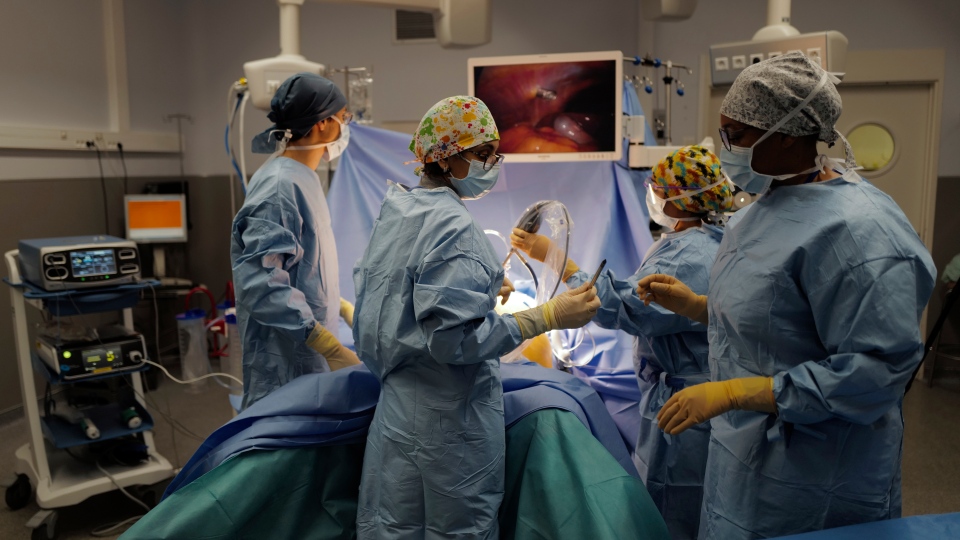
A surgery takes place in this file photo. (AP Photo/Francois Mori)
 
Across the country a logjam of hundreds of thousands of surgeries grew as hospitals put off 'elective' surgeries to make space, free up doctors and nurses to focus on COVID and more beds made available for ICUs meant for the care of COVID-19 patients suffering extreme and potentially lethal symptoms of the coronavirus. Those delayed treatments spoken of as 'elective' were all too often anything but. It described patients waiting for eye procedures to allow them to retain their vision; orthopedic operations for debilitating joint pain and surgery for the removal of cancerous tumours.

Every province in Canada cancelled "elective" surgery last March for an initial three-month period, spurred on by news coming out of northern Italy and New York City, as hospitals and intensive-care units were overwhelmed by a crush of seriously ill COVID patients and health-care officials made the decision that non-emergency surgeries could be suspended in preparation for a potential flood of coronavirus emergency cases. 
 
Ontario's Financial Accountability Office figures put the province's surgical backlog at 419,000 by September, judging that it will require $1.1 billion to clear up the waiting case load, over a period of three and a half years. "Without question, we're seeing a higher severity of disease", said surgeon Dr.Michael Brandt who has witnessed a clear fallout from both surgery waits and delays in patients diagnosed with skin cancer.

Ophthalmological procedures' increased wait times could result ultimately in greater numbers of people suffering vision loss. According to a recent paper by researchers from Queen's University and University of Toronto whose modeling study looked at cancellations during the first wave, suggesting waits for orthopedic surgery such as  hip and knee replacements would increase 3.4-fold on average, where a half-year wait would become 21 months in limbo.
 
Patient prepared for operation at Cambie Surgery Centre in Vancouver, 2016. The B.C. government has contracted for surgeries in private clinics as well as adding hospital capacity to catch up on 30,000 procedures to prepare for COVID-19 cases in the medical system. (The Canadian Press)

Labels: , , , ,

Wednesday, April 14, 2021

COVID-19 vs Cancer

"I do believe that patients with cancer in Canada -- are being rendered fatal, terminal or incurable, as a result of what's happened."
"It has absolutely had an impact. I've seen it with my own eyes. It's extremely stressful."
Dr.Neil Fleshner, chair, urology, University of Toronto

"Where this gets us is another pandemic."
"When we do catch these people, when we do screen them and get them through diagnosis, it won't be early any more, it will be more advanced cases of cancer."
Dr.Eva Villalba, executive director, Quebec Cancer Coalition

"Clearly, it's something that may have consequences."
"What we really see is that the screening leads to earlier diagnosis, and it will also lead to earlier management of breast cancer."
Dr.Joseph Ragaz, medical oncologist, breast-cancer expert, University of British Columbia
An infusion drug to treat cancer is administered to a cancer patient via intravenous drip. Canadian oncologists worry the pandemic has led to cancer going undiagnosed and untreated. (Gerry Broome/The Associated Press)
 
Over four thousand people who would under other circumstances have been diagnosed with a malignancy during the first wave of COVID-19 went undiagnosed, according to the Quebec Ministry of Health. Thousands of Canadians had no access to proactive cancer screening or diagnoses, or chose not to present at hospitals or doctors' offices for fear of contracting the SARS-CoV-2 virus throughout the course of 2020, giving many doctors reason to fear a surge in advanced tumours and deaths, as a result.

Proactive screening of patients without symptoms, and diagnosis of people suspected of having cancer dropped abysmally in the initial months of the onset of the coronavirus. A particularly dramatic change was seen with prostate cancer, when 60 percent fewer biopsies were performed last March and August in Ontario. Currently numbers of tests have been re-established to reflect normal levels. Which still leaves hundreds of thousands fewer mammograms, pap smears and colorectal cancer screens taking place last year in comparison to the year before.

A matter of great concern to Dr.Fleshner who feels that though the missed screening may prove to have less short-term impact than delayed surgeries, his experience of encountering more patients with advanced, harder-to-treat disease gives him great unease. This, at a time when the grave situation unfolding with the presence of COVID's phase three driven by the far more infectious U.K. variant has led the medical community to talk of triaging, to assess who among the gravely ill COVID-19 patients will be prioritized for limited critical-care resources.
 
Mammograms are one of several screening tests for cancer that were put on hold during the first wave of the COVID-19 pandemic. (Enrique Castro-Mendivil/Reuters)
 
Yet, as far as Dr.Fleshner is concerned, a form of triaging has already been in place in the health care system. And it is patients with cancer and those among other non-coronavirus patients that the brunt of that prioritizing has taken place. These are horrendously difficult decisions to make, since making every effort conceivable to attempt to control the pandemic is an absolute requirement.

According to Dr.Villalba, over 8,000 Quebecers have been undiagnosed over the past year. The province's Health Ministry's January report detailed the pandemic's impact on cancer care, such that based on the reduced number of biopsy and other pathology reports an estimated 4,119 new cancers were undiagnosed that would have been discovered earlier, under normal circumstances. All of which added to the situation of hundreds of thousands of elective operations having been shelved in the face of panic over hospital space and treatment for COVID.
 
According to British Columbia's Provincial Health Services Authority there was a 20 percent decrease in new cancer diagnoses in the first months of the pandemic.The province has now approached pre-COVID levels with the number of screening mammograms performed in February roughly similar as in February of 2019. Dr.Ragaz of UBC is of the opinion that many missed tumours would be slow-growing, that some of the impact of lost screening is to be rectified through 'catch-up' procedures.
 
In a colonoscopy, a doctor inserts a small camera into a patient's large intestine and checks for possible tumours. Shifting medical resources to deal with the COVID-19 pandemic has made it harder to screen for colorectal and other cancers in Quebec. Experts worry a wave of advanced cases could hit in coming months. (Jean-Paul Pelissier/Reuters)
 
The consensus of opinion of the situation is not totally unanimous, however. There are skeptics and one such who does not support the efficacy of mass screening, like Dr.Steven Narod a breast cancer expert at University of Toronto. "I can pretty much promise you there will be no difference", he asserted, pointing out that mass cancer screening programs detect so few serious malignancies there is likely to be minimal if any impact from the coronavirus complications.

The pandemic "gives us a really interesting opportunity to evaluate (screening)", he said in the face of the reality that about 0.5 percent of screening mammograms finds a tumour of any size. There is, in fact, no end in sight for the near future of these medical interruptions with ongoing disruptions. Ontario is once again scaling back elective surgeries, despite that huge numbers have already been delayed.

215,000 fewer cancer and other operations, not including heart or transplant surgeries, have been carried out in Ontario since the pandemic arrived, compared to the same period a year earlier. Resections, removal of tissue, and biopsies to diagnose cancer dropped by about 20 percent between March and August in Ontario, while prostate biopsies saw the steepest decline, at 60 percent.

surgery
A surgery takes place in this file photo. (AP Photo/Francois Mori)

Labels: , , , ,

 
()() Follow @rheytah Tweet