Ruminations

Blog dedicated primarily to randomly selected news items; comments reflecting personal perceptions

Friday, October 24, 2025

COVID mRNA Vaccines a Survival Boost to Cancer Patients

"The implications are extraordinary -- this could revolutionize the entire field of oncologic care."
"We could design an even better nonspecific vaccine to mobilize and reset the immune response, in a way that could essentially be a universal, off-the-shelf cancer vaccine for all cancer patients."
"One of the mechanisms for how this works is when you give an mRNA vaccine, that acts as a flare that starts moving all of these immune cells from bad areas like the tumor to good areas like the lymph nodes." 
"If this can double what we're achieving currently, or even incrementally -- 5%, 10% -- that means a lot to those patients, especially if this can be leveraged across different cancers for different patients." 
Elias Sayour, UF Health pediatric oncologist, Stop Children's Cancer/Bonnie R. Freeman Professor for Pediatric Oncology Research
 
"Although not yet proven to be causal, this is the type of treatment benefit that we strive for and hope to see with therapeutic interventions -- but rarely do."  
"I think the urgency and importance of doing the confirmatory work can't be overstated."
Duane Mitchell, director, UF Clinical and Translational Science Institute 
Cancer Patients Lived Longer After COVID Shot
Receiving a COVID-19 mRNA vaccine near the start of cancer immunotherapy dramatically improved survival in advanced lung and skin cancer patients. The discovery hints at a new era of universal, immune-boosting cancer vaccines. Credit: Shutterstock
 
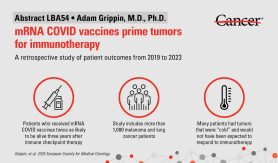
Visual graphic showing key trial data that is repeated in the article
"This data is incredibly exciting, but it needs to be confirmed in a Phase III clinical  trial."
"The COVID-19 mRNA vaccine acts like a siren and activates the immune system throughout the entire body, [including inside the tumour, where it] starts programming a response to kill the cancer." 
"We were amazed at the results in our patients." 
"We’re sensitizing immune-resistant tumors to immune therapy." 
Adam Grippin, radiation oncologist, MD Anderson Cancer Center, Houston, Texas 
 
During the COVID pandemic, COVID-19 vaccines rallied the human immune system to fight off the often-deadly virus. What those mRNA vaccines also did, it turns out, was to almost double median survival-length of cancer patients, as a new retrospective study points out, by researchers at the University of Texas MD Anderson Cancer Center, and the University of Florida, who published their findings recently in the journal Nature
 
Records of over a thousand patients who had begun approved immunotherapy for advanced non-small-cell lung cancer and melanoma (a type of skin cancer), comparing those who received coronavirus RNA vaccines against those who had not, comprised the backbone of the study.  The hope is that scientists    may develop a universal off-the-shelf vaccine for patients with various cancers, but the findings arrive at a difficult juncture for research into vaccines using messenger RNA. 
 
Those vaccines, with a single-stranded molecule instructs the immune system -- without infecting the body -- teaching cells to produce a harmless virus protein. The Operation Warp Speed program introduced by President Trump's first administration  saw scientists scramble to use the mRNA platform to develop vaccines in less than a year following detection of the Coronavirus, whereas such vaccine development can take up to 10 to 15 years in the development process.
 
The study scientists examined records of close to 900 patients with advanced lung cancer, to find that those who were inoculated with COVID-19 vaccines within 100 days of beginning cancer immunotherapy experienced median survival of 37.3 months in comparison with 20.6 months for those not vaccinated. Those patients whose melanoma had not spread, also showed improved median survival when vaccinated. 
 
The reason why mRNA vaccines proved so effective in awakening the immune system to the presence of cancer is not yet fully understood but it is hypothesized that it may be related to RNA's role in the evolution of life. "RNA preceded DNA evolutionarily, so cells don't like RNA from the outside world coming in", explained Elias Sayour, one of the paper's authors. 
 
A healthcare worker prepares a shot of the Pfizer COVID-19 vaccine in La Paz, Bolivia, Jan. 7, 2025. (AP Photo/Juan Karita, File)    
 

Labels: , , , ,

Saturday, April 23, 2022

Infection or Vaccine for Maximum Effectiveness?

Influenza virus
"[The study ended before Omicron took off], and we can't necessarily extrapolate our findings to the situation today."
"Obviously, if you have to choose between getting a vaccine versus getting COVID, I would highly recommend going the vaccine route."
"But I do think it's an interesting finding [the robust nature of immunity post infection]."
"I expected to see some level of protection, but personally I was surprised that it was as high as it was."
Dr.Jessica Ridgway, infectious diseases specialist, University of Chicago

"Vaccination, although imperfect, provides a much more standard level of protection."
"When you have an Omicron infection  you don't generate really strong immune responses that protect you from subsequent Omicron in the absence of vaccination."
"Omicron needs at least three doses of vaccine, because you have to have sky-high levels of antibodies to deal with it. It would be lovely if your third shot gave you zero chance of picking up the infection. But what your third shot does is provide you with a better infection -- shorter, less severe, less likely to develop long-term health consequences." 
"It's [the most recent study] got inevitably, what we call a survivor bias. Meaning, anyone who died of their first infection is not in the study. It doesn't account for all the people who didn't live to be in this study because of their first infection."
Dawn Bowdish, immunologist, McMaster University

"The good news is that vaccines still protect very well against severe disease."
"We will see large numbers of double and triple vaccinated people getting infected [since the subvariants are ultra transmissible and require high levels of neutralizing antibodies for reinfection prevention]."
Dr.Marc-Andre Langlois, molecular virologist, University of Ottawa
COVID-19 infection potentially gives those who are unvaccinated strong, durable protection from reinfection. It can mitigate the disease through allowing for mild infections rather than severe to develop. In short, a new research study gave every indication that 'natural immunity' can produce an infection-aversive effect similar to those reported for mRNA vaccines. That is, it did, with the Delta strain, prevalent in the period of the study, before the advent of the Omicron variant.

The study has been hailed, however, for offering insights into the debate that is ongoing relating to the risk of SARS-CoV-2 reinfection among those who are unvaccinated. People opposed to vaccination believe that natural immunity, gained from infection is superior because it's 'natural', that immunity can be gained as a result of infection. The argument in some quarters is that it makes no difference where immunity is raised from; infection or vaccine.

The study team at University of Chicago viewed data from over 100,000 people who had been tested for COVID in six western American states between 2020 and 2021, with solely unvaccinated people included. It was found that a past infection turned out to be 85 percent protective against reinfection and 88 percent against hospitalization, with no waning of protection up to nine months from initial infection.

In other words, the researchers saw protection levels similar from severe COVID, and mild, whether by 'natural' immunity or immunity gained through a mRNA vaccine. The conclusion fairly well matches a large study conducted between 2020 and 2022 in Qatar, where researchers found natural infection to be associated with stronger, more durable protection against infection, variants aside, than two doses of either Pfizer or Moderna.

Natural immunity "demonstrated hardly any waning in protection for eight months of followup after the primary infection", wrote the researchers, whereas protection gained through vaccines waned with time. following the second dose. Natural infection was seen to be associated with stronger protection against reinfection when the Omicron wave led to a massive increase in reinfections in both groups. Despite which "vaccination remains the safest and optimal tool" against infection and death", they concluded.

"It is natural to become immune through contracting infections, but it is also natural to die from serious infections", wrote the researchers in the Journal of Medical Ethics. The notion that natural infection is somehow 'superior' to vaccine-induced immunity is a "grave mistake and a form of the naturalistic fallacy", they wrote. "It would be prudentially irrational to choose to be infected rather than to have the vaccine, for those who are vulnerable to COVID 19." 
 
Since, obviously, COVID infection can cause grave damage to the heart, lungs, liver, kidneys, and lead to long-term consequences such as long COVID. One study indeed found that one in four people infected with COVID suffer from impaired cognitive function. In addition to which, COVID is increasingly being linked with an incidence of accelerated aging. 
 

Orginal viral spike is shown binding to antibody from vaccine and from infection. Variant spikes only bind to antibody from vaccine.
"[The study is important, well-designed, confirming recently published work and I don't see an argument] that would favour letting the virus run free, aim for 'natural immunity' through infection of unvaccinated people."
"SARS-CoV-2 in unvaccinated people can cause severe pathologies and death, especially in the aging and immunocompromised population, often with long-term consequences."
"The only way to lower the negative effects is vaccination and not natural immunity."
Dr.Jorg Fritz, immunology professor, McGill University

Labels: , , ,

 
()() Follow @rheytah Tweet