That Healthy Skin Glow, Underlining Risky Behaviour
"The sun as a means of getting a tan is carcinogenic. And it is dangerous.""It is one of the worst public health behaviours from the perspective of skin cancer risk that occurs in human beings."David Fisher, chairman, dermatology department, Massachusetts General Hospital"[Tanning oils] essentially concentrate the sun's rays to enhance the penetration and the amount of sun that you're getting to get a bigger tan.""You're basically cooking yourself because it's increasing the amount of sunlight that you're getting.""It's kind of just increasing the strength of the sun as it hits you."Jordan Parker, dermatologist, assistant professor of dermatology, University of Missouri
 |
| Washington Post |
Come summer, the beauty conscious seek the sun to achieve that healthy glow that a tanned skin tends to project, showing off a body and skin colour-enhancing summer clothing styles, all meant to convey the appearance of casual beauty. Now that outdoor weather has finally relieved us of the dreary days of winter confinement, the sense of carefree spontaneity reflected by a tanned body becomes the envy of those who may or may not consider the risks of courting the sun.
People impatient for the drawn-out process of skin exposure to sun rays gradually achieving that bronzed glow, often turn to chemical aids. Tanning oils spread lovingly on human skin attracts ultraviolet (UV) rays of the sun, increasing the absorption rate of those penetrating UV sun rays for a quicker, satisfyingly deeper tan. Human skin responds to UV rays by releasing melanin, resulting in that longed-for deeper tan, courtesy of the process acceleration with the use of tanning oils.
Interpreting the resulting tan is not difficult for the trained professionalism of dermatologists who explain that the tan signals that skin cells have sustained DNA damage. In the use of the tanning oils as a tanning accelerant, that deeper tan signals increased skin damage. A sun protection factor of 15 or less accompanies many tanning oils. An amplitude of sun-related skin risks are associated with tanning; hyperpigmentation, sun hives, wrinkles and a weakening of the skin's immune system making the skin susceptible to infections.
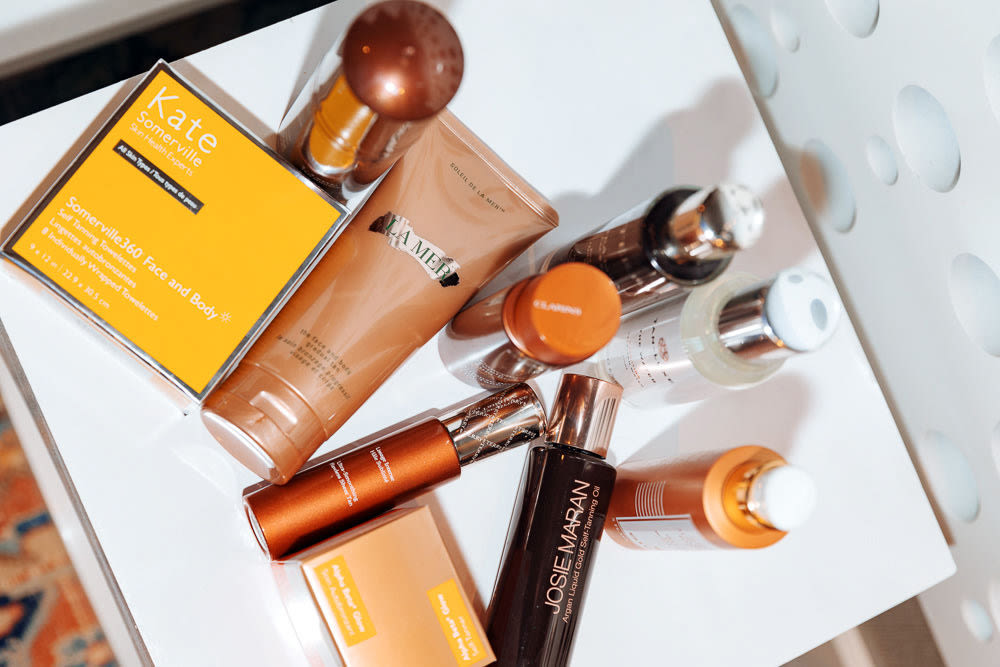 |
"Going out into the sun and tanning increases your risk of skin cancer, especially without some sort of sunscreen", explains Shanthi Sivendran, clinical associate professor at Penn Medicine, specializing in melanoma and non-melanoma skin cancers. Sugarlike ingredient Dihydroxyacetone, the primary ingredient in sunless tanning products, reacts with dead amino acids on the top skin layer in the creation of an artificial tan over the skin. The artificial glow that results lasts a few days then fades as the dead skin cells are shed.
Self-tanner products are favoured by many dermatologists over tanning oils since they feature less direct interaction with the sun. Many self tanners provide an SPF of 3 or 5, making users at risk still of a sunburn with self-tanners. Despite that self-tanners permit the acquisition of tans without the sun being involved, some researchers find that people who use sunless tanning products to be less likely to use a sun-protection method, linking them to risky skin cancer-related behaviours.
"If you're using those self-tanners, that doesn't protect you from the sun. You will have to do all those sun safety behaviours", explains Professor Sivendran at Penn Medicine, senior vice-president of cancer-care support at the American Cancer Society.
 |
| Skin Cancer Foundation |
"What we know is that the gen Z generation is beauty- and image-obsessed, and there are few things that can look and feel as good as tanning.""This is a group that has grown up with and has been consumed by social media and its projections of perfectionism and beauty."Mona Sadeghpour, dermatologist
Labels: Cancer Potential, Exposure to the Sun's UV rays, Self Tanners, Tanning Oils
posted by Pieface @ 7:41 PM
0 comments