Ruminations

Blog dedicated primarily to randomly selected news items; comments reflecting personal perceptions

Thursday, January 19, 2023

Unsafe At Any Time In Any Amount

"Many Canadians are unaware that alcohol consumption increases the risk of cancer, and most don't realize they are drinking unsafe amounts."
"The less alcohol you drink, the lower your cancer risk."
Andrea Seale, CEO, Canadian Cancer Society
"The last time we did the guidelines, it was in 2011."
 "In ten years there's definitely been significant improvements in our understanding of mortality and morbidity associated with alcohol use."
" We have a much better understanding of the link between alcohol and cancer."
Catherine Paradis, interim associate director, research, CCSA

New guidelines have been issued by the Canadian Centre on Substance Use and Addiction, an agency of the Canadian government, with the advice to the public that the illusion of safe-drinking is wishful thinking. The report recommends that warning labels be placed on alcohol products informing consumers of alcohol's link to cancer.

The research was compiled over two years with the use of 6,000 peer-reviewed studies by a panel of 23 experts from 16 organizations. Low- to high-risk of alcohol is covered in the report, the outcome of which is the determination that two drinks weekly falls into a low-risk category, whereas the last guideline dated 2011 suggested a maximum of 15 drinks each week for men and ten drinks for women as the ideal to see negative health effects reduced.
 
One /standard drink:
  • 142 mL (5 oz) of wine, 12% alcohol content
  • 43 mL (1.5 oz) of spirits, 40% alcohol content
  • 341 mL (12 oz) of beer or cider, 5% alcohol content
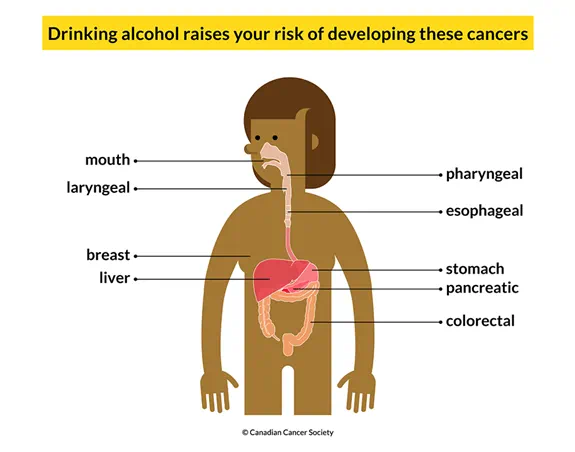
Body showing that drinking alcohol raises your risk of developing mouth, breast, liver and other cancers
The new guidelines found a moderate risk between three to six drinks weekly, including for breast and colon cancer. Each drink following that number increases risk of heart disease, liver disease and seven types of cancers. The findings appearing in the report are quite precise: Liver, heart disease and stroke, depression, anxiety and suicidal ideation were associated with drinking as well.

Most Canadians, according to a corresponding survey, are at risk of the hazardous health impacts of drinking, with 40 percent of respondents having consumed six or more drinks weekly, and an additional 17 percent three to six drinks a week. No evidence of health benefits in drinking was found by the research which cited as well the increased risk of injury and violence associated with the use of alcohol.
"[Alcohol causes 18,000 deaths yearly in Canada according to the latest data], with most cases being breast or colon cancer, followed by cancers of the rectum, mouth and throat, liver, esophagus and larynx."
Report on Alcohol Consumption
National health data, quoted by the report, reveals that alcohol use costs Canada $16.6 billion annually; of which $5.4 billion is spent on health care. Adding warning labels to bottles and packaging is not very popular with the alcohol industry which has called for an independent review of the report.

A person walks past shelves of bottles of alcohol on display.
A person walks past shelves of bottles of alcohol on display at an LCBO in Ottawa in this 2020 file photo. The Canadian Centre on Substance Use and Addiction (CCSA), which released its final report Tuesday, says no amount of alcohol is safe and that consuming any more than two drinks a week is risky. (Adrian Wyld/The Canadian Press)

Labels: , , ,

Wednesday, November 03, 2021

Investing In Sleep

"One  hour can indeed be enough to throw our internal clock out of sync. When we change our sleep schedules by an hour or longer from one day to the next, we are sending signals to the brain that we are attempting to transition to a new time zone, making the next night's sleep challenging."
"We discovered that over the course of the day, the brain produces toxins, the accumulation of which is associated with neuro-cognitive decline such as Alzheimer's disease and dementia."
"When we sleep, not only does the brain stop producing these toxins, but it also produces a cerebral fluid which, in essence, pressure-washes the brain to remove the toxins that have built up." 
Dr.Rebecca Robbins, instructor in medicine, Harvard Medical School; associate scientist, Division of Sleep and Circadian Disorders, Brigham and Women's Hospital, Boston
Insomnia updated
Sleep Health Foundation

Pandemic stress the last two years has impacted on the quality of many peoples' sleep through  the psychological upset and other associated factors, where people are discovering that they are suddenly affected with an inability to sleep as soundly and as long as they've been accustomed to. And many, if not most people are anticipating the annual shift in our daily pattern, affecting sleep with the end of Daylight Saving and the re-entrance of Standard Time.

It has long been proven that one hour back and forth (spring forward, fall backward) has a deleterious effect on most people's circadian rhythm. People feel groggy, discommoded, uncomfortable, finding it difficult to adjust to a misplaced hour in their daily lives. More accidents occur the day after the time change. There is time-confusion in peoples' minds for at least a week following the transition. And sleep patterns become interrupted.

There are ample studies warning of long-term brain health with risks increasing of a future of Alzheimer's for people who suffer from insomnia and are incapable, not of their own thinking volition, of enjoying a sound night's sleep on a nightly basis. Heart problems and life expectancy are also impacted by sleep shortages. New research published in the journal Science shows how it is that adequate sleep helps to protect the brain.
 
HealthPrep 
 
With the arrival of cold and flu season "How sleep affects our immunity is so relevant right now", advises Dr. Robbins, with research showing the human body produces and releases proteins called cytokines to target infection and inflammation during sleep. "There is one very interesting study that has looked at rhinovirus, a sister pathogen of SARSCoV-2. The researchers found that those who are sleep-deprived have more than a twofold greater risk of colds and flu", explained Dr. Robbins.
 
Having a bath before bed has been found by researchers to help sleep arrive a 10 minute average faster then snuggling directly into bed. What should be a staple condition in finding uninterrupted sleep and achieving a pattern for it consistently is setting a firm bedtime. Setting a firm time to go to bed and faithfully continuing that firm time for bed night after night, to allow for eight and a half hours' sleep.

Screens should be avoided, but a bedtime book can be useful until the urge to sleep overtakes reading. "When it comes to this wake-up (during the night), resist looking at your phone and get out of bed and try sitting in an armchair or in a cross-legged position on the floor and do a meditation or visualization exercise", Dr. Robbins recommends, based on studies that show getting out of bed in the middle of the night can help to fall asleep 15 minutes faster than merely remaining in bed, awaiting sleep to return.

A cool temperature ambiance is also helpful; say, 18C, mattress and bedding of natural fibres to help regulate body temperature further -- a hint from another study reported in the journal Nature and Science of Sleep.
"There is an expectation that sleep should just come easily because it's a natural process. Then when it doesn't, it can feel like something is wrong."
"But the truth is we need to learn how to sleep and how to prioritize it."
"Sleep is an investment, but one that will pay off."
Dr.Rebecca Robbins
Healthline


Labels: , , ,

 
()() Follow @rheytah Tweet