Ruminations

Blog dedicated primarily to randomly selected news items; comments reflecting personal perceptions

Sunday, September 20, 2026

Judged 'Not Criminally Responsible', Yet a Community Threat

https://content.presspage.com/uploads/2189/1920_suspect-5.jpg?10000
Hamilton Police
"He pulled out a knife and began stabbing her with it in the back. She was stabbed upwards of seven times and suffered a severed bicep and collapsed lung amongst other injuries."
"He resumed using cannabis during the time he was living with his parents."
"[The panel] concluded that Mr. Ghawar remained a significant threat to the safety of the public and that a detention order was necessary and appropriate. With respect to the additional privileges suggested by the hospital, the panel determined that it was appropriate to include in the disposition seven-day passes accompanied by an approved person, and seven-day passes indirectly supervised with a pre-approved itinerary."
Ontario Review Board (ORB)  
"In April 2014, Mr. Ghawar stopped taking his anti-psychotic medication, and his mental health symptoms intensified almost immediately."
"According to his family, Mr. Ghawar became very anxious and irritable, and would refuse to leave the house alone."
Hospital Report  
This is an Ontario resident who twice stabbed people multiple times in the back, and subsequently found not criminally responsible, which led to his being granted a series of day passes, despite the fact that he remains, in the professional opinion of health experts, a "significant threat to the safety of the public". 
 
Diagnosed with schizophrenia and cannabis use disorder "in remission in a controlled environment", Muneeb Ali Ghawar was found in February of 2024 to be not criminally responsible for aggravated assault while wearing a disguise. The second episode where he stabbed a woman took place in 2023, at a Hamilton cannabis store. 
 
He had entered the Sweet Releaf Cannabis shop on February 3, 2023 wearing a mask and a trapper hat pulled down over his forehead. A female clerk began the process of ringing up his cannabis purchase, and while she was thus engaged, the man moved behind her, and withdrawing a knife, stabbed her back repeatedly. Ghawar ran from the store when another employee screamed and called 911. 
 
https://smartcdn.gprod.postmedia.digital/nationalpost/wp-content/uploads/2026/09/cannabis_304621129.jpeg?quality=90&strip=all&w=564&h=423&type=webp&sig=9nz8KVrPqHKgV_BaIWN_sw
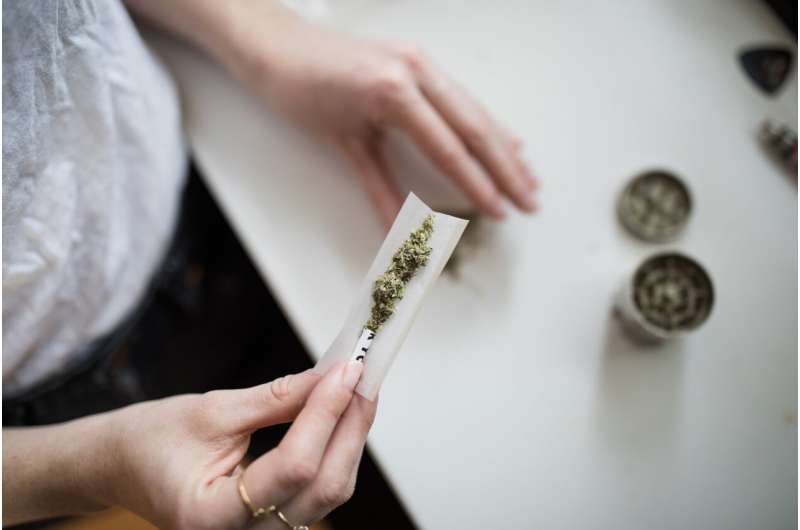
Lighting up a marijuana joint. Photo by Adobe Stock
 
Ghawar was identified through studying the surveillance video at the cannabis operation where he had appeared on a previous occasion, unmasked. Six days following the stabbing he was arrested. He is now under the jurisdiction of the Ontario Review Board for a second time. He had been declared 'not criminally responsible' for a similar attack nine years previously, when an acquaintance was stabbed in the back and torso by him. He was hospitalized in a psychiatric ward for two years then discharged to live with his family.   
"Mr. Ghawar was compliant with his medication, met consistently with the outpatient team, and maintained stable mental health. He was granted an absolute discharge on February 11, 2019."
"There has been no evidence of mood disorders or psychotic breakthrough. He engages appropriately with co-patients and staff and is always pleasant and polite during interactions."
"His persistent use of cannabis is a  significant risk factor."
"He was using cannabis at the time of the first index offence in 2014, and at the time of the current index offence in 2023. He became extremely psychotic and committed very violent offences that could have resulted in the death of either victim."
Ontario Review Board ruling  
Mental health symptoms had afflicted the man for years. He began the use of cannabis at age 15. In 2024 he was ordered to be placed at St. Joseph's Healthcare where he was given privileges whereby he could enter the community of Hamilton under indirect supervision. He has been treated for anxiety and depression since 2012 by a psychiatrist. He also has amassed a criminal record including assault, mischief, break-and-enter, and assault with a weapon.
 
A psychological assessment in 2023 revealed that Ghawar "expressed delusional thought content, such as that the victim of the index offence was selling bad cannabis to kids in order to draw them into sex trafficking", the ORB decision noted. Ghawar admitted long-standing auditory hallucinations, and that he had stopped taking his medication prior to the offence, while smoking marijuana. 
 
https://lh3.googleusercontent.com/gps-cs-s/AHRPTWmg1zCZ0wc0OAr17ycwFh9lzR5R90_G_wl37CpvmP30uWZUbTiW4oL8-xH-gMN7ryepJ1SUYL62pbxJiuHy3of6BhqEGJlOeaBspIelDQHrAucHKMNOdCubSYsBhhvZvayIReCR=s680-w680-h510
Sweet Releafs Inc.
 
"He again denied using cannabis, and suggested that the positive urine result was from others smoking cannabis around him", noted the ORB decision. And this is the man his parents plan to take to Pakistan to have him married there. "This would be an arranged marriage to a woman he has not met", even while his psychiatrist "expressed concern that bringing another person into the family home would increase the stress at a time when Mr. Ghawar is struggling with cannabis use".  
 

Labels: , , , , , , ,

Thursday, September 28, 2023

Cannabis Medical Use to Alleviate Mental Health Symptoms : Cannabis Use the Cause of Schizophrenia

"Our findings demonstrate an important increase in risk of being diagnosed with schizophrenia after an episode of substance-induced psychosis or substance use without psychosis -- 163 times and ten times higher than the background risk in the general population."
"[Canada, which was the second country in the world after Uruguay to legalize cannabis is becoming] the world's laboratory for seeing what happens."
"You worry about long-term increases in the number of people living with schizophrenia."
Dr. Daniel Myran, assistant professor, University of Ottawa
 
"Frequently, people using cannabis are not aware of the associated risks for their mental health and need to be better informed."
"[Substance use is the rule, rather than the exception and people tend to have] zero literacy on the effects of cannabis on mental health."
"People should know what they are buying and I don't think that is the case."
Marco Solmi, medical director, First Episode Psychosis On Track service, The Ottawa Hospital 
https://scx1.b-cdn.net/csz/news/800a/2023/cannabis-3.jpg
Credit: Unsplash Public Domain
 
A new study led by Ottawa researchers -- one of the largest of its kind -- found that people treated in emergency departments with substance-induced psychosis had an 18.5 percent chance of developing schizophrenia within three years of treatment. This is the latest study highlighting mental health risks seen to be associated with the use of cannabis, striking young men in particular. Some Ottawa-area mental health specialists are seeing a "striking increase" in patients with significant psychiatric issues appearing to be linked to cannabis use. 

Annual rates of cannabis-induced psychosis increased across the province of Ontario by 220.7 percent between 2014 and 2021.Heightened risk of developing schizophrenia was also seen among those who visited emergency departments for substance use without psychosis. For this group the risk appeared significantly reduced, yet higher than the risk to the general population; 0.1 percent.

The research study which Dr. Myran, a researcher with Ottawa's Bruyere Research Institute, and an assistant professor at University of Ottawa guided, was published in the medical journal JAMA Psychiatry. Brief periods of hallucinations or delusions triggered by substance use or substance withdrawal are the hallmarks of substance-induced psychosis, while schizophrenia is a chronic mental disorder characterized by disruptions in thought processes, perceptions, emotional responsiveness and social interactions.

According to the study, although amphetamine use is a risk factor as well, risk factors for diagnosis with schizophrenia are higher for cannabis than with other substances. Individuals had a 3.7 percent risk of being diagnosed with schizophrenia within three years, who were treated in emergency for amphetamine use without psychosis -- a risk greater than 28 percent higher than the general population. Researchers studied health records of close to ten million people in Ontario between January 2008 and March 2022. They found 407,737 people had visited an emergency department for substance use, among the total.

A jar with marijuana is pictured in a file photo taken on Jan. 25, 2020.
People who had visited an emergency department with cannabis-induced psychosis held a 26 percent grater risk of developing schizophrenia within three years, a figure 242 times greater than the risk posed to the general population. Males between the ages of 14 and 24 were found to have the highest risk with over 40 percent in that age group who came to an emergency department with cannabis-induced psychosis being diagnosed with schizophrenia within three  years.

A sharp increase in emergency room visits for cannabis-induced psychosis in recent years had  strong links between cannabis-induced psychosis in young men with schizophrenia, although it is unclear how much of the increase could be related to the legalization of cannabis in 2018, or to other factors; for example the appearance of the pandemic. Dr. Myran spoke of potential policy implications related to these findings, in possibly discouraging the early use of cannabis.

Recommended delaying of the use of cannabis is linked to lower-risk cannabis guidelines until at least age 16, and preferably in the mid-20s. Cannabis use is seen to be highest among people under age 25. 2022 data from the federal government indicates that 27 percent of Canadians used cannabis over the previous year. With youth aged 16 to 19, the rate of  use was 29 percent and 50 percent in youth between the ages of 20 and 24. The survey found that 22 percent of people between 16 and 19 and 29 percent between 20 and 24 made use of cannabis at least five days each week.

Mental health specialists are alert to increases in psychiatric issues appearing to be linked to cannabis use. Dr. Jess Fiedorwicz, head of the department of mental health at The Ottawa Hospital, stated that specialists at the hospital had seen a "striking increase" in people presenting with significant psychiatric issues appearing as a result of cannabis use, at a time when surveys indicate a steady trend of increased cannabis use across the country. "We hope this study draws attention to this important but too often ignored public health issue", he pointed out.

"The high risk of cannabis use, particularly for young men, has important implications for public education and policies given global trends of increasing cannabis use and interest in the legalization of cannabis."
"I think in general the public is not aware as they could be about the risk."
Dr. Daniel Myran, lead author, study on links between drug use and schizophrenia


Labels: , , , ,

 
()() Follow @rheytah Tweet