Blog dedicated primarily to randomly selected news items; comments reflecting personal perceptions
Friday, July 17, 2026
The One-Time 'Toronto The Good' has Disappeared into a Maisma of Criminality
"These individuals trafficked, and conspired to traffic, more than 100 firearms from Florida to Canada in 2023 and 2024."
"Of those firearms, 29 were recovered from Canadian crime scenes, including homicides."
U.S. Department of Justice press release
"[The victim was] beaten and tortured by his assailants for several hours."
"After succeeding in obtaining from the victim the details required to enable a cryptocurrency transfer, the suspects fled."
Montreal law enforcement
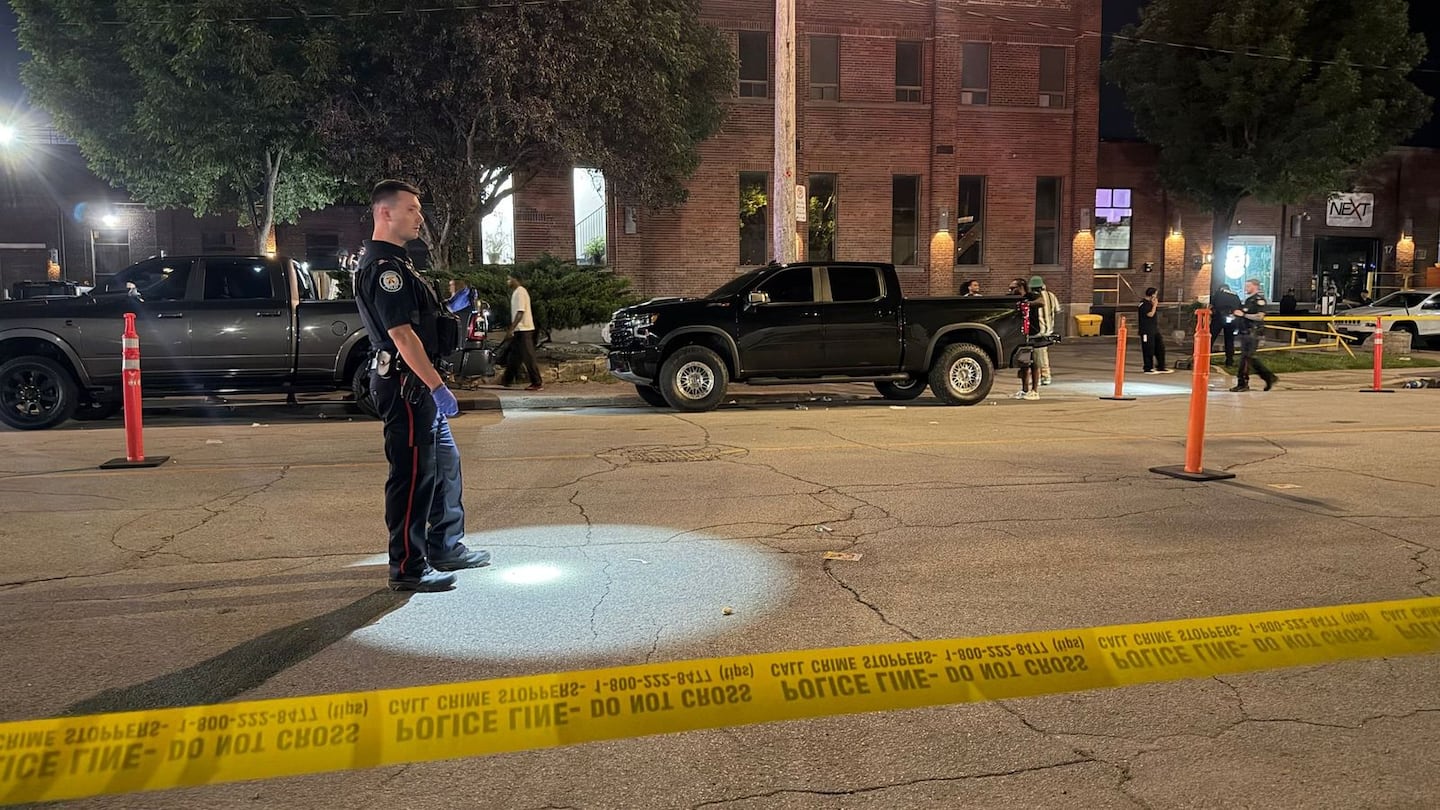
Police investigating after early
morning shooting near Polson Street and Cherry Street in Toronto on
Sunday July 12, 2026 (CP24 photo)
Toronto Police on Sunday announced that 25-year-old Omar Abdul Singateh was charged with reckless discharge of a firearm in connection with a 3:30 a.m. shooting outside the Rebel nightclub where he opened fire on the nightclub crowd, then ran over pedestrians in a stolen ride-share vehicle. This is the same man who had been arrested in a torture investigation last year and had been freed on bail.
The police report described a man opening fire on patrons leaving the nightclub, then hijacking a ride-share vehicle "that had customers on board".
In his getaway attempt Singateh "struck pedestrians and vehicles" with the four passengers trapped in the car with him. This at a time when he was awaiting sentencing for a home invasion and extortion case of singular brutality. Singateh and two other men broke into the home of a Montreal-area cryptocurrency entrepreneur in 2024. They beat and tortured their victim, forcing him finally to surrender to them $15,000 in cryptocurrency.
A remarkably violent weekend in Toronto has left communities on edge and anti-gun violence advocates calling for action. Still from video/CBC
Seven months ago Singateh was named in a U.S. indictment respecting a smuggling ring specializing in transferring over 100 illegal guns into Canada. Some of those guns are known to have been used in various incident of criminal activity. This, at a time when gun crimes in Toronto have been on a rapid increase; law enforcement crediting a surge of smuggled weapons entering Canada through the United States.
During a gang war outside a recording studio, 100 shots were fired. Of 16 distinct firearms used in the shootout, all had originally come from the U.S. Another charge against Singateh is that of "causing bodily harm" through dangerous operation of a motor vehicle, in addition to four counts of forcible confinement in reference to the ride-share passengers who were trapped in the vehicle that Singateh had hijacked in his escape bid following the chaotic gunfire at the Toronto Rebel nightclub.
"Non-life-threatening" injuries were sustained by those whom Singateh shot, or hit with the escape vehicle, while Singateh himself sustained "gunshot injuries" during the shooting spree. Simultaneous to the Rebel nightclub event other high-profile public shootings occurred in Toronto over the weekend. One being a "targeted" shooting during the city's Salsa event at the St.Clair street festival. There, two people were shot dead and four injured after two gunmen fired at one another, forcing crowds to flee the festival.
A fatal shooting at Salsa on St. Clair in midtown Toronto has raised
questions about how to keep street festivals safe in the city. (CBC)
"The point is, the location is not the cause of the violence. Period. A simple venue change for public mass
festivals is not going to address the gun violence problem."
"[Street festivals, with an open-air environment, are known as] soft targets [for criminal activity]."
"Basically, we try the best we can to make things as safe as we can [there was lots of visible security at Saturday's festival]."
"The
[amount] of adaptations to make a perfectly safe environment would
change the entire street."
Jack Rozdilsky, associate professor of disaster and emergency
management, York University
"It is alleged that these officers have demonstrated varying degrees of criminality and associations to criminal networks."
"We are alleging that some police officers were collecting personal and private information unlawfully and distributing it to members of organized crime, which ultimately resulted in serious harm in our communities."
"[Criminals sought and obtained] confidential information from various Toronto police officers. In some cases, police officers were offered bribes for this information."
Deputy Chief Ryan Hogan, York Regional Police
"In all, three officers and one retired officer have been charged with offences related to unlawful queries and the distribution of confidential, personal information."
"Four officers face bribery charges in connection to this operation."
"[A plan was uncovered to] support the operation of illegal cannabis dispensaries by accepting bribes to obstruct any possible enforcement action to be taken at those locations."
York Regional Police
"[This is] a painful and unsettling moment."
"I was not provided an opportunity to make investigative decisions [impacting] the speed and flow of the investigation."
Toronto Police Service Chief Myron Demkiw
From left to right: Toronto Police Service Chief Myron Demkiw, York
Regional Police Chief Jim MacSween and York Regional Police Deputy Chief
Ryan Hogan. The three men spoke at a press conference on Feb. 5, 2026,
to announce the arrest of seven Toronto police officers and one retired
Toronto officer.York Regional Police
An investigation of Toronto police officers of some months' duration was finally wrapped up when an investigation into a conspiracy to commit murder, led to the arrest of seven of Toronto's police officers and a retired officer. Ranging in age from 24 to 57 years, the officers were suspended from duty; in the case of four of those charged, suspension without pay is being sought in reflection of the serious nature of the charges.
One officer's charges include drug trafficking (MDMA, cocaine, Oxycodone, Adderall and Xanax) along with trafficking property obtained by crime, leading to a total of 17 charges. A total of eight charges were levied against another officer who faces charges including breach of trust and possession of a prohibited weapon. The investigation led as well to the arrest of another 19 suspects.
A conspiracy to murder a member of corrections management working at an Ontario facility was uncovered in June of 2025, which led to the investigation being initiated. Over a 36-hour period, suspects appeared at the targeted man's home on three occasions. Evidence is lacking, according to police, that the corrections member had been involved in criminal activity of any kind. Speculation is that his "commitment to integrity in his position" may have led to his being targeted.
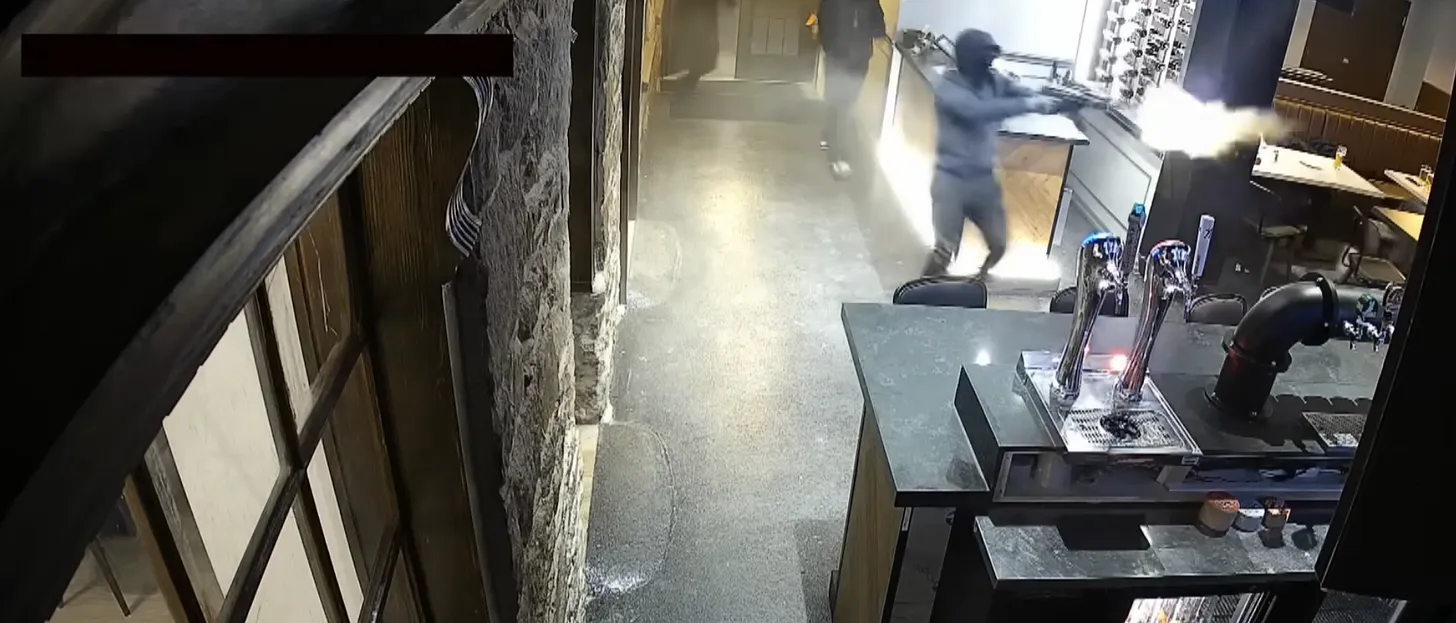
Security camera footage shows a gunman entering a Toronto pub during a
mass shooting in March 2025 that was linked to tow truck industry
violence. Toronto police arrested 10 people in connection with the
incident. (CBC News: The National)
Surveillance footage revealed three masked men returning to the residence armed with a loaded handgun, likely intending to commit murder. A vehicle was rammed by the suspects into a police cruiser where officers tasked to protect the victim were at the scene in response to discovering the man had become a target. It was there and then that the three suspects were arrested.
Police allege that a Toronto police officer had accessed confidential information unlawfully relating to the victim, giving it to a key figure within a criminal network who forwarded the information on within the network. At a later time, three other suspects who were part of the murder plot were also arrested. A number of serious criminal acts were identified by police which included seven shootings in York Region. A suspect could be seen shooting in residential neighbourhoods in one surveillance video.
Police uncovered a plan led by a key figure in the criminal network to "support the operation of illegal cannabis dispensaries by accepting bribes to obstruct any possible enforcement action to be taken at those locations". One of the criminals the investigation revealed was affiliated with the tow truck industry, long plagued with violence and extortion in the Greater Toronto Area linked to a turf war. Over $4.2 million in assets and over a dozen arrests took place in last year's industry crackdown.
Toronto Police Service Chief Myron Demkiw came to the defence of involvement by the Toronto police in the investigation, brushing aside allegations that it represented a conflict of interest since the investigation was led by York Regional Police. The charged officers represented four different divisions within the Toronto Police Service. The retired officer had been a member of the Emergency Management Unit. Arrested with him was his son, both suspects in the investigation of criminal activity.
John Madeley Sr. (left) and John
Madeley Jr. (right), the father and son accused in Project South, a
seven-month-long investigation into organized crime and corruption. CTV News
Canada's 'Safer Supply' Drug Addiction Mitigation Program
"We quickly assembled health-care teams to dish out and prescribe mass quantities of opioids and it wasn't very long until gangs infiltrated the hotels."
"These are disabled people. Old people. Little women. So very early on, we knew it was happening."
"My colleagues have had some high-profile overdoses -- a 12-year-old and a 14-year-old, fatally over-dosed. We've never seen kids that young overdosing before."
Dr. Caroline Ferris, front-line addiction physician, Victoria, British Columbia
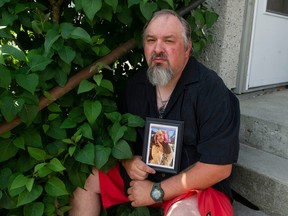
Greg Sword with a picture of his 14-year-old daughter Kamilah, who died of a drug overdose last August.Photo by Jason Payne /PNG
"As in many Canadian cities, the pandemic created a homelessness crisis in Victoria, which lead to the rise of several dangerous encampments, whose residents were eventually relocated to hotels that had been converted into supportive housing."
"At first, Dr. Ferris thought it was beneficial that dirt-cheap, diverted hydromorphone was flooding into Canadian communities, as she assumed that it would mitigate fentanyl consumption. However, Dr. Ferris said that 'it hasn't really gone that way' and that diverted hydromorphone is going to youth and to 'regular Joes who would never use opioids unless their colleague was offering them one for a buck a pill'."
"She now believes that it's 'a bit facile' to argue that hydromorphone diversion mitigates fentanyl consumption, especially given the increasing number of fentanyl overdoses in British Columbia."
"Though safer-supply advocates claim that the strategy's critics are merely fringe voices, Dr.Ferris said that half of the health-care professionals she knows have been 'passionately lamenting this since the start of the pandemic'.
Adam Zivo, Investigative Journalist, National Post
Canada's 'safer supply' drug strategy has come under some intense scrutiny of late, and deservedly so. Front-line addiction physician Dr. Caroline Ferris prescribes safer supply hydromorphone, an opioid more potent than heroin, where she works in community settings in British Columbia's capital city, Victoria. The idea behind safer supply was to reduce the incidences of overdoses and deaths. British Columbia has been experiencing an alarming increase in both.
Making free pharmaceutical opioids available to drug users was seen as an attractive and life-saving alternative to street drugs which could be tainted with, for example fentanyl and carfentanil, two potentially deadly drugs mostly manufactured in China, entering the illicit market to capture ever increasing numbers of users as merchants of death, drug dealers, bring it to the streets and adulterating less potent drugs with the potentially lethal products.
Dr. Ferris initially was taken with the thought that progressive drug policies inclusive of drug legalization would be of benefit. It was during the coronavirus pandemic when the initiative was taken to increase safer supply across the country that she began to have second thoughts. She would be informed by vulnerable patients their experiences of gang members confiscating their drugs. And so it became understood within the profession that criminals were acquiring hydromorphone and shipping it across Canada.
Artwork about harm reduction adorns an appointment room at Parkdale Queen West Community Health Centre in Toronto. Laura Proctor for STAT
Now, she and some of her colleagues meet to discuss the issue, all of whom are "concerned by the number of youth using hydromorphone, or who started with it and then moved on to fentanyl." Youth whose ages between 12 and 14, are "unprecedentedly young". The number of patients of all ages also alarms Dr. Ferris for those who have relapsed or have developed new addiction issues resulting from hydromorphone use. She conducted a survey of her patients to discover that of 41 current patients requiring assistance for opioid use disorder five used hydromorphone alone, but another ten were using hydromorphone along with another drug.
She has seen and recognized some benefit to the safer supply program among patients in the early stages of recovery-oriented treatments, like methadone. Because many patients expect they will receive hydromorphone in perpetuity, however, they occasionally become abusive when informed they must discontinue the drug once it has performed its required function to bring them to the next stage of recovery.
As well, patients suffering from chronic pain and who as a result of prescribing restrictions cannot access the opioids they need for pain-free living, can benefit from safer supply. "True" safer supply for fentanyl users requires pharmaceutical fentanyl options, she feels, which should be provided with caution. A very limited model of safer supply differing dramatically from the grossly irresponsible 'one-size-fits-all' in use in Canada today, has its attractions. The current safer supply, she feels, represents an inadequate solution for chronic pain management, and the diversion crisis must be addressed since it serves to add fuel to the opioid epidemic.
“We
know that there has been an issue with diversion, but we really do
believe that safe supply is an evidence-based approach in saving lives,”
insists Minister of Mental Health and Addictions Carolyn Bennett. Photo by Darryl Dyck /The Canadian Press
"The anecdotal evidence precedes the data collection. Somebody sounds an alarm and then we collect data. With the OxyContin crisis and fentanyl, we in the field knew what was happening before there was data to support it."
"It's disrespectful to discount our observations."
"It's disrespectful to ignore the concerns of prescribers and communities who see this happening."
"A lot of these folks are, in fact, older people who have chronic pain conditions and have been de-prescribed due to fear from our professional college [as a result of onerous prescribing restrictions implemented after the OxyContin crisis], or they've lost their family physician and can't find anybody to prescribe, because, of course, the optics of going around to clinics and asking for Dilaudid [hydromorphone] are very poor."
Dr. Caroline Ferris, front-line addiction physician, Victoria, British Columbia
Booths for supervised consumption services. Laura Proctor for STAT
"Mr. Cugliari is believed to be a made member of the 'Ndrangheta [accused of] Mafia-type association, fictitious ownership of assets as well as a robbery of (pounds)220,000 committed with the use of weapons, in collaboration with other individuals, against a bank branch in the province of Vibo Valentia."
"Canada is one of the strongholds of the 'Ndrangheta, along with countries such as Germany, Australia and the United States."
"Every time we investigate, there is some reference to Canada, where clans associated with the Calabrian Mafia have been operating for decades. Canada is a place to take refuge, but above all a place to invest the proceeds of illegal activities and manage shipments of cocaine bound for Europe."
Nichola Gratteri, anti-Mafia prosecutor, Italy
"Among the defendants there are also law enforcement officers, politicians, professionals, and entrepreneurs."
"It is important to remember that external relations have always been the backbone of Mafia power."
"This trial, in terms of the number of defendants, is second only to the maxi-trial in Palermo [in the 1980s]."
Antonio Nicaso, specialist on the 'Ndranghet, Queen's University, Kingston, Ontario
Domenico Cugliari was arrested after arriving in Rome from Toronto on Tuesday.Photo by Interpol
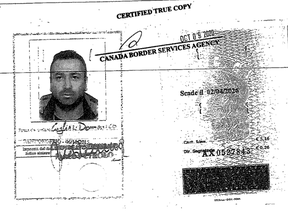
Domenico Cugliari, 40 years of age, was deemed to be a member of a powerful Mafia organization, hiding in Canada while slated to stand trial at the largest anti-Mafia mega-trial in a generation. Identified at one time as a fugitive, arrested in 2020, he had claimed refugee protection on the basis of facing persecution by the Italian state. This was his defence at immigration hearings and court challenges. While Italy awaited the man's repatriation, to stand trial for criminal actions.
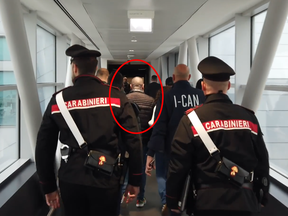
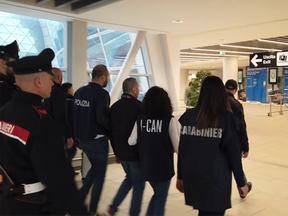
Finally, the Canadian justice system got around to deporting Cugliari and when the Air Canada jet arrived in Rome an honour guard of nine police officers awaited him as he deplaned, reaching out as the airplane door opened, prepared to grab this most-wanted passenger. After a three-year wait. His arrest at the airport was deemed to represent "the end of a complex administration procedure".
In charge of the mega-trial known as Operation Rinascita Scott, Nicola Gratieri, a crusading anti-Mafia prosecutor, advised that the reluctant returnee will join his Mafia colleagues in court. The 'Ndrangheta which began life in Calabria in the boot of Italy, has become so notorious it managed to eclipse the Cosa Nostra of Sicily, becoming one of the world's wealthiest, most powerful crime groups.
Domenico Cugliari is a relative minor figure among those swept up in the wide Operation Rinascita Scott. 'Ndrangheta bosses have used Canada as a hideout for decades, living among friends and family many of whom are citizens of Canada; others are avoiding prison or rivals back in Italy, and they congregate in the Toronto area. In Sant'Onofrio, Cugliari's hometown, Italian police describe him as a "close" and "serious" member of the Bonavota clan, one of many alternately feuding and co-operating within the 'Ndrangheta.
Domenico Cugliari escorted through the airport in Rome.Photo by Interpol
He acted as a "postman", tasked to deliver messages between mobsters, frequently doing so while visiting them in prison. According to Italian police he made company with senior members of the Bonavota clan. He was tangled up in an illegal cannabis plantation, caught there in 2015, while claiming the 800 plants were for his personal use. Members of his clan, the Bonavota, have had residence in Ontario for 15 years, trusted and respected by senior mob bosses in Toronto.
Mr. Cugliani had applied online for a visitor's visa to Canada, approved the very day, arriving at Toronto's Pearson airport on November 28, 2018. He made it his business to return on a number of occasions, evading a series of police raids that swept his home province of Vibo Valentia. Hundreds of mobsters and associates were arrested in Operation Rinascita Scott. Listed on Italian arrest warrants, Mr. Cugliari was absent during the raids, living quietly in Canada.
He marrid a Canadian woman in 2020 whose family was also from Sant'Onofrio. They lived in a modest bungalow in north Toronto. The RCMP was informed of an Interpol Red Notice for him at the time of his wedding, alleging membership in the 'Ndranghetaaa. A Red Notice signifies an internatnational request for police agencies globally to detain a wanted suspect.
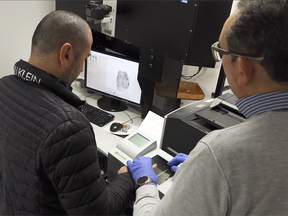
Domenico Cugliari gets fingerprinted at the airport in Rome. Photo by Interpol
The RCMP's search came to nothing. Canada Border Services Agency (CBSA) at the same time opened an investigation into whether Cugliari was legally allowed to remain in Canada, deciding ultimately he was not. As Cugliari was leaving his Toronto home in September 2020, he was arrested by CBSA and Toronto police. That very day the Immigration and Refugee Board ordered him held in custody as a danger to Canada and a flight risk, he made a refugee claim for protection in Canada from the Italian government.
"I find it peculiar that Mr. Cugliari, up until his arrest, did not seek asylum in Canada, if he had a genuine fear of returning to Italy."
"Only now that he has been caught, has he hinted that he is afraid to return home."
CBSA officer file
He was ruled inadmissible to Canada due to organized criminality in November of 2021 despite his tstimony that he was not a part of the Bonavota clan nor a member of the 'Ndrangheta after he was released on bond following a lengthy immigration hearing. Weeks later his refugee claim was rejected. Which led him to appeal to the Federal Court of Canada, challenging both decisions. His appeals were rejected by a Federal court judge on February 23, 2023.
"Everyone ordered to be removed from Canada is entitled to due process before the law, and all removal orders are subject to appeal and procedural fairness."