Ruminations

Blog dedicated primarily to randomly selected news items; comments reflecting personal perceptions

Thursday, June 11, 2026

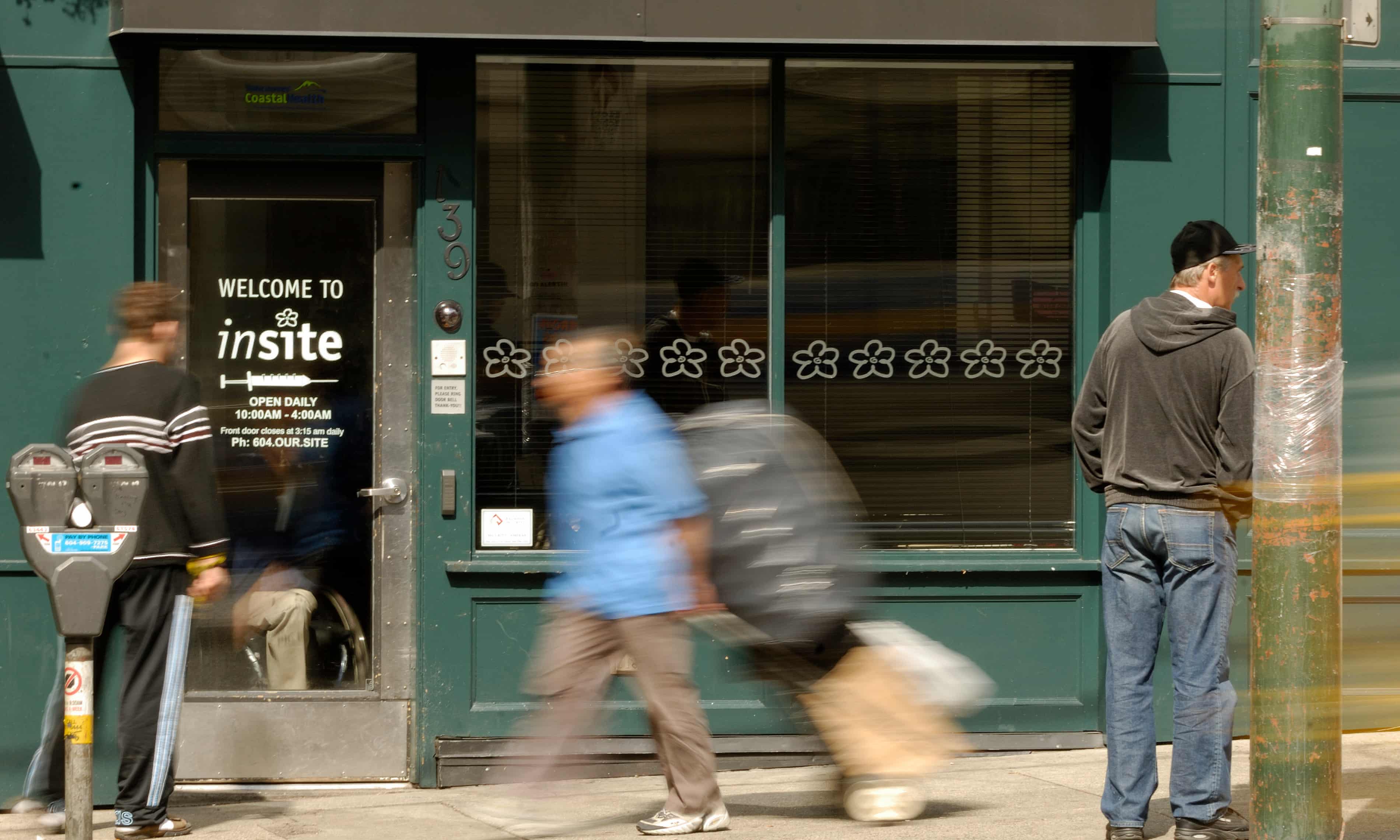
In Canada, Safe Consumption Sites, Children Under 16

"If the Liberals' proposed digital safety bill passes as written, Canada would enter a unique legal environment in which its minors would be barred from accessing social media, but would still be able to inject illicit drugs at a government-run safe consumption site."
"Thus, Canadian 15-year-olds could soon face a regime in which they are not allowed to use Facebook, but could face no barriers to injecting fentanyl at a government-run facility."
"The relatively easy access of harm reduction services to Canadian minors stands in contrast to a growing number of areas in which authorities are looking to impose ever-tighter age restrictions, a federal social media ban being only the latest example."
Tristin Hopper, Journalist, National Post 
 
"Youth under 19 years of age can access harm reduction supplies, naloxone, overdose prevention services, and, in appropriate circumstances, witnessed consumption by a regulated or nonregulated health or social service provider, without a capacity assessment."
"[If minors were to be denied access to supervised drug consumption, it risked creating a] lasting imprint on the relationship between the youth and the health system." 
"[Children were cleared to use drugs at] nonregulated [facilities, even] without a capacity assessment."
British Columbia Medical Journal, 2023 paper 
https://i.cbc.ca/ais/1.3572057,1709489233000/full/max/0/default.jpg?im=Crop%2Crect%3D%28263%2C34%2C1654%2C955%29%3BResize%3D796

The Sandy Hill Community Health Centre on Nelson Street opened a supervised consumption site in 2018. (CBC)

Heaven forfend that underage children -- facing a concerned health system that denied them free-and-easy access to recreational drugs to speed them along the passage from youthful curiosity to hard-core drug use, a life of unregulated indiscipline, the incapacity to hold down a job, live a normal life, facing the potential for homelessness, criminality and poverty -- end up resenting a federal health authority from roadblocking them from the full realization of negative future prospects.
 
In woke societies, which Canada has become, it is wrong and socially inept leading to great harm in self-esteem to deny youth the intriguing opportunities to explore new horizons in an atmosphere, current and growing, where recreational narcotics are cool, and 'everyone' does it, so why not me? In households where parents too, value the use of soft drugs to enhance their lives, it is only natural that their offspring gravitate to similar habits. Presuming that adults can be more cautious and observe limits, it's unlikely that children are imbued with a similar sense of caution, with curiosity impelling them toward 'enhanced' trips into the promised world of deep self-exploration.
 
https://i.cbc.ca/ais/1.5896676,1684427110000/full/max/0/default.jpg?im=Crop%2Crect%3D%280%2C73%2C1402%2C788%29%3BResize%3D860
Hydromorphone, a type of opioid, is pictured at a managed opioid program in Ottawa, Ont. Most patients who take prescription opioids such as hydromorphone or fentanyl patches in B.C., will have to do so under the supervision of a pharmacist or health professional. (Ashley Burke/CBC)
 
"Supervised consumption services save lives and benefit communities. Supervised consumption sites provide a safe, clean space for people to bring their own drugs to use, in the presence of trained staff. This prevents accidental overdoses and reduces the spread of infectious diseases, such as HIV."
"Supervised consumption sites may offer a range of evidence-based harm reduction services, such as drug checking. The sites also provide access to important health and social services, including substance use treatment for those who are ready."
Government of Canada 
"If someone comes to the [safe consumption] site looking for help and a place to be supported when they're using a substance, there is no requirement for ID", stated Health Canada official Kendal Weber, affirming no age limit for service at safe consumption sites. Canada's supervised drug consumption clinics were pioneered as a social welfare experiment in British Columbia. The rationale behind the sites was well-intentioned; for government to step in with a social solution to the growing epidemic of drug overdoses that became a public menace with the introduction of fentanyl flooding Canadian streets.
 
"In B.C., there is no set age when a child is considered capable to give consent. This means there is no legal age limit for youth to access harm reduction services", an information sheet by Interior Health, part of the provincial government's health authority, states. And nor is parental consent sought when servicing the perceived needs of an underage person. The use of the sites was diversionary as well as ostensibly geared toward protecting the vulnerable. With drugs and paraphernalia available free of charge to users there would be no need for them to seek out more harmful drugs than what was available free.
https://harmreduction.org/wp-content/uploads/2020/07/SupervisedConsumptionSites-01-1024x819.png
Harm Reduction Coalition
 
What was eventually revealed is that drug users all too frequently eschewed the use of the free drugs like hydromorphone. It wasn't long before the free drugs were being sold in the street, the profit used to buy fentanyl instead. In Quebec there is a policy of distributing free syringes, snorting straws and allied drug equipment for children as young as 14, through its harm reduction sites. "People who wish to obtain drug injection equipment do not need to register anywhere, consult someone to get a referral or have a Quebec health insurance card", an official guide states online.
 
That same guide alerts users under 14 that though ID is not checked for access to "safe drug use equipment", young users are expected to "meet with a healthcare professional in order to access new consumption equipment". As an accompaniment to the distribution of drug use equipment, a healthcare worker will carefully explain to the 14-year-old how best to use the equipment; how very convenient, assuaging the conscience of those that make the rules that children whose parents are not notified are being taught nonetheless best-practise in the use of drug paraphernalia.
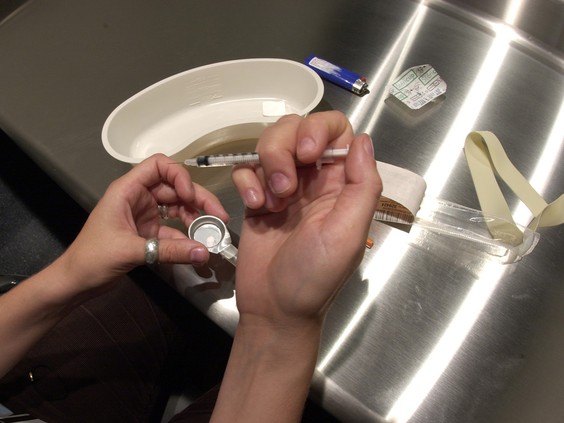
 
https://smartcdn.gprod.postmedia.digital/nationalpost/wp-content/uploads/2026/06/injection-site.jpg?quality=90&strip=all&w=564&h=423&type=webp&sig=hiOP8OTDtZW4wX9W3ti4Gw
A client shoots up drugs at a safe injection site in Vancouver. Photo by Handout/File


Labels: , , , ,

Wednesday, December 17, 2025

Cornering the World Market on Fentanyl : Beijing's Industrial Complex

"We're looking to collaborate with China, because it's not an indictment against the Chinese government, per se."
"It's companies, chemical companies in China, that are engaged in this kind of conduct -- and the Chinese government has taken a lot of action in terms of regulating and prohibiting various [fentanyl] precursors."
"There's very little north-south movement of produced fentanyl across the borders [U.S./Canada/Mexico]."
"Even if [there's 0.01 of a pound or percent going across, my uber-focus -- while I suppose to a degree aspirational -- has been to lower that to zero, and to eliminate fentanyl the best as I can from a supply perspective, but also reduce demand in this country."
"[U.S. officials expressed] strong acknowledgment of the efforts being made and encouragement to continue on this path [tackling fentanyl, if not necessarily] satisfaction." 
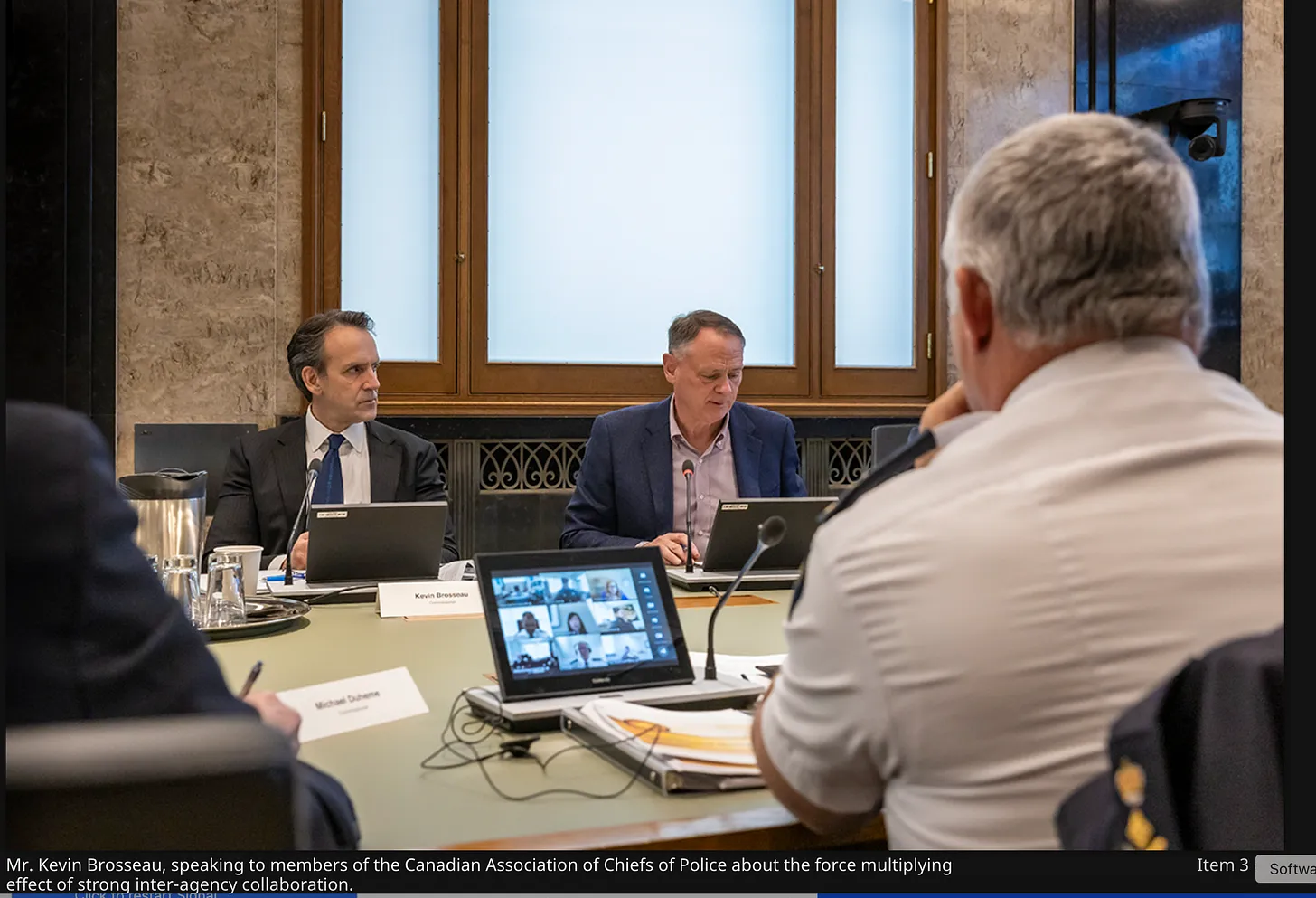
Kevin Brosseau, Liberal government 'fentanyl czar'
https://substackcdn.com/image/fetch/$s_!ImwC!,w_1456,c_limit,f_webp,q_auto:good,fl_progressive:steep/https%3A%2F%2Fsubstack-post-media.s3.amazonaws.com%2Fpublic%2Fimages%2F47dbc55f-4600-414f-89d8-53886fbb499d_2434x1660.png 
 
In line with Canadian Prime Minister Mark Carney's plan to visit China next year to confer with President Xi Jinping over trade issues primarily linked to poisoned diplomatic relations over the past several years when Beijing's hostage-diplomacy went a long way to alienating its regard in Canada, along with China's penchant for industrial piracy and cyber espionage as well as blatant interference in Canadian politics, a move is underway to collaborate with China for the purpose of putting a halt to the chemicals pouring into Canada used in the production of the synthetic opioid that has caused an overdose epidemic in Canada. 
 
Under successive Liberal governments, business and trade with China has always been seen as a high priority. This, despite China's investing in Canadian universities to launch China-friendly studies, and its record of criminally taking possession of industry and government blueprints to enhance and speed China's own industries at a cost to those whose successful systems, mechanisms and techniques made them world leaders in the world of  high tech. The end result has been China perfecting its rival industries and those from whom production expertise was surreptitiously taken saw their own collapse.
 
Canada's liberal governments were always able to overlook these inconveniences in favour of smoothing over differences and getting on with what they considered to be the more important work of benefiting from trade and cooperation with the world's industrial colossus. Years ago the United States managed an agreement with Beijing to help ensure that opioid-type drugs and their chemical precursors would be monitored in an effort to stop the carnage in human lives they cause as they flood into the West. The situation has persisted and continues to take its toll.


To believe that the Chinese Communist Party is incapable of fully controlling the flow of fentanyl and its precursors produced by chemical producers in China, is to disregard the total control it has over its industries, many of which have direct ties to the government or to the Peoples' Liberation Army. China monitors its population carefully and closely, thanks to face recognition technology and the ubiquitous presence of closed circuit cameras and apps Chinese must download to their iphones. To assume it has little knowledge of fentanyl production and trade is naive. It is just another industrial production that Beijing nurtures in control of a lucrative market.
 
The punitive tariffs that the Trump administration has slapped on trading partners throughout the world has made strange bedfellows in any event. U.S. President Donald Trump, in his insistence that the United States would no longer be taken advantage of through what he claims is uneven trade, has upended the world economy as a struggle ensued to plead for a more moderate tariff toll on those who consider themselves allies of the U.S. who have been  hit just as hard as those the United States considers adversarial countries.
 
https://www.lowyinstitute.org/sites/default/files/2025-11/54890669668_9f11288970_k.jpg
Donald Trump in talks with Xi Jinping (Daniel Torok/White House Photo)
 
Citing illegal migration crossing the border from Canada into the U.S. as well as large fentanyl shipments entering across the border, the tariffs imposed on Canada as punishment for presumed laxity in those areas has been a stinging blow. Seizures of fentanyl at or close to the border with the U.S. are minuscule from Canada, averaging 3.5 pounds monthly over the past three years. In comparison those drug seizures with Mexico averaged slightly over 1,500 pounds per month. But even 3.5 pounds of a deadly opioid has catastrophic consequences. 
 
Citing China as "the primary source country for illicit fentanyl precursor chemicals" as well as pill-pressing equipment, U.S. intelligence agencies named India as second in line; the drug itself, acknowledges Brosseau, is produced now "largely" within North America. Adding that the US. produces its own fentanyl as well as what comes across its border from Mexico. Canada, on the other hand, is responsible for its own fentanyl production. In the background, President Trump signed one of his famous 'executive orders' classifying fentanyl as a "weapon of mass destruction".
 
https://www.lowyinstitute.org/sites/default/files/styles/interpreter_article_image/public/2025-11/GettyImages-2234387567.jpg?itok=uYe1yPYW
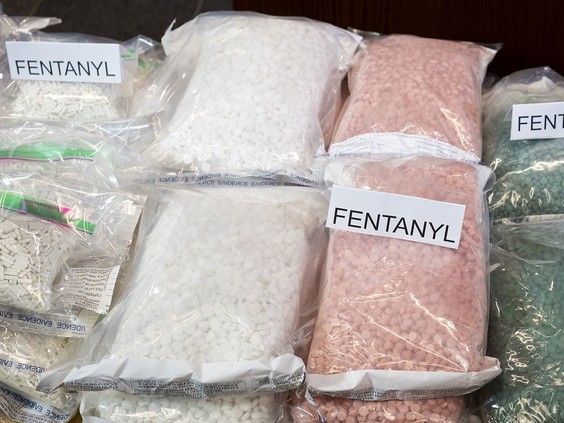
Barrels of fentanyl production precursor materials displayed to the media in Pasadena, Ca, September 2025 / Getty Images 
 

Labels: , , , , , ,

Saturday, August 02, 2025

Child Deaths in Addiction Households in Canada

"As a pediatrician of 38 years, I beg to differ [with the contention that a child's best place is with the family]. I think it's usually with your family ... In many cases, sadly it is not."
"The opiate puts you to sleep and convinces your brain to stop breathing. It doesn't take much. It doesn't take gram quantities to do it."
"With opioid overdose, you don't die right away -- I think they put the baby down, thinking it was going to be OK, they went to sleep and woke up, and everything wasn't OK."
"I think because of resource constraints [underfunded child welfare services] children are often in situations in which they might be potentially in harm's way."
"Addiction is a horrible disease. It wires you badly. People in drug-using homes in drug-using circumstances, make decisions that do not seem rational. They do it because the addiction drives them."
Dr. Michael Rieder, pediatrician, professor, Western University Schulich School of Medicine and Dentistry, London, Ontario 
 
"When you have an unexplained drug toxicity in a child, you just can't always say whether it got into them accidentally because of something somebody did, or was there intentional provision of that substance to the child."
"It's very difficult to answer those questions at times."
Dr. Dirk Huyer,  chief coroner, Ontario 
https://smartcdn.gprod.postmedia.digital/nationalpost/wp-content/uploads/2025/02/fentanyl-drugs-seized-surrey-british-columbia-police-web-e1753111034804.jpg?quality=90&strip=all&w=564&h=423&type=webp&sig=vReMEG8YAIqSA5BM2kWGbw
Fentanyl recently seized, displayed during a press conference at BC RCMP Divisional Headquarters in Surrey, B.C., Friday, Feb. 23, 2024. Photo by Tijana Martin/The Canadian Press
 
 Ten fatal opioid poisonings in children under ten in Ontario over a four-year span was the subject of a recently published review which detailed the youngest of the fatalities was just nine months old and the oldest close to five, published in the journal of the Canadian Paediatric Society, Pediatrics & Child Health. What the review discovered in research carried out by Dr. Rieder and his colleagues was that with every case before the child's death from ingesting an opioid, child welfare services were involved.
 
One American study of 731 fatal drug poisonings in children five and under across 40 states, found one-sixth only had a history of open child protection service at time of death. Opioids accounted for close to fifty percent of the deaths. Leading Dr. Rieder to contemplate the old adage, respected by child welfare workers that a child's best place is with the family. "Societies get  judged by how they take care of their kids. This is not a good judgement on us", he remarked.
 
Adults account for most fentanyl -- and other opiate-related deaths, with an average of 20 such deaths a day in Canada, but it is the "staggering effect" on pediatric mortality known as child deaths, that has been overlooked, reported Dr. Rieder and his colleagues. Who pointed out that fentanyl kill babies and young children in the very same manner that it does adults. 
 
The drug acts on the body's central nervous system, causing sedation and euphoria. When the dose is of sufficient quantity, breathing slows, along with the heart rate, and as breathing slows, the body's cells become stressed from oxygen lack and carbon dioxide buildup. "Eventually the heart just packs it in and says, 'Enough is enough. I'm going to stop'", stated Dr. Rieder. The difference between an adult overdose and that of a child is obvious; for the child all it takes is a trace amount of ingested fentanyl to cause death.
  
 
The study group made use of anonymized data acquired from the Office of the Chief Coroner of Ontario; scrutiny of case notes were studied in an effort to understand the circumstances surrounding such deaths to improve the potential for intervention and aspire to prevent more children from dying, wrote the study authors. The primary drug of toxicity in the study was found to be either fentanyl alone, or in combination use with other drugs.
 
Fentanyl was found in the child sleeping or play area, with the common explanation that the child was discovered to be unresponsive after being settled down for a nap. In the youngest infants' instance, drug powder may have contaminated baby formula, ventured Dr. Rieder. The study's first author, Dr. Katrina Assen, pediatrician at the Alberta Children's Hospital in Calgary, pointed out that most childhood opioid deaths historically came by way of prescription medications. "Now we're switching to fentanyl."
 
Households where these deaths occurred were often small, cramped, disorderly, cluttered and untidy -- with often five people on average living in them. The mean age of the deceased children was under two, a particularly "exploratory age" when children move from age two to age four and "climb anywhere and eat everything", pointed out Dr. Rieder. 
  
https://www.schulich.uwo.ca/about/news/2024/img/Rieder_880x300.png
Researchers share recommendations for preventing opioid-related deaths among children. (Towfiqu barbhuiya/Pexels)
"[Should drug-associated material be found in a household], action by CWS [child welfare services] workers should be taken forthwith and followup visits [at a minimum education on safe drug storage be required] to ensure that these steps are put into place."
Research team report 
 
"If concerns are identified, CAS's [Ontario Association of Children's Aid Societies] will work with the caregivers to create safety/mitigation plans and monitor these until the risk is reduced to a level [where] child protection intervention is no longer required."
"For substance use issues these plans could be a number of things along a continuum of intrusiveness spanning from harm-reduction strategies to removal of children from the home and other legal intervention."
Ontario Association of Children's Aid Societies 
 

Labels: , , , ,

Monday, February 17, 2025

Pioneers in 'Safer Supply' British Columbia Benefits the Opioid Black Market

"Significant [quantities of] safer supply [opioids are being diverted to the black market with assistance of organized gangs and some unscrupulous health-care providers]."
"Taxpayer-funded 'safe supply' drugs are flooding the streets, enriching organized crime, in some cases with diversion fraudulently facilitated by pharmacies and medical professionals."
"A significant portion [of safer supply opioids are being diverted to the black market, where they are being trafficked] provincially, nationally and internationally."
Power Point presentation produced by British Columbia's Ministry of Health 
https://static01.nyt.com/images/2024/07/11/multimedia/00canada-overdose-01-vmcg/00canada-overdose-01-vmcg-superJumbo.jpg?quality=75&auto=webp
A memorial wall for people who died as a result of using drugs is featured inside the offices of the Vancouver Area Network of Drug Users, a nonprofit group. The New York Times
"The last six months of 2020 they dispensed 577,000 opioid pills. In the two years between 2022 and 2024, it was over 22 million. It's humiliating. How many people are living in British Columbia, for goodness sake?"
"We've got to stop calling things harm reduction. It's not proven."
"Is giving people giant buckets full of hydromorphone to dump into the community harm reduction? No. It's not proven to reduce harm. It's not evidence-based. It's an experiment."
"Of course we need to deal with kickbacks from pharmacies. Even if every pharmacy is on the straight and narrow, it would still be a problem. A huge problem."
"We're not talking about safe injection sites at all. You're giving dope to people who are addicted and they're not taking it. They're using it as a currency to buy street drugs and still put themselves at risk."
B.C. MLA Elenore Sturko
https://i.cbc.ca/1.5896676.1684427088!/cumulusImage/httpImage/image.jpg_gen/derivatives/16x9_1180/hydromorphone.jpg?im=Resize%3D780
Hydromorphone, a type of opioid, is pictured at a managed opioid program in 2019. The drug is among those whose prescriptions have dramatically increased in recent years. The province is investigating the diversion of a 'significant portion' of opioids. (Ashley Burke/CBC)

Part of a confidential report produced by British Columbia's Ministry of Health summarizing findings of a special investigative unit looking into the fallout of the province's initiative to react to the growing phenomenon of fentanyl overdoses leading to death that has swept Canada, and manifested hugely in British Columbia, has been leaked. Its findings discovered that the freely distributed hydromorphone that has been handed out to people addicted to opioids has flooded the streets, the result of that free hydromorphone being bartered for more potent fentanyl craved by drug addicts.
 
The cheaper and more freely available handout drugs on the streets have made their way into the hands of teenagers which has resulted in a growing use of drugs with occasionally fatal consequences for young people. Government agencies have denied that the 'safer supply' they have invested so heavily in relating to their open-minded search for a solution to the fentanyl black market, could be ending up on the streets in a black market bonanza. Yet reports from hospital personnel, police, and community investigators have all held the government to fault for a situation that really is imperilling a greater swath of the population, despite government denials.
 
Now, years after the accusations of government ineptness and malcompetence made the news, a leaked document -- that investigators have produced verifying the accusations -- has surfaced. Even before that, however, the government of B.C. came to a decision to curtail their experiment in 'harm reduction' through 'safer supply'. No longer able to deny that throughout this experiment, accidental deaths due to overdoses have increased, not diminished, and a wider net has been cast in the process, capturing a younger cohort in the drug spiral.
 
Within the presentation photos of diverted safe supply prescriptions still in their original packaging were included; evidently having been confiscated during vehicle searches by police. At least 60 British Columbia pharmacies were identified by the investigative unit as having provided prohibited paid "incentives" to clients, doctors and assisted living residences for the purpose of increasing their operating profits. 
 
https://smartcdn.gprod.postmedia.digital/vancouversun/wp-content/uploads/2025/02/0907-bi-qw-council-addictions-bi.jpg?quality=90&strip=all&w=564&h=423&type=webp&sig=WKvXF3OKFTn4nSlCv_3Fnw
 
A dispensing fee is charged for each prescription filled; in this instance billed to the provincial government. Up to three prescriptions a day can be dispensed for a single safer supply patient. Dispensing fees are around $10 each, so the potential for pharmacies to earn up to $11,000 annually for each safer supply patient served is a compelling temptation. Normal customers are worth around $120 in dispensing fees yearly. The obvious conclusion is that a single safer supply patient can result in more revenue than 90 others not related to safer supply combined, would produce.
 
According to the leaked presentation, some 'incentivized' patients may procure only one of their three daily prescriptions while diverting their extra opioids to the black market. Alternately, the pharmacy involved could fraudulently bill the province while failing to dispense the drugs, so that patients don't receive some or all of their prescriptions. Either way, extra opioids end up on the black market fueling organized crime and leading to an increase in drug use in the population. 

According to the presentation, between 2022 and 2024, some 20-million milligrams of hydromorphone (an opioid as potent as heroin) and 232,000 fentanyl patches were dispensed through safer supply, equal to 19 percent of all the hydromorphone and 13 percent of all the fentanyl patches dispensed during this period in the province.
 
https://i.cbc.ca/ais/1.7156186,1717224314156/full/max/0/default.jpg?im=Crop%2Crect%3D%280%2C0%2C1919%2C1079%29%3BResize%3D620
Some pharmacies are paying cash kickbacks to vulnerable patients in Vancouver’s Downtown Eastside to attract more business — years after crackdowns related to the practice.    CBC News
 

Labels: , , ,

Friday, February 07, 2025

British Columbia's Experimental 'Safer Supply' Flop

"A significant portion of the opioids being freely prescribed by doctors and pharmacists are not being consumed by their intended recipients."
"[Those opioids are being trafficked]provincially, nationally and internationally."
"As long as [safer supply] gives valuable things away for free, or for far below market prices, one should expect there to also be 'profiteers' wishing to profit by obtaining supply for resale."
Leaked B.C. document
 
"You can stand in front of just about any of these pharmacies that are involved in this -- usually close to the safer supply prescribing office -- and you can sit outside for five minutes and watch all kinds of transactions going down."
Addiction outreach worker David McEvoy
 
"We have noted an alarming trend over the last year in the amount of prescription drugs located during drug trafficking investigations, noting they are being used as a form of currency to purchase more potent, illicit street drugs."
RCMP spokesperson Cpl. Jennifer Cooper 

"We have been concerned about this increasingly polarized rhetoric that is not informed by evidence, that is not paying attention to evidence, as a matter of fact, and is sharing opinion or anecdote that, in fact, is clearly not defensible if you look at the data."
"[Hydromorphone was not] present in a significant number [of the bloodstreams of the roughly 200 people per month dying of overdoses in B.C.]" 
Former B.C. Chief Coroner Lisa Lapointe
https://i.cbc.ca/ais/1.7156186,1717224314156/full/max/0/default.jpg?im=Crop%2Crect%3D%280%2C0%2C1919%2C1079%29%3BResize%3D620
Some pharmacies are paying cash kickbacks to vulnerable patients in Vancouver’s Downtown Eastside to attract more business — years after crackdowns related to the practice. Still from video
 
For years health officials in British Columbia dismissed concerns expressed relating to freely handed out opioids to drug addicts through 'safer supply' outlets, in a program designed to charitably provide a product considered safer than street opioids, in an effort to wean people off more dangerous drugs like fentanyl in response to an epidemic of deadly overdoses. Those overdoses have occurred across Canada, but British Columbia remains the poster child of drug-induced accidental overdoses. 

Which is what led the government of B.C. to develop a ground-breaking system of 'safer supply', representing, since 2020, one of the world's most comprehensive such programs. Once the program was operational, sharp eyes began to notice a proliferation in the illicit street market of diverted opioids and it wasn't difficult to conclude that the giveaway drugs were being sold on the black market in exchange for more powerful drugs like fentanyl. 
 
And while the less dangerous drugs were selling on the street at very competitive prices, they lured teenagers into venturing into the temptation of 'trying them out', creating a new generation of drug users.
 
The evidence of diversion was clear, and investigative reportage delved into the problem, publishing their damning results; the larger availability of drugs flooding the marketplace thanks to 'safer supply' initiatives, doing far more harm to society broadly; in effect enabling addicts who spurned the lesser highs of hydromorphone for the attraction of infinitely more potent (and dangerous) fentanyl-laced street drugs. These were dismissed by the province's health authorities as unsubstantiated rumours and 'false news'. 
 
This week, however, the provincial Opposition Conservatives in the province released a leaked presentation that had explored the issue without prejudice, finding that those accusations of 'safe supply' boosted opioid availability at the street level, and leading in fact to more accidental drug overdoses rather than preventing them as intended, were indeed reflecting reality. The Conservatives labelled the issue of diversion, as evidence of "taxpayer-funded drug trafficking".
 
https://smartcdn.gprod.postmedia.digital/vancouversun/wp-content/uploads/2024/09/png-0502n-overdose-037.jpg?quality=90&strip=all&w=564&h=423&type=webp&sig=SwU4R5fpM3qvebKB1TNPlg

The undeniable evidence that the government health authorities had been apprised, despite their denials, even led B.C. Health Minister Josie Osborne to confirm that the claims about diversion outlined in the report were a reflection of reality, that the report's destination was intended for the attention of law enforcement. "These allegations are here. There's absolutely no denial of it. There's no diminishing of it, and there should be no acceptance of it."
 
The very direction of distributing free recreational drugs to addicts was meant for the purpose of weaning them away from illicit drug supplies tainted by fentanyl or heroin. "Safer supply services can help prevent overdoses, save lives, and connect people who use drugs to other health and social services", an official Government of Canada policy backgrounder explained. 

In the years from 2022 to 2024, 19,751,000 mg of hydromorphone was handed out representing safer supply equivalent to 2.5 million 8-mg pills, while 1.4 million mg of oxycodone was also distributed, equating to 70,000 20-mg pills. When the program was initiated, critics gave warning that users would end up selling their rations of 'safer sup' to use the profits from their sale to acquire illicit drugs. Which led to government-supplied drugs flooding the market and addicts gaining money to buy illicit drugs.
 
"We ... know that about 50 percent of the hydromorphone pills that we come across can indeed be attributed to safe supply", the Standing Committee on Health was told by Vancouver's Deputy Chief Constable Fiona Wilson. Which did not deter drug policy advocates and government of B.C. officials from repeatedly insisting diversion was no problem; contending otherwise represented misinformation or political posturing.
 
https://i.cbc.ca/1.5896676.1684427088!/cumulusImage/httpImage/image.jpg_gen/derivatives/16x9_1180/hydromorphone.jpg?im=Resize%3D780
Hydromorphone, a type of opioid, is pictured at a managed opioid program in 2019. The drug is among those whose prescriptions have dramatically increased in recent years. The province is investigating the diversion of a 'significant portion' of opioids. (Ashley Burke/CBC)


Labels: , , , , , ,

Sunday, January 12, 2025

"One Dies and Ten More Addicts are Born ... We Don't Worry About Them"

"You inject this into a hen, and if it takes between a minute and a minute and a half to die, that means it came out really good."
"If it doesn't die or takes too long to die, we'll add xylazine."
Fentanyl cook 

"The illicit market gets much more benefit from its substances by cutting them with different things such as xylazine."
"You enhance it and therefore need less product, and you get more profit."
Alexiz Bojorge Estrada, deputy director, Mexico mental health and addiction commission
Mexico’s government on Dec. 3 announced the largest-ever seizure of fentanyl in Sinaloa state. The Sinaloa Cartel has been split by warring factions, but production continues. Omar H. Garcia Harfuch/Handout  via REUTERS
 
Cartel laboratories in Mexico are where the synthetic opioids that reach North American markets derive from. Those who are called 'cooks' mix chemicals to the point where they are felt to be acceptable for the street market; precision is not a prime consideration, whereas the cartel knows that the products that provide a big hit are; dangerous but totally effective, as far as the end-users are concerned and this is where their profits lie. 

Those who spend their time mixing chemicals in rudimentary cook sites, by default expose themselves to toxic substances, so much so that on occasion some cooks end up retching, then they pass out and occasionally die. University chemistry students are being recruited by the cartels to work as cooks. One of these students spoke to an undercover investigator revealing that drug users living on the street are sometimes brought in to test their formulas.
 
https://static01.nyt.com/images/2024/12/29/multimedia/29mexico-fentanyl-dispatch-1-ljqz/29mexico-fentanyl-dispatch-1-ljqz-superJumbo.jpg?quality=75&auto=webp
New York Times
 
Injecting them as guinea pigs with the synthetic opioid. "We've had people convulse, or start foaming at the mouth", the student said. No one has yet died in her experience she said, but bad batches have been responsible for bad outcomes. 

In Culiacan, Mexico, cartel operatives visit  homeless encampments, bringing with them syringes filled with the latest fentanyl formula, offering to pay those living at such camps up to $30, to those agreeable to allowing the experimental batches to be injected into them. There are times the operatives visit daily to watch as the drugs take effect; snapping photos and filming reactions to the drugs.

"When it's really strong, it knocks you out or kills you. The people here died", explained one of the homeless men who had volunteered himself repeatedly. The chemicals required to produce the opioid have become more difficult to access as a result of efforts to crack down on the synthetic opioid. Originally sourced from China, exports of the raw ingredients have now been restricted, leading the cartels to these risky new methods of maintaining production of fentanyl.
 
A member of the Mexican navy and a canine sentry patrol Mexico’s Port of Manzanillo last year. REUTERS/Daniel Becerril
 
This type of experimentation involves the drug being combined with a wide range of additives -- including animal sedatives and other anesthetics that can be dangerous. Testing the results they come up with involves injecting these mixtures into animals like rabbits and chickens, as well as human subjects willing to lend themselves as guinea pigs. According to a number of cooks, should the rabbits survive beyond 90 seconds, the drug is considered to be too mild for the American market. 
 
The U.S. government places the blame on fueling a synthetic opioid on the Sinaloa Cartel. According to one cook's explanation, he began recently mixing fentanyl with an oral surgery anesthetic. Another cook using a cartel safe house in Sinaloa State explained that if the batch was too insipid, he would add xylazine, an animal tranquilizer.

According to cartel members, drug users and experts, many users in North America look to access a particularly deadly batch they know will get them high. "One dies, and ten more addicts are born", one operative for the cartel said: "We don't worry about them".

https://www.reuters.com/investigates/special-report/assets/drugs-fentanyl-brokers/claudia-sheinbaum.jpg?v=030114040125
Mexican President Claudia Sheinbaum at the National Palace in Mexico City last month with a letter destined for Donald Trump. The U.S. president-elect has threatened steep tariffs if Mexico fails to stem a tide of drugs and migrants flowing north. Carlos Ramos Mamahua/Presidencia de Mexico/Handout via REUTERS

Labels: , , , ,

Friday, May 17, 2024

Reversing Drug Decriminalization in British Columbia

"Enough is enough. Common Sense Conservatives will not allow this devastation from this experiment to play out in other Canadian communities. Canadians deserve a government that will keep hard drugs out of hospitals and will protect staff and patients."
"Do British Columbians believe that someone should be allowed to smoke crack, meth and bring machetes into hospitals right next to patients who are trying to recover from cancer or a heart attack?"
"Or do they believe in my common sense approach that would ban the drugs, stop giving out tax-funded opioids and instead invest in treatment and recovery to bring our loved ones home drug-free?"
"The Safe Hospitals Act will stop some of the insanity that [Prime Minister Justin] Trudeau and the NDP have unleashed in our communities."
Pierre Poilievre, leader of the Parliamentary opposition Conservative Party, next Prime Minister of Canada 
https://i.cbc.ca/1.6736808.1675481763!/cumulusImage/httpImage/image.jpg_gen/derivatives/16x9_780/bc-decrim.jpg
Fentanyl is pictured during the first day of decriminalization of drugs in British Columbia on Jan. 31, 2023. The B.C. government is now significantly rolling back the pilot following months of public pressure and concerns over public safety. (Ben Nelms/CBC)
 
The leader of Canada's official opposition party in the House of Commons has committed to bringing into law a bill his party is set to introduce to prevent drug decriminalization "insanity", a year-old experiment in the Province of British Columbia that has resulted in a wild frenzy of public recreational drug use without penalty under the law, where drugs proliferate, endanger the lives of new young users when freely available government-sponsored drugs meant to wean addicts away from more dangerous opioids are being sold in the streets so the recipients of the free drugs can buy fentanyl.

The Safe Hospital Act set to be presented in Parliament would ensure that no exemptions are granted under the Controlled Drug and Substances Act in response to a phenomenon where hospital staff in British Columbia are advised they must not confiscate drugs brought into hospitals by addicts admitted for health care, nor the weapons they may also bring with them; to be regarded as 'personal effects' and left in the possession of those patients. Open drug use in those hospitals now runs rampant, and so do incidents of violence.

Bill C-321 includes a sentencing aggravating factor against assaults committed by those patients against health-care workers or first responders, along with tougher punishment should a weapon be brought into a hospital by a criminal. The situation in British Columbia has engendered a backlash of opposition and outrage from British Columbians, to the extent that the provincial premier of the NDP government, David Eby, sought a reversal of the approval he was granted last year for decriminalization.

That reversal would return the status quo to once more make public drug use illegal in public spaces; in effect the decriminalization pilot project has been an abysmal failure. The health and safety of nurses, hospital staff and other patients were placed at risk by patients openly using drugs across the province's hospitals. A leaked memorandum reflected the situation that nurses in the Northern Health Region where nurses were ordered not to confiscate patients' belongings including drugs of weapons.

In the wake of British Columbia's attempts at decriminalization, the City of Toronto requested a similar exemption in forwarding an application for decriminalizing small amounts of hard drugs. Ontario's Premier Doug Ford is adamantly hostile to granting the now-two-year-old-and-waiting request by Toronto. And the federal government has made it clear that without the support of the provincial government to permit this exception for Toronto, permission would be withheld.

In 2021 Montreal too passed a motion calling on the federal government to decriminalize certain drugs. Accidental deaths caused by the powerful fentanyl used to lace other drugs and sold on the street have harvested the lives of far too many drug users, to the extent the deaths have become a national emergency looking for avenues of deterrence.

https://i.guim.co.uk/img/media/06745d0f2be34ca5b51c731a713d11b1b90a67eb/0_193_3872_2323/master/3872.jpg?width=1900&dpr=2&s=none
A safe injection site in Vancouver, where drugs will still be permitted following the ban. Photograph: Christopher Morris/Corbis/Getty Images

Labels: , , , ,

Sunday, October 01, 2023

And The Solution to the Scourge of Drug Addiction Is .... ?

"We are regularly seeing and hearing in our practices that diverted hydromorphone is causing harm to both adults and children."
"We call on the government to ensure that all hydromorphone prescribed to people with opioid addiction is provided in a supervised fashion or that funding be ceased for the current harmful practice."
"[The] Unsupervised Free Government Funded Hydromorphone [is] causing further harm to our communities by increasing the total amount of opioids on the streets and providing essentially unlimited amounts of opioids to vulnerable people with addiction."
"As a result of this practice, we are witnessing new patients suffering from opioid addiction, and additional unnecessary overdoses and death."
Open letter to government of Canada from 17 addiction specialists
https://www.reuters.com/investigates/special-report/assets/baby-opioids-pennsylvania/overview-video.jpg?v=322416211117
A Reuters investigation found 110 examples of children whose mothers used opioids during pregnancy and who later died preventable deaths after they were sent home from the hospital. A federal law meant to protect those children has largely been ignored by states across America.
 
"What is killing people is an increasingly toxic and unpredictable drug supply... The idea in giving people an alternative to that, that is predictable."
"It's not as if our field is in disarray, in disagreement around sort of the more conventional treatment of addictions."
"This is a very specific item which has a lot of controversy associated with it."
Dr. Paxton Bach, co-medical director, B.C. Centre on Substance Use, addiction medicine physician, St.Paul's Hospital, Vancouver
A person injects an opioid at a Vancouver clinic.
A group of addiction physicians called on the Liberal government to ensure that safe-supply drugs are either not provided entirely, or if they continue to be provided for drug-addicted people, it be in a supervised manner. This, given accounts of people addicted to drugs visiting safe-supply outlets that provide them with free hydromorphone to ensure they have an alternative to the vastly more preferred street-acquired illegal fentanyl which has been implicated in an epidemic of drug overdoses.

The problem has become that those receiving the hydromorphone use it as leverage on street markets by selling it to others and using the profit they gain by so doing, to acquire the more desired fentanyl, thus entirely negating the purpose of the safe supply function, and in the process making more drugs available on the street. Hydromorphone availability has been cited as the cause of inciting more youth to become addicted to drugs, among other untoward consequences.

The pharmaceutical-grade hydromorphone made easily available through the street clinics as a method of reducing drug overdoses from heroin or fentanyl has backfired, the government-funded program of ten pilot projects in British Columbia, Ontario and New Brunswick has simply created a wider and more complicated system of drug use. Despite that a report in the Harm Reduction Journal in June of 2023 concluded enrolment in safer-supply programs leads to "fewer overdoses and overdose-related deaths, reduced drug-related harms, and improved health and social outcomes".

Angelica Richardson McKenney feeds her daughter Lynndaya in December 2012. The snapshot was taken the day before McKenney, high on a trio of drugs, fell asleep on top of Lynndaya and suffocated her. REUTERS/Handout
 
Not, however, in the opinion of critics claiming the programs have led to a number of other problems being created. The letter's authors argue that research of safer supply is "methodologically weak" and the program should be reformed or altogether cancelled. Author of the letter, Dr. Rob Cooper, spoke of a patient receiving safe supply treatment: "She's now dead. She was selling the hydromorphone she was getting and she was buying fentanyl. The problem here is there's no safety measures protecting that person or the public."

Founder of he ACT Addictions Clinic chain in Ontario, Dr. Clement Sun, a signatory to the letter, explains the situation is "almost like we're getting back to the days ... that the source of the drug is not from the illegal dealer [but] is from these safe clinics", resembling how over-prescribed OxyContin fuelled the opioid crisis.

"I'm not against them trying to help addicts, because that's what my job is. But this way, it is reckless", added Dr. Sun. Drug users receive their safer supply drugs, then turn around on the streets and sell them. The "diversion" money is "commonly used to purchase more potent opioids such as fentanyl. There is widespread evidence that this is occurring", the letter adds. In addition to which they argue that the diverted hydromorphine is "creating more children with addiction in our Junior High and High Schools".

Data out of British Columbia indicates hydromorphone to be present in five percent of the opioid deaths that took place in the province. In comparison to fentanyl, which was seen to be present in 88 percent. Dr. Sun believes these deaths might not yet be showing up in statistics. "They're not seeing it, because they're selling it to the kids and they haven't overdosed yet", he stated. "We're not talking about people dying. We're talking about the fact that you're spreading a medication that's addictive and being the supplier to the dealers, to the people who are selling it."

Drs. Cooper and Sun suggest that people who want the pharmaceutical grade opioids could be instructed they must be taken under supervision at a 24-hour pharmacy, while Dr. Bach agreed there are ways that such prescribing could be improved, yet a countrywide reform that addresses all concerns is unlikely to be developed. "I don't think there is going to be any one solution that is universally appropriate. But there is lots of opportunity to be thoughtful about this", he concluded.

https://static01.nyt.com/images/2022/07/26/science/00opioids-vancouver1/00opioids-vancouver1-superJumbo.jpg?quality=75&auto=webp
Credit...Jackie Dives for The New York Times

Labels: , , , , , ,

Monday, May 29, 2023

Canada's 'Safer Supply' Drug Addiction Mitigation Program

"We quickly assembled health-care teams to dish out and prescribe mass quantities of opioids and it wasn't very long until gangs infiltrated the hotels."
"These are disabled people. Old people. Little women. So very early on, we knew it was happening."
"My colleagues have had some high-profile overdoses -- a 12-year-old and a 14-year-old, fatally over-dosed. We've never seen kids that young overdosing before."
Dr. Caroline Ferris, front-line addiction physician, Victoria, British Columbia
Greg Sword.
"As in many Canadian cities, the pandemic created a homelessness crisis in Victoria, which lead to the rise of several dangerous encampments, whose residents were eventually relocated to hotels that had been converted into supportive housing."
"At first, Dr. Ferris thought it was  beneficial that dirt-cheap, diverted hydromorphone was flooding into Canadian communities, as she assumed that it would mitigate fentanyl consumption. However, Dr. Ferris said that 'it hasn't really gone that way' and that diverted hydromorphone is going to youth and to 'regular Joes who would never use opioids unless their colleague was offering them one for a buck a pill'."
"She now believes that it's 'a bit facile' to argue that hydromorphone diversion mitigates fentanyl consumption, especially given the increasing number of fentanyl overdoses in British Columbia."
"Though safer-supply advocates claim that the strategy's critics are merely fringe voices, Dr.Ferris said that half of the health-care professionals she knows have been 'passionately lamenting this since the start of the pandemic'.
Adam Zivo, Investigative Journalist, National Post
Canada's 'safer supply' drug strategy has come under some intense scrutiny of late, and deservedly so. Front-line addiction physician Dr. Caroline Ferris prescribes safer supply hydromorphone, an opioid more potent than heroin, where she works in community settings in British Columbia's capital city, Victoria. The idea behind safer supply was to reduce the incidences of overdoses and deaths. British Columbia has been experiencing an alarming increase in both.

Making free pharmaceutical opioids available to drug users was seen as an attractive and life-saving alternative to street drugs which could be tainted with, for example fentanyl and carfentanil, two potentially deadly drugs mostly manufactured in China, entering the illicit market to capture ever increasing numbers of users as merchants of death, drug dealers, bring it to the streets and adulterating less potent drugs with the potentially lethal products.

Dr. Ferris initially was taken with the thought that progressive drug policies inclusive of drug legalization would be of benefit. It was during the coronavirus pandemic when the initiative was taken to increase safer supply across the country that she began to have second thoughts. She would be informed by vulnerable patients their experiences of gang members confiscating their drugs. And so it became understood within the profession that criminals were acquiring hydromorphone and shipping it across Canada.
 
Harm reduction artwork and medical supplies
Artwork about harm reduction adorns an appointment room at Parkdale Queen West Community Health Centre in Toronto. Laura Proctor for STAT
Now, she and some of her colleagues meet to discuss the issue, all of whom are "concerned by the number of youth using hydromorphone, or who started with it and then moved on to fentanyl." Youth whose ages between 12 and 14, are "unprecedentedly young". The number of patients of all ages also alarms Dr. Ferris for those who have relapsed or have developed new addiction issues resulting from hydromorphone use. She conducted a survey of her patients to discover that of 41 current patients requiring assistance for opioid use disorder five used hydromorphone alone, but another ten were using hydromorphone along with another drug.

She has seen and recognized some benefit to the safer supply program among patients in the early stages of recovery-oriented treatments, like methadone. Because many patients expect they will receive hydromorphone in perpetuity, however, they occasionally become abusive when informed they must discontinue the drug once it has performed its required function to bring them to the next stage of recovery.

As well, patients suffering from chronic pain and who as a result of prescribing restrictions cannot access the opioids they need for pain-free living, can benefit from safer supply. "True" safer supply for fentanyl users requires pharmaceutical fentanyl options, she feels, which should be provided with caution. A very limited model of safer supply differing dramatically from the grossly irresponsible 'one-size-fits-all' in use in Canada today, has its attractions. The current safer supply, she feels, represents an inadequate solution for chronic pain management, and the diversion crisis must be addressed since it serves to add fuel to the opioid epidemic.

Hydromorphone clinic
"The anecdotal evidence precedes the data collection. Somebody sounds an alarm and then we collect data. With the OxyContin crisis and fentanyl, we in the field knew what was happening before there was data to support it."
"It's disrespectful to discount our observations."
"It's disrespectful to ignore the concerns of prescribers and communities who see this happening."
"A lot of these folks are, in fact, older people who have chronic pain conditions and have been de-prescribed due to fear from our professional college [as a result of onerous prescribing restrictions implemented after the OxyContin crisis], or they've lost their family physician and can't find anybody to prescribe, because, of course, the optics of going around to clinics and asking for Dilaudid [hydromorphone] are very poor."
Dr. Caroline Ferris, front-line addiction physician, Victoria, British Columbia
 
Booths for supervised consumption services. Laura Proctor for STAT

Labels: , , , ,

Saturday, May 13, 2023

The Great Compassionate Progress in Safe Injection Sites

"Patients who diverted [hydromorphone given to addicts at Safe Injection Sites entering the street market for sale to enable the sellers to afford the more potent and desirable fentanyl] were able to have an increase in their standard of living."
"What I saw at the very beginning was absolutely that. But as fentanyl became more available in the community, I've seen more and more people divert to get fentanyl."
Dr. Sharon Koivu, addiction physician, London Health Sciences Centre

"[Diversion is an issue; high opioid tolerance among fentanyl users was a] top challenge."
"[Safer supply program staff said] Even maximal doses of [hydromorphone] have little effect except withdrawal management."
"This leads people to continue to use street fentanyl, as [hydromorphone does] not approximate the effect they get from fentanyl."
Health Canada report findings from safer supply pilot projects
A needle outside of The Hamilton Clinic.
 
Compassionate progressives want to believe that by providing drug users with government-funded substitutes for what is often potentially tainted illicit substances, people can be saved from overdosing with ultra-potent street drugs such as fentanyl and even worse, carfentanil. Unfortunately theory doesn't match human idiosyncracies leading people to value brief and fleeting mood changes brought by psychotropics, an excess of which could usher them out of this world.
 
An opioid crisis in Canada has been responsible for the death of over 35,000 people since 2016. The safer supply drugs distributed through government-funded programs are frequently left unconsumed by the recipients who choose to sell them on the black market at irresistible prices which then goes on to fund the procurement of fentanyl, preferred by the recipients of the 'safer' drugs. The black market resale is formally referred to as 'diversion'. The result of this situation is that across Canada communities are being flooded with cheap opioids.
 
With little incentive to switch to hydromorphone, fentanyl addicts sell their safer supply at bargain prices to buy their substance of choice.
Fentanyl addicts sell their safer supply at bargain prices
Hydromorphone, the primary opioid dispensed at such supply sites has dropped in price significantly in cities that operate safer supply programs. Addiction physicians are being informed by drug users that diverted hydromorphone leaves these cities to enter other markets where opioids are less accessible, to sell for higher prices. This has attracted the attention and invited the presence of gangs and drug dealers.

A 2017 study published in Psychopharmacology  establishes that hydromorphone produces "similar subjective and physiological effects as heroin", but is "more potent than heroin", while another 1990 study published in The Journal of the International Association for the Study of Pain estimated hydromorphone is in fact, five times stronger than heroin.

Relating to the increases in availability and affordability of hydromorphone as a black market drug, there have been negative consequences where physicians report a new wave of opioid addictions pronounced among youth. Addiction physicians also report that many patients once thriving in recovery now relapsing as patients, either abandon treatment to enroll in safer supply programs or are drawn to return into addiction by the abundance and cheap cost of hydromorphone on the streets.

Drug users looking for a quicker rush often crush hydromorphone tablets meant for oral consumption in favour of injecting them intravenously, leading to excruciating, disfiguring infections where paralysis has resulted for some patients. The Canadian government saw virtue in investing almost $80 million in 28 safer supply projects. According to Dr. Koivu of the London Health Sciences Centre, fentanyl was not seen widely in London in 2016, then over ensuing years spread and with it came the abuse of safer supply programs.

The typical 8-milligram tablet of hydromorphone delivers four times the dose generally used in hospital settings, yet it is still not as powerful as fentanyl. Since users prefer to sell their government-provided hydromorphone pills in favour of using the sale funds to supply themselves with fentanyl, the safer supply program, whose primary benefits include mitigation of fentanyl use, is actually in reality, subsidizing fentanyl usage.

A nurse at the Crosstown Clinic, a supervised injection site in Vancouver, British Columbia, handed out a syringe of medical-grade heroin to a patient in May.
Credit...Jackie Dives for The New York Times

Labels: , , , ,

 
()() Follow @rheytah Tweet