Ruminations

Blog dedicated primarily to randomly selected news items; comments reflecting personal perceptions

Sunday, March 08, 2026

The 'Creative Destruction' of Artificial Intelligence

"Having some boom-bust in a sector is normal. Maybe even how it has to be. [But as companies go under it can create wider risks, particularly when failed businesses borrowed big funding]."
"What  you don't want is to infect the credit, and  you definitely don't want to get inside the banking system."
Simon Johnson, MIT, Nobel laureate in economics
 
"The key difference from the 1990s is that the internet only disrupted information distribution."
"AI disrupts cognitive production at large. That's a much bigger economic surface area."
Anton Korinek, AI expert, University of Virginia 
 
"[Management] was like, ‘Okay, this is a nice tool that you can use to make your job easier’."
"It felt like the rug was being pulled out from under me."
Devin Marsh, 36, senior agent handling customer support and sales for telecom giant Rogers through a third-party company, Foundever
 
"Our AI policy in Canada is really being focused primarily on the priority of stimulating the industry in Canada … with almost no attention to the impact on work and preparing workers to navigate the changing nature of work."
"That's a real frustration."
 "It’s very hard to disentangle the incredible disruption that’s going on in the Canadian economy generally from these longer-term technological changes that are also beginning to ripple through the economy more slowly."
Chris Roberts, director, Social & Economic Policy department, Canadian Labour Congress
people working in the office
Photo by Tima Miroshnichenko on Pexels.com
 
It seems not that long ago that ultra-computer-literate ambitious young people entering university chose programs like web development and areas of computer science to distinguish themselves as job applicants whose expertise would be in demand in a job market hungry for good, reliable coding workers as cybersecurity and cloud systems, along with machine learning dominated the field, along with upcoming artificial intelligence. Now, it's suddenly all artificial intelligence and those with secure employment suddenly begin to wonder, for how long?
 
A shadow of uncertainty now looms over companies in the field of internet and computer science  technology as creeping concerns enter their minds at future prospects of ongoing prosperity linked to IT technology. Will they still be in business, will they need their current stable of employees, or will they just harness AI to their programs and manage to cope? The expectation is that artificial intelligence will be the ultimate source of higher productivity. 
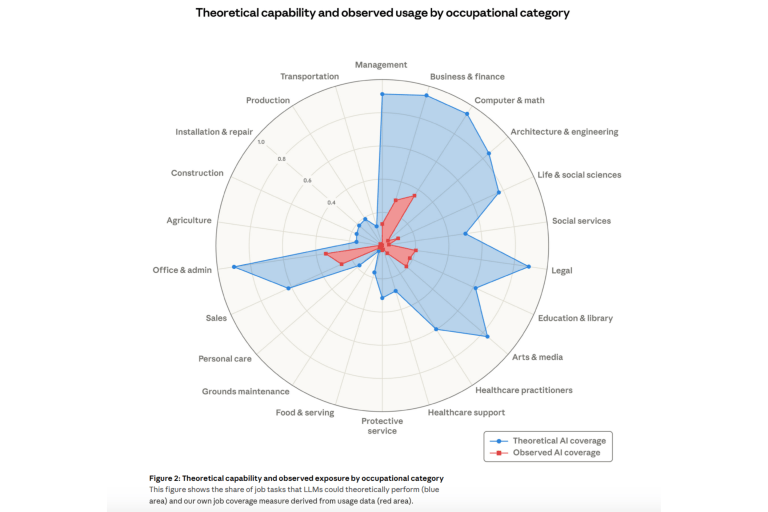
 
https://fortune.com/img-assets/wp-content/uploads/2026/03/Anthropic-5.png?format=webp&w=768&q=100
There was a disruption of the status  quo with the IT revolution that made some industries redundant; classified advertising and newspapers, video rental stores, travel agents, stockbrokers to name a few. There is growing nervousness about what will change in the wake of rising AI development and use, and the potential of disruptions on a much larger scale than what occurred with the IT revolution. 
 
"Is this time bigger? Yes"; perhaps by a factor of ten, mused Anton Korinek, AI expert at University of Virginia. Yes, most certainly AI though still an untested technology, holds the promise to enable more productivity from workers using it. But then, what happens when AI itself, no longer requires a human mind to direct it toward its functional capabilities? Productivity, a measure of worker output using available tools, has surged upward since 2023.
 
While it remains as yet uncertain how much this productivity acceleration owes to AI, analysts believe AI efficiency has had a large part to play in the productivity rise. Since the release of Chat GPT in 2022, capital markets have risen spectacularly; gains driven by surging value of AI companies and their suppliers; Meta Platforms, Nvidia Corp. The concern is the continued rise of productivity to the point where white-collar layoffs and company irrelevance means both will become inevitable.
Man in jacket
Jack Dorsey. Photo: Richard Drew/AP
 
Businesses begin to cut payroll costs when technology enables them to produce more with fewer employees resulting in more profit for shareholders. The fintech firm that Jack Dorsey, Twitter founder runs, announced the halving of its staff, while depending on AI productivity, and saw its shares rise over 15 percent. Columbia Business School Daniel Keum studying automation technologies change the balance within companies found employees being referred to as 'costs'. 
 
He concludes that even if jobs and wages are not yet being cut, areas like health care, remote work and freebies are being trimmed. "These side benefits are what the companies go after first, before they go after reducing your paycheque." Businesses fall by the wayside in response to advanced technologies, like Kodak and the Blockbuster chain, left behind by the internet. What the economist Joseph Schumpeter refers to as the "creative destruction" leading to progress.

illustration with claymation-style smiling figure with dollar signs for eyes, wearing blue suit, sitting on high tree branch facing trunk and using chainsaw to saw off same branch
Illustration by Stephan Dybus
 
"That's been happening for hundreds of years in this country. It's part of the essence of capitalism", stated Federal Reserve Bank of Richmond president Tom Barkin when asked if the Fed should attempt to counter disruption to business and the labour market by AI disruption.  
"Eventually, the disruption will extend to any firm whose competitive advantage lies in human expertise that AI can replicate."
"The transition period may involve stranded assets, debt overhang and the potential for sharp market corrections."
Anton Korinek 

Labels: , , , , ,

Thursday, April 26, 2018

Unanticipated Efficiencies

How could anyone who loves animals, will have no truck with drugs or alcohol, campaigns against tobacco use and is a vegetarian, inspire rabid hatred in people as a leader of a nation concerned with health not only for himself but others? Of course human beings are multi-dimensional in their interests, their proclivities and their biases. That same person could be a racist of profound dimensions, believing in the superiority of the Aryan 'race' and set himself up as a totalitarian dictator whose goal is to wage war against his immediate European neighbour-nations in preparation for overturning the world order to install himself as the supreme ruler of the international community.

On his way to achieving this goal this man who also believed in astrology and the occult, decided he would cleanse the world of the presence of a religious, ethnic, social-cultural group of people against whom he had taken a profound dislike, waging a disabling public relations campaign of dehumanization against them to convince an already-anti-Semitic European audience that Jews represented a rapacious force of evil prepared to control the world, before unleashing the 'final solution' that would destroy six million European Jews, sending them up the smokestacks of crematoria to replenish the nutrients of the soil of a devastatingly bombed-out Europe.

Human beings can be profoundly, surprisingly, strange. We don't expect psychopaths to have much of a conscience and they don't have, but neither do we expect that they will be concerned over matters of public health -- however in Hitler's case, it was because he envisioned and aimed for a superior human, that the German example of a perfect man and woman creating perfect progeny would be fit to take their place as a symbol of German superiority.

And Hitler's modern-day fascist descendants?
"We dismiss the Islamic State as savage. It is savage. We dismiss it as barbaric. It is barbaric. But at the same time these people realized the need to maintain institutions."
"The Islamic State's capacity to govern is really as dangerous as their combatants."
Fawaz A. Gerges, author, ISIS: A History

"Confiscation [will be applied to the property of every single] Shia, apostate, Christian, Nusayri and Yazidi based on a lawful order issued directly by the Ministry of the Judiciary."
The Caliphate on the Path of Prophecy handbook

"We had no choice but to go back to work. We did the same job as before. Except we were now serving a terrorist group."
"They took our files and started going through them, searching which of the properties belong to Shia, which of them belong to apostates, which of them are people who had left the caliphate."
Muhammad Nasser Hamoud, Iraqi Directorate of Agriculture, Mosul, Iraq

"The only thing I could do during the time of government rule is to give a worker a one-day suspension without pay [for not performing his work up to specifications]."
"Under ISIS, they could be imprisoned."
Salim Ali Sultan, garbage collection authority
mosul-feature5.jpg
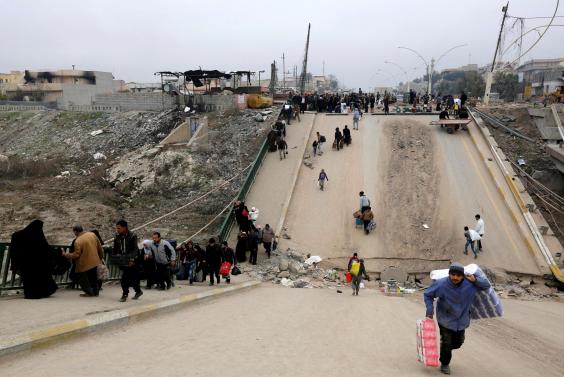
Displaced people, who fled Isis, cross the bridge in Al-Muthanna neighbourhood of Mosul (Reuters)

Mosul, in Iraq, was the largest city with the greatest population that Islamic State governed once it marched on the city and the Iraqi military melted away in fear without a shot being fired in opposition. ISIS was able to loot the bank of the second largest Iraqi city of its hundreds of millions, it took oil revenues from the nearby oil wells, and it undertook to govern the city of close to two million people representing Shia and Sunni Muslims, Turkmen, Kurds, Armenians, Yazidis, Circassians, Assyrians  and others.

Mosul was majority Sunni, many resentful of the Shia-led Iraqi government with its preference for Shiite advancement and ignoring Sunni equality in the sectarian divide. Doubtless when Islamic State first entered Mosul the Sunnis felt their time had come. Until the domination-and-conquest-led, Salafist ISIS with its 'pure' Sharia imposition made life difficult for everyone, and took to exacting the 'state' penalty of capital punishment on those citizens whose defiance and/or lack of respect for Sharia brought them death.

In the fist days of the occupation all municipal civil servants were ordered to return to work in their various departments immediately. They were told that as long as they did their work they would be assured protection. Municipal employees returned to fixing potholes, painting crosswalks, repairing powerlines, overseeing payroll, and everything and anything else that a civil society requires to function while ISIS was busy administering an extended population of 12 million people under their purview representing the growing size of their 'caliphate'.

While Islamic State was busy waging war in territories they meant to absorb, and horrifying the international community with its gloating videos of decapitation, crucifixions, and other atrocities, it was also busy building an efficient administration everywhere to collect taxes and haul away municipal trash. It operated a marriage office, issued birth certificates, driver's licenses and vehicle registration. And it did so with exemplary efficiency. Residents noted that the streets were cleaner, roads fixed as required, garbage collected, public transit running on time.

What Mr. Hamoud, who was Sunni, noticed immediately in the early days of ISIS occupation and control was that Sunnis had swiftly replaced Shiite workers; his own department became staffed one hundred percent by Sunnis, while Shia and Christian workers were dismissed or fled entirely. Islamic State policed the population closely, throwing people into  jail for crimes of eyebrow plucking, inappropriate haircuts, playing dominoes or cards or music and hookah smoking.

Nothing was grown, manufactured, delivered and sold that wasn't taxed by Islamic State. Households were taxed for electricity, municipal water, garbage collection, telephone lines, marriage licenses and birth certificates. A personal tax calculated at 2.5 percent of anyone's assets was another toll, up to ten percent for agricultural production. "We have to be honest. It was much cleaner under ISIS", said Mr. Hamoud in an interview, whose daughter had been beaten once by morality police for not wearing the niqab in public, sustaining permanent eye injuries as a result.

In one town, ISIS ordered a committee of electrical engineers to repair an overloaded electrical grid, so new circuit breakers were installed leading to reliability in electricity production locally for the first time in memory. And then, in early 2017, the Iraqi military retook possession of Mosul, were welcomed as heroes. The Islamic State circuit breakers were disconnected, leading to a resumption of the previous power failures.

mosul-feature7.jpg
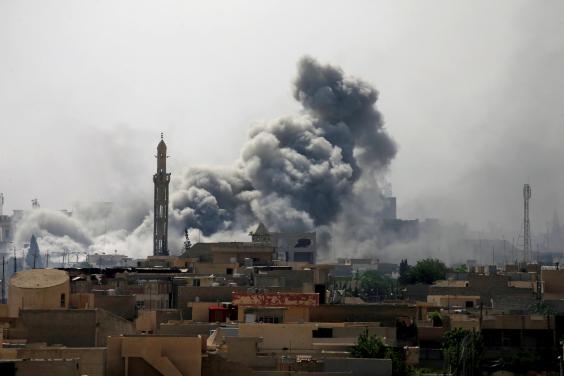
Smoke rises from an air strike during a battle between Iraqi forces and Isis in west Mosul (Reuters)

Labels: , , , ,

 
()() Follow @rheytah Tweet