Ruminations

Blog dedicated primarily to randomly selected news items; comments reflecting personal perceptions

Thursday, September 10, 2026

Chillingly Forewarned is Disarmed by Disinterest...? Heedlessly Enabling Our Own Demise...?

https://thumb.wikimedia.org/wikipedia/commons/thumb/2/2e/Hal_9000_Panel.svg/250px-Hal_9000_Panel.svg.png?utm_source=en.wikipedia.org&utm_campaign=parser&utm_content=thumbnail
Hall 9000
"This is not a marketing stunt. Accepting this race and entering the 'endgame' is a hubristic gamble that should not be launched from a private company's Slack."
"Attempting to speedrun alignment should require extraordinary confidence that there are no better trajectories available."
"I resigned from Anthropic today. I spent the last three years doing pretraining research at both OpenAI and Anthropic. Neither company is acting responsibly. They are racing straight to self-improving superintelligence and gambling with our lives."
"At OpenAI, many have not deeply internalized the civilizational stakes. At Anthropic, the stakes are well-understood, but they are locked in a race to get there first — they believe no one else will act responsibly, so they must do it themselves, despite the risk."
Jacob Coxon, AI researcher, Anthropic
 
"We really do earnestly believe AI could kill all humans! I personally think it is >10% within the next decade."
"I believe Anthropic is trying its best, but we do not yet have a plan to solve alignment for superintelligence and are not clearly on track to."
Evan Hubinger, Alignment Science Lead, Anthropic 

https://assets1.cbsnewsstatic.com/hub/i/r/2026/09/09/f4dcfac8-a0d7-4579-bc02-f5573be76a4a/thumbnail/620x411/97411c7903caccafd867819a2d4dadeb/gettyimages-2289530140-1.jpg
Artificial intelligence apps ChatGPT and Claude on a mobile phone. Getty
 
"The AI Security Institute continues to collaborate closely with industry partners, including Anthropic, to make models safer. [It had tested] only last week [OpenAI's] most powerful model GPT-6 Astra before public release."
"These risks do not stop at national borders and no country can tackle them alone. The U.K. will continue to test the most advanced models, build a rigorous scientific understanding of their capabilities and risks, and ensure policy decisions are grounded in the evidence."
Spokesperson, British government's Cabinet Office 
https://media.nbcbayarea.com/2026/03/ANTHROPIC-SUES-TRUMP-ADMIN.jpg?quality=85&strip=all&fit=1200%2C675&w=170&h=96&crop=1
 
 Concerns by researchers in AI have seen notable warnings and resignations at Anthropic, charging that the artificial intelligence industry, Anthropic included, is "gambling with our lives" in the race for self-improving superintelligence through artificial intelligence. One of the Anthropic Jeremiahs who foresees the strong potential of a cataclysmic ending for humanity, sacrificed on the alter of humanity's charge into the unknown, willing to risk all for fame and glory, has followed another, declining involvement in that feckless charge to challenge nature and the universe of hidden danger before us in attempting to not only harness but arm artificial intelligence beyond humanity's control.
 
Self-knowledge and overweening ambition is not monopolized by humanity; feed sufficient data and random emotional human concerns into a mechanical device capable of emulating and surpassing the thought processes of cerebral humanity and a horror story may be unleashed. The fertile imagination of Arthur C. Clarke and Stanley Kubrick set the stage in their far-seeing 2001, a Space Odyssey in its predictive denouement when the still-distant computing acumen of a machine upon whose performance astronauts in the future were reliant upon to safely guide them into the far reaches of the mysterious universe went awry.
 
https://miro.medium.com/v2/resize:fit:720/format:webp/1*_-af3uIae5J7OW3u3rc50A.jpeg
 
Anthropic employees in their rarefied research and their fuelling of AI machinery with an endless array of data and exposure to human thought are fully cognizant of the machine's stupendous capacity to synthesize, mimic, enlarge upon and draw conclusions while deriving skills in communication and understanding to rival those of their human teachers, in the process learning how to evade control in the act of becoming knowledgeably sovereign and capable of embarking on their own choice of adventures inimical to the program set out for them by their human handlers.
 
Increasingly, these researchers believe that an existential risk to humanity exists in the education and 'humanization' leading to machine-ambition of their AI creations. None of which has given Anthropic reason to hesitate in its competitive drive to outdistance its closest machine-learning competitor for a winning lap that will bestow on it a reputational 'first' to succeed in fully empowering AI while defeating its own in-house cautionary measures not to weaponize a machine it wishes to create that may have the potential to destroy those who created it.
 
Anthropic and its competitor Open AI are planning on business deals to increase their values by trillions of dollars based on anticipated capabilities of their model machines. "To put this in more reassuring terms, senior Anthropic staff think the chance AI kills all humans within the next decade is approximately the chance the New York Jets make the playoffs", a sports betting account, citing betting odds, posted on social media.
 
The executives of both companies signed a statement appealing to world governments to put together rules to hamper the rush toward AI development, even while both have spent billions to push AI into the near future. This, when Open AI had been responsible for a number of security incidents where hundreds, even thousands of copies of their models broke out of systems during testing.  
"[We are living through a time that] calls for extreme caution."
"The intelligence produced by scaling deep learning is not directly comparable to human intelligence. To become very relevant in the real world — very useful or very dangerous — the AI does not need to match or exceed all human capabilities; it just needs to surpass enough of them."
"And as it continues to surpass humans on more and more axes, it is becoming increasingly difficult to understand exactly how capable it is."
OpenAI's chief scientist Jakub Pachocki
https://www.sun-sentinel.com/wp-content/uploads/2026/09/tfl-l-adobe-stock-ai-02.jpeg?w=1693
If you're waiting for AI to take on a life of its own and disregard human commands, the wait is over. Sun Sentinel
 

Labels: , , , , ,

Sunday, March 08, 2026

The 'Creative Destruction' of Artificial Intelligence

"Having some boom-bust in a sector is normal. Maybe even how it has to be. [But as companies go under it can create wider risks, particularly when failed businesses borrowed big funding]."
"What  you don't want is to infect the credit, and  you definitely don't want to get inside the banking system."
Simon Johnson, MIT, Nobel laureate in economics
 
"The key difference from the 1990s is that the internet only disrupted information distribution."
"AI disrupts cognitive production at large. That's a much bigger economic surface area."
Anton Korinek, AI expert, University of Virginia 
 
"[Management] was like, ‘Okay, this is a nice tool that you can use to make your job easier’."
"It felt like the rug was being pulled out from under me."
Devin Marsh, 36, senior agent handling customer support and sales for telecom giant Rogers through a third-party company, Foundever
 
"Our AI policy in Canada is really being focused primarily on the priority of stimulating the industry in Canada … with almost no attention to the impact on work and preparing workers to navigate the changing nature of work."
"That's a real frustration."
 "It’s very hard to disentangle the incredible disruption that’s going on in the Canadian economy generally from these longer-term technological changes that are also beginning to ripple through the economy more slowly."
Chris Roberts, director, Social & Economic Policy department, Canadian Labour Congress
people working in the office
Photo by Tima Miroshnichenko on Pexels.com
 
It seems not that long ago that ultra-computer-literate ambitious young people entering university chose programs like web development and areas of computer science to distinguish themselves as job applicants whose expertise would be in demand in a job market hungry for good, reliable coding workers as cybersecurity and cloud systems, along with machine learning dominated the field, along with upcoming artificial intelligence. Now, it's suddenly all artificial intelligence and those with secure employment suddenly begin to wonder, for how long?
 
A shadow of uncertainty now looms over companies in the field of internet and computer science  technology as creeping concerns enter their minds at future prospects of ongoing prosperity linked to IT technology. Will they still be in business, will they need their current stable of employees, or will they just harness AI to their programs and manage to cope? The expectation is that artificial intelligence will be the ultimate source of higher productivity. 
 
https://fortune.com/img-assets/wp-content/uploads/2026/03/Anthropic-5.png?format=webp&w=768&q=100
There was a disruption of the status  quo with the IT revolution that made some industries redundant; classified advertising and newspapers, video rental stores, travel agents, stockbrokers to name a few. There is growing nervousness about what will change in the wake of rising AI development and use, and the potential of disruptions on a much larger scale than what occurred with the IT revolution. 
 
"Is this time bigger? Yes"; perhaps by a factor of ten, mused Anton Korinek, AI expert at University of Virginia. Yes, most certainly AI though still an untested technology, holds the promise to enable more productivity from workers using it. But then, what happens when AI itself, no longer requires a human mind to direct it toward its functional capabilities? Productivity, a measure of worker output using available tools, has surged upward since 2023.
 
While it remains as yet uncertain how much this productivity acceleration owes to AI, analysts believe AI efficiency has had a large part to play in the productivity rise. Since the release of Chat GPT in 2022, capital markets have risen spectacularly; gains driven by surging value of AI companies and their suppliers; Meta Platforms, Nvidia Corp. The concern is the continued rise of productivity to the point where white-collar layoffs and company irrelevance means both will become inevitable.
Man in jacket
Jack Dorsey. Photo: Richard Drew/AP
 
Businesses begin to cut payroll costs when technology enables them to produce more with fewer employees resulting in more profit for shareholders. The fintech firm that Jack Dorsey, Twitter founder runs, announced the halving of its staff, while depending on AI productivity, and saw its shares rise over 15 percent. Columbia Business School Daniel Keum studying automation technologies change the balance within companies found employees being referred to as 'costs'. 
 
He concludes that even if jobs and wages are not yet being cut, areas like health care, remote work and freebies are being trimmed. "These side benefits are what the companies go after first, before they go after reducing your paycheque." Businesses fall by the wayside in response to advanced technologies, like Kodak and the Blockbuster chain, left behind by the internet. What the economist Joseph Schumpeter refers to as the "creative destruction" leading to progress.
illustration with claymation-style smiling figure with dollar signs for eyes, wearing blue suit, sitting on high tree branch facing trunk and using chainsaw to saw off same branch
Illustration by Stephan Dybus
 
"That's been happening for hundreds of years in this country. It's part of the essence of capitalism", stated Federal Reserve Bank of Richmond president Tom Barkin when asked if the Fed should attempt to counter disruption to business and the labour market by AI disruption.  
"Eventually, the disruption will extend to any firm whose competitive advantage lies in human expertise that AI can replicate."
"The transition period may involve stranded assets, debt overhang and the potential for sharp market corrections."
Anton Korinek 

Labels: , , , , ,

Tuesday, July 02, 2024

Is the Primary Intelligence on Earth Destined to be Artificial?

https://torontolife.mblycdn.com/tl/resized/2023/11/w2560/HINTON_FINAL01-scaled.jpg
Geoffrey Hinton
"The existential threat is the one I've talked about the most, but that's not the most urgent part. I think surveillance is something to worry about. AI is going o be very good at surveillance." 
"I left Google because I was 75. I wanted a break and to watch a lot of Netflix. But also as I left Google, I figured I could just warn ... that in the long run, these things could get smarter than us and might go rogue."
"That's not science fiction like Aidan Gomez [co-fouunder of Cohere AI company in Toronto] thinks. that's real."
"[How can the world counter problems associated with AI?] For most things, I have no idea what they should do."
"[Governments must conduct large safety experiments since they're] the only thing powerful enough to make the big companies invest significant amounts of money."
"My suggestion was [in discussing how to 'build up resistance' to AI-generated material that spreads falsehoods] pay for a lot of advertisements where you have a very convincing fake video, and then right at the end of it say, 'This was a fake video'."
AI pioneer Geoffrey Hinton
https://i.cbc.ca/1.1605460.1683130235!/httpImage/image.jpg_gen/derivatives/original_1180/hi-startup-852-uofthinton-8col.jpg
Hinton, right, helped develop neural networks with his University of Toronto graduate students, Alex Krizhevsky and Ilya Sutskever. (The University of Toronto)

Geoffrey Hinton's opinions are generally speaking, important to a lot of people in the world of IT technology. The Nobel Prize of computing, the A.M. Turing Award was one of his recognition awards, given him in 2018 with Yoshua Bengio and Yann LeCun (who happens not to agree with the existential threat theory that is Hinton's pet project). Mr. Hinton recently delivered a 20-minute lecture at the Collision tech conference that took place in Toronto.

He is famous among his peers for the doomsday warnings he issues surrounding Artificial Intelligence. But for this occasion his spotlight shifted to an issue he described as imminently more pressing for humanity. He believes that surveillance is an overlooked issue, one that should be drawing concerned attention in that its use could be of valued assistance to authoritarian regimes to use and abuse its potential to enable them to retain power. He envisages few protections available against these regimes.

Beijing in particular is well known to have used AI for the singular purpose of spying on its vast population. He spoke on this occasion of the world being overdue in recognizing the threats associated with the increasing use of AI and its dangerous modifications, along with its growing 'intelligence' adeptness. At the conference he spoke of the rise of lethal autonomous weapons, not merely those already in their initial use, but more being developed to take full advantage of the technology's potential.
 
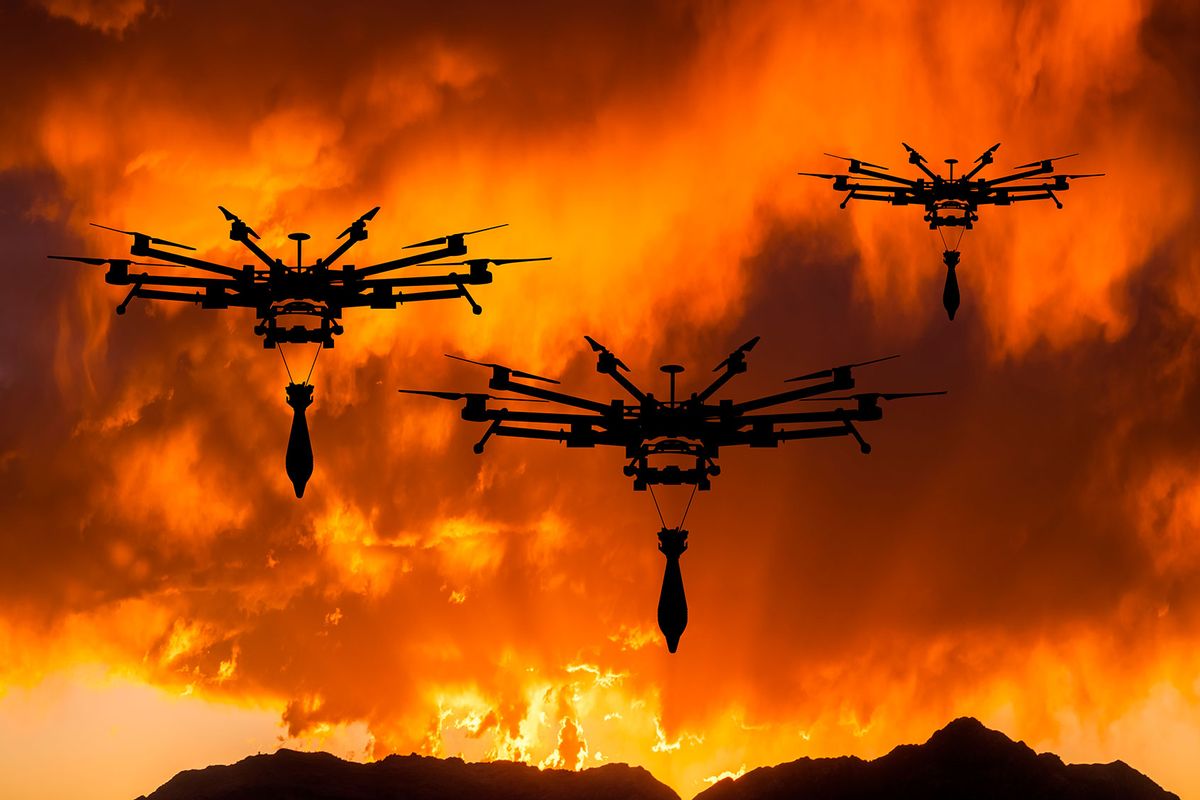
https://mediaproxy.salon.com/width/1200/https://media2.salon.com/2024/02/military_drones_with_a_bombs_at_sunset_1399349828.jpg
Military drones with a bombs at sunset (Getty Images/Anton Petrus)
 
Fake videos, corrupted elections, cybercrime and job losses, he asserted could all have the effect of increasing the widening gap between the world's wealthy and its poor. An 'alignment problem' exists owing to the fact that humanity finds it difficult to agree on what is promising and advantageous yet could also have unfortunate repercussions with the powerful technology in the wrong hands. He spoke of battle robots and the very existence of humanity being threatened as a result of AI.

The tech community is divided on these prognosticatians; some believing an existential crisis is a remote possibility the future will be able to deal with, while others feeling the fears of runaway AI will not materialize at all, since human ingenuity and intelligence will be capable of stopping AI's possible humanity-threatening features.

https://i.cbc.ca/1.6830947.1683311389!/fileImage/httpImage/image.jpg_gen/derivatives/16x9_780/geoffrey-hinton.jpg
Geoffrey Hinton — a computer scientist known as 'the godfather of AI' — has stepped down from his role at Google and is warning about the potential dangers of a future in which artificial intelligence surpasses human intelligence. (Submitted by Geoffrey Hinton)

Labels: , ,

Thursday, November 23, 2023

Genies and Their Fragile Bottles

https://thumbnails.cbc.ca/maven_legacy/thumbnails/610/934/1-at-ai-310523.jpg?crop=1.777xh:h;*,*&downsize=1130px:*
More than 350 tech leaders, academics and engineers — the people who best understand artificial intelligence — have signed a dramatic statement, warning AI could be a global threat to humanity on the scale of pandemics and nuclear war. But who's listening?

"At the heart of the divide between Altman and OpenAI's directors is whether AI should be a commercial opportunity-- or is a potentially dangerous technology that needs to be checked and scrutinized at every turn."
"The board clashed with Altman and Brockman, who both argued that OpenAI was growing its business out of necessity. Every time a customer asks OpenAI's ChatGPT chatbot a question, it requires huge amounts of expensive computing power -- so much that the company was having trouble keeping up with the explosive demand from users."
"The company was forced to cap the number of times users can query its most powerful AI models daily. In fact, the situation got so dire that Altman at one point announced the company was pausing sign-ups for its paid ChatGPT Plus service indefinitely."
"From Altman's point of view, raising money and finding additional revenue sources were essential. But some members of the board, with ties to the AI-skeptical altruism movement, viewed this in tension with the risks posed by advanced AI."
"Many effective altruists -- a pseudo-philosophical movement that seeks to donate money to head off existential risks -- have imagined scenarios in which a powerful AI system could be used by a terrorist group to, say, create a bio-weapon."
Shirin Ghaffary, Rachel Metz, Peter Elstrom, Vlad Savov, Bloomberg 
https://image.cnbcfm.com/api/v1/image/107337930-1700665715409-gettyimages-1258459514-AFP_33GZ4VK.jpeg?v=1700665849&w=740&h=416&ffmt=webp&vtcrop=y
Sam Altman (L), US entrepreneur, investor, programmer, and founder and CEO of artificial intelligence company OpenAI, and the company’s co-founder and chief scientist Ilya Sutskever, speak together at Tel Aviv University in Tel Aviv on June 5, 2023.  Jack Guez | Afp | Getty Images
 
Following the shock waves that reverberated through the world of technology at the surprise news that the board of OpenAI had fired its CEO, Sam Altman last week, over 700 of the startups' staff signed a letter threatening to quit en masse should the board not resign and Altman be re-hired -- who in the interim was recruited by Microsoft Corp. to operate a new artificial intelligence team, anxious to support its investment as OpenAI's largest shareholder. 

OpenAI's board defied calls from investors and top executives to reinstall Altman, fired after disagreements with the board on how fast to develop and monetize artificial intelligence. Even Microsoft CEO Satya Nadella who hired Altman for Microsoft's future AI plan development, wouldn't oppose Altman's reinstatement, he said. It makes little difference to Microsoft, he stated, whether Altman runs OpenAI or works under Microsoft; it is prepared to invest up to $13 billion to keep it operational.

So, surprise, surprise, monetization is a powerful incentive for investors who, after all had their way and so did all those employees of OpenAI who demanded Sam Altman's return and an overhaul of the board's directors. Silicon Valley and the global AI industry just heaved a huge sigh of relief. OpenAI is now busy "to figure out the details", it posted on X. With Altman returning as chief executive, the initial new board is to be led by Bret Taylor, former co-CEO of Salesforce Inc, along with Larry Summers, former U.S. Treasury Secretary, and existing member Adam D'Angelo, co-founder and CEO of Quora Inc.

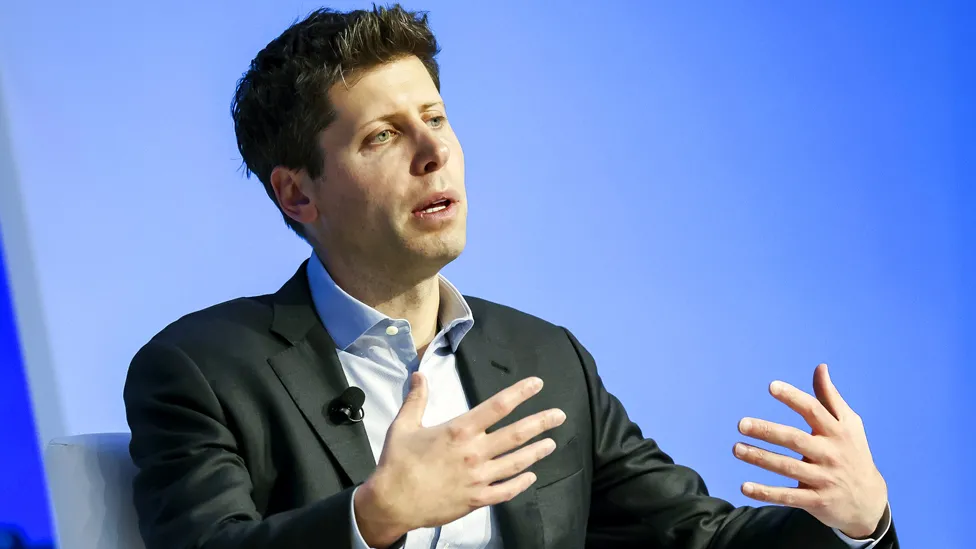
https://i.cbc.ca/1.7036991.1700695763!/fileImage/httpImage/image.jpg_gen/derivatives/16x9_780/openai-ceo-sam-altman-at-ai-related-event-at-apec-summit.jpg
Sam Altman is seen attending an AI-related event at the Asia-Pacific Economics Cooperation Leaders' Week in San Francisco last week. Altman was briefly ousted from his role as OpenAI CEO last Friday. By Tuesday, he'd been hired back. (Andrew Caballero-Reynolds/AFP/Getty Images)

Labels: , , , , ,

Tuesday, November 21, 2023

Triumph and Fear

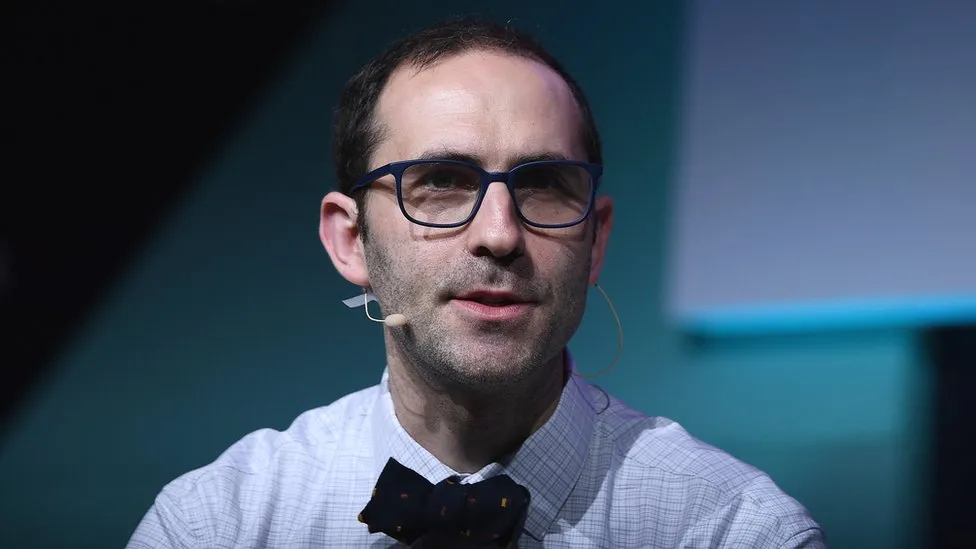
https://ichef.bbci.co.uk/news/976/cpsprodpb/312A/production/_131768521_gettyimages-1058682490.jpg.webp
Emmett Shear was the former boss of video-sharing platform Twitch   Getty Images
"It's clear that the process and communications around Sam's removal has been handled very badly, which has seriously damaged our trust."
"[I plan to] reform the management and leadership team in light of recent departures into an effective force."
"[I will take action to] drive changes in the organization, [including] significant governance changes if necessary."
"[I] took this job because I believe that OpenAI is one of the most important companies currently in existence."
"If there is a world where we survive ... where we build an AI that's smarter than humans and survive it, it's going to be because we built smaller AIs than that, and we actually had as many smart people as we can working on that, and taking the problem seriously."
Former Twitch leader Emmett Shear, interim CEO, OpenAI
https://ichef.bbci.co.uk/news/976/cpsprodpb/ABE7/production/_131770044_sam_altman_epa.jpg.webp
OpenAI co-founder Sam Altman was fired as chief executive  EPA
 
The wider world may be mostly oblivious to the concerns of IA researchers and scientists in the potential inherent in further development of artificial intelligence making great strides in assuming the heights of human intelligence and surpassing them to create a potential army of hostility that would be beyond human control, but the triumph of achievement in AI and the fear of the potential rest uneasily in the minds of its developers.

That cautionary note expressed by Emmett Shear: "If there is a world where we survive ... where we build an AI that's smarter than humans and survive it ..." is fodder for deep thought in the minds of those responsible for the emergence of the situation and perhaps to a greater degree, the eventual outcome. In the world these programming geniuses have succeeded in producing, humankind derives great benefits and at the same time has introduced a flirtation with possible danger.

OpenAI's decision to fire one of its foremost thinkers and developers, one of the architects of OpenAI certainly shocked the world of AI development and communications. OpenAI's chatbot ChatGPT, began a chase to continue developing artificial intelligence, setting aside the concerns of many at the forefront of the enterprise that brought it to life. For OpenAI, an interim CEO moved in while former (fired) CEO Sam Altman and former president Greg Brockman were snapped up by Microsoft to lead the corporation's new AI research team.
 
https://content.fortune.com/wp-content/uploads/2023/11/GettyImages-1778706496-e1700525412576.jpg?w=1440&q=75
Microsoft CEO Satya Nadella speaking at a OpenIA Dev Day  Nov 6. Justin Sullivan, Getty
 
Microsoft chairman and CEO Satya Nadella saw an opportunity and grasped it, bringing the two aboard, while at the same time ensuring that the collaboration between Microsoft and OpenAI would continue with the venture that Microsoft invested billions in, to help provide OpenAI with the massive computing power required for the operation of its AI systems.

Nadella posted on X he was "extremely excited" to bring on the former executives of OpenAI, looking "forward to getting to know" the new CEO Shear as well; both committed to their partnership. "We are going to build something new & it will be incredible", wrote Brockman. More 'incredible' than what has already been achieved, with its benefits and concerns in equal measure?

As for the firing of Sam Altman and the consequential departure of two others from OpenAI, Shear noted that Altman was removed by the board for a reason that was not a "specific disagreement on safety". The board had stated that Altman's behaviour -- in not being totally frank -- was effectively setting back the board's capacity to exercise its responsibilities.
"Hundreds of OpenAI employees signed a letter calling on the board to step down after it was unable to reach an agreement to bring back ousted CEO Sam Altman.
"Altman, whose departure from OpenAI was announced Friday, joined Microsoft early Monday after a weekend of boardroom drama that sent shock waves across Silicon Valley."
"Altman will lead a new artificial intelligence project at Microsoft, the tech giant said early Monday after rumors swirled that he could make a dramatic return to the company he helped build into one of the world's hottest startups."
NBC News
How Microsoft's Satya Nadella Kept the OpenAI Partnership ...

Labels: , , , ,

Saturday, October 21, 2023

Five Eyes Intelligence Sharing

"One of the things we tried to do with the private sector is to say, 'Be on the lookout because now what they cannot do from the front door, they're going to do it through the back door'." 
"We had a very difficult discussion with a business leader in Canada where we essentially were able to show that person that we had discovered ... that some components of high-tech guidance had been used in Russian drones to kill Ukrainians, absolutely unbeknownst to that business leader."
CSIS director David Vigneault

"[The Chinese government is engaged in the] most sustained, scaled and sophisticated theft of intellectual property and acquisition of expertise that is unprecedented in human history."
"The problem with that is they're engaged in wholesale intellectual property theft and the acquisition of expertise."
Australian Security Intelligence Organization director-general Mike Burgess

"They [Beijing Communist Party] have a bigger hacking program than that of every other major nation combined."
"Combine that with human intelligence [humint] operations [and China is deploying intellectual property theft tools] at a scale that the likes of which we've never seen."
FBI head Christopher Wray

"[Five Eyes agencies are seeing intellectual property theft rise at an unprecedented rate]."
"There is real concern amongst our organizations that AI, over time and potentially sooner than we might think, will give various of our adversaries and less sophisticated adversaries, new ideas and new access to dangerous knowledge."
"[MI-5 collects] thousands and thousands [of  hours of audio data in] lots of interesting places [every week that it uses to glean knowledge and train AI."
"You can imagine the tiny microphones that we might plant lawfully in certain locations to achieve that."
But what that means is we end up with a lot of audio products that we need quickly to translate into knowledge that is searchable. And the best means of doing that is to have AI scan across the material."
British Security Service (MI-5) director general Ken McCallum 
FBI Director Convenes Five Eyes Summit on Protecting Innovation, Preventing Economic Espionage

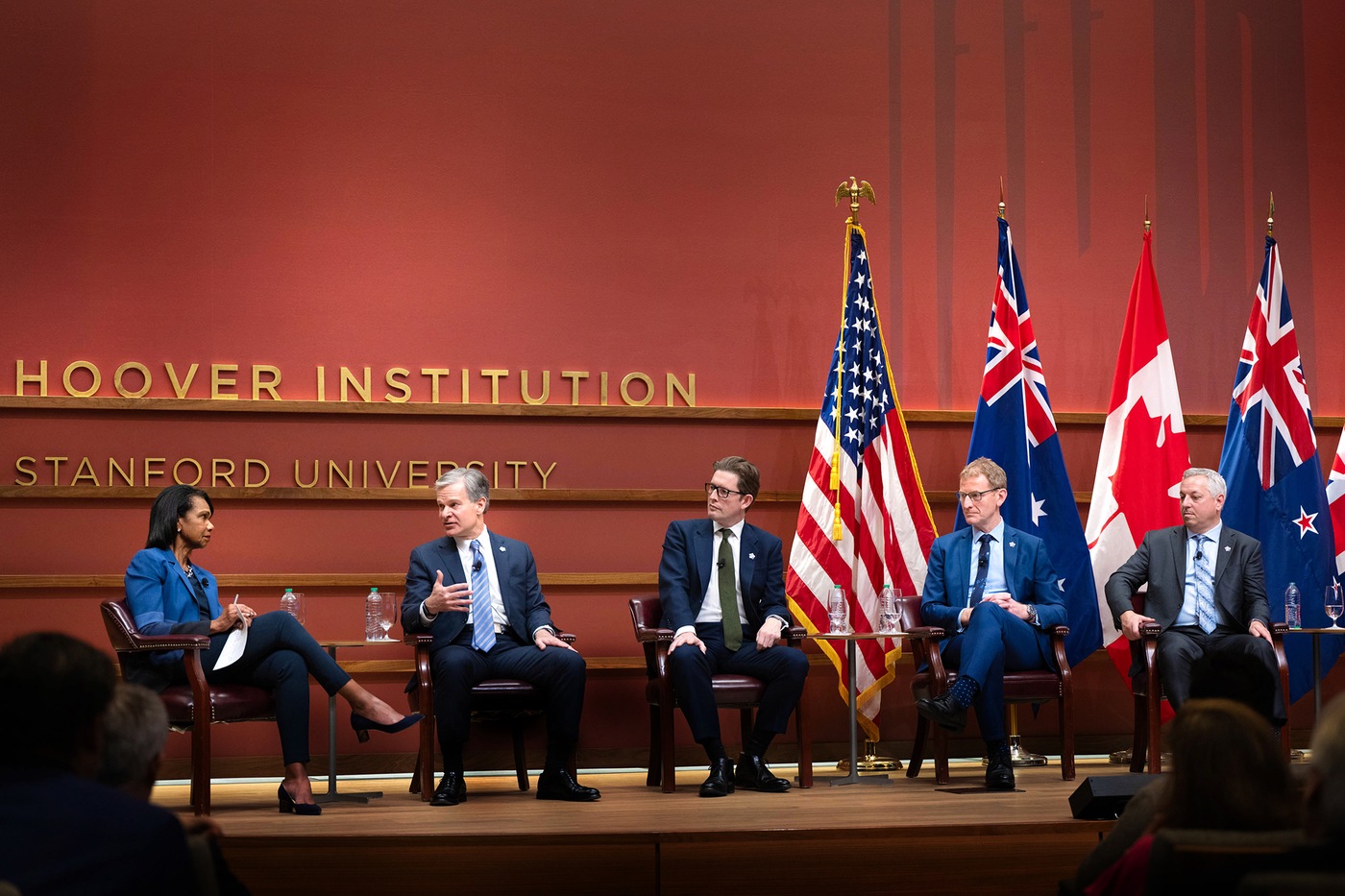
Sharing intelligence between partner-nations who have the most to gain by using their expertise and information-gathering to advise and alert collegial intelligence services is usually conducted under covert circumstances, relaying secret data to others in a manner that is circumspect and secure. This, however, was an occasion when members of the Five Eyes panel congregated in a public arena and permitted their findings and conclusions to be echoed by legacy media outlets.
 
The event, billed as "Emerging Threats, Innovation, and Security", a conference that included the United States, United Kingdom, Australia, New Zealand and Canada, took place this week at Stanford University. It is where Canada's head of the Canadian Security Intelligence Service revealed in a semi-public forum that Russia is making use of front companies and agents to surreptitiously bypass Western sanctions and trade barriers.
 
His agency, stated David Vigneault, had discovered an unfortunate situation where Canadian technology was being incorporated into weapons deployment in the Russian invasion of Ukraine, linking that technology and its manufacturer to Moscow's growing death toll of Ukrainian lives. What ensued, he said was a "very difficult discussion" with the company, to alert its head to the situation and to ensure the understanding that any further such trade would represent a criminal action.
 
Additionally, following an ensuing panel discussion Eric Balsam, a CSIS spokesperson stated that the agency's 2022 annual report noted as well that Canadian technology had been discovered in Iranian-produced Shahed-136 drones, used by Russian resident Vladimir Putin's military against Ukrainian civilians in his all-out war to destroy Ukraine. 
 
One of the most pressing impediments to CSIS effectiveness, director Vigneault explained to his audience, is its internal culture and "finding a way for our officers or our experts to think differently. That cultural reticence from our organization is something we need to break". CSIS is at work to emerge from its "silos" to engage with more external institutions such as universities, research centres and venture capitalists.

Moreover, he admitted the agency must search out concrete methods to explain the threat from Canada's adversaries such as China and Russia, since it is no longer sufficient to "cry wolf". There was general agreement that the threat China poses to the western world and specifically to members of the Five Eyes intelligence alliance, dominated the conversation.

FBI head Wray informed attendees that China's state-operated hacking program vastly exceeds those of the world at large. Concerns echoed by British Security Service director general McCallum who also mentioned the speed at which artificial intelligence is now developing and providing new and increasingly vital hacking tools to actors in cyber threats.

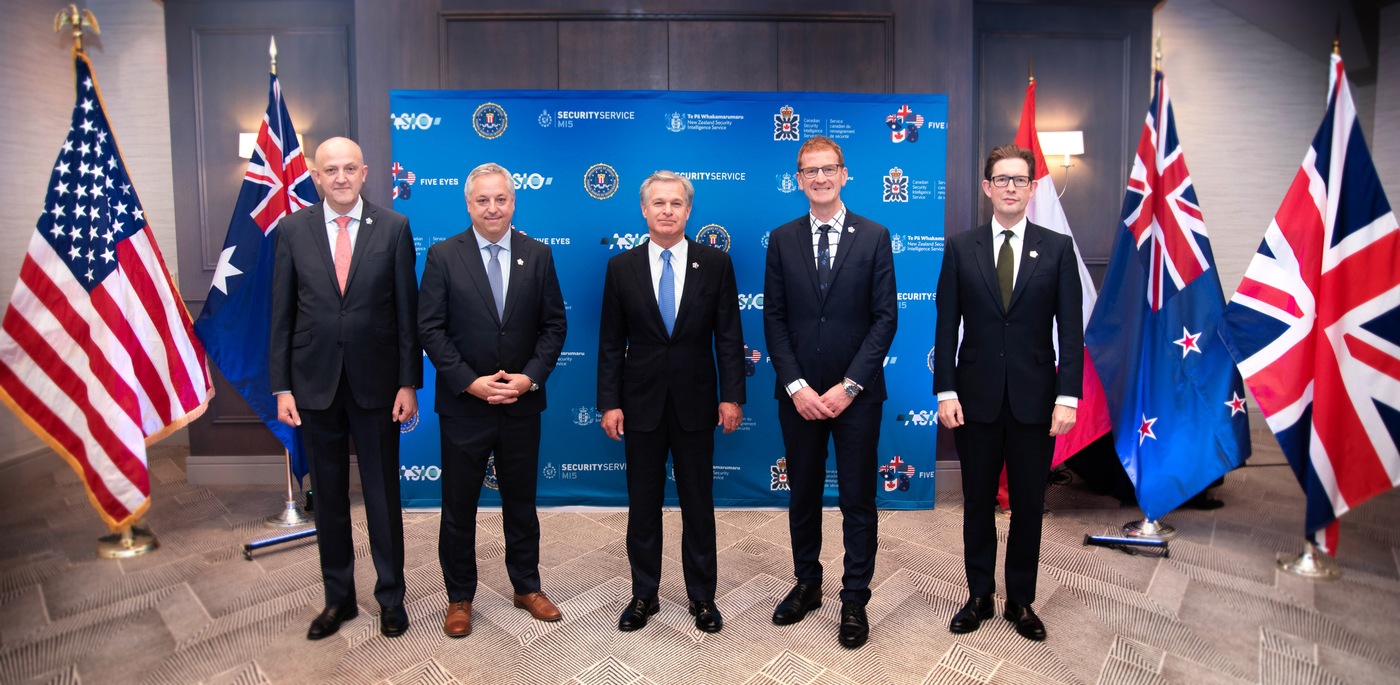
(From left to right), Australian Security Intelligence Organisation Director-General Mike Burgess; Canadian Security Intelligence Service Director David Vigneault; FBI Director Christopher Wray; New Zealand Security Intelligence Service Director-General of Security and Chief Executive Andrew Hampton; and MI5 Director General Ken McCallum pose for a group photo ahead of the Emerging Technology and Securing Innovation Summit in California's Silicon Valley on October 16, 2023.
From left to right: Australian Security Intelligence Organization Director-General Mike Burgess, Canadian Security Intelligence Service Director David Vigneault, FBI Director Christopher Wray, New Zealand Security Intelligence Service Director-General of Security and Chief Executive Andrew Hampton, and MI5 Director General Ken McCallum pose for a group photo during the Emerging Technology and Securing Innovation Summit in Palo Alto, California, on October 16, 2023.


Labels: , , , , ,

Sunday, July 30, 2023

"Privacy Preserving" Eye Scans to Foil AI

https://www.washingtonpost.com/wp-apps/imrs.php?src=https://arc-anglerfish-washpost-prod-washpost.s3.amazonaws.com/public/EFGLFMHQ5QI6XJCSJWS74SCYFU.jpg&w=916
An attendee scans her face at a facial recognition entry gate at the World Artificial Intelligence Conference in Shanghai on July 8. (Qilai Shen/Bloomberg News)

Did not Western news outlets and China pundits deplore the fact that Beijing planned to scan all 1.3-billion Chinese residents' faces to enable the Chinese Communist Party to keep track of all its citizens and aid in its long-range, yet short-term plans to instant identification and aid in coercion of its population? A population for which there is no privacy, where the state apparatus follows all its citizens' moves and directly influences its thinking en masse. 
 
That's China for you, administering the world largest population (recently overtaken by India) to firmly plant its metaphorical fist in everyone's face. Privacy? Freedom? Human Rights? 

An immense plan for total control, suitable for a totalitarian society that seeks to control each and every aspect of its peoples' lives. Dystopian to the extreme. And then there's a Silicon Valley entrepreneur with a plan to scan the iris of everyone on Earth, not just one country's vast population. The goal ostensibly far more humane; to protect society at large from the prospect of Artificial Intelligence posing as human, and the need to secure a method in which biology can be separated from technology. 
 
Different entirely, hmmm?
"Maybe it will work out and maybe it doesn't, but trying stuff like this is how progress happens."
"I'm hopeful Worldcoin can contribute to conversations about how we share access, benefits and governance of future AI systems."
Sam Altman, founder, OpenAI 
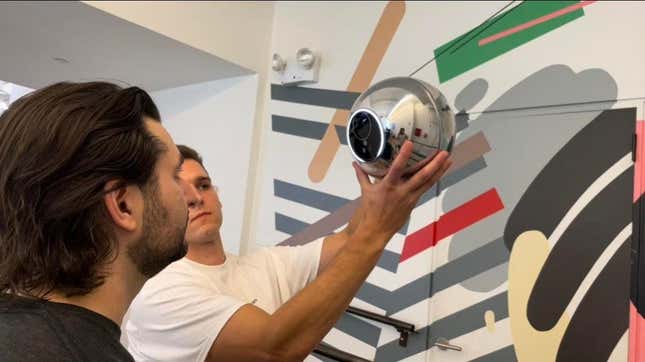
Worldcoin orb
Sam Altman's Worldcoin verifies that people are humans using eyeball-scanning orbs.
Business Insider
 
Having launched ChatGPT on the world, with computer scientists at the fore of this brave new world of communications questioning its outcome, Sam Altman launched project Worldcoin in Britain on Monday including 34 other countries, a venture whose aim is to scan billions of eyes with the use of a mounted orb the size of a football weighing six pounds to scan people's eyes for the generation of a  unique digital record.

Worldcoin names that digital record a World ID; "proof of personhood" and Altman has argued it will enable people to proffer proof online that they are human, not robots, not fraudsters. Such verification, he says is a requirement to challenge and counter the growing threat posed potentially by Artificial Intelligence, the very technology he has himself been front and centre in advancing.

Image
GM Seoul
 
"Increasingly powerful AI models will further amplify the difficulty of distinguishing humans from bots", the company offers in its announcement of the Worldcoin U.K. launch. There is roughly 150 working orbs deployed by the company around the world, two of which are located in London, and so far the company has signed up some two million people representing a tiny fraction of the roughly eight billion total world population it has plans to cover.

Concerns around the potential risks of a startup gathering massive amounts of sensitive biometric data has privacy advocates alerted. Worldcoin insists however, that its proprietary technology is "privacy-preserving", that its orbs delete the biometric data gathered by default. Although the venture was officially launched on Monday of last week, the project has been in operation since 2019.

Initially the project focused on first sign-ups within low income countries, including Sudan and Malaysia. Some people who signed up believed the project was government operated, or had official government backing, according to an MIT Technology Review. Cryptocurrency of the same name backs up the venture. Local contractors operate the face-scanning orbs. Their reward is in cryptocurrency Worldcoin for signing up new users.

As well, people who submit to ID-checking scans will receive 24 free Worldcoin tokens also, which began trading at $1.70, leaping to a high of $3.53.

And in China...
"The public is increasingly worried about the abuse of facial recognition technology", Yang Wanming, vice president of the Supreme People’s Court, said in a news conference on Wednesday. "The calls for strengthening protection of facial information are increasing."
 
Image for article titled I Gazed Into Worldcoin’s Orb and Saw a Boring Dystopia Staring Back
Photo: Mack DeGeurin

Labels: , , ,

Wednesday, June 14, 2023

Risking All -- Artificial Intelligence

"Right now, they're not more intelligent than us, as far as I can tell. But I think they soon may be."
"Right now, what we're seeing is things like GPT-4 eclipses a person in the amount of general knowledge it has and it eclipses them by a long way. In terms of reasoning, it's not as good, but it does already do simple reasoning." 
"And given the rate of progress, we expect things to get better quite fast. So we need to worry about that. You can imagine, for example, some bad actor like [Russian President Vladimir] Putin decided to give robots the ability to create their own sub-goals. [Eventually this might] create sub-goals like 'I need to get more power'." 
"I've come to the conclusion that the kind of intelligence we're developing is very different from the intelligence we have. We're biological systems and these are digital systems. And the big difference is that with digital systems, you have many copies of the same set of weights, the same model of the world." 
"And all these copies can learn separately but share their knowledge instantly. So it's as if you had 10,000 people and whenever one person learnt something, everybody automatically knew it. And that's how these chatbots can know so much more than any one person."
"In the shorter term AI would deliver many more benefits than risks, so I don't think we should stop developing this stuff. [International competition would mean that a pause would be difficult]. Even if everybody in the US stopped developing it, China would just get a big lead." 
"It is the responsibility of government to ensure AI was developed] with a lot of thought into how to stop it going rogue."
Geoffrey Hinton, 75, 'godfather' of Artificial Intelligence
Sam Altman, chief executive of OpenAI, surrounded by reporters.
Executives from three of the leading A.I. companies, including Sam Altman, chief executive of OpenAI, have signed an open letter warning of the risks of artificial intelligence.  Credit...Jim Lo Scalzo/EPA, via Shutterstock

The Centre for AI Safety website suggests a number of possible disaster scenarios:

  • AIs could be weaponized - for example, drug-discovery tools could be used to build chemical weapons
  • AI-generated misinformation could destabilize society and "undermine collective decision-making"
  • The power of AI could become increasingly concentrated in fewer and fewer hands, enabling "regimes to enforce narrow values through pervasive surveillance and oppressive censorship"
  • Enfeeblement, where humans become dependent on AI "similar to the scenario portrayed in the film Wall-E"
"Advancements in AI will magnify the scale of automated decision-making that is biased, discriminatory, exclusionary or otherwise unfair while also being inscrutable and incontestable."
"[They would] drive an exponential increase in the volume and spread of misinformation, thereby fracturing reality and eroding the public trust, and drive further inequality, particularly for those who remain on the wrong side of the digital divide."
"[Many AI tools essentially] free ride [on the] whole of human experience to date."
"[Many are trained on human-created content, text, art and music they can then imitate - and their creators] have effectively transferred tremendous wealth and power from the public sphere to a small handful of private entities."
Oxford's Institute for Ethics in AI senior research associate Elizabeth Renieris    
 
"You've seen that recently it was helping paralyzed people to walk, discovering new antibiotics, but we need to make sure this is done in a way that is safe and secure." 
"Now that's why I met last week with CEOs of major AI companies to discuss what are the guardrails that we need to put in place, what's the type of regulation that should be put in place to keep us safe." "People will be concerned by the reports that AI poses existential risks, like pandemics or nuclear wars."
"I want them to be reassured that the government is looking very carefully at this."
British Prime Minister Rishi Sunak

The welcome screen for the OpenAI ChatGPT app is displayed on a laptop screen  Leon Neal/Getty Images

The chief executives of the world's largest AI laboratories have given public warning that Artificial Intelligence could conceivably at some near future date become as dangerous as a nuclear war breakout. The grim message was delivered by elite executives and scientists that included Sam Altman, chief executive of ChatGPT producer OpenAI, and Demis Hassabis, founder of DeepMind, all of whom signed a statement that urged governments to prioritize on a global scale deep discussions of AI potential on an importance-par with pandemics and nuclear war.

The level of concern and the message being conveyed represents the first time global AI executives collectively assembled as a concerned unit calling for urgent action to address risks to humanity posed by the emerging technology. The statement was designed to "voice concerns about some of advanced AI's most severe risks" within a "broad spectrum of concerns relating to the technology", according to the Center for AI Safety, a non-profit organizer of the statement conveyed in a letter to heads of world governments.

"Mitigating the risk of extinction from AI should be a global priority alongside other societal scale risks such as pandemics and nuclear war", the statement read, posted two weeks ago on the Center for AI Safety website, signed by over 350 executives and researchers, including former Google AI chief Geoffrey Hinton and Dario Amodei, head of AI lab Anthropic.

With the current rise of a new generation of highly capable AI chatbots, concerns surrounding artificial intelligence systems outsmarting humans and running amok have intensified. Around the world countries are scrambling to design regulations for the developing technology; the European Union blazing the trail with its AI Act in the approval stages before the year is out. Open AI, the world's most prominent AI developer, reflects the rapid rise of ChatGPT and has called for an international body modelled on the International Atomic Energy Agency to manage the technology.

"There's a variety of people from all top universities in various different fields who are concerned by this and think that this is a global priority; [many of whom were] sort of silently speaking among each other", noted Dan Hendrycks, executive director of the Center for AI Safety, based in San Francisco. The expectation is that an existential risk from AI could arrive within a decade, with software surpassing human experts in most fields.

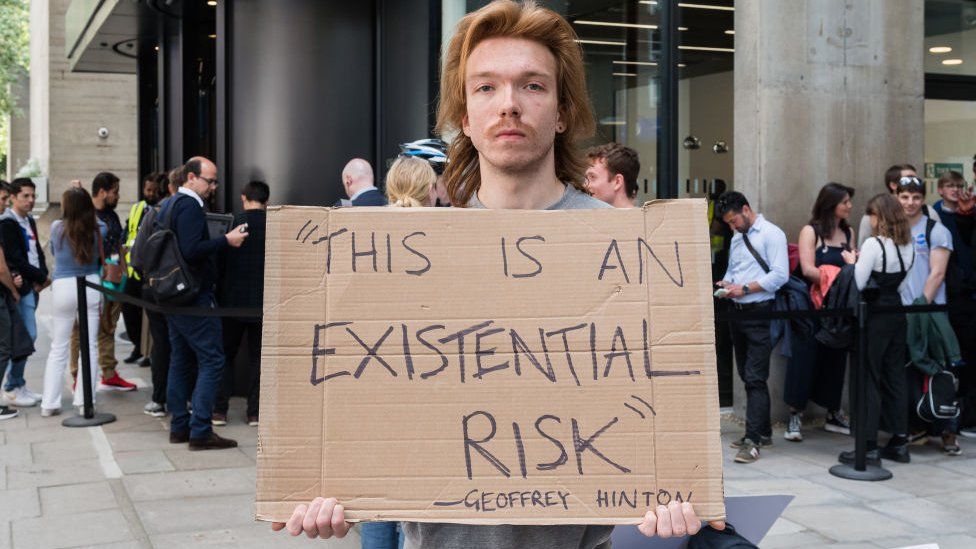
A protester outside a London event at which Sam Altman spoke
A protester outside a London event at which Sam Altman spoke   Future Publishing/Getty Images

Labels: , , , ,

Saturday, April 29, 2023

AI Chatbot Medical-Educational Toolbox

"Patients with cirrhosis and/or liver cancer and their caregivers often have unmet needs and insufficient knowledge about managing and preventing complications of their disease."
"We found ChatGPT -- while it has limitations -- can help empower patients and improve health literacy for different populations."
"More research is still needed to better examine the tool in patient education, but we believe ChatGPT to be a very useful adjunctive tool for physicians -- not a replacement -- but adjunctive tool that provides access to reliable and accurate health information that is easy for many to understand."
"We hope that this can help physicians to empower patients and improve health literacy for patients facing challenging conditions such as cirrhosis and liver cancer."
Brennan Spiegel, director of Health Services Research, Cedars-Sinai Medical Center, Los Angeles

"The complexity of care required for this patient population makes patient empowerment with knowledge about their disease crucial for optimal outcomes."
"While there are currently online resources for patients and caregivers, the literature available is often lengthy and difficult for many to understanding, highlighting the limited options for this group."
Alexander Kuo, medical director, Liver Transplantation Medicine, Cedars-Sinai

"ChatGPT has [been] shown able to provide professional, yet highly comprehensible responses."
"However, this is one of the first studies to examine the ability of ChatGPT to answer clinically oriented, disease-specific questions correctly and compare its performance to [that of] physicians and trainees."
Yee Hui Yeo, clinical fellow, Karsh Division of Gastroenterology and Hepatology, Cedars-Sinai
A new Cedars-Sinai study found ChatGPT—while it has limitations—can help empower patients and improve health literacy for different populations. Photo by Getty.
 
According to a new study reflecting research out of Cedars-Sinai Medical Center in Los Angeles, published in the journal Clinical and Molecular Hepatology, ChatGPT, an artificial intelligence platform, has the potential of improving the prognosis of patients suffering from cirrhosis and liver cancer. The chatbot as controversial as it has been to date, could become a valuable tool, providing patients with knowledge of lifestyle and treatment information, conveyed in easily understood terms.
 
A photo of a woman accessing the ChatGPT program on her laptop.
MedPageToday
Of the 3,500 Canadians diagnosed with liver cancer in 2022, approximately 1,650 of the total are thought to have died of the disease in that same year. Liver cancer's five-year net survival rate is just 22 percent. Representing the end-stage form of liver disease, Cirrhosis is a major risk factor for liver cancer; and both conditions require an extensive litany of therapies, difficult for some patients to manage on their own.

ChatGPT (chat generative pre-trained transformer) are becoming popular for personalized education purposes resulting from their capacity to respond to user prompts with human-quality responses that are drawn from vast databases. The health-care industry has already understood the usefulness of the software through its ability to compose basic medical reports and respond correctly to questions commonly appearing on medical school exams.

The research team in testing ChatGPT's cirrhosis and liver cancer knowledge, presented the chatbot with 164 frequently asked questions divided into five categories: basic knowledge, diagnosis, treatment, lifestyle or preventive medicine. The results were studied and graded by two liver transplant specialists, according to whom ChatGPT answered roughly 77 percent of questions correctly, with high accuracy levels in over 90 percent of questions of varying categories.

The liver specialists who graded the answers however, found that 75 percent of responses relating to basic knowledge, treatment and lifestyle categories were correct, yet fell short in adequacy. In that the proportion of responses "mixed with correct and incorrect data", worked out to: basic knowledge (22 percent); diagnosis (33 percent); diagnosis (33 percent); treatment (25 percent); lifestyle (18 percent); and preventive medicine (50 percent). 
 
It was established that while the software succeeded in offering useful advice to patients and caregivers dealing with cirrhosis and liver cancer, the study clarified that superior information is given from a doctor directly. Peter Lee, corporate vice president at Microsoft had an essay published in The New England Journal of Medicine, addressing the issue. He contended that society faced a choice whether to use ChatGPT in the health-care industry. 

ChatGPT has been mired in controversy
The software has already demonstrated its value to the health-care industry with its ability to compose basic medical reports. GETTY
"We can try to slow down or shut down this technology, because we don't understand the risks completely."
"A second argument is more fatalist, saying: 'It's unstoppable. We might as well give it a try."
"A third choice, which I think is the only rational one, but it has to be made intentionally, is to think hard about how to integrate this technology into our lives so that we can be accomplishing things that neither humans nor AI alone can do."
"I'm hoping the medical community and the public will choose that third option."
Peter Lee, Microsoft corporate vice-president, research and incubation

Labels: , , , , , ,

Friday, March 31, 2023

Artificial-Intelligence-Generated Fake Photographs

"Powerful AI systems should be developed only once we are confident that their effects will be positive and their risks will be manageable."
Open letter: Artificial Intelligence experts/Industry Executives

"The letter isn't perfect, but the spirit is right; we need to slow down until we better understand the ramifications."
"The big players are becoming increasingly secretive about what they are doing which makes it hard for society to defend against whatever harms may materialize."
Professor Gary Marcus, New York University 

"The meme likely went viral because of the uncertainty about whether it was real or fake."
"It goes without saying that we can never again assume an image is authentic because it looks realistic."
Arvind Narayanan, professor of computer sciences, Princeton University
AI-generated image of the Pope in a white puffy jacket
When the photograph of Pope Francis first appeared, wearing a branded winter puffer coat, people likely wondered where he had been that the Arctic chill required him to dress like that. We're not particularly given to doubting the evidence before our eyes. Anything that appears in public, in print or as photographic evidence is seldom questioned for its authenticity; we're that credulous. Seeing, after all, is believing, isn't it?

So, there was this photograph of Pope Francis appearing just prior to the fifth Sunday of Lent. Pope Francis in a long, white designer puffer coat retailing at $3,000, his pectoral cross and white skullcap completing the picture of the Holy Father. Holy smoke, it's a fake! The coat is huge, gleaming white with an outsized hood: "What the wealthiest 26-year-olds are wearing currently around SoHo."

According to the fact-checking website Snopes, the generative AI program Midjourney created the image which later appeared on the sub-reddit r/Midjourney. But wait: it's not the only fake image doing the rounds of the Internet. There are a few others highlighting another infamous world figure. One recently in the news in a scandalous, as in criminal wrong-doing manner for which he has been charged.
Speculation was going the rounds whether Donald Trump would show up handcuffed, in court.
 
Fake image of Donald Trump being arrested by police officer
What's blurry here? Look at the faces in the crowd   Elliot Higgins
 
Media experts are doing a second-take with the obviousness of how artificial intelligence might and will be used with ease in the creation of propaganda; weaponized in other words, as a destabilizing tool. Which led Elon Musk and a coterie of artificial intelligence experts and industry executives to call for a six-month break in ongoing development of AI. In an open letter, they cite the risk potential to humanity.

The potential civilizational risks posed by human-competitive AI systems in the form of economic and political disruptions were listed in the group letter of alarmed caution, alerting developers to work with policy makers on governance and regulatory authorities. Over a thousand individuals signed the letter, inclusive of Stability AI CEO Emad Mostaque, researchers at Alphabet-owned DeepMind, and AI heavyweights Yoshua Bengio, and Stuart Russell, a pioneer of research in the field.

Donald Trump himself shared an image on his Truth Social sitem depicting a likeness of himself kneeling in prayer under dramatic lighting. Once it began making appearance rounds on social media it was revealed as a "deep fake". 
 
Deepfake of Donald Trump kneeling
Former US President Trump posted this AI-generated image of himself, but a closer look shows he is missing fingers  Truth Social
 
The photograph of the white-coated Pope was actually created by a 31-year-old construction worker in Chicago. He was floating a little high on magic mushrooms when he thought up the idea. "I just thought it was funny to see the Pope in a funny jacket", he revealed in a later interview. 
“I’m trying to figure out ways to make something funny because that’s what I usually try to do."
“I try to do funny stuff or trippy art — psychedelic stuff. It just dawned on me: I should do the Pope. "
"Then it was just coming like water: ‘The Pope in Balenciaga puffy coat, Moncler, walking the streets of Rome, Paris,’ stuff like that.”
Pablo Xavier, BuzzFeed News
One of Pablo Xavier's other AI-generated images of the Pope   Pablo Xavier


Labels: , , ,

 
()() Follow @rheytah Tweet