Ruminations

Blog dedicated primarily to randomly selected news items; comments reflecting personal perceptions

Sunday, March 08, 2026

The 'Creative Destruction' of Artificial Intelligence

"Having some boom-bust in a sector is normal. Maybe even how it has to be. [But as companies go under it can create wider risks, particularly when failed businesses borrowed big funding]."
"What  you don't want is to infect the credit, and  you definitely don't want to get inside the banking system."
Simon Johnson, MIT, Nobel laureate in economics
 
"The key difference from the 1990s is that the internet only disrupted information distribution."
"AI disrupts cognitive production at large. That's a much bigger economic surface area."
Anton Korinek, AI expert, University of Virginia 
 
"[Management] was like, ‘Okay, this is a nice tool that you can use to make your job easier’."
"It felt like the rug was being pulled out from under me."
Devin Marsh, 36, senior agent handling customer support and sales for telecom giant Rogers through a third-party company, Foundever
 
"Our AI policy in Canada is really being focused primarily on the priority of stimulating the industry in Canada … with almost no attention to the impact on work and preparing workers to navigate the changing nature of work."
"That's a real frustration."
 "It’s very hard to disentangle the incredible disruption that’s going on in the Canadian economy generally from these longer-term technological changes that are also beginning to ripple through the economy more slowly."
Chris Roberts, director, Social & Economic Policy department, Canadian Labour Congress
people working in the office
Photo by Tima Miroshnichenko on Pexels.com
 
It seems not that long ago that ultra-computer-literate ambitious young people entering university chose programs like web development and areas of computer science to distinguish themselves as job applicants whose expertise would be in demand in a job market hungry for good, reliable coding workers as cybersecurity and cloud systems, along with machine learning dominated the field, along with upcoming artificial intelligence. Now, it's suddenly all artificial intelligence and those with secure employment suddenly begin to wonder, for how long?
 
A shadow of uncertainty now looms over companies in the field of internet and computer science  technology as creeping concerns enter their minds at future prospects of ongoing prosperity linked to IT technology. Will they still be in business, will they need their current stable of employees, or will they just harness AI to their programs and manage to cope? The expectation is that artificial intelligence will be the ultimate source of higher productivity. 
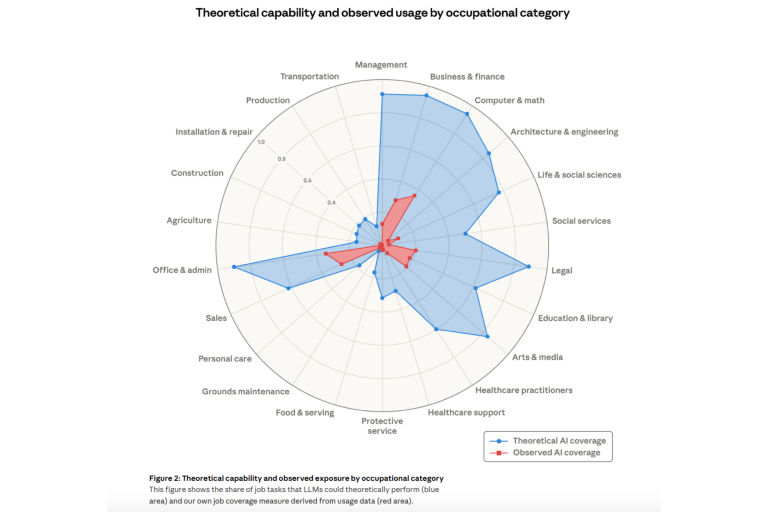
 
https://fortune.com/img-assets/wp-content/uploads/2026/03/Anthropic-5.png?format=webp&w=768&q=100
There was a disruption of the status  quo with the IT revolution that made some industries redundant; classified advertising and newspapers, video rental stores, travel agents, stockbrokers to name a few. There is growing nervousness about what will change in the wake of rising AI development and use, and the potential of disruptions on a much larger scale than what occurred with the IT revolution. 
 
"Is this time bigger? Yes"; perhaps by a factor of ten, mused Anton Korinek, AI expert at University of Virginia. Yes, most certainly AI though still an untested technology, holds the promise to enable more productivity from workers using it. But then, what happens when AI itself, no longer requires a human mind to direct it toward its functional capabilities? Productivity, a measure of worker output using available tools, has surged upward since 2023.
 
While it remains as yet uncertain how much this productivity acceleration owes to AI, analysts believe AI efficiency has had a large part to play in the productivity rise. Since the release of Chat GPT in 2022, capital markets have risen spectacularly; gains driven by surging value of AI companies and their suppliers; Meta Platforms, Nvidia Corp. The concern is the continued rise of productivity to the point where white-collar layoffs and company irrelevance means both will become inevitable.
Man in jacket
Jack Dorsey. Photo: Richard Drew/AP
 
Businesses begin to cut payroll costs when technology enables them to produce more with fewer employees resulting in more profit for shareholders. The fintech firm that Jack Dorsey, Twitter founder runs, announced the halving of its staff, while depending on AI productivity, and saw its shares rise over 15 percent. Columbia Business School Daniel Keum studying automation technologies change the balance within companies found employees being referred to as 'costs'. 
 
He concludes that even if jobs and wages are not yet being cut, areas like health care, remote work and freebies are being trimmed. "These side benefits are what the companies go after first, before they go after reducing your paycheque." Businesses fall by the wayside in response to advanced technologies, like Kodak and the Blockbuster chain, left behind by the internet. What the economist Joseph Schumpeter refers to as the "creative destruction" leading to progress.
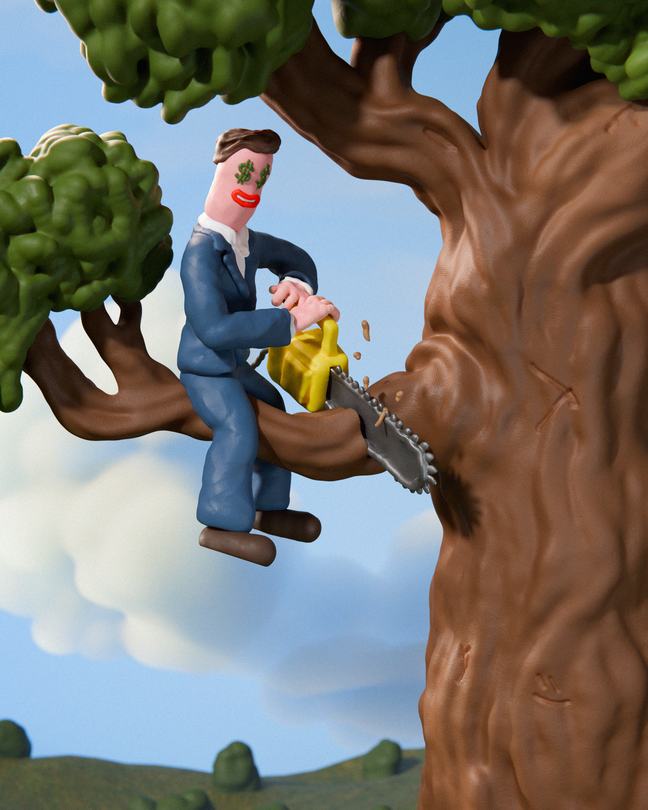
illustration with claymation-style smiling figure with dollar signs for eyes, wearing blue suit, sitting on high tree branch facing trunk and using chainsaw to saw off same branch
Illustration by Stephan Dybus
 
"That's been happening for hundreds of years in this country. It's part of the essence of capitalism", stated Federal Reserve Bank of Richmond president Tom Barkin when asked if the Fed should attempt to counter disruption to business and the labour market by AI disruption.  
"Eventually, the disruption will extend to any firm whose competitive advantage lies in human expertise that AI can replicate."
"The transition period may involve stranded assets, debt overhang and the potential for sharp market corrections."
Anton Korinek 

Labels: , , , , ,

Tuesday, April 20, 2021

Post-COVID, as the World Economy Turns to 'Normal'

"It's very easy after a gruelling year or more to feel really relieved that things are back on track."
"But a lot of the effects that we see historically are often for decades and are not easily addressed."
Vellore Arthi, University of California, Irvine

"Getting back to the pre-COVID standard will take time."
"The aftermath of COVID isn't going to reverse for a lot of countries. Far from it."
Carmen Reinhard, chief economist, World Bank

"Innovation supports higher productivity growth, and new investment raises living standards."
"Key too are strategies to keep and train workers to take advantage of the higher productivity opportunities."
Catherine Mann, chief economist, Citigroup Inc.

"There's genuine uncertainty over how much people's behaviour in terms of consumption patterns changes as a result of this crisis."
"If people go back to eating in restaurants, doing leisure travel, working out in gyms then a lot of those industries will revive."
"But it's also possible that people's tastes just genuinely change, in which case there is going to be transitionally more unemployment and there's no good government fix for that."
Adam Posen, president, Peterson Institute for International Economies
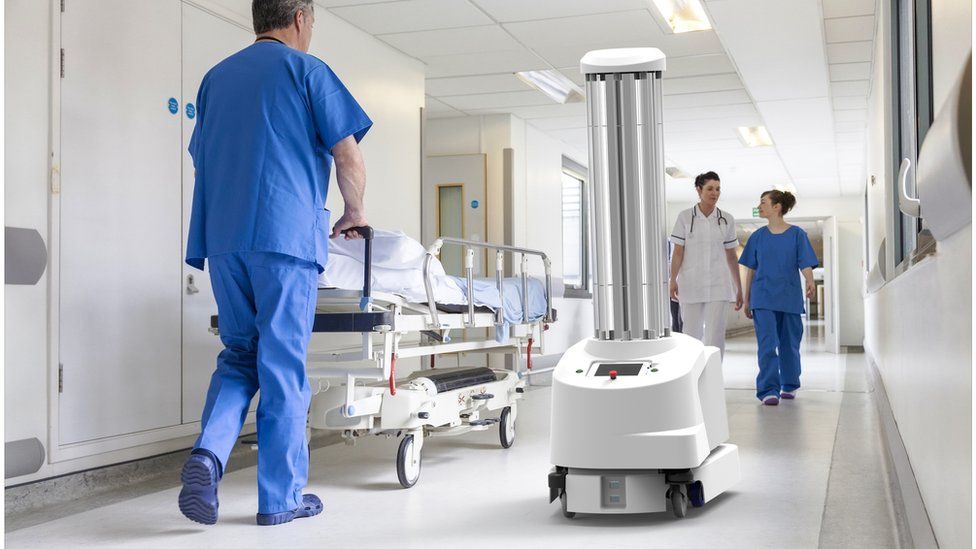
cleaning robots in a hospital hallway
UVD-Robots, which makes cleaning robots for hospitals, has had hundreds of new orders since Covid-19 broke out    UVD Robots
 
Economists taking a long view of the world economic situation looking to a COVID-free future entertain doubts of the kind of universal recovery that will take shape across the globe. A whopping $26-trillion of crisis support linked with the presence of COVID vaccines managed, to the surprise of many, to fuel a quicker recovery than had been anticipated. That, in the face of another reality, that the legacy of education in abeyance, job disappearances, crippling debt levels and greater inequalities hobbling ethnic groups, genders, generations and geographies strikes a discordant note.

The first half of the equation will benefit advanced economies, the second half will burden the poorest nations. Last year, the overall decline in gross domestic product represented the largest descent since the Great Depression. According to the calculations of the International Labour Organization, 255 million workers lost their full-time employment. The global middle class, according to research at the Pew Research Centre, shrank for the first time, since the 1990s.

A scorecard of 31 metrics across 162 nations devised by Oxford Economics Ltd, emphasizes how unevenly the costs will fall with the Philippines, Peru, Colombia and Spain representing economies most vulnerable to long-term struggles. Those countries most likely to emerge with considerably less scarring have been identified as Australia, Japan, Norway, Germany and Switzerland. Economies less affected by the coronavirus this year and beyond will not be affected as deeply.

Greater suffering will be experienced by low-income countries and emerging markets, in contrast to the 2008/9 recession when it was the rich nations that bore the brunt of the global recession. Supported by trillions of dollars in stimulus, projections indicate little residual scarring for the world's largest economy, as a result of the pandemic, with U.S. GDP forecasted to be larger than projected from before the emergence of COVID-19, according to the International Monetary Fund.
 
A Worker in Sub-Saharan Africa standing near a truck is seen wearing a mask
A worker wears a mask in Sub-Saharan Africa. © Lucian Coman/Shutterstock 
 
"A decade of global growth disappointments" is on the horizon -- warned the World Bank in its January report -- should corrective action not be taken. Global output, it estimated, was on course to be 5 percent lower by 2025 than its pre-pandemic trend. Countries quick to control the virus warn of the uneven road that lies to the future. As an example, New Zealand's economy contracted in the last three months of 2020, caused by the absence of foreign tourists. The country that consistently topped Bloomberg's COVID resiliency rankings now faces the prospect of a double-dip recession.

The use of robots has been accelerated by the crisis, in both manufacturing and in the services industry, reflecting the need for both workers and customers to be protected from the spread of the SARS-CoV-2 virus. Looking ahead to a revival in productivity growth spurred on by the prospect of greater robotic usage, in the process millions of jobs are on the line. The question of whether new ones will be created in the changeover, a blank slate.

In eight of the world's largest economies, over 100 million people may be faced with a need by 2030 to change their occupations ... and those most likely to suffer from gaps in their skill levels are identified as the less educated, women, ethnic minorities and the young.  Skills tend to atrophy, in a process known as hysteresis, the longer people are out of the workforce.
"A lot of those jobs are gone forever."
"Low-wage job in marginal companies or marginal sectors are gone as the companies have gone bankrupt or the sectors have been hollowed out."
"A lot of the more-adaptive companies will have filled the void, but with fewer workers."
Eric Robertson, global head of research, Standard Chartered PLC
COVID-19 will accelerate robots that keep workers safe and deliver better products faster

Labels: , , , ,

 
()() Follow @rheytah Tweet