Ruminations

Blog dedicated primarily to randomly selected news items; comments reflecting personal perceptions

Wednesday, August 23, 2023

Deathly Suspense and Timely Rescue

"I had heard stories about miracles, but I saw a miraculous rescue happening with my own eyes."
"We suddenly felt a jolt, and it all happened so suddenly that we thought all of us are going to die."
"They were telling us don't worry, help is coming,"
"We cried, and tears were in our eyes, as we feared the cable car will go down."
Osama Sharif, 15, rescued schoolboy
 
"I thought I was the smallest and I would die before anyone. I had no hope when I did not see any help and failed the attempt till 4pm [….]"
"I became hopeful when the army rescued Irfanullah and I lost hope again when it became dark and the army halted heli operations. I regained hope when a local man rescued the second boy."
Ibrar Ahmed, 13
 
"After four hours, the first military helicopter hovered over our heads and he tried his best but it did not succeed."
"The second heli returned with no success as well. It made me very worried that helicopters were not succeeding and we will die soon."
"I was hell scared and all the children started screaming. We started holding each other as it kept dangling. I thought I was dead now."
Attualah, 16

"I could see death in front of my eyes."
"The wind pressure was too fast and the cable car was dangling and it had no doors from one side for over a year."
"Everyone was crying."
Rizwanullah, 15
 
"To be honest, no matter how I was making children calm and telling them we would survive, I did not see any chance that we would."
"It was a chaotic situation. But I was struggling to find ways and my phone saved us."
Gul Faraz, 24, local man
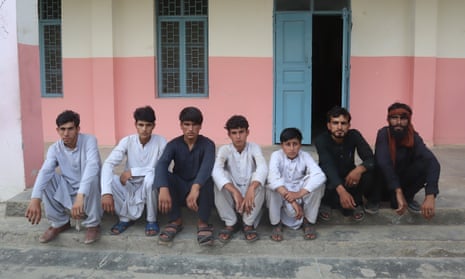
From left: Niaz, Attaullah, Usama, Ibrar Ahmed, Rizwanullah, Gul Faraz and Sher Nawaz, after their rescue.
From left: Niaz, Attaullah, Usama, Ibrar Ahmed, Rizwanullah, Gul Faraz and Sher Nawaz, after their rescue. Photograph: Shah Meer Baloch/The Guardian

Pakistan suffered a day of suspense praying for the rescue of six children and two adults on a makeshift chairlift that regularly transported people living in the area over a deep and wide ravine, that had suddenly malfunctioned, losing one of its guideropes, a cable that had broken, leaving the car dangling hundreds of metres above the canyon in a remote part of Pakistan. 

The passengers, in a routine method of transportation for the area and many others like it in geologically mountainous terrain where these makeshift chairlifts act as the sole means of travel and communication, became trapped early in the day on Tuesday. They were crossing a river canyon in Khyber Pakhtunkhwa province, Battagram district. The six children, all adolescents on the car, were on their way to school.
 
Military personnel are seen using ropes and harnesses carrying people to another location.
Pakistani military and local rescue workers bring people from the dangling cable car to safety using ropes and harnesses. (Pakistan Rescue Military/The Associated Press)
 
Nearby residents watched in horror as the cable car was suspended on its single cable, hoping it too would not break and send those clinging to it to certain death, as they awaited a government response that would bring the trapped people to safety. Throughout the country Pakistanis in their offices, shops, restaurants, homes and hospitals crowded around televisions in the grip of drama, clasping hope of rescue.

"Relieved to know that ... all the kids have been successfully and safely rescued", commented caretaker Prime Minister Anwaar-ul-Haq Kakar as he congratulated the military and other rescuers for that ultimate success of their endeavours. "Great team work by the military, rescue departments, district administration as well as the local people."

The rescue helicopters were  unable to fly after sunset, and it was feared that the wind created by the helicopter blades might further weaken the remaining cable. That concern resulted in rescuers shifting from an airborne rescue effort to an operation with high risks involving the use of one cable still intact to approach the car with the chairlift.

The commandos' rope was seen swaying in the wind against the mountainous landscape on footage played on television stations showing a child in a harness pulled to safety. Helicopter rescues in these circumstances described by an expert, are extremely delicate, emphasizing wind generated by helicopter blades threatening to weaken the remaining cable, it alone holding the car aloft.
 
The backs of dozens of people are shown in a mountainous area as they look up to watch a helicopter travelling through the area.
People watch as an army soldier slings down from a helicopter during the rescue mission. (AFP/Getty Images)
 
Most of the rescued children, handed over to their families burst into tears. "Everyone was praying for this moment" commented Nazir Ahmed, a senior police officer in the area where the rescue mission took place. Before the rescue was completed those on the stranded, swaying car were provided with food and water. Some of the trapped were enabled contact by cellphone with their families.

The cable cars are often poorly maintained to the extent that yearly people die or become injured while using them. They are a necessity in the region however, frequently used by villagers to get around the mountainous regions of Pakistan. After this heart-stopping episode that garnered the bated breath of the wider public, the president stated his intention that safety inspections be undertaken for the country's cable cars and chairlifts.

The group of eight, the two adults and six children, were marooned in those dangerous conditions for six hours, suspended precariously 350 metres above ground, even before the helicopters were dispatched after appeals were sent for an emergency response to a potentially deadly situation. In the event, the disaster management authority rose to the occasion.
 
Three children receive medical attention.
Youngsters who were trapped in a broken cable car receive first aid following their rescue, in Pashto village, a mountainous area of Battagram district in Pakistan's Khyber Pakhtunkhwa province, on Tuesday. (Nazir Mahood/The Associated Press)


Labels: , , , , , ,

Monday, August 14, 2023

Deadly Tornadoes, Hurricanes, Wildfires

"They were moving fast. The winds were vicious and kept changing. He [Charles] said they were inside a dark smoke [that] felt like a tornado and they could not see nothing,"
"They kept calling each other’s name."
"He was screaming ‘run, run, run, Carole run.’ He eventually could not hear her anymore."
Gardner Hartley, Facebook post
 
"Indo-Pacom is on a hair trigger to be able to support as necessary. Everyone fully understands the pain that people are experiencing right now."
"We want to do everything we can help. But we also don’t want to contribute to the problem by sending unnecessary capabilities that then will hinder any type of emergency response."
Pentagon spokesman Brig. Gen. Pat Ryder
 
"The remains we're finding is through a fire that melted metal... When we pick up the remains ... they fall apart."  
"[Cadaver dogs still had a vast area to search for what could still be hundreds of people who are unaccounted for]."
"We're going as fast as we can. But just so you know, 3% — that's what's been searched with the dogs."
Maui Police Chief John Pelletier
 
"The mountain behind us caught on fire and nobody told us jack."
"You know when we found that there was a fire? When it was across the street from us."
Vilma Reed, 63, Maui resident
 
"I will tell you this, as a physician, it is a harrowing sight in Maui."
"When those providers, the police and this division, do come across scenes in houses or businesses it is very difficult for them because they know, ultimately, they will be sharing with our people that there have been more fatalities."
"I do expect the numbers to rise." 
Governor Josh Green
A group of volunteers who sailed from Maalaea Bay, Maui, form an assembly line on Kaanapali Beach on Saturday, Aug. 12, 2023, to unload donations from a boat. Maui residents have come together to donate water, food and other essential supplies to people on the western side of the island after a deadly fire destroyed hundreds of homes and left scores of people homeless. (AP Photo/Rick Bowmer)

One of the most popular tourism resorts in the United States, Hawaii is undergoing a horrific wildfire emergency. Wildfires on Maui have killed 96 people so far and more lethal casualties are expected before this dreadful natural disaster is over. To the present, 2,700 structures have been destroyed by the wildfires that moved at astonishing speed to demolish everything in their path. Countless people have been left homeless, leaving social assistance authorities with a huge task of providing immediate relief to grief-stricken people.

The historic town of Maui is no more, completely destroyed. Disaster relief springs into action. And the hope is that the relief will be more effective than the largest integrated outdoor all-hazard public safety warning system in the world, that Hawaii has been so proud of. There are about 400 sirens positioned across the island chain; their purpose, to alert people to natural disasters and any other threats that could conceivably arise. What could go wrong?

Survivors reveal there was no sound of sirens, nor did they receive any kind of warning, giving them time to prepare. Hawaii's emergency management records indicate no warning sirens had sounded before people were forced to run for their lives. People realized the extreme danger they suddenly faced only when they actually saw flames or heard the explosions that erupted nearby in the state's deadliest natural disaster since 61 people died in a 1960 tsunami.

That territory-wide emergency system was developed as a result of a 1946 tsunami that marked the death of over 150 people on the Big Island. The system sirens are regularly sounded to test their readiness. And when they should have been sounded it seems that no one in authority actually thought to use them from a real emergency.
 
Officials had sent out alerts to mobile phones, through television and radio stations -- the fly in that ointment was predictably, wide-spread power and cellular outages would have had the expected result of limiting that outreach.

The death toll, warns Governor Josh Green, is expected to rise, with search and rescue operations continuing and cadaver-sniffing dogs brought in to help in the search for people's remains resulting from the inferno that overtook them. 70-year-old retired mail carrier Thomas Leonard from Lahaina wasn't aware of the fire and then he smelled smoke. The town was given no real-time information of the danger they were facing.

When he attmpted to leave in his Jeep he was forced to abandon it and run for the shore as cars nearby began exploding. There, he hid for hours behind a seawall while wind blew hot ash and cinders around him. Eventually firefighters arrived, escorting Leonard and other survivors to safety through the flames. 
 
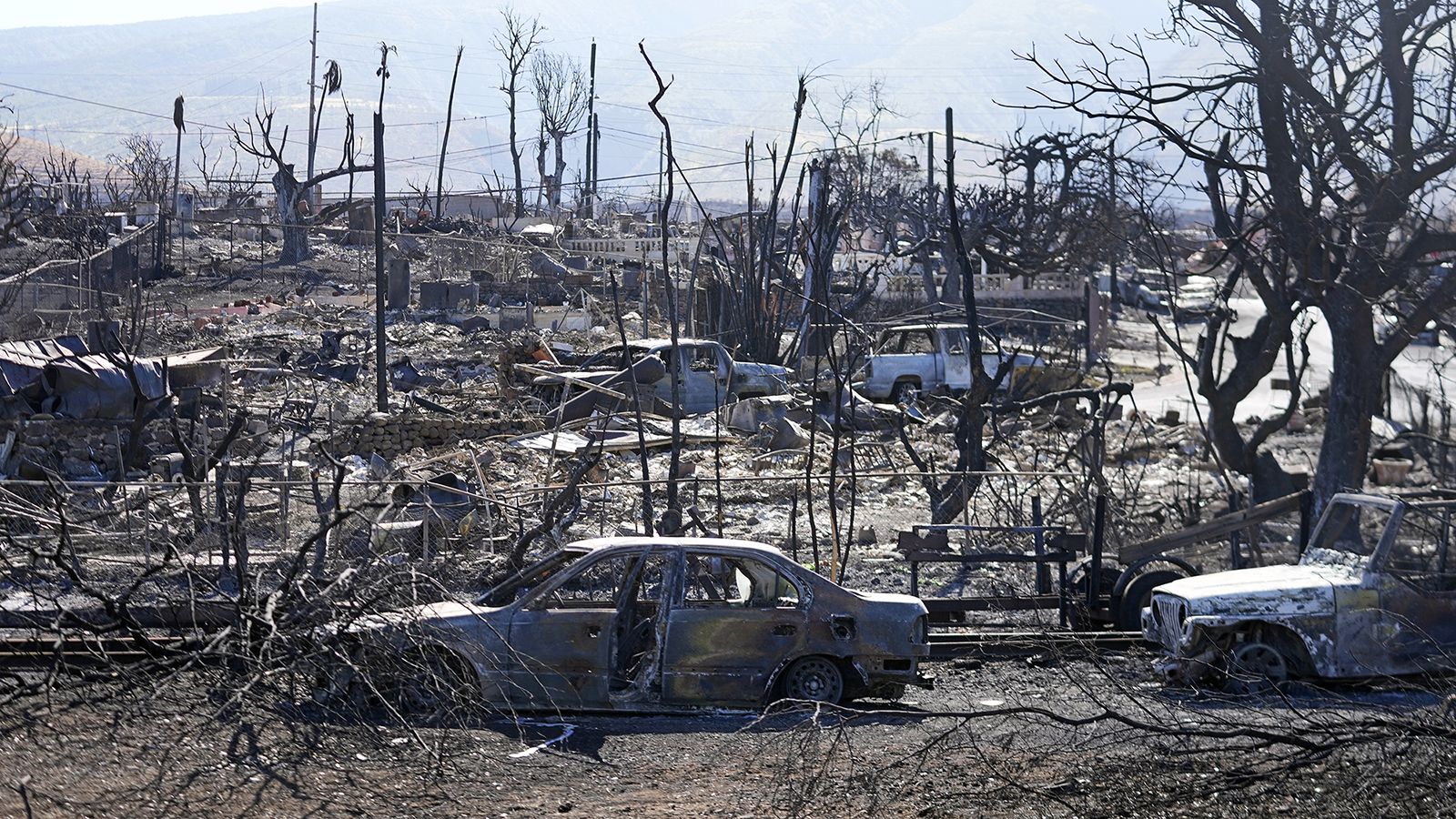
A dry summer and ferocious winds from a passing hurricane fuelled at least three wildfires that erupted this week on Maui. As the most serious of the wildfires raced through parched brush, Lahaina was left a grid of grey, ashen rubble with skeletal remains of buildings under blaze-pancaked roofs. Harbour boats scorched, the stench of burning lingers on the air from torched palm trees.

https://dynaimage.cdn.cnn.com/cnn/digital-images/org/9cc413f2-7737-4fab-9dba-a551931f7358.jpg
Destroyed homes and cars Sunday, August 13, 2023, in Lahaina, Hawaii. Rick Bowmer/AP
"The price tag is astronomical in the context of Maui's size, as annual output is about $10 billion."
"With the median single-family house price in Maui just above $1 million, the effect on the housing stock alone pulls the estimate into the billions. Combine this with the loss of a couple of hotels and numerous retail shops, most of which are more highly valued than the typical home on the island, and the number climbs considerably."
"Many visitors to Hawaii are known to travel to more than one island, which means that the cancellation of entire itineraries will have ripple effects beyond Maui. Some would-be travelers could also paint all of the Hawaiian Islands with the same broad brush and shy away from visiting, especially after volcanic eruptions on the Big Island in recent years."
Adam Kamins and Katie Nied, Moody's Analytics economists
US-FIRE-HAWAII
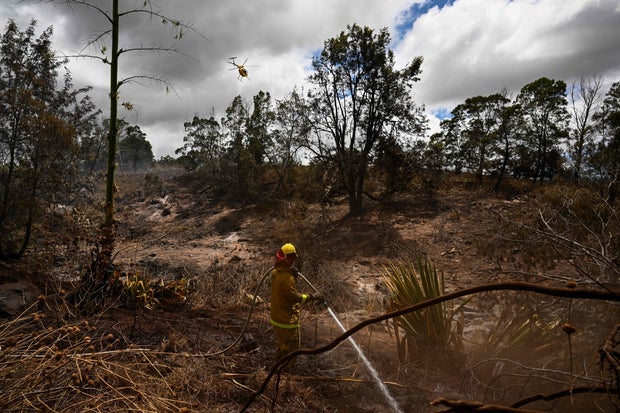
A firefighting helicopter makes a water drop as a Maui County firefighter extinguishes a fire near homes during the upcountry Maui wildfires in Kula, Hawaii on August 13, 2023.  PATRICK T. FALLON / AFP via Getty Images


Labels: , , , , , ,

 
()() Follow @rheytah Tweet