Fallout of Russia's Invasion of Ukraine
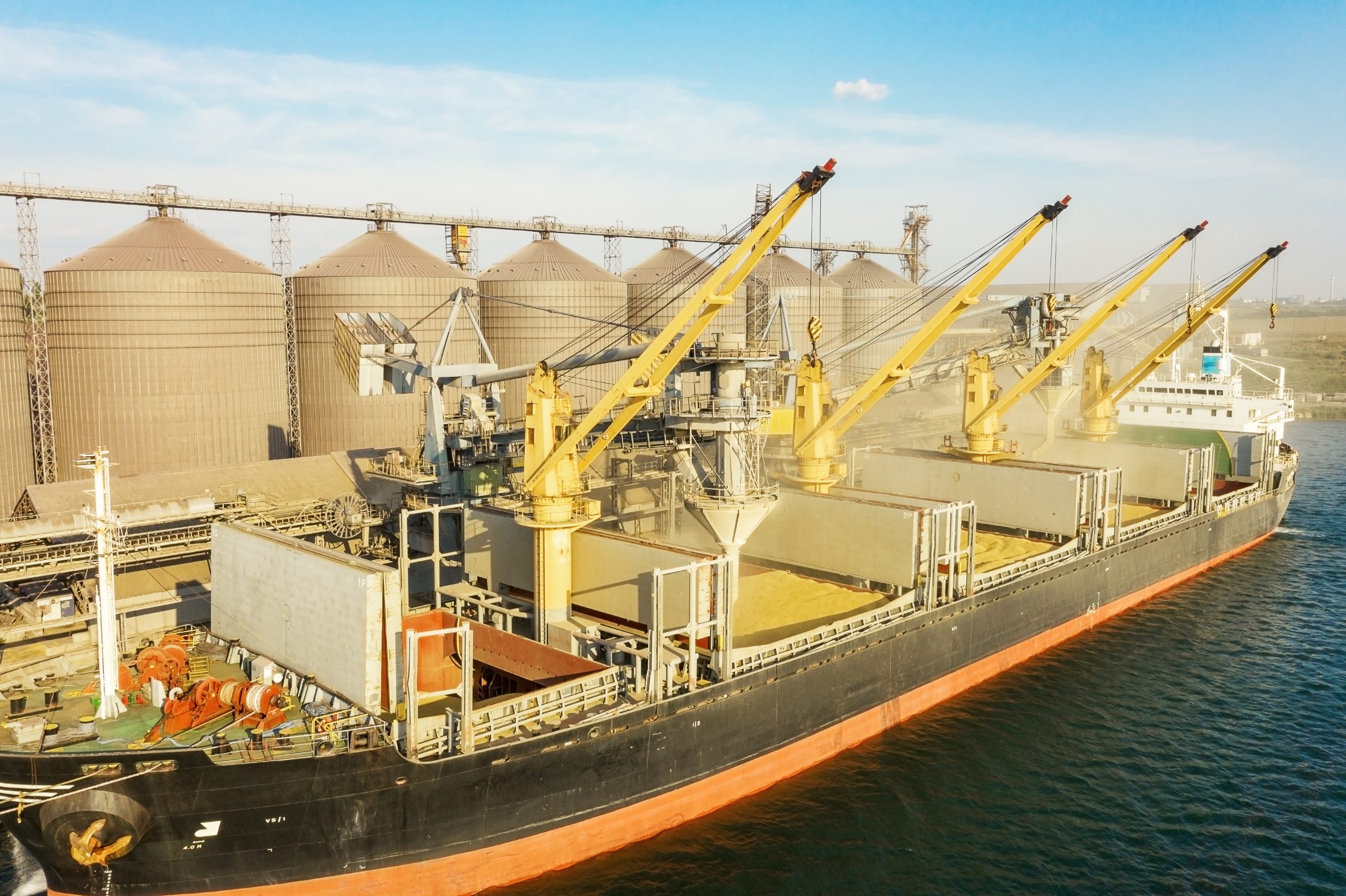
"The difficulty with commodities like a crop market is that it takes a while for the market to adjust. It's not like you can add a second shift or open up the tap.""The disruption to those two countries [Ukraine and Russia] represents a significant cut in the availability of wheat. And so, as a result, prices jumped up dramatically; increasing by about 50 percent since Russia invaded Ukraine."Alfons Weersink, professor, food, agriculture and resource economics, University of Guelph"The amount of wheat that is missing due to this conflict is like one thousandth of one percent of all supply.""The situation is very serious for people in certain countries because, sure, it's just a temporary local shortage, but a temporary local shortage that lasts a week can kill you.""And the best thing that people in wealthier western countries can do is just settle down."Sarah Taber, U.S. crop consultant"The very high likelihood of disruptions to Ukraine's grain and oilseed harvests, combined with the threat of trade restrictions on Russia's exports of cereals and other basic foodstuffs ... would jeopardize the food security of many countries around the world, and of discern, to many economically vulnerable countries."United Nations report"It certainly won't affect our [Canadian] harvest and won't really have that big influence on seeding, simply because plans are made and field crop rotations are pretty sound so it's not like we can just suddenly swing into a bunch of more wheat acres."Jim Wickett, secretary-treasurer, Western Canadian Wheat Growers Association
 |
As a result of Russia's invasion of Ukraine not only is Europe facing massive destabilization and the potential for the conflict to metastasize and have the potential to lead to a wider conflict, it also forces Europe to look elsewhere for their energy sources, deviating from their dependence on Russia for a good proportion of their gas and oil. Food production is also on the line in the eventuality of a crop shortages, in particular wheat since both Ukraine and Russia are major international exporters of wheat.
Turbulence has entered the international wheat market, leading to questions about how an expected shortfall will be handled. Just as the complications relating to weaning Europe off Russian-derived oil and gas has presented as an issue, so too does the complex issue of the vital distribution of cereal grains now present as an emergent problem, one that will affect less affluent countries dependent on imports of Russian and Ukrainian crops to supplement or to entirely provide as their sole source of wheat and other grains.
The spectre of global food shortages looms large with two major exporters of agricultural commodities now at war, placing underdeveloped nations, major importers of food, at a critical disadvantage. From Russia and Ukraine close to 64 percent of sunflower seed oil supplies the world market. Ukraine provides the world with 14 percent of its barley and 20 percent of rapeseed. Between them, Ukraine and Russia account for roughly 28 percent of world wheat exports.
The dire predictions of shortages has eyes swivelling to another major exporter of world grain supply; Canada. The Food and Agriculture Organization of the United Nations' recent analysis of the Russia-Ukraine conflict fallout argued that the fighting could lead to a "sudden and prolonged reduction in food exports" culminating in the undernourishment of between eight and 13 million people worldwide from economically vulnerable countries.
 |
Combine harvesters unload harvested wheat grain into a truck near Stavropol, Russia. Source: Bloomberg |
According to figures supplied by the US Department of Agriculture, about seven million tons of wheat is absent from the global supply chain as a result of the conflict, partially offset in exports by Australia and India. Black Sea wheat from the two countries in conflict is largely exported to the Middle East and North Africa, along with underdeveloped countries heavily reliant on food imports. Eritrea sourced all of its wheat last year from Russia and Ukraine. In the Seychelles over 90 percent of wheat came exclusively from Ukraine in 2021.
Around the world close to fifty countries source in excess of 30 percent of their wheat imports from Russia and Ukraine. A situation which has led to some governments taking action as in Egypt, the largest wheat importer in the world, where the government has fixed the price of bread to guard against price hikes. Lebanon is now seeking its wheat from India to compensate for the 80 percent it normally obtains from Ukraine.
As for Canadian farmers, few are likely to add more fields to wheat production since even at increased prices wheat is not a profitable crop. Moreover since other crops tend to be more favourably priced such as canola, farmers are unlikely to plant more wheat in the face of other, more profitable crops presenting as an option. Canada produced 21.7 million tonnes of what last year, 12.6 million tonnes of canola, 14 million tonnes of corn and 6.3 million tonnes of soybeans. Barly fields rounded out with 6.9 million tonnes, and oats, 2.6 million tonnes.
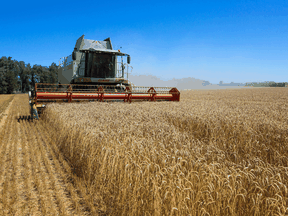 |
| A harvester at work in the Khmelnytskyi region of Ukraine. Russia and Ukraine account for about 28 per cent of the world's wheat exports. |
"Wheat prices have increased to the point where they're likely profitable, if you can get the yields, but also all the other commodities have increased as well.""You can't grow canola every year -- at least a person shouldn't be -- so throwing that wheat into the rotation breaks up the disease cycles on some of the more profitable crops.""And yeah, on a lot of years, if you can get good yields, there is still a potential for profit on wheat."Bill Prybylski, vice-president, Agricultural Producers Association of Saskatchewan
Labels: Conflict, Energy Shortages, Food Crop Shortfalls, Russian Invasion of Ukraine
posted by Pieface @ 8:21 PM
0 comments


