Ruminations

Blog dedicated primarily to randomly selected news items; comments reflecting personal perceptions

Monday, April 13, 2026

That Critical Maritime Passage

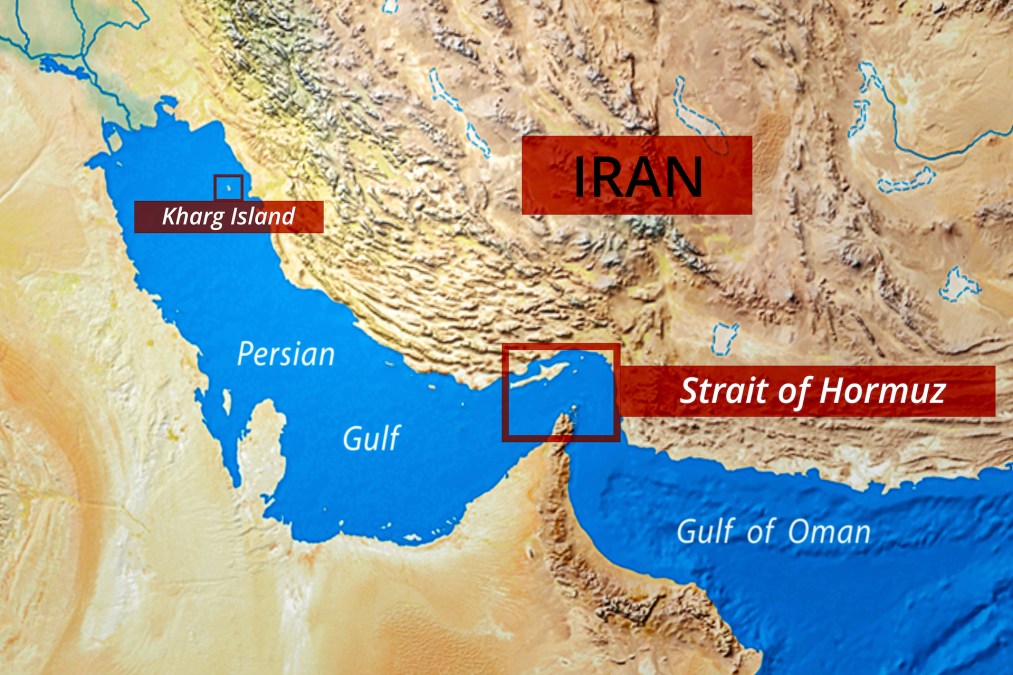
"Today, we began the process of establishing a new passage and we will share this safe pathway with the maritime industry soon."
"Additional U.S. forces, including underwater drones, will join the clearance effort in the coming days."
U.S. Central Command commander Admiral Brad Cooper 
 
"Effective immediately, the United States Navy, the Finest in the World, will begin the process of BLOCKADING any and all Ships trying to enter, or leave, the Strait of Hormuz. At some point, we will reach an “ALL BEING ALLOWED TO GO IN, ALL BEING ALLOWED TO GO OUT” basis, but Iran has not allowed that to happen by merely saying, “There may be a mine out there somewhere,” that nobody knows about but them. THIS IS WORLD EXTORTION, and Leaders of Countries, especially the United States of America, will never be extorted. I have also instructed our Navy to seek and interdict every vessel in International Waters that has paid a toll to Iran. No one who pays an illegal toll will have safe passage on the high seas. We will also begin destroying the mines the Iranians laid in the Straits. Any Iranian who fires at us, or at peaceful vessels, will be BLOWN TO HELL!"
U.S. President Donald J. Trump 
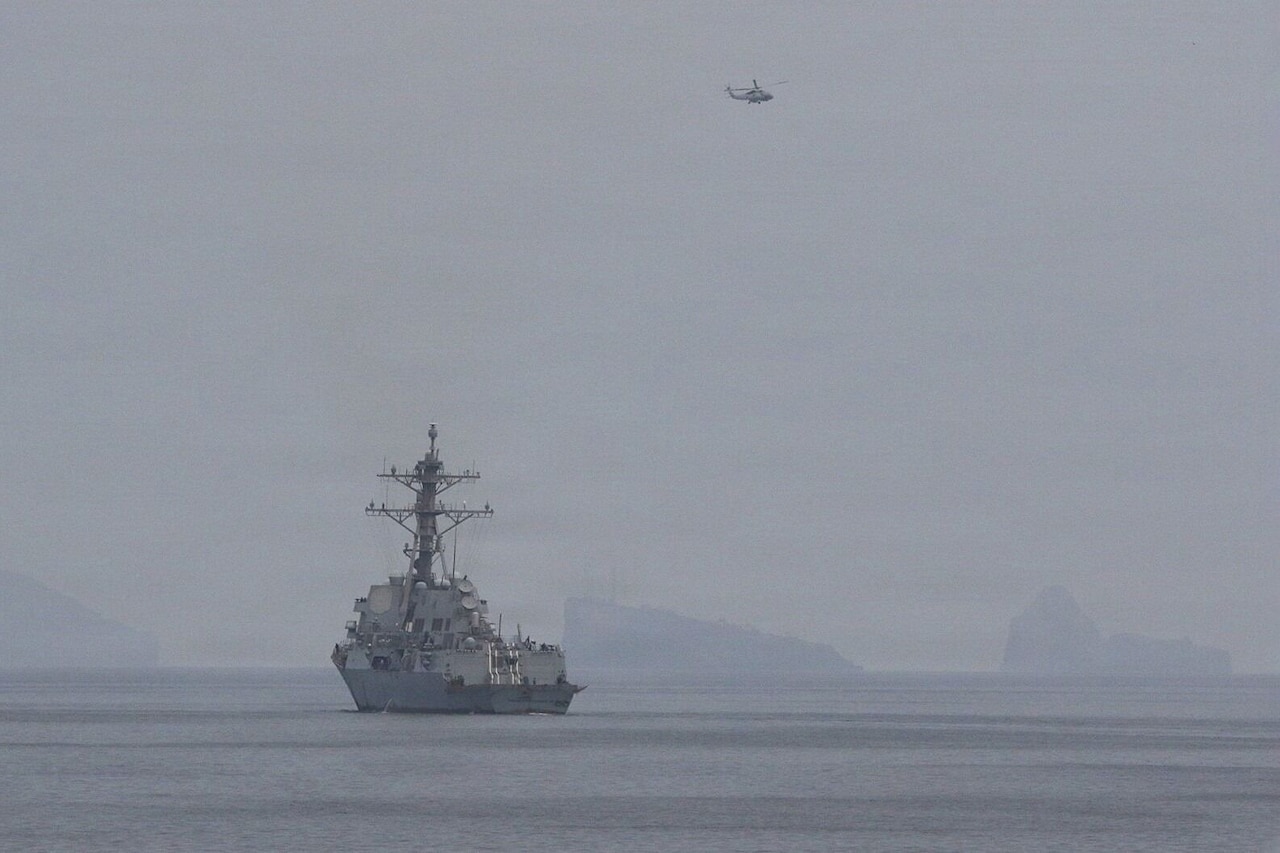
A large military ship sails in the water as a military helicopter flies overhead.

A Navy destroyer in the U.S. Central Command area of operations transits the Strait of Hormuz, April 11, 2026.  Photo: U.S. War Department  

"The blockade will be enforced impartially against vessels of all nations entering or departing Iranian ports and coastal areas, including all Iranian ports on the Arabian Gulf and Gulf of Oman. CENTCOM forces will not impede freedom of navigation for vessels transiting the Strait of Hormuz to and from non-Iranian ports."
"Additional information will be provided to commercial mariners through a formal notice prior to the start of the blockade. All mariners are advised to monitor Notice to Mariners broadcasts and contact U.S. naval forces on bridge-to-bridge channel 16 when operating in the Gulf of Oman and Strait of Hormuz approaches [per the release]."
Centcom press release  
The U.S. Department of War announced on its website that the USS Frank E. Peterson and the USS Michael Murphy are operating in the Persian Gulf, part of a broader mission to fully clear the Hormuz Strait -- an international sea passage and essential trade corridor -- of sea mines, laid courtesy of the Islamic Revolutionary Guard Corps. Underwater drones, along with  additional American forces, are set to join the clearance project in coming days.
 
https://c.ndtvimg.com/2026-04/vsb3hv7o_us-navy-ship_625x300_12_April_26.jpeg?downsize=773:435
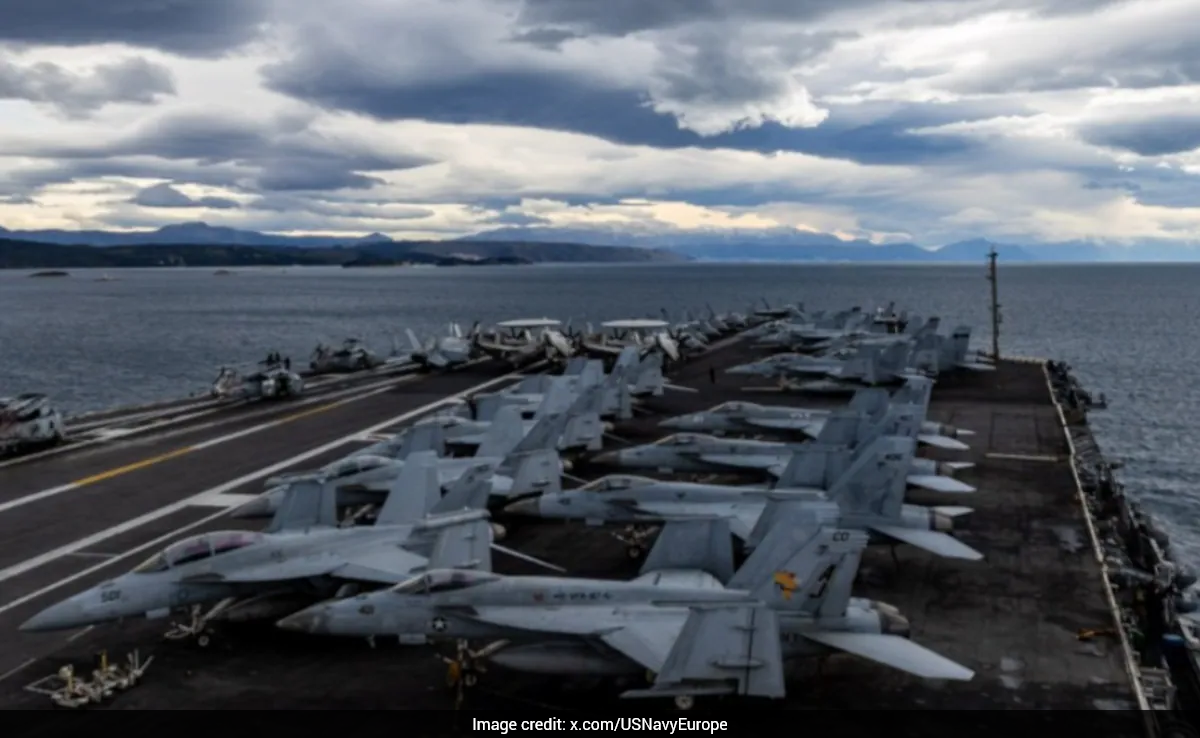
US has deployed two Navy guided-missile destroyers to Hormuz (Representational Image)

"We're sweeping the strait. Whether we make a deal or not makes no difference to me", said President Trump, even as negotiations between U.S. and Iranian representatives -- alongside a Pakistani mediator -- on a potential ceasefire broke down. The Iranian preconditions were a non-starter, with Israel intent on continuing its strikes on Hezbollah in southern Lebanon. Iran's continued insistence on its right to continue with its nuclear program, its demand that the U.S. withdraw from bombing Iran and prepare to pay reparations, along with its refusal to put a stop to its support of proxy terrorist groups ensure the talks would go nowhere.

The Islamic Republic's 'red lines' expressed as demand for damage caused by U.S.-Israeli strikes compensation and the release of  Iran's frozen assets, are a reflection of the supreme arrogance of a ruling elite that refuses to acknowledge its position as a bludgeoned theistic hegemon that threatened its neighbours and launched terror attacks by proxy internationally whose beating is its just due for the further threat its nuclear ambition poses to the world at large. 

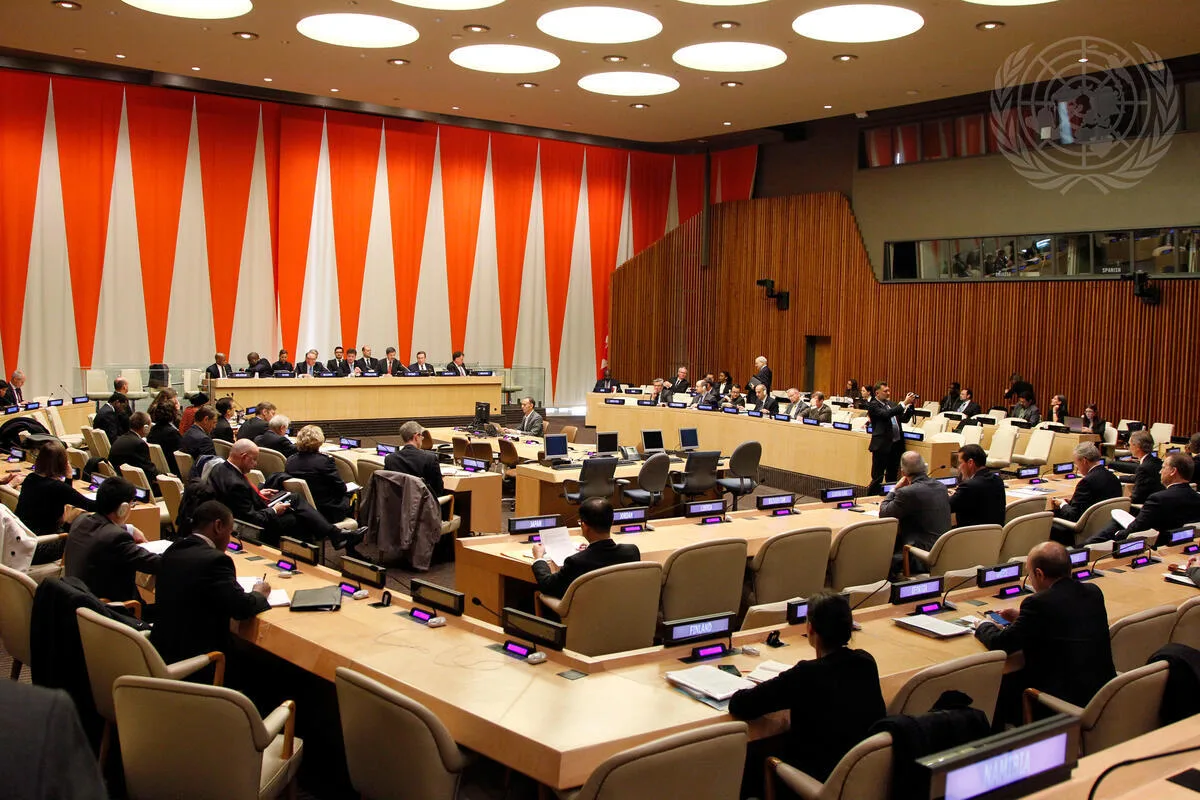
The country of 93 million people is deserving of relief from the tyranny of a regime that persecutes its own population, using vast oil reserves to fund global terrorism rather than investing in internal infrastructure of benefit to the country's future -- not as a conquering Islamist totalitarian state, but as a responsible government adhering to international norms of human rights standards. That its disregard for and abuse of its female population's right to equal treatment and respect given to their male counterparts is ignored by the United Nations where Iran was recently appointed to a human rights group is cynicism on steroids.
https://unwatch.org/wp-content/uploads/UN7269960.jpg.webp
United Nations General Assembly, UN Watch

The 15-point proposal by the United States includes restrictions on Iran's nuclear program and the reopening of the Strait of Hormuz, while Iran's 10-point proposal prior to the talks focused on a guaranteed end to the war and control over the Strait of Hormuz, where it plans to collect a maritime passage fee for each ship passing through, amounting to $1 million. An average of 100 to 130 ships passed through the strait daily, prior to the U.S.-Israel joint aerial assaults. 

That toll, if permitted to proceed, despite the deep objections of the other Gulf States that the IRGC has been bombing persistently since February 28, would enable the Islamic Republic to amass an astronomical fortune, far outstripping its revenues up to the conflict derived from its energy products. And all of it would be directed toward restoring its destroyed ballistic missile and drone stocks, along with other military assets that it has lost during the prosecution of the war, including warplanes and warships. 

"An integrated suite of unmanned maritime systems and sensors, the MCM MP counteracts mines in the littorals while increasing the host vessel’s standoff distance from the threat area."
"Embarked with the MCM MP, [a littoral combat ship] or a vessel of opportunity can conduct the full spectrum of detect-to-engage operations (hunt, neutralize, and sweep) against mine threats using sensors and weapons deployed from the MCM Unmanned Surface Vehicle (USV), an MH-60S multi-mission helicopter, and associated support equipment."
U.S. Navy, new mine countermeasures mission package
Getty Images


Labels: , , , ,

Saturday, March 14, 2026

What a Tangled Web is Woven

"{Iraq is increasingly bearing the economic and security costs of the widening conflict between Iran and a U.S.-Israel alliance, as attacks and shipping disruptions threaten the country’s vital oil sector and broader stability."
"Despite the close ties between Baghdad and Tehran, the conflict has intensified pressure on Iraq, trapping energy infrastructure, tanker routes, and military sites in the escalating regional hostilities."
"Shipping disruptions in the Strait of Hormuz and attacks linked to Iran-aligned militias have strained Iraq’s oil exports, the country’s main source of government revenue and the backbone of its economy.
Analysts warn that damage to Iraq’s oil and gas sector could have long-term consequences for investment, particularly after years of effort to attract foreign companies following periods of conflict and instability."
"Major international energy firms, including BP, TotalEnergies and Chevron, have invested heavily in Iraq’s energy industry, while companies such as ExxonMobil previously withdrew after spending billions of dollars on projects in the country."
Baghdad (IraqiNews.com) 
 Iraq caught between Iran and US-Israel as war threatens stability and oil sector
IraqiNews.com
  
"Iraq is getting caught in the crossfire of the Iran war as the only country facing strikes from both sides, and that threatens to drag the nation that has so far avoided two years of regional turmoil into a full-blown crisis."
"As the war nears two full weeks, Iraq’s situation is growing more desperate. Disruptions to Gulf shipping and strikes on oil fields and infrastructure have all but halted exports, jeopardizing a state that relies on such trade for the bulk of its revenue."
The Canadian Press 
Caught in the crossfire of this conflict where the Islamic Republic of Iran is being bombed by a U.S.-Israel coalition, Iraq is now the sole country in the region that has the dismal distinction of being hit with strikes from both the IRGC and Israel/U.S. bombing, even as Iraq has been desperate to avoid being pulled into a conflict at a time when regional turmoil, blown into full crisis mode hits a nation that is struggling to overcome the results of its own protracted internal tribal-sectarian crises. 
 
Its  high dependence on oil exports sees a dramatic cut with new disruptions to Gulf shipping and oilfield and infrastructure strikes. The bulk of Iraq's state revenues is derived from exports; that interruption threatens its revenue stream alarmingly, to the point should the shutdown of the Strait of Hormuz continue, Baghdad's oversized public-sector payroll could be threatened. A feared prelude to a country-wide risk of destabilizing civil strikes. 
 
In desperation the Iraqi federal government turned to northern Kurdish leadership in hopes of persuading them to resume exports through a pipeline to Turkey. Kurds and Turkey are like vinegar in milk; Recep Tayyip Erdogan's relentless war against Kurds make it hugely unlikely that the Iraqi Kurds could ever sign on to a expedient that flies in the face of their own interests. 
 
The Iraqi Shiite militias loyal to the Islamic Republic and at their beck and call have long threatened U.S. interests in Iraq. With the attack on Iran, the Iraqi militias have stepped up their targeting of U.S. bases leading to the U.S. mounting retaliatory strikes in defence of its troops stationed in Iraq. Drone and missile attacks now target American interests in Iraq as a response to the February 28-initiated strikes in Iran, with military bases in the Baghdad and Irbil airports and American diplomatic facilities becoming targets.
 
Members of the Iraqi armed group Kataib Hezbollah hold flags during the funeral of their members, who were killed in an airstrike amid the US-Israel conflict with Iran, in Baghdad, March 2, 2026.
Members of the Iraqi armed group Kataib Hezbollah hold flags during the funeral of their members, who were killed in an airstrike amid the US-Israel conflict with Iran, in Baghdad, March 2, 2026. The Arab Weekly
 
Oilfields and energy infrastructure in the country have also been purposefully struck by Iran and the militias, to escalate the toll taken by the wider war in the region. Iraq is unique in the region for hosting, however unwillingly, the Iran-aligned forces that have entrenched themselves in the country, as well as significant U.S. interests. Disruptions to production of exports of oil through the Strait of Hormuz create an unsustainable sharp cut in government revenue even as a political transition takes place.
 
Near-daily drone attacks target Irbil, capital of Iraq's autonomous Kurdish region, even as Iran and allied groups send drone and rocket strikes throughout Iraq. In Irbil, beyond strikes at U.S. military bases, strikes aim as well for commercial sites, including hotels. Kurdish groups in northern Iraq are also being struck by the Shiite militias following reports that the Kurds signalled interest in mounting cross-border operations into Iran, should the U.S. support them. 
 
With one of the global community's largest public-sector workforces and pensioner contingents in Iraq, concerns that delays on payment of salaries due to the government's shrinking revenues leading to public  unrest, have reached anxiety proportions of high magnitude of the restive population. The war has also complicated a transition from a caretaker administration, since the U.S. opposed the nomination of former prime minister Nouri al-Maliki. 
 
Members of the Popular Mobilization Forces attend a funeral in Najaf, Iraq, Friday, March 13, 2026 for colleagues who were killed in an airstrike in Qaim. (AP Photo/Anmar Khalil) The Associated Press
 

Labels: , , , , , ,

Monday, December 08, 2025

That Elusive Peace Between Totalitarian Islam and Israel

"[International mediators, led by the U.S. are working] to force the way forward [to the second phase to cement the deal]. What we have just done is a pause. We cannot consider it yet a ceasefire."
"A ceasefire cannot be completed unless there is a full withdrawal of Israeli forces, there is stability back in Gaza, people can go in and out, which is not the case today."
"There is a root for this conflict. And this conflict is not only about Gaza."
"It's about Gaza. It's about the West Bank. It's about the rights of the Palestinians for their state."
"We are hoping that we can work together with the U.S. administration to achieve this vision at the end of the day." 
Sheikh Mohammed bin Abdulrahman Al Thani, Qatari prime minister 
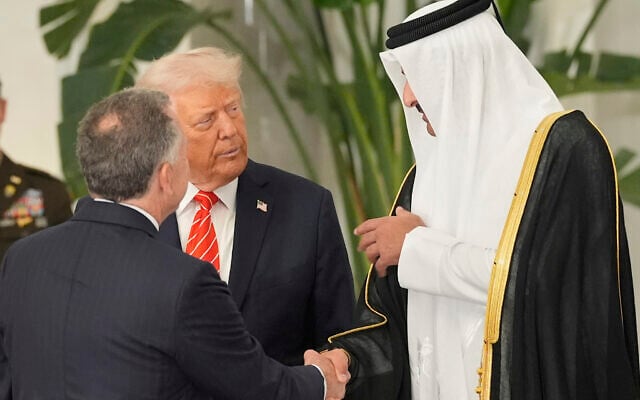
Qatar's Emir Sheikh Tamim bin Hamad Al Thani shakes hands with White House Special Envoy Steve Witkoff, as they speak with President Donald Trump before a state dinner at Lusail Palace in Doha, Qatar, May 14, 2025. (AP Photo/Alex Brandon)
 
In actual fact, this conflict is about Israel refusing to depart from its resumed geographic seat on a mere portion of its ancestral homeland. It is about surrounding Arab/Muslim countries apoplectic at the presence of a Jewish state reborn on land that the Arab conquest consecrated to Islam. It is about over four millennia of historical existence of Jews being wiped off the slate of history to argue that 'Palestine' is a deserved homeland for Arabs who migrated from Syria, Lebanon and Egypt in the last century to claim it as their own, when 'Palestine' always denoted a Jewish presence.
 
It is about repetitive bouts of conflict forced on the Jewish state by hostile, aggressive neighbours in a sectarian-tribal-clan tradition of competition and conflict. And it is, above all, the collective Middle East Arab councils of those governments inciting Arab Palestinians to believe that the land in question is theirs and theirs alone. The Arab Palestinians in fact, serve as a device to convince the international community that a human rights violation of immense proportions took place when Arab Palestinians were displaced when Jews reclaimed their patrimony.
 
And while most of those surrounding states -- who forcefully exiled a greater number of Jews who had lived in Arab countries for millennia, greater in number than the Palestinians who fled 'Palestine' in 1948 -- have now softened their stance and are prepared to accept that the Jewish presence which predated their own is permanent and its presence can enhance future prospects for peace and prosperity, the Palestinians themselves see the imperative of denying Israel's presence as cast in stone. They have, of course, had great assistance from Aryan-Muslim-Shiite Iran and from Qatar and their satellite Shiite militias. Iran has provided the theological impetus and Qatar the funding for terrorist groups dedicated to Israel's annihilation.
 
The Hamas charter pledge of destroying Israel alongside that of the Popular Front for the Liberation of Palestine, Fatah and Palestinian Islamic Jihad are the Palestinian instruments of terror that Iran and Qatar rely upon to produce the coveted goal of Jewish annihilation. Hezbollah, Yemen's Houthis and Shia militias loyal to Iran have collectively done their utmost in that direction. Despite all odds, Israel's military has met them all in combat and remains immovable. Even so, Qatar, aided by Turkey, has no intention of allowing Israel to defeat the combined forces of Islamist jihadists.
 
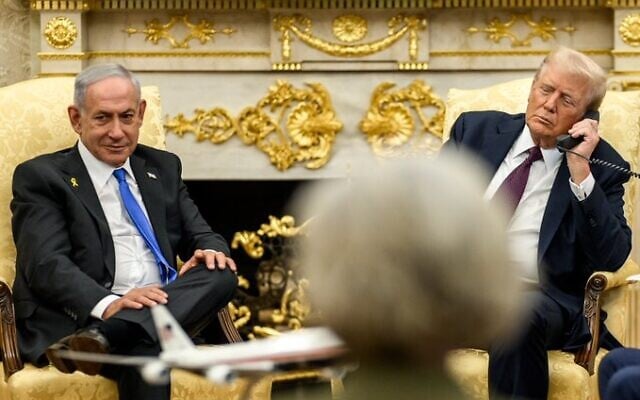
US President Donald Trump hosts a trilateral phone call with Prime Minister Benjamin Netanyahu and Prime Minister Mohammed bin Abdulrahman bin Jassim Al Thani of Qatar in the Oval Office, September 29, 2025. (The White House)
 
Qatar is alerting the United States, Israel's powerful backer, that the Trump peace plan is in a 'critical moment' with the first phase 'over', and the second soon to begin. Actually, it is not over until it is over; the first phase is incomplete, not only because the last of the Israeli hostages held in Gaza has not yet been returned, but critically, Hamas will not, as 'agreed upon' surrendered its arms. It has actually been busy in the interval between 'phases' of the peace plan, rearming, recruiting, reordering priorities and digging in as it resumes its control over that portion of Gaza it still occupies.
 
And this not-unexpected turn of events is being engineered and supported by Qatar, Iran and Turkey, for Gaza to remain in Hamas control, despite powerful rival clans in Gaza opposing Hamas's return to power and the conflict in that sector is ongoing. Gaza 'health officials' -- which is to say Hamas health sector operatives -- warn the international community of Palestinians still being targeted by the Israeli military, but further elaboration explains that these are Hamas operatives approaching Israeli troops in areas off limits to them as per the agreement.
 
The second phase relies upon the deployment of an international security force in Gaza, formation of a new technocratic government, disarmament of Hamas which would in theory lead to an eventual Israeli forces withdrawal. There are no expectations that such an international security force will deploy to Gaza; no foreign countries are anxious to have their military personnel placed in the kind of danger facing Hamas would entail. And since Hamas leaders have stated time and again they will not surrender their arms, Israeli troops will not withdraw.
 
https://media.tag24.de/720x480/q/5/q57mwogxsv4q6rnvhtjiber2ywdw6yjp.jpg
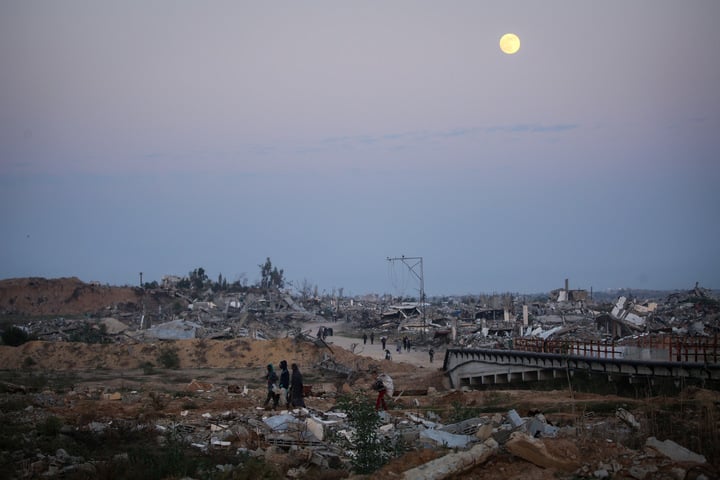
People walk amid the rubble of destroyed buildings as the Cold Moon, the last supermoon of the year, rises over the Nuseirat camp for displaced Palestinians in the central Gaza Strip on December 4, 2025.   Eyad BABA / AFP
 

Labels: , , , , , ,

Saturday, March 22, 2025

"The First Step In A Movement To Peace"

"[This is the first step in a] movement to peace."
"Both leaders agreed this conflict needs to end with a lasting peace." 
"The blood and treasure that both Ukraine and Russia have been spending in this war would be better spent on the needs of their people."
White House statement
 
"We have received signals from the United States that we are talking about the ceasefire on energy facilities, so not to attack energy infrastructure, and we are also talking about the civilian infrastructure facilities."
"We talked only about one power plant, [Zaporizhzhia nuclear power plant in south Ukraine] which is under Russian occupation."
"[I had] felt no pressure [from Trump]. It was a fruitful conversation, perhaps the most fruitful we have had, the mood was positive."
"We instructed our teams to resolve technical issues related to implementing and expanding the partial ceasefire."
Ukrainian President Volodymyr Zelenskyy
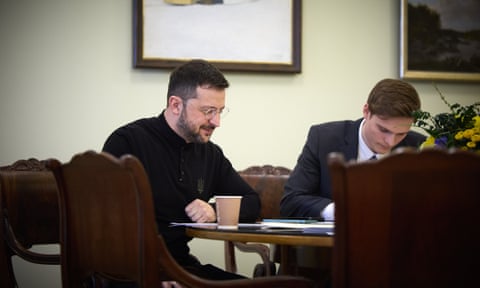
Volodymyr Zelenskyy sitting at at desk with an aid sitting next to him, writing notes
Ukraine’s president, Volodymyr Zelenskyy, said he had ‘a positive, very substantive’ conversation with the US president. Photograph: @ZelenskyyUa/X
 
"The need to halt arms supplies to Kyiv was discussed during Putin and Trump’s conversation."
"[Ceasing military aid would be] high on the agenda in negotiations between Russia and the US, but the topic will not be discussed publicly."
Vladimir Putin’s spokesperson, Dmitry Peskov
 
"It’s a very strange demand, of course. He [Vladimir Putin] wants Ukraine to give up its army, to give up security guarantees, to give up its right to be in alliances, and to give up on various territories."
"This is what he’s been fighting for for three years, and he couldn’t do it militarily …"
"And now that’s what he wants from the negotiations process."
Zelenskyy aide Mykhailo Podolyak
During a lengthy telephone call on Tuesday, U.S. President Donald Trump and Russian President Vladimir Putin agreed to seek a limited ceasefire against energy and infrastructure targets in the Russia-Ukraine conflict, an agreement that the White House felt would eventually include a maritime ceasefire in the Black Sea, and ultimately, a full and lasting end to the fighting between Russia and Ukraine. 

A statement by the White House added plans for negotiations to "begin immediately" on those steps, to take place in the Middle East, though it was not clear whether Ukraine is in agreement with the phased ceasefire plan. A limited ceasefire covering the Black Sea and long-range missile strikes and the release of prisoners was what Ukrainian officials envisaged at their meeting with the U.S. delegation this month in Saudi Arabia.
 
Mr. Putin, on the other hand, according to the Kremlin, welcomed President Trump's calls for the maritime ceasefire and felt confident enough it "agreed to begin negotiations to further work out specific details of such an agreement".  Russia and Ukraine were preparing to exchange 175 prisoners of war on each side the day following, according to the Putin-Trump conversation. Russia planned to hand over to Ukraine in addition, 23 badly wounded soldiers.
 
During the 90-minute conversation, Mr. Putin called on his American counterpart to end its foreign military and intelligence arrangements with Ukraine. While the White House focuses on Russia to sign off on its 30-day ceasefire proposal aimed at ending the Russian invasion of Ukraine, Ukrainian officials agreed last week to the 30-day ceasefire proposal in talks led by Secretary of State Marco Rubio.
 
President Volodymyr Zelenskyy, nonetheless remains skeptical that the Russian president is sincere in his oblique statements for peace, given that Russian forces continue to pound his country. The latest engagement is yet another turn in dramatically shifting U.S.-Russia relations reflecting Mr. Trump's pre-election statements of his intention to quickly put an end to the war as a top priority. 
 
That in so doing ties with longtime U.S. allies are strained, given their insistence that Putin must pay a price for its invasion of Ukraine, seems not to trouble Mr. Trump one whit. 

As for Ukraine's president, in his nightly video address on Monday, his statements clearly reflected his doubt that Putin is ready for peace. "Now, almost a week later, it's clear to everyone in the world -- even to those who refused to acknowledge the truth for the past three years -- that it is Putin who continues to drag out this war", he said.
 
As an aside during the conversation between the U.S. and Russian presidents, the White House later stated that what also came under discussion between the two leaders  during their extensive conversation, is the explosive situation currently unfolding in the Middle East; both purportedly agreeing that "Iran should never be in a position to destroy Israel".
 
As for Mr. Putin's longer-range designs, the Kommersant Russian newspaper reported that Putin had informed a meeting of senior business leaders of his intention to continue the fighting until such time that he obtains full control of -- along with international recognition of -- the four regions in Ukraine that Moscow annexed in 2022. Quite obviously, Mr. Putin has abandoned none of his hardline objectives in the war he imposed upon Ukraine.
 
https://images.theconversation.com/files/656324/original/file-20250319-56-5tzlnp.jpg?ixlib=rb-4.1.0&rect=0%2C0%2C2220%2C1110&q=45&auto=format&w=1356&h=668&fit=crop
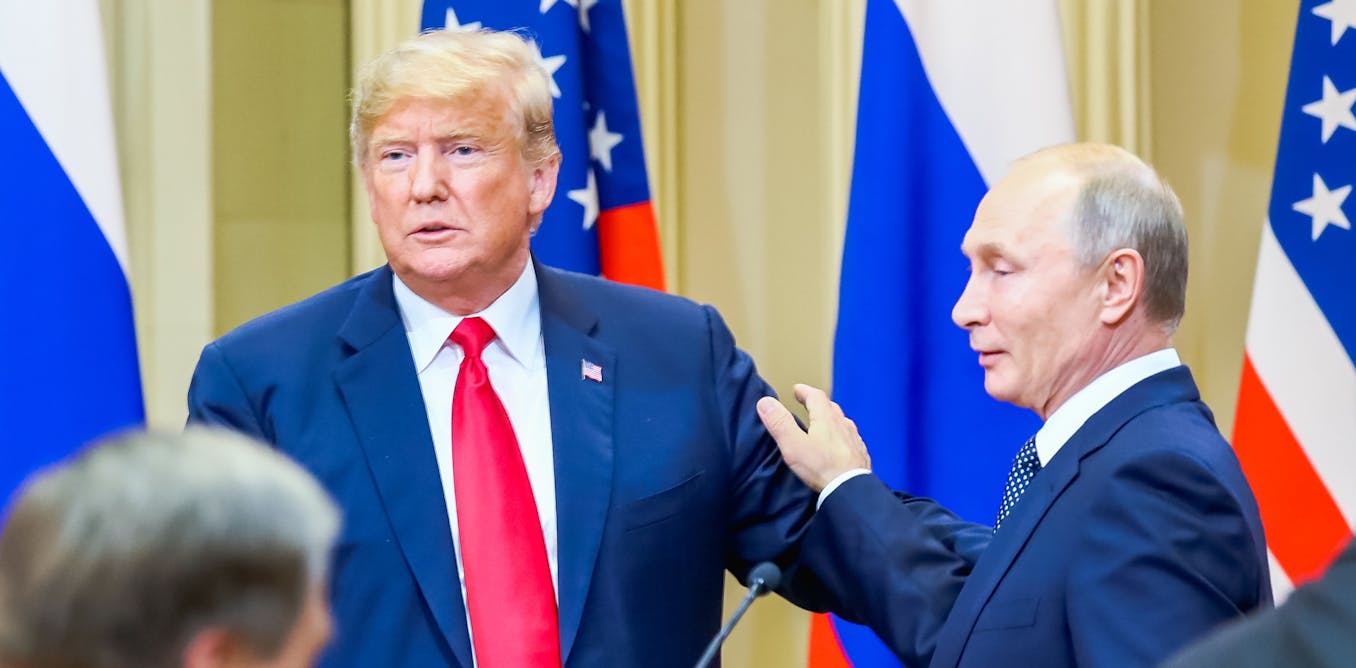
Donald Trump and Vladimir Putin meeting at a summit in Helsinki, July 2018. EPA-EFE/Mauri Ratilainen


Labels: , , , , ,

Saturday, November 09, 2024

Stoking Divisions Trudeau Style

"[The attack on a Hindu temple in Canada over the weekend was an] appalling [attempt at intimidation]."
"Such acts of violence will never weaken India's resolve."
"We expect the Canadian government to ensure justice and uphold the rule of law."
Indian Prime Minister Narendra Modi
 
"The attack by Khalistanis on the Hindu-Canadian devotees inside the premises of the Hindu Sabha temple in Brampton shows how deep and brazen Khalistani violent extremism has become in Canada."
Liberal MP Chandra Arya  
 
"[India's a lot more cooperative with the U.S.,] and I think that's telling of Canada and maybe something we need to take more seriously."
"I'm not sure dealing with the diplomatic tensions that came with this [Trudeau's pandering to Sikh-Canadian separatists] are potentially worth it. I think that's telling of Canada and maybe something we need to take more seriously."
"I think leaving it up to the Mounties [RCMP] and the intelligence agencies, that certainly could have been done."
Rupinder Lidar, PhD student, McGill University
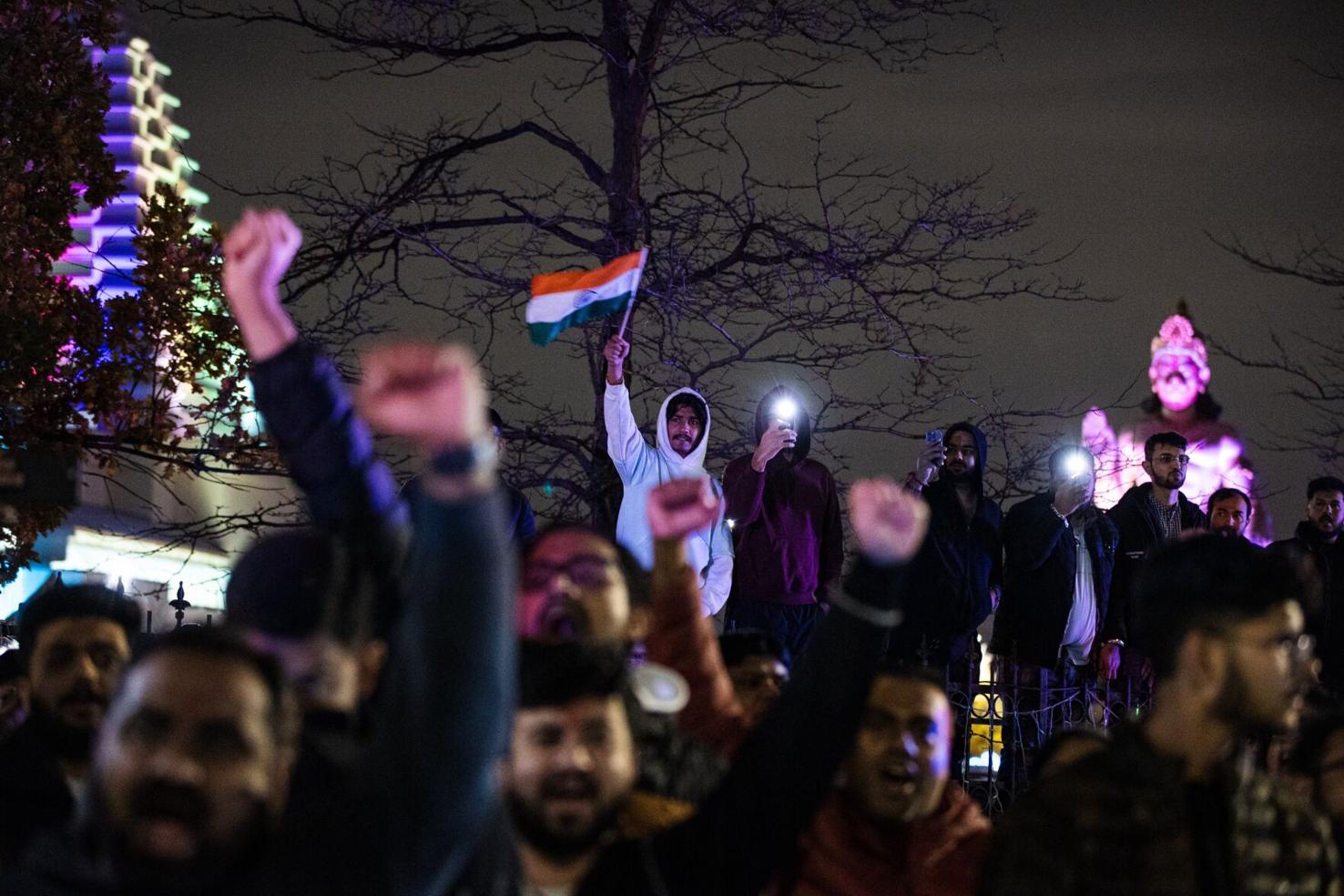
Holding flags, Brampton’s Hindu community members hold a rally at the Hindu Sabha temple whose structures are lit at night.
Members of Brampton’s Hindu community hold a rally at the Hindu Sabha temple Monday. Peel police say they issued a public safety alert after some participants were wielding weapons at the demonstration. (Evan Mitsui/CBC)
 
Last Sunday while Indian consular officials were at a Hindu temple in Brampton, violence suddenly erupted, ending with three people arrested and charged by Peel Regional Police. Demonstrators carrying banners in support of a separate Sikh portion of India named Khalistan clashed with Hindu-Canadians, some of whom held India's national flag aloft. The Khalistani movement is held by India to be illegal and a threat to its sovereignty. Khalistanis are thought of as terrorists in India, some of whom have been convicted of serious crimes in their zeal for separatism.

Videos in circulation on social media show fist fights, with opposing groups striking one another with poles, on the grounds around the Hindu temple. Police are investigating "several acts of unlawfulness" in connection with the protests.According to India's Ministry of External Affairs, the temple had been attacked by "extremists and separatists", asking the government of Canada to protect all places of worship. "Anti-India elements" orchestrated "violent disruption" outside a consular camp in Brampton on November 3, the Indian High Commission in Ottawa posted on X.

Since last fall when Prime Minister Justin Trudeau stood in the House of Commons and accused the Indian government of being involved in the killing of Sikh activist Hardeep Singh Nijjar in Alberta, both countries have been in a deep diplomatic freeze with one another. More latterly, each country ejected the other's diplomats. Additionally, a top Canadian official claimed that Indian Home Minister Amit Shah authorized a campaign of violence, intimidation and intelligence gathering against Sikh separatists in Canada.
 
https://bloximages.chicago2.vip.townnews.com/thestar.com/content/tncms/assets/v3/editorial/3/00/3009c48f-37c3-5da2-ac2f-879a6ef48f97/672d6dd864912.image.jpg?resize=1476%2C984

A large crowd gathered at the Hindu Sabha Mandir temple in Brampton on Monday.

"I can't see how it's helped [Justin Trudeau informing a federal enquiry into foreign interference that Indian agents are playing a role in widespread violence in Canada, including killings, all of which India denies]."
"It's a really grave and serious accusation. There has to be an investigation. It has to be completed ... But I think the fact that senior political leaders have gotten involved makes it harder to find a resolution, certainly publicly."
"I imagine there are back-channel discussions going on at the highest level to the extent that that's possible"
"But publicly, there's a standoff and an impasse between the two governments. [Diplomatic relations between Canada and India] are in the deep freeze."
"India has consistently refuted these allegations and tensions have escalated. [When leaders including Trudeau and Modi wade in, it] ups the ante. [That's] going to incentivize both governments to really stick to their positions, at least publicly."
Sanjay Ruparelia, associate professor of political science, Toronto Metropolitan University
On Monday night hundreds of protesters marched in close proximity to the temple until police dispersed them. Weapons had been observed in the possession of the protesters. Police announced the arrest of three people related to Sunday's violence. In British Columbia three protesters were arrested at a Hindu temple in Surrey. 
"This kind of fanned the flames for a lot of people who have existing anti-immigrant sentiments or they feel that immigration in Canada has gone too far."
"That we've imported issues from the other world here."
"It's kind of given them a leg to stand on with those arguments."
 Rupinder Liddar
https://i.cbc.ca/1.7372570.1730682464!/fileImage/httpImage/image.jpg_gen/derivatives/original_1180/hindu-sabha-mandir-temple-post-protest.jpg
A crowd gathers outside Hindu Sabha Mandir temple Sunday evening, hours after a protest outside the temple prompted a police investigation. The temple has reinstated a priest who had been suspended for his involvement in a clash with protesters, according to a statement Thursday. (Britnei Bilhete/CBC)

Labels: , , , , ,

Friday, June 07, 2024

IDF In Gaza Pursuing Deadly Terrorism

"The strike eliminated terrorists who had planned to carry out terror attacks and advance imminent terror schemes against our forces."
"Many steps were taken before the strike to minimize the risk of harm to uninvolved people [including analyzing aerial footage and making use of precise intelligence]."
Israel Defense Forces statement
https://static.timesofisrael.com/www/uploads/2024/06/AFP__20240607__34VU4WX__v1__HighRes__PalestinianIsraelConflict-640x400.jpg
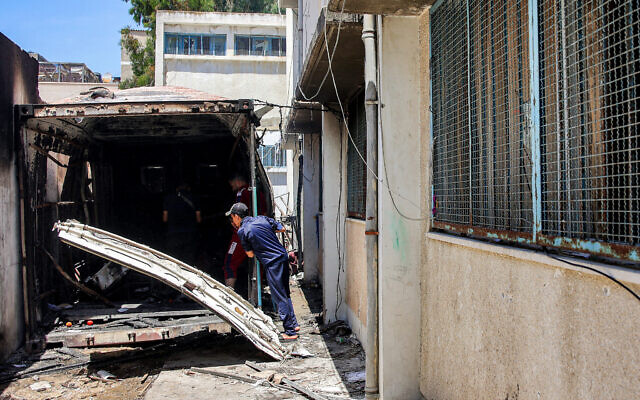
Youths inspect damage to a storage container that was hit by an Israeli strike at the Asmaa school, run by the UN Relief and Works Agency for Palestine Refugees (UNRWA), in Gaza City's Shati refugee camp, June 7, 2024. The IDF says a Hamas cell was operating from the container. (Omar Al-Qattaa / AFP)

A compound  within a United Nations school located in central Gaza saw the usual Hamas formula being played out with Hamas operatives using a school, generally viewed by the international community as being off limits to any kind of military operations, for their own purposes, of shielding themselves from direct confrontation with the Israeli military using school pupils, and in this particular instance, Palestinian internally displaced citizens who were sheltering at the school as human shields. 

The Israel Defense Forces has, over time, and experience with Hamas subterfuge and its deliberate endangerment of its own civilian population, established protocols of its own in dealing with the imminent threat posed by the terrorists while at the same time doing its utmost to prevent if at all possible in conditions of conflict, collateral damage from military actions that have the potential to injure or take the lives of men, women and children not engaged in combat.
 
https://static.timesofisrael.com/www/uploads/2024/06/AFP__20240606__34VK9RJ__v2__HighRes__PalestinianIsraelConflict-640x400.jpg
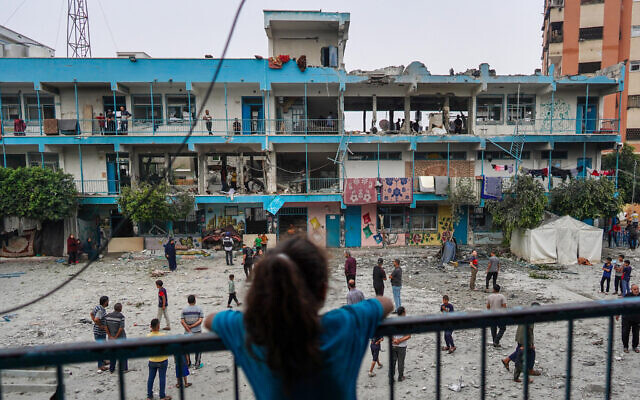
A UN school housing displacing Palestinians that was hit by an Israeli strike in Nuseirat, in the central Gaza Strip, on June 6, 2024. The IDF said it hit a compound where Hamas and Islamic Jihad terrorists were gathered, killing many of them. (Bashar Taleb/AFP)
 
There are, as usual two conflicting versions of what came next. The IDF explained its precautions taken in an effort to reduce any harm to civilians with the use of its "precise strike" on  a compound embedded within a UNRWA school in Nuseirat. Its target was between twenty to thirty terrorists known to be sheltering at the compound, among them participants in the October 7 invasion and slaughter that took place in southern Israel on October 7. 
 
These terrorists, known to have been involved in that singular atrocity must face justice and the kind of justice meted out ensures they pay the ultimate penalty.

While the members of the terror groups were gathered in three classrooms held separately from the areas where civilians displaced by the war were sheltered, they were struck and killed. The media office of Hamas made claim to 27 people having been killed in an Israeli "massacre". The number of those who were reported dead, according to UNRWA's communications director, was held to be between 35 and 45; the actual numbers unconfirmed, the individual admitted.

The IDF identified the Hamas Nukhba force involved at the school, known to have taken part in the October 7 massacre of Israelis. They, as well as members of the Palestinian Islamic Jihad "directed terror attacks from the area of the school, while exploiting it as a civilian location and as shelter", the army further explained. The strike in question was fine-tuned with the intention of avoiding harm to civilians, and as such had been twice postponed.
 
https://static.timesofisrael.com/www/uploads/2024/06/4e0785c3-4674-4188-ae5c-114655a066b0-640x400.jpg
A graphic issued by the IDF in the aftermath of a strike at the Asmaa school run by the UN Relief and Works Agency for Palestine Refugees (UNRWA), in the Shati camp west of Gaza City on June 7, 2024. The IDF says a Hamas cell was operating from the container (Israel Defense Forces)
 
That Hamas uses schools, UN offices and other civilian infrastructures such as mosques and hospitals where it is known that civilians take shelter, is a well-established reality. As the governing body of the Gaza Strip, Hamas is not held accountable for the dire harm it brings to the Palestinians dependent on the terrorist group for security, yet the target of Hamas's lethal campaign against Jews and Israel, is held accountable by the international community for the outcome of a situation where Hamas deliberately places its own population in harm's way for propaganda purposes.
 
What is even more difficult to digest, is the resounding success Hamas realizes from its slanderous propaganda holding Israel accountable for all the human suffering that Hamas alone, along with other Palestinian terrorist groups, is responsible for. 
 
The ancient curse of the Jews exemplified by the Phoenix-like flare ups of antisemitism is reawakened by terrorist-dominated public relations aimed at the West whose legacy media, government agencies, academic institutions and unions weigh accounts emanating from terrorists as equal in credibility to those coming from a democracy whose system of laws and strict adherence to human rights responsibilities reflect their own.
 
https://static.timesofisrael.com/www/uploads/2024/06/5391bfa7-e171-45d1-8f9a-3dc11044e67f-640x400.jpg
A graphic issued by the IDF on June 7, 2024, shows eight Hamas and Palestinian Islamic Jihad operatives, in addition to nine previously identified, whom the army says it killed in a June 6, 2024 airstrike on a UN school in central Gaza’s Nuseirat (Israel Defense Forces)


Labels: , , , ,

Saturday, March 26, 2022

Fallout of Russia's Invasion of Ukraine

https://www.atlanticcouncil.org/wp-content/uploads/2022/03/iStock-1335385841-scaled.jpg
"The difficulty with commodities like a crop market is that it takes a while for the market to adjust. It's not like you can add a second shift or open up the tap."
"The disruption to those two countries [Ukraine and Russia] represents a significant cut in the availability of wheat. And so, as a result, prices jumped up dramatically; increasing by about 50 percent since Russia invaded Ukraine."
Alfons Weersink, professor, food, agriculture and resource economics, University of Guelph 

"The amount of wheat that is missing due to this conflict is like one thousandth of one percent of all supply."
"The situation is very serious for people in certain countries because, sure, it's just a temporary local shortage, but a temporary local shortage that lasts a week can kill you."
"And the best thing that people in wealthier western countries can do is just settle down."
Sarah Taber, U.S. crop consultant

"The very high likelihood of disruptions to Ukraine's grain and oilseed harvests, combined with the threat of trade restrictions on Russia's exports of cereals and other basic foodstuffs ... would jeopardize the food security of many countries around the world, and of discern, to many economically vulnerable countries."
United Nations report

"It certainly won't affect our [Canadian] harvest and won't really have that big influence on seeding, simply because plans are made and field crop rotations are pretty sound so it's not like we can just suddenly swing into a bunch of more wheat acres."
Jim Wickett, secretary-treasurer, Western Canadian Wheat Growers Association
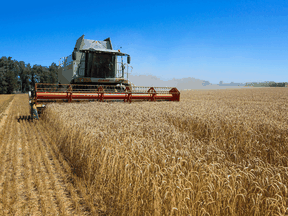
Farmers harvesting wheat last year near the village of Tbilisskaya, Russia. A crucial portion of the world’s wheat, corn and barley is trapped in Russia and Ukraine because of the war.
Credit...Vitaly Timkiv/Associated Press

As a result of Russia's invasion of Ukraine not only is Europe facing massive destabilization and the potential for the conflict to metastasize and have the potential to lead to a wider conflict, it also forces Europe to look elsewhere for their energy sources, deviating from their dependence on Russia for a good proportion of their gas and oil. Food production is also on the line in the eventuality of a crop shortages, in particular wheat since both Ukraine and Russia are major international exporters of wheat.
 
Turbulence has entered the international wheat market, leading to questions about how an expected shortfall will be handled. Just as the complications relating to weaning Europe off Russian-derived oil and gas has presented as an issue, so too does the complex issue of the vital distribution of cereal grains now present as an emergent problem, one that will affect less affluent countries dependent on imports of Russian and Ukrainian crops to supplement or to entirely provide as their sole source of wheat and other grains. 

The spectre of global food shortages looms large with two major exporters of agricultural commodities now at war, placing underdeveloped nations, major importers of food, at a critical disadvantage. From Russia and Ukraine close to 64 percent of sunflower seed oil supplies the world market. Ukraine provides the world with 14 percent of its barley and 20 percent of rapeseed. Between them, Ukraine and Russia account for roughly 28 percent of world wheat exports. 

The dire predictions of shortages has eyes swivelling to another major exporter of world grain supply; Canada. The Food and Agriculture Organization of the United Nations' recent analysis of the Russia-Ukraine conflict fallout argued that the fighting could lead to a "sudden and prolonged reduction in food exports" culminating in the undernourishment of between eight and 13 million people worldwide from economically vulnerable countries.
Combine harvesters unload harvested wheat grain into a truck near Stavropol, Russia.

Combine harvesters unload harvested wheat grain into a truck near Stavropol, Russia. Source: Bloomberg

According to figures supplied by the US Department of Agriculture, about seven million tons of wheat is absent from the global supply chain as a result of the conflict, partially offset in exports by Australia and India.  Black Sea wheat from the two countries in conflict is largely exported to the Middle East and North Africa, along with underdeveloped countries heavily reliant on food imports. Eritrea sourced all of its wheat last year from Russia and Ukraine. In the Seychelles over 90 percent of wheat came exclusively from Ukraine in 2021.

Around the world close to fifty countries source in excess of 30 percent of their wheat imports from Russia and Ukraine. A situation which has led to some governments taking action as in Egypt, the largest wheat importer in the world, where the government has fixed the price of bread to guard against price hikes. Lebanon is now seeking its wheat from India to compensate for the 80 percent it normally obtains from Ukraine.

As for Canadian farmers, few are likely to add more fields to wheat production since even at increased prices wheat is not a profitable crop. Moreover since other crops tend to be more favourably priced  such as canola, farmers are unlikely to plant more wheat in the face of other, more profitable crops presenting as an option. Canada produced 21.7 million tonnes of what last year, 12.6 million tonnes of canola, 14 million tonnes of corn and 6.3 million tonnes of soybeans. Barly fields rounded out with 6.9 million tonnes, and oats, 2.6 million tonnes.

A harvester at work in the Khmelnytskyi region of Ukraine. Russia and Ukraine account for about 28 per cent of the world's wheat exports.
"Wheat prices have increased to the point where they're likely profitable, if you can get the yields, but also all the other commodities have increased as well."
"You can't grow canola every year -- at least a person shouldn't be -- so throwing that wheat into the rotation breaks up the disease cycles on some of the more profitable crops."
"And yeah, on a lot of years, if you can get good yields, there is still a potential for profit on wheat."
Bill Prybylski, vice-president, Agricultural Producers Association of Saskatchewan

Labels: , , ,

Sunday, March 13, 2022

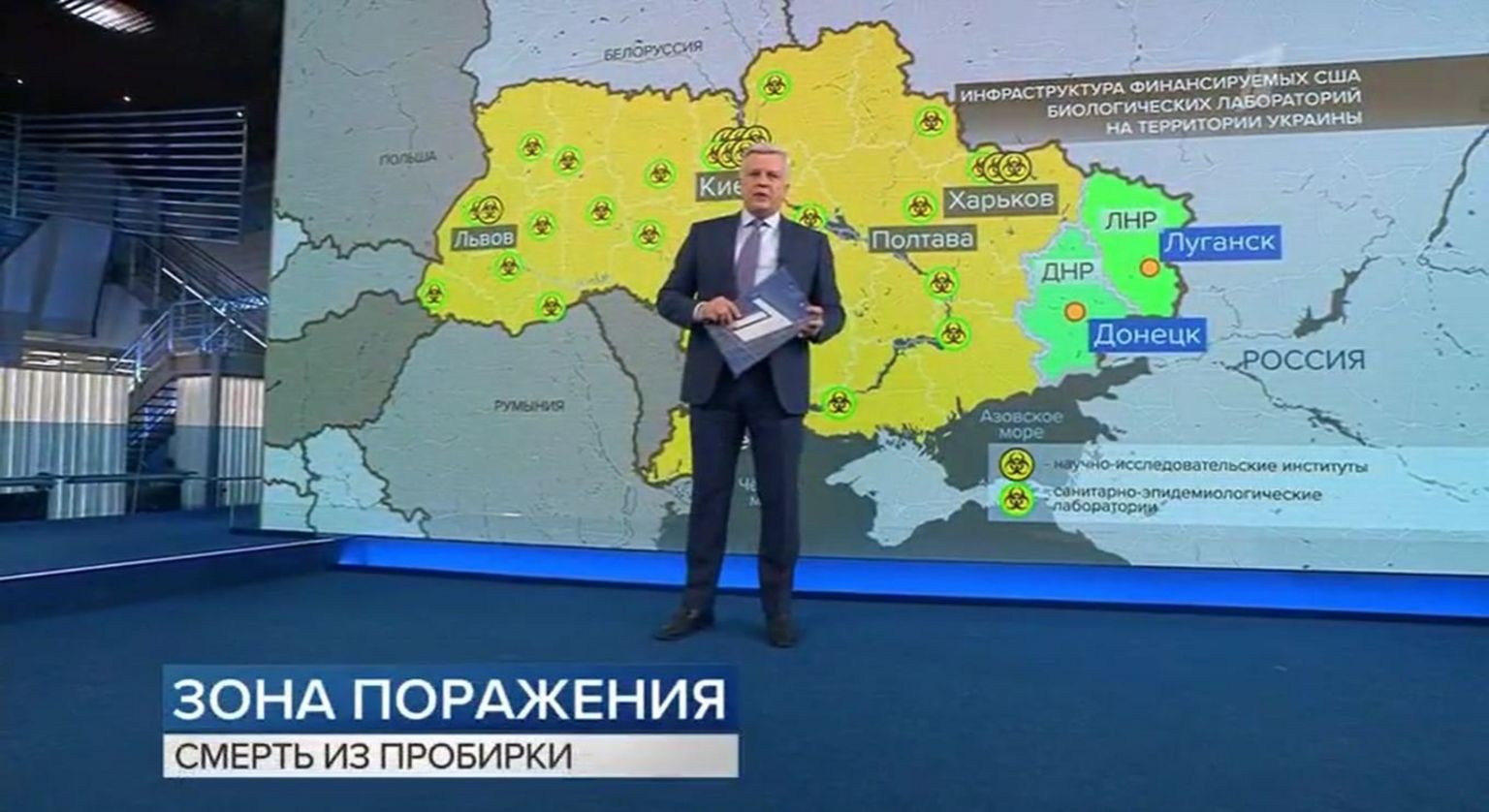
Ukrainian Bio-Lab Threatening Russia?

"[There is likely a] high degree of probability that the United States and its Western allies were producing chemicals for the distinct purpose of selectively attacking] various [groups from within the population of Russia]." 
"[Documents uncovered by the Russian military in Ukraine on 24 February - the day the Russian invasion started] show that the Ministry of Health of Ukraine has set the task of completely destroying bio-agents in laboratories."
"The Pentagon knows that if these documents fall into the hands of Russian experts, then it's highly likely that Ukraine and the United States will be found to have violated the Convention on the Prohibition of Biological and Toxin Weapons."
General Igor Kirillov, head, Radiation, Chemical and Biological Protection Troops, Russian Armed Forces
Russian state TV
Russian state TV has been showing sites which officials say are being used to develop bioweapons
 
"There are no indications that Ukrainian labs have been involved in any nefarious activity, or any research or development in contravention of the Biological Weapons Convention."
Filippa Lentzos, biosecurity expert, King's College London
 
"[The World Health Organization advised Ukraine to destroy high-threat pathogens stored at the country's public health labs to prevent] any potential spills [that would spread disease among the population]."  
"[The agency collaborated with Ukrainian public health labs for several years to enhance biosafety and biosecurity and help prevent] accidental or deliberate release of pathogens."  
World Health Organization
 
"These labs publish in openly available literature."
"They collaborate on many public health projects with global partners."
Brett Edwards, senior lecturer, security and public policy, University of Bath

"Devoting considerable sums of money and significant resources to conducting bioweapons research makes no strategic sense for Ukraine given the difficulty in using them in a conflict."  
"Conventional warfare weapons are much easier and more effective to use for countries like Ukraine."                                                                                                      Dan Kaszeta, former US serviceman, expert on defence against biological weapons
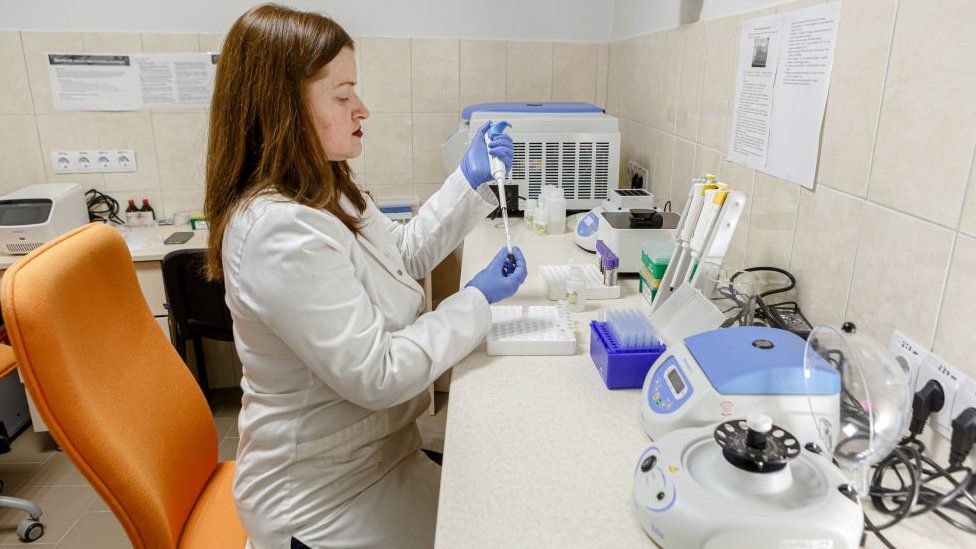
Lab in Ukraine
The US says it funds work in Ukrainian labs to tackle dangerous diseases  Getty Images

 Back in 1991, several former Soviet bioweapons laboratories in Ukraine underwent conversion by the United States, becoming facilities meant to decommission weapons of mass destruction. For the obvious purpose of preventing them from falling into the possession of those who might wish to use them following the dissolution of the Soviet Union. This appears to be the program that has now sparked conspiracy theories, useful to Russian propaganda intent on painting Ukraine and its Western allies with broad, black strokes of threats by whatever means, to Russia.

In 1992 when then-Russian Premier Boris Yeltsin, visited the United Kingdom, at a time when relations between Russia and the West were on a friendly track with signs of warming trust and collegiality, he spoke with members of the Defence Intelligence Staff, telling them that Russian bioweapons scientists were undertaking research into the influence on human genes of chemical substances.

This was echoed years later when Dr.Christopher Davis, serving on the Defence Intelligence Staff spoke of the research as having opened the door to a weapon that could be indiscriminately sprayed, yet it would prove lethal to only "certain people it was designed to find and attack". Russia has first-hand knowledge of the potential of developing biological weapons to target individuals of a distinct ethnic group, since Russia itself developed such weapons in the past.

Scientists are notoriously inquisitive about the nature of things and their interaction; it is what moves science forward, for good and for ill. Laboratories may not be involved directly in formulating bioweapons, but legitimate fears abound with respect to "dual-use" biological research. The type of research whose product could feasibly be used for nefarious purposes, once in the wrong hands.

In 2019, the Centre for the Study of Existential Risk at Cambridge University circulated a warning of the possibility that biological weapons could be formulated and produced for the very purpose of targeting a demographic representing a particular ethnic group, based entirely on their DNA. Russia's new claims warning that Ukraine was producing just such weapons, fall directly into the type of claims that follow a typical pattern of disinformation linked to Russian propaganda.
 
Dr. Filippa Lentzos, co-director of the Centre for Science and Security Studies at King's College London, had on an earlier occasion tackled similar claims made by Russia of the existence of a laboratory in Georgia dedicated to a similar purpose, to justify its invasion and conflict with Georgia, another former USSR satellite which was anxious to go its own way of independence with the collapse of the Soviet Union. Reports in Russian state media in 2018 claimed untested drugs were given to citizens at a lab funded by the U.S. in Georgia.
 
A convoy of pro-Russian troops are seen outside the separatist-controlled town of Volnovakha in the Eastern Ukrainian Donetsk region on Saturday. (Alexander Ermochenko/Reuters)
 
Now the very same claims, under very similar circumstances are once again being trotted out to justify Russia's need to invade Ukraine leading to the destruction not of a putative bioweapons laboratory but the entire national infrastructure. When Russia invaded Georgia, it re-possessed the allegiance of two provinces. Moscow has already done that in Ukraine, repeating the very same pattern that the Kremlin never seems to tire of, declaring eastern Ukraine's Donetsk and Luhansk regions in the Donbas to be independent of Ukraine; Russian territory. With Crimea thrown in for good measure.
 
And with Mariupol encircled and battered with artillery and constant shelling, with the bombing of apartment buildings, schools, government offices and hospitals it too is meant to fall into Russian hands to provide a land link between Russia and the Crimean peninsula. A gradual, creeping reclamation of a sovereign geography Moscow claims historically to be part of Greater Russia.
 
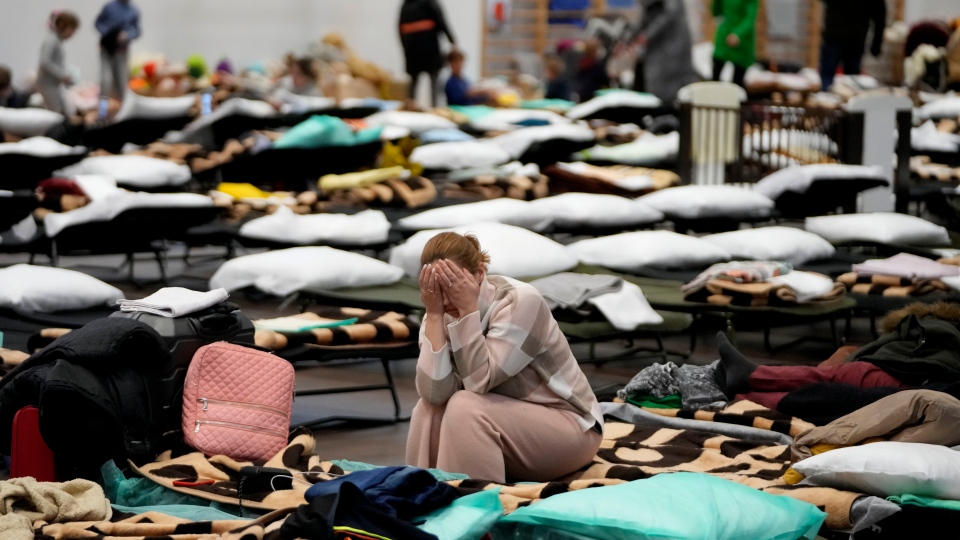
Poland shelter
A woman puts her head in her hands as she sits on a cot in a shelter, set up for displaced persons fleeing Ukraine, inside a school gymnasium in Przemysl, Poland, Tuesday, March 8, 2022. (AP Photo/Markus Schreiber)

Labels: , , , ,

Thursday, March 03, 2022

Fallout From Russia's Invasion of Ukraine on Food Accessibility and Prices

"Given what has been happening around the world over the last several months with supply chain issues, saying that food price inflation will stem from this conflict is an understatement."
"If you think Canada is immune to all of this, given our domestic agriculture production, think again."
"Agricultural commodities are traded on world markets. What happens in Ukraine and Russia affects us."
"The world, especially the agri-food world, is deeply interconnected."
Professor Sylvain Charlebois, senior director, Agri-Food Analytics Lab., Dalhousie University, Halifax
Farmers harvested wheat near Tbilisskaya, Russia, last year.
   Credit...Vitaly Timkiv/Associated Press
Oil has been recognized as Russia's big stick. Its lockhold on energy shipments to Europe where many countries are highly dependent on the mercurial decision-making of Vladimir Putin, threatens those countries when he holds back supplies, as he indulges in from time to time. Security of supply for their own domestic market grinds the wheels of industry, heats homes and businesses, and is of vital importance for any country's economy.

The swift and direct result of the current situation with Russia's full-scale invasion of Ukraine has unleashed that insecurity, and it has imposed upon Europe as well as the global community energy destabilization in the steeply rising price of oil. A year ago there was an oversupply of oil, and it was being sold at $35 a gallon. It has now increased to a staggering $100 a gallon -- and rising. Inflation is on its way to a gallop overall, increasing the price of durable product shipments and food.

Under normal circumstances, Russia exports roughly five million barrels of crude daily and about half is piped to Europe. Making it extremely difficult for those countries hugely dependent on Russian oil to follow through on their intentions to punish President Putin for his irredentist inclinations, culminating in invasion with the intention to occupy Ukraine in the sense of installing a puppet government loyal to Russia.

Penalizing Russia's Putin regime comes with unpalatable risks on many levels, in an increasingly interconnected world of finance and trade. While expressing their displeasure with Mr. Putin's imperious move to break Ukraine of its intention to move ever closer to the West, aspiring to join NATO and the European Union, many countries are concerned over the disruption of Russian energy exports. Particularly at a time when the world is slowly recovering from the economic disaster that SARS-CoV-2 wrought globally.
 
ukraine-wheat-agriculture
Ukraine's highly fertile black soil makes it an important country for global wheat supplies. (Photo by Alexander RekaTass via Getty Images)
 
Transportation costs for all manner of goods, and most particularly food, will be increasing at an uncomfortable rate. The region under a state of conflict is an exporter of nitrogen, potassium and phosphorus fertilizer. In response to the invasion fertilizer prices were increased by over $200 a ton overnight. Farmers hoping to increase their yields in response to higher prices now are viewing steeper operating costs. 

Ukraine, the second largest land mass in Europe, favoured by nature and geography with rich soil, has long been a breadbasket for Europe. Global commodity markets are responding with the onset of the conflict that Russia has brought upon Ukraine. It took no time at all to see wheat and corn futures reaching record-high levels. Canada is a world-class grain producer, the second-largest land mass in the world, after Russia. 

Ukraine, the ninth-largest producer of wheat in the world, has a production level marginally smaller than Canada on a yearly basis. It is also the fifth-largest world producer of corn with agriculture representing some 70 percent of the land in the country, reflecting the fact that about 25 percent of black soil reserves is in Ukraine, enjoying exceptional growing conditions. Ukraine and Russia together account for 25 percent of global wheat exports. The region also produces barley and rye in large quantities.

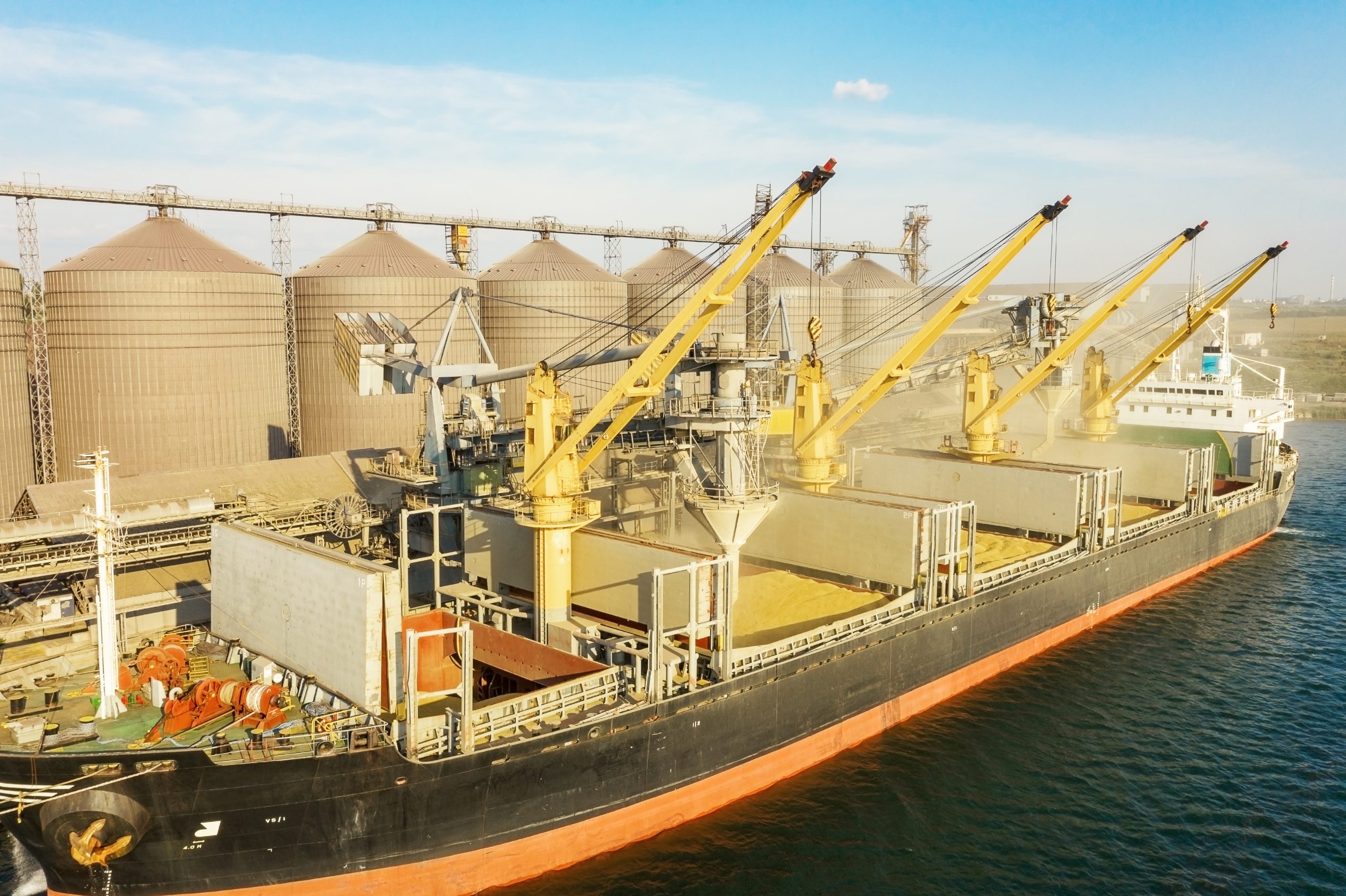
With the invasion, a ban on all commercial vessels has resulted in the inland sea of Azov -- the main connection to the Black Sea, the location of Ukrainian ports -- becoming inaccessible. Ukrainian grain exports are transported mostly by sea, and marine transport logistics have now been severely compromised in the region.
 
Harbour cranes are seen in Mariupol trade port in Mariupol, south coast of Sea of Azov in eastern Ukraine in 2018. “The invasion has led to a ban on all commercial vessels in the inland Sea of Azov, which is the main connection to the Black Sea, where Ukrainian ports are located. Almost 90 per cent of Ukrainian grain exports are transported by sea, and marine logistics in the region have been severely compromised,” writes Sylvain Charlebois.
"Global wheat markets have been tighter this year than usual, and that is because there were reduced harvests,"
"At the same time, demand has been really strong, so that has made wheat markets really vulnerable to any – even potential – supply shock."
"With both Russia and Ukraine being major exporters of wheat, this is only going to add pressure to wheat markets."
Erin Collier, economist, trade and markets division, UN’s Food and Agriculture Organization

Labels: , , , , ,

Thursday, March 28, 2019

Penetrating Suspicion, Delivering Vaccines

"There is today a health zone called Vuhovi."
"We are having huge troubles to access it." 
"We need to really be able to join hands and work together on this [inoculating vulnerable isolated villagers in Democratic Republic of Congo]."
Dr. William Perea, incident manager, WHO

"I heard someone shouting, 'bring the matches'."
"And then I felt the heat of the fire from my bed."
Kavu Mate, Ebola patient, Butembo, Democratic Republic of Congo

"They hit me with wooden sticks and they broke the car."
Gilene Barati, epidemiologist, WHO
This health clinic, specialised in treating Ebola victims, was destroyed during an attack by armed militants. The photo on the right shows a burned out vehicle belonging to French medical charity MSF. (Photos by our Observers Bienvenu and Djiress Bakoli)

Ebola has proven resilient, adaptable and opportunistic, feeding on the ignorance of isolated tribes and a climate of suspicion from people who have suffered violent discrimination for as long as they can recall, and who are suspicious of government representatives purporting to be interested in preserving their lives. The contagious, deadly virus has broken out in what is virtually a conflict zone. Responding to the outbreak in such circumstances is doubly difficult, fraught with danger for those who enter.

An Ebola treatment centre in Butembo in the east of the DRC experienced first-hand the difficulties of tending to the needs of the medically fragile when rebels with machetes and guns ran amok in the medical centre and set fire to many of the tents. Hooked to drips, weak patients faced another deathly threat; if the virus didn't kill them the terrorists just might. Somehow it was the tents containing the pharmacy, archive room, washing station and cars that were set aflame, sparing tents with patients.

Research for Medecins Sans Frontieres (MSF) established that 43 percent of Ebola patients had no links to other cases, adding to the difficulty of following the infection's spread, though it is well established that Ebola spreads through contact with bodily fluid and the virus is alive and hugely contagious on the bodies of the dead which tribal custom dictates be washed and tended before burial. MSF pulled out of Butembo following attacks on two treatment centres by Mai Mai rebels.
This photo shows part of the burned out health center in Butembo. (Photo taken on February 28 by Bienvenu Lutsumbi.)

The rebels appear particularly incensed at the presence of health workers in the area, targeting them for attack. A WHO team of epidemiologists who had travelled to a nearby village hoping to trace a patient's contacts was attacked, just another in a long string of attacks targeting Ebola centres in North Kivu province in the past month alone in a region where, since the summer the disease has been infecting the population at a steady rate.

This is a volatile region where conflict erupted and continued for over two decades, where an estimated 120 armed groups prey on the population.The spread of the disease has been significantly halted thanks to a new vaccine. "If it weren't for the vaccine, the disease could have killed thousands by now" commented Dr. Oly Hunga, minister of health for the DRC. Over 80,000 people have been inoculated in a concerted effort between the ministry and the World Health Organization.

Because some of the villages in the region represent rebel strongholds they are impossible to enter. And when health teams appear in some of the villages hoping to trace patient contacts and vaccinate them, suspicion is raised to an even higher level when they're accompanied, for safety reasons, with police escorts. "For one ill person, ten cars come with the police and people in masks", observed Alexis Kasserka a skeptical villager.

One villager expressed the opinion that the government was responsible for deliberately spreading the disease; far-fetched paranoia at first listen, until the realization strikes that the people of his tribe have faced massacres over the years. "Ebola is a game bought by white people to make money from us", offers another villager, newborn baby on her lap. The struggle to convince these communities that prevention is key to battling Ebola faces many obstacles.
"Unfortunately, the safe method of burial doesn’t correspond with traditional practices and it ends up angering the many people who aren’t allowed to touch the body or take it out of its body bag." "Recently, the number of attacks has increased and grown more serious in Butembo-Katwa. There were two more attacks in February, aside from the tragedies in Vuhovi and Katwa. We hope to see the results of our efforts to raise awareness."
Dr Jacques Katshishi, supervisor, Red Cross Ebola program
DRC Ebola death toll reaches 385
Ebola crisis continues, but mistrust means some in DRC deny it’s real    Africa Times

Labels: , , , , ,

 
()() Follow @rheytah Tweet