Ruminations

Blog dedicated primarily to randomly selected news items; comments reflecting personal perceptions

Monday, July 15, 2019

Mass Migration

"The migrations themselves are totally invisible."
"We have a lot of information about every individual insect that flies over overhead, including a measure of the shape and a measure of their size."
"I think that people will be amazed by the scale of the migrations and the significance of the ecosystem services."
"If the densities observed over southern UK are extrapolated to the airspace above all continental landmasses, high-altitude insect migration represents the most important annual animal movement in ecosystems on land, comparable to the most significant oceanic migrations."
Jason Chapman, ecologist, University of Exeter, Britain

"Many of the insects we studied provide important ecological services which are essential for maintaining healthy ecosystems, such as pollination, predation of crop pests and providing food for insectivorous birds and bats."
Dr Gao Hu, visiting scholar, Nanjing Agricultural University, China

"Animal migration, especially in insects, is a very complex behaviour which takes millions of year to evolve and is very sensitive to climatic condition."
"Global climatic change could cause decline of many species, but equally other highly adaptable species thrive and become agricultural crop pests."
Co-author Dr Ka S (Jason) Lim, Radar Entomology Unit, AgroEcology Department at Rothamsted Research 
Amidst UK Pollinator Declines, Migrant Hoverflies Are Doing Well

 Dr. Chapman and his colleagues operate a network of radar stations in Britain which scan the sky spotting insects, 24 hours each day. They decided recently to scan their captured images for the presence of hoverflies, small harmless flies which nature designed to mimic stinging insects such as bees, as a natural defence from predators. They are named hoverflies because they seem to hover, their wings beating, without moving from the same spot until such time as they do.

In their larvae stage hoverflies eat aphids, a bonus for gardens and agriculture in general. When they reach their adult stage they function to pollinate flowers as a byproduct of supping on nectar and pollen, just as bees do. Dr. Chapman's research team determined the distinctive radar signature of a marmalade hoverfly, studying it in their laboratory, then launched a search for that signature presence in scans produced by their radar stations.

I was found that great hordes of hoverflies zip about overhead with an estimated 4 billion of the tiny flies migrating into and departing southern England annually. This finding was published in the journal Current Biology in June. The identified mass migration has an immense impact on the environment.  Dr. Chapman and his researchers estimate the larvae produced by migrating hoverflies yearly devou on average 6 trillion aphids; the aphids estimated to weigh a collective 6,350 tons.
main article image
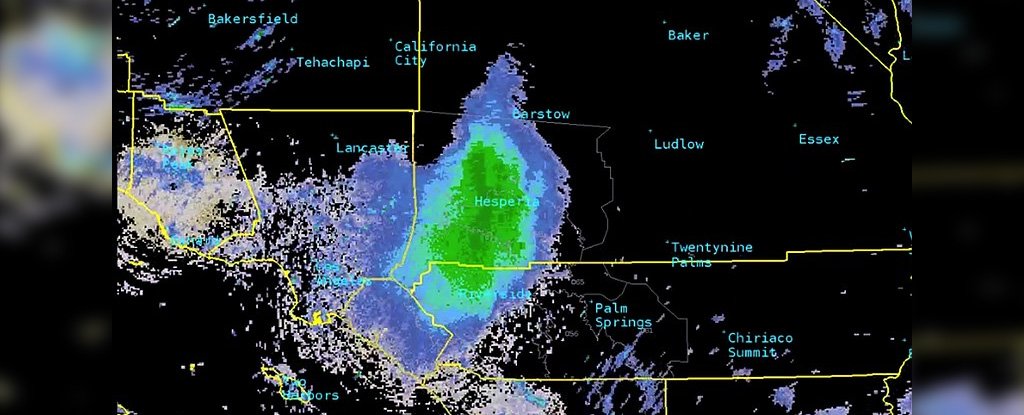
(NWSSanDiego/Twitter)

On June 4, American meteorologists in California looked over radar images and saw what appeared to be a wide area of rain; curiously no clouds were to be seen -- so they made contact with an amateur weather-spotter located directly beneath the mysterious disturbance who informed them no rain was falling at all. What he did see was every bit as puzzling as the no-cloud-perhaps-rain scenario; a broad phalanx of ladybugs in flight.
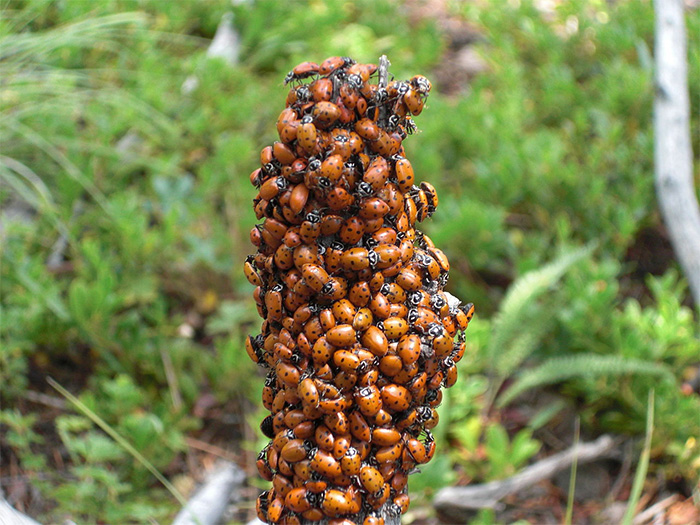
adult aggregation of convergent ladybeetles
Adult aggregation of convergent ladybugs. (Drobincorvette/CC BY-SA 3.0/Wikimedia)

An immense cloud of migrating ladybugs spaced 130 kilometers wide with a dense core, circulating 1,525 to 2,740 meters in the atmosphere was finally identified, to the astonishment of all involved. Needless to say, the intention of the meteorologists was to continue tracking the giant swarm. Despite which the ladybugs appeared to vanish with no one the wiser as to their purpose nor their final destination.
Like the marmalade fly, Eupodes corollae is a migratory species whose larvae feast on pest aphids.
WILLIAM HAWKES, UNIVERSITY OF EXETER
Leading to the speculative theory that other species of insects may also, hitherto undetected, regularly crowd the skies, their presence, let alone their destination anyone's guess. Researchers do not ordinarily tend to use radar for tracking purposes, though in Australia scientists there scan for the appearance of locusts, destructive insects which can swarm in huge numbers to eat their way speedily through agricultural crops.

Biologists have knowledge of migration habits of animals, but those of insects are as yet a scientific mystery as insects move from place to place without any but entomologists taking particular notice. Unless they're associated with outbreaks of disease, as carriers of pathogens. In the case of the hoverflies and their vital contribution to agriculture, they're known to visit billions of flowers yearly.

 Hoverflies, according to research, import 3 billion to 8 billion pollen grains into southern England in spring. And conversely as they fly south in the fall they take 3 to 19 billion pollen grains along with them in their exodus. Hoverflies are preyed upon by birds and other animals; those that die as a result of their natural lifespan coming to an end fertilize the soil. They represent about 70 tons of biomass equalling 35 million calories, according to the researchers' estimate.


Estimated biomass of migrating insects over southern United Kingdom recorded by radar and balloon flights.


Labels: , , , , ,

Thursday, January 24, 2019

Another 'Biological Wonder'

"After 20 minutes, we were still driving through these [large mounds located in northern Brazil], and I started saying, 'Well, what are they'?"
"As humans, we have never built a city that big, anywhere."
"These termites live on dead leaves, and they get to feed once a year."
"The first time I was there, it's just unbelievable. You just cannot believe what you're looking at. What's strange is they're really regularly spaced, as if there was a grand plan."
"They're actually the oldest living structures … made by insects and actually still occupied today, around about 4,000 years."
"These mounds were formed by a single termite species that excavated a massive network of tunnels to allow them to access dead leaves to eat safely and directly from the forest floor."
"It's incredible that, in this day and age, you can find an 'unknown' biological wonder of this sheer size and age still existing, with the occupants still present." 
Stephen J. Martin, entomologist, University of Salford, Britain
Murundus (termite mounds) in Brazil    Roy Funch

"[When termites build], the individual termite receives little signals from the other termites."
"It puts a ball of dirt down, and then when 100 million other balls of dirt are down, you suddenly have a mound."
"There are lots of different kinds of termite mounds. Some of them actually keep the termites cool during the day, and a little bit warmer at night."
"There's a lot to love about the termites, I think."
Lisa Margonell, science journalist

"This is apparently the world's most extensive bioengineering effort by a single insect species." "Perhaps most exciting of all -- the mounds are extremely old -- up to 4,000 years, similar to the ages of the pyramids."
"[They’re just amorphous lumps of soil, with no internal structures. Nothing lives inside them. Instead], they’re just slag piles."
"It used to be all green and brown, but around eight years ago, Google Earth sharpened their [satellite] images, and I could see the mounds that I had known from the ground."
"There’s no doubt that they’re termite-made. I’ve seen termites building the mounds with my own eyes. There’s no engineering involved. They’re just throwing the stuff out."
Roy Funch, ecologist, Universidade Estadual de Feira de Santana, Brazil
A termite queen, left, and a termite king are displayed at the Chongqing Termite Control Institute, on May 16, 2007 in Chongqing Municipality, China. (China Photos/Getty Images)
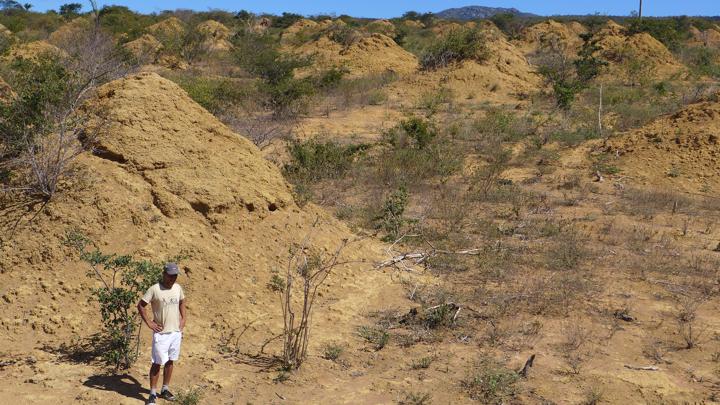
They looked like huge mounds of dirt, as though a large construction project had left them there after something like a new highway had just been completed. But these mounds were located in a very remote area and clearly no large construction projects undertaken by human agency had taken place there. Dr. Martin's companions, Brazilians, informed him it was their impression the mounds represented hills made by termites, and as such they were indeed waste left over from large and ancient construction projects, but not man-made.

Then Dr. Martin met a Brazilian ecologist, Roy R. Funch, at State University of Feira de Santana who was busy planning to undertake radioactive dating in a bid to date the age of the mounds. Several years of investigation ensued where the two scientists collaborated on studying the peculiar mounds, each three meters tall, and nine meters wide. They determined that the construction of what they realized from satellite images was 200 million mounds, represented the industry of Syntermes dirus. some of the largest termite species; insects roughly one centimeter in length.
More than 200 million termite mounds have been discovered in Brazil, spread across an area so vast that they are visible from space. (Submitted by Stephen Martin)
Spaced on average about 18 meters distance from one another, the mounds spread out across an area somewhat equal to the geographic size of Britain. Radioactive dating of eleven of those mounds put the youngest at about 690 years and the oldest at least 3,820 years of age; about equal in archaeological terms to the Great Pyramid of Giza, in Egypt.  According to the scientists' calculations the termites would have to excavate 10 cubic kilometers of dirt -- equal in volume to some 4,000 Great Pyramids -- to build those 200 million mounds.

Tunnel networks are excavated below the earth, the dirt carried up along a central tube to the summit of a mound, and discarded there, enlarging the mound, bit by bit over time. The pattern revolving around the equal spacing of the mounds appeared to result from an inherently efficient spacing of 'garbage' dirt piles. The presence of the mounds has not been known to anyone outside the region, since the area is hidden by scrub forest where temperatures reach 38 degrees Celsius and greater for most months of the year.

In that landscape the trees are scorched by heat, where the landscape turns a temporary green following a limited month-long rainy season after which the foliage falls from the trees and the landscape once again reverts to its desolate, blanched appearance. It is those fallen leaves that represent the termites' food source, available for only a short period. Since the termites are so dependent on that source of food, when the forest is cut, while the mounds remain, the termites move elsewhere, deprived of their food source.


The area occupied by the mounds is hot and dry, unsuitable for agrarian purposes, though locals did make an effort to try to grow crops there, and failed. A part of the forest was cleared and it was hoped the ensuing field would be able to bear a crop; to no avail. When the two scientists investigated below the surface they discovered layers of 'galleries' where there was storage room for old leaves, and they could see nurseries where young termites were being nurtured to maturity.
Researcher Stephen Martin, bottom, stands next to a cross-section of one of the massive dirt mounds built by termites in northeastern Brazil. (Submitted by Stephen Martin)


Labels: , , , ,

Sunday, May 27, 2018

The Itty-Bitty Spider

"It is also hoped ultimately to assemble complete case histories of several individual nests [of trap-door spiders]." 1977 report
"[To track and identify] A life-cycle of perhaps twenty years notwithstanding."
"I wanted to know how long the spiders lived."
"Although adult nests frequently have their doors and twig-lines torn off [presumably by birds] none appear to have been seriously affected by this. The spiders reattach their doors, sometimes upside down or back-to-front and attach new twig-lines." 1978 report.
Barbara Main, arachnid researcher, Australia

"We spend three hours on our knees as Barbara checks each burrow to see if it's occupied or not"
"She observes, with a mild air of concern, how few new trap door burrows there are and how unseasonably dry the reserve is [where they are located]."
"Inside, I can just see the spider, which has pulled a veil of silk lining half across its burrow. Under my breath, I introduce myself and wish her well."
Vicki Laurie, Australian Broadcasting Corp. reporter, 2013

"She was going to finish the study when number 16 died. She was going to write it up as a big thing."
"She [the legendary, long-lived southwest Australian Gaius villosus trap-door spider] was cut down in her prime. It took a while to sink in, to be honest."
"Number 16 was out in the bush, which is even more impressive because we all know that animals living captivity can live longer, perhaps, than those in the wild."
"We can be inspired by an ancient megalomorph spider and the rich biodiversity she embodied."
Leanda Mason, ecologist, Curtin University, 2016

This is a female trapdoor spider from a longterm population study in Australia. Another spider from the same study, called Number 16, died at the age of 43. It was the oldest known spider the world. (Submitted by Leanda Mason)

A spider, a tiny, blind, secretive spider living to eat and to breed and doing so in the perpetuation of her species for 43 years. Living in a minuscule burrow she herself dug before she was a year old, after having lived in her mother's burrow for the first six months of her life, without once exiting it, until finally her mother did and Spider 16 and her dozens of sibling spiders also left, to embark on a life of their own, for as long as they could survive through the vagaries of weather conditions and predators.

Spider 16 was named thus by zoologist Barbara Main in 1975, when the spider was already a year old. She had built her nest just as her mother before her had done, as an infinitesimally small tunnel-burrow, lined with silk and where she would live in the soil in the dark in a hollow sufficiently large to contain her tiny body, and no larger. As she grew she would enlarge the burrow, but it would always be tiny because she was, a fraction of an inch across.

This first home would be Spider 16's only and permanent home within the North Bungulla Reserve in Australia. After lining her burrow with silk, she wove a door of silk to stretch across the mouth of her home, and attached it with a hinge to one side of the opening. Then she hauled countless tiny twigs to the doorway's edge one after another, laying them precisely to radiate from the opening like blades of a fan, from inherited memory.

Spider 16 retreated within her burrow and there she stayed, after closing the door that would only be opened when vibration above betrayed to the tiny blind animal that something was moving among the twigs at which point she leaped out and drew into her nest an ant or a tiny beetle or mayfly. She is one of dozens of trap door spider species in the wilderness areas of the Australian wheat belt.

She started being tracked when Barbara Main set out to find, label and track her species in 1975, and placed beside her nest a small, very small, metal sign engraved with the numeral "16", identifying the spider as one of hundreds that would eventually be discovered and personalized with a number. This zoologist with the University of Western Australia marking every burrow she found of Gaius villosus, then reported her intention in 1977 to the International Congress of Arachnology of discovering their longevity potential.

Gaia, of course, is what we call Mother Earth. All of the burrows with their spider-residents were located within a few metres of one another, close to an old gravel pit, under an Acacia tree. The scientist noted when Spider 16's mother and siblings died, but number 16 lived on. Eventually a reporter with ABC broadcasting heard of an elderly scientist who had tracked a spider for four decades and asked to accompany her on her next foray.

It was explained to the reporter that females lived in their burrows, never emerging but briefly to bring in prey,  until they died. And on their death no other spider would take possession of the empty nest. Soon after their joint expedition to assess the spiders' health and presence which Dr. Main had done for forty years, an aspiring doctoral candidate joined them as an aide to Dr. Main who continued to catalogue the generations of spiders.

The zoologist, however, finally retired in her late 80s last year, succumbing to ill health and the inability to get around as she once did to pursue her investigations. Mason, studying for her doctorate in ecology, inherited the project and continued to study the spiders until in 2016 she went out for field work to the reserve to check on Spider 16. To discover that the twigs around the burrow door were in disarray.

A tiny hole was seen in the centre of the silk door. Lifting the door, Ms. Mason lowered an endoscope into the burrow and her suspicions were confirmed. A parasitic wasp had in all likelihood broken through the silk seal to lay its eggs in 16's body. And the venerable spider became a sustaining meal for the developing wasps as they matured from egg to larvae to wasp.

Spider 16 had lived for a remarkable and unexpected 43 years before she succumbed to the order of nature. Male trapdoor spiders, on the other  hand, die as soon as they impregnate a female That too is nature's order.
Number 16, the world's oldest spider, spent most of its life inside its burrow. (Submitted by Leanda Mason)

Labels: , , , ,

 
()() Follow @rheytah Tweet