Ruminations

Blog dedicated primarily to randomly selected news items; comments reflecting personal perceptions

Tuesday, August 08, 2023

XBB Sublineage of COVID-19 : Fall Vaccines

"The Government of Canada, along with provinces and territories, will continue efforts to optimize its COVID-19 vaccine supply management and further reduce COVID-19 vaccine surpluses and wastage to help inform vaccine supply planning for future pandemics."
"More information on this vaccine [single-strain shots focusing on a version of the XBB subvariant], including the authorized age groups, will be available in coming months."
Public Health Agency of Canada

"[Concerns respecting the threats and effects of COVID have likely diminished] due to the mostly mild illness experience [and while both positive and negative emotions have grown more acute with each new booster campaign, the prevalence of] annoyance [has arisen the most]."
Duke University research study

"[COVID vaccines are shifting toward a yearly routine much like annual flu shots], timed against expected seasonal rise and matched against what is most likely to circulate."
"There are people dug in against vaccination now to the extent that makes getting information to them, having that dialogue and conversation, very difficult. That, I think, is a major problem."
"I hope that we can push the needle forward on getting people vaccinated. But I think it will be very difficult."
"Dr. Fahad Razak, internist, epidemiologist, St. Michael's Hospital, Toronto

"[Decreasing rates of severe disease] will probably influence uptake and acceptability."
"[But when a virus changes sublineages, or subvariants], that does present a new challenge for the antibodies that have been generated with previous versions."
Dr. Mathew Tunis, executive secretary, National Advisory Committee on Immunization (NACI)
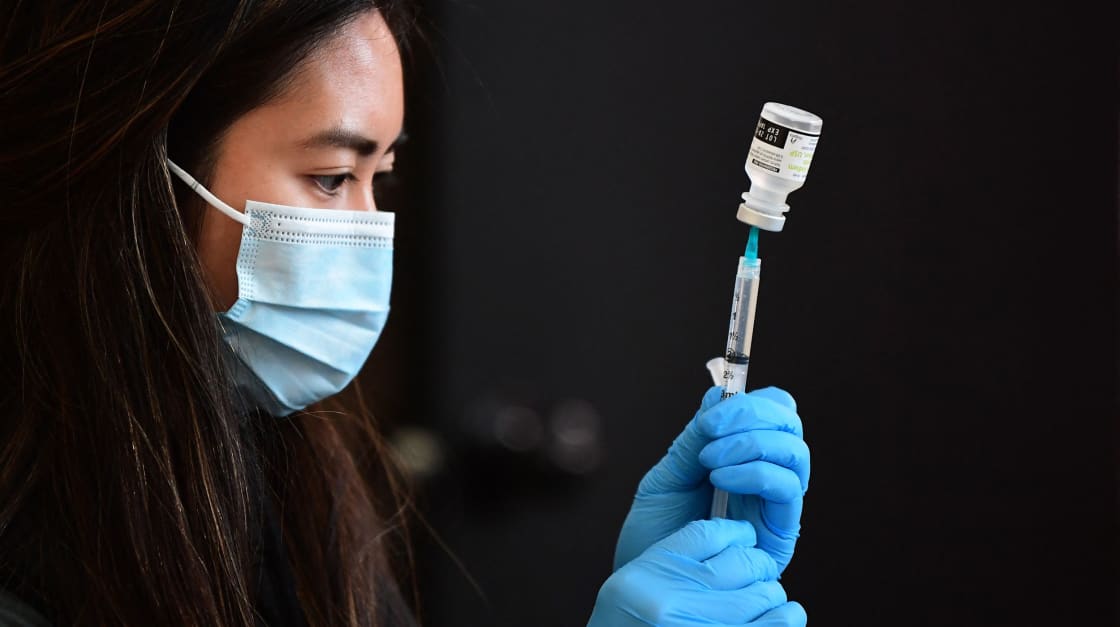
https://media-cldnry.s-nbcnews.com/image/upload/t_fit-560w,f_auto,q_auto:eco,dpr_2.0/rockcms/2022-07/220713-covid-vaccine-mn-0950-53c798.jpg
Frederic J. Brown / AFP - Getty Images file
 
It has been revealed that the current federal government in Canada destroyed over 14 million unused and expired doses of COVID-19 vaccines this year alone, with another four million on the cusp of exceeding shelf life by year's end, in a general public atmosphere of growing disinterest in COVID inoculation. This, at a time when the latest Omicron offshoots have of necessity generated new and as-yet-to-be approved vaccines.

Canada's federal vaccine inventory with its 14.4 million doses expired saw to their being discarded this year; as well, 12 million expired doses were disposed of in 2022. By the end of July, 8.6 million unused doses remained in the federal depository, and of that number, another four million is set to expire at year's end. That colossal waste reflects only what has occurred at the federal level without taking into account vaccines that expired and were disposed of once sent to provincial and territorial governments.

The auditor general of Canada criticized the Public Health Agency last year for its "unsuccessful" methods of minimizing vaccine waste, leading to squandered vaccines to the value of $1billion. Then came a scathing editorial in the British Medical Journal, highlighting Canada among the worst of the world's vaccine "hoarders". The Liberal government had "boasted" of securing more doses per capita than any other country.

"Up to 429 million doses of seven different vaccines, approximately 11 doses reserved for each of Canada's 38 million inhabitants", wrote researchers in the special Canada COVID series appearing in the BMJ. At that time it wasn't known which of the vaccines might prove effective. Canada's apparent reluctance to redistribute doses to other countries in need "once it became apparent Canada would have more than enough" for its own population, was a puzzle, wrote the researchers.

 
https://www.cidrap.umn.edu/sites/default/files/vaccine_quality_testing.jpg
iStock
 
The world is now on the doorstep of a new round of reformulated boosters; single-strain shots that focus on a version of the XBB subvariant, thought to represent the most immune-dodging COVID variant yet experienced. Ottawa seems to hesitate how many doses of the new boosters it is prepared to procure though they're expected to be available in early fall. Agreements with vaccine suppliers guaranteed access to up to 60 million doses in 2024 from Pfizer-BioNTech, along with 35 million from Moderna.

The National Advisory Committee on Immunization, Canada's panel of vaccination advisers, recommends anyone eligible receive one of the new fall boosters as long as six months has elapsed since their last vaccine or alternately last COVID infection, most particularly those individuals aged 65 and older, along with other high-risk groups.

At least two doses of a COVID vaccine covered about 83 percent of the Canadian population, a process that saw the initial willingness to be inoculated diminished with the entry of one booster after another. More Canadians now see COVID as an irritation in life, rather than a health threat, with data suggesting that 80 percent of the population  was infected with COVID since the pandemic's appearance, mostly with Omicron.

The Pandemic is no longer considered a global health emergency, reflected by the number of hospital and ICU beds occupied by a COVID sufferer plummeting. According to NACI, however, a fall booster is meant to aid in reducing the risk of infection for individuals and at the same time diminish the strain on public health systems, already in a parlous state. 

https://www.washingtonpost.com/wp-apps/imrs.php?src=https://arc-anglerfish-washpost-prod-washpost.s3.amazonaws.com/public/6RDG4JS6XNJYP62ICIWA44NIWA_size-normalized.jpg&w=1440&impolicy=high_res
Oxford Street, London (Dan Kitwood/Getty Images)

Labels: , ,

Wednesday, August 02, 2023

Looking Ahead To A COVID Fall/Winter Renewal

"The good news is that the epitopes [parts of the spike protein] recognized by T-cells, which are critical in protection against severe disease, have remained relatively well conserved."
"So, even if you were only vaccinated with the original ancestral strain, protection against severe disease in those who are relatively young and healthy appears to be holding up."
"I believe we should stop trying to prevent all symptomatic infections in healthy, young people by boosting them with vaccines containing mRNA strains that might disappear a few months later."
Dr. Paul Offit, member, U.S. Food and Drug Administration vaccine advisory committee

"My worry is that we will have very low uptake of vaccines in the fall."
"[SARS-Cov-2] has evolved dramatically in the last three years. The mutations that have emerged in many ways makes the virus nearly unrecognizable to the immune system, and to the protections we had in place against the original variant."
Dr. Fahad Razak, internist, Unity Health, Toronto, past scientific director Ontario COVID-19 scientific advisory table
A nurse uses a needle to deliver COVID vaccine to a man.
Moderna's bivalent COVID-19 vaccine was among those being offered by health-care workers at a vaccination site in Brampton, Ont., on Oct. 11, 2022. (Turgut Yeter/CBC)
 
Dr. Matthew Tunnis, immunologist and executive secretary to the National Advisory Committee on Immunization (NACI) speaks of diminishing vaccine uptake -- that the public with respect to COVID vaccines may be approaching "sort of an acceptability settling point". And to address the issue, additional "promotional activities" and communication strategies may be required in the interests of being able "to explain and rationalize what value the vaccine program can bring".

Outside Canada, some experts in the field question the requirement for yet another expansive round of boosting. A member of the U.S. Food and Drug Administration's vaccine advisory committee wrote "I believe we should stop trying to prevent all symptomatic infections in healthy, young people..." in the New England Journal of Medicine, earlier in the year. Dr. Offit feels that boosters are "best reserved" for  high-risk groups like the elderly and the immunocompromised.

Human T-cell defence, cellular immunity, appears to be coping with SARS-CoV-2 mutations, he feels, to the point that the level of neutralizing antibodies fail to tell the entire story. A sizable proportion of the Canadian population has given signals of being booster-weary, just as have populations elsewhere in the world. At least two doses of a COVID vaccine covers 83 percent of the population, over half, 51.5 percent, are "fully vaccinated" with a third dose, according to the COVID-19 Vaccine Tracker.

On the other hand, a mere 26 percent of Canadians from age five and older received one of the bivalent vaccines rolled out last September; a 50-50 mix containing some of the original strain along with the then-rapidly spreading Omicron subvariants BA.4 and BA.5. If someone hasn't been vaccinated as of today, Dr. Razak cautioned, "don't go out and get vaccinated now, unless you have a specific, high-risk reason to do so". Wait until updated shots are available, come fall.

Now under review by Health Canada, the latest formulations entirely dropped the original strain which is considered no longer in circulation. The target is newer Omicron subvariants, specifically the dominant currently-circulating stain XBB. "Individuals vaccinated with the updated formulation are expected to benefit from a better immune response against these variants in comparison to current vaccines", the latest advice from NACI.

Come fall, for those previously vaccinated against COVID-19, NACI recommends a dose of the new vaccines for people in any age groups who are ultimately authorized to receive them, at least six months from their previous COVID vaccine or identified SARS-CoV-2 infection. Immunity from even hybrid protection; vaccination plus infections; wanes with time.

COVID is no longer the unpredictable, severe respiratory disease it once presented as, with overwhelming COVID pneumonias where people rapidly deteriorated. requiring high levels of oxygen, and many of these patients dying..."are very, very rare now", assured Dr. Razak.

https://www.washingtonpost.com/wp-apps/imrs.php?src=https://arc-anglerfish-washpost-prod-washpost.s3.amazonaws.com/public/TCQDY6UQIKBSRGRLTVXB7FEBZI.jpg&w=916
A pharmacist administers a coronavirus booster dosage at a vaccination clinic in Lawrence, Mass. (Charles Krupa/AP)
"[The best way to protect the vulnerable] is to have everyone boosted."
"It's imperative we get vaccinated so that during cold and flu season we don't see the same disruptions to health care that we saw last year."
"[Part of the problem is calling them] boosters -- suggesting a] top-up. Like a yearly flu shot] you can't reasonably expect to be protected from symptomatic infections or hospitalization unless you are recently vaccinated with a matched vaccine."
Dawn Bowdish, immunologist, McMaster University

Labels: , , , , , ,

 
()() Follow @rheytah Tweet