Ruminations

Blog dedicated primarily to randomly selected news items; comments reflecting personal perceptions

Wednesday, August 02, 2023

Looking Ahead To A COVID Fall/Winter Renewal

"The good news is that the epitopes [parts of the spike protein] recognized by T-cells, which are critical in protection against severe disease, have remained relatively well conserved."
"So, even if you were only vaccinated with the original ancestral strain, protection against severe disease in those who are relatively young and healthy appears to be holding up."
"I believe we should stop trying to prevent all symptomatic infections in healthy, young people by boosting them with vaccines containing mRNA strains that might disappear a few months later."
Dr. Paul Offit, member, U.S. Food and Drug Administration vaccine advisory committee

"My worry is that we will have very low uptake of vaccines in the fall."
"[SARS-Cov-2] has evolved dramatically in the last three years. The mutations that have emerged in many ways makes the virus nearly unrecognizable to the immune system, and to the protections we had in place against the original variant."
Dr. Fahad Razak, internist, Unity Health, Toronto, past scientific director Ontario COVID-19 scientific advisory table
A nurse uses a needle to deliver COVID vaccine to a man.
Moderna's bivalent COVID-19 vaccine was among those being offered by health-care workers at a vaccination site in Brampton, Ont., on Oct. 11, 2022. (Turgut Yeter/CBC)
 
Dr. Matthew Tunnis, immunologist and executive secretary to the National Advisory Committee on Immunization (NACI) speaks of diminishing vaccine uptake -- that the public with respect to COVID vaccines may be approaching "sort of an acceptability settling point". And to address the issue, additional "promotional activities" and communication strategies may be required in the interests of being able "to explain and rationalize what value the vaccine program can bring".

Outside Canada, some experts in the field question the requirement for yet another expansive round of boosting. A member of the U.S. Food and Drug Administration's vaccine advisory committee wrote "I believe we should stop trying to prevent all symptomatic infections in healthy, young people..." in the New England Journal of Medicine, earlier in the year. Dr. Offit feels that boosters are "best reserved" for  high-risk groups like the elderly and the immunocompromised.

Human T-cell defence, cellular immunity, appears to be coping with SARS-CoV-2 mutations, he feels, to the point that the level of neutralizing antibodies fail to tell the entire story. A sizable proportion of the Canadian population has given signals of being booster-weary, just as have populations elsewhere in the world. At least two doses of a COVID vaccine covers 83 percent of the population, over half, 51.5 percent, are "fully vaccinated" with a third dose, according to the COVID-19 Vaccine Tracker.

On the other hand, a mere 26 percent of Canadians from age five and older received one of the bivalent vaccines rolled out last September; a 50-50 mix containing some of the original strain along with the then-rapidly spreading Omicron subvariants BA.4 and BA.5. If someone hasn't been vaccinated as of today, Dr. Razak cautioned, "don't go out and get vaccinated now, unless you have a specific, high-risk reason to do so". Wait until updated shots are available, come fall.

Now under review by Health Canada, the latest formulations entirely dropped the original strain which is considered no longer in circulation. The target is newer Omicron subvariants, specifically the dominant currently-circulating stain XBB. "Individuals vaccinated with the updated formulation are expected to benefit from a better immune response against these variants in comparison to current vaccines", the latest advice from NACI.

Come fall, for those previously vaccinated against COVID-19, NACI recommends a dose of the new vaccines for people in any age groups who are ultimately authorized to receive them, at least six months from their previous COVID vaccine or identified SARS-CoV-2 infection. Immunity from even hybrid protection; vaccination plus infections; wanes with time.

COVID is no longer the unpredictable, severe respiratory disease it once presented as, with overwhelming COVID pneumonias where people rapidly deteriorated. requiring high levels of oxygen, and many of these patients dying..."are very, very rare now", assured Dr. Razak.

https://www.washingtonpost.com/wp-apps/imrs.php?src=https://arc-anglerfish-washpost-prod-washpost.s3.amazonaws.com/public/TCQDY6UQIKBSRGRLTVXB7FEBZI.jpg&w=916
A pharmacist administers a coronavirus booster dosage at a vaccination clinic in Lawrence, Mass. (Charles Krupa/AP)
"[The best way to protect the vulnerable] is to have everyone boosted."
"It's imperative we get vaccinated so that during cold and flu season we don't see the same disruptions to health care that we saw last year."
"[Part of the problem is calling them] boosters -- suggesting a] top-up. Like a yearly flu shot] you can't reasonably expect to be protected from symptomatic infections or hospitalization unless you are recently vaccinated with a matched vaccine."
Dawn Bowdish, immunologist, McMaster University

Labels: , , , , , ,

Wednesday, March 29, 2023

Drug-Resistant , Hospital Acquired Fungal Pathogen

"[They're not] thermo-tolerant. They don't grow well in hot conditions and by hot, I mean body temperatures, like us. Like, 37 degrees [Celsius]."
"Fungi are an entire kingdom of life of their own. They're quite distinct from other organisms."
"[They're microscopic, in many cases] except when they come up as mushrooms." 
"They consist of everything from yeast that raise bread and make beer, to moulds and mildews and all the terrible things that affect our crop plants."
"[But they're also] fantastic chemists. They make such amazing molecules. [Penicillin comes from a fungus; the antibiotic era was launched out of the discovery of penicillin]."
"It probably jumps onto your skin first. You can imagine, especially if you're in a hospital, where there's lots of lines into you, and you're being poked and prodded a lot, it creates an opportunity for the skin to break and the fungus to get in."
Professor Gerry Wright, Department of Biochemistry and Biomedical Sciences, McMaster University
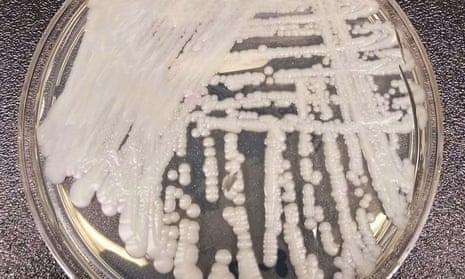
a strain of Candida auris cultured in a petri dish at a CDC laboratory.
Also concerning was a tripling in 2021 of drug-resistant cases. Photograph: Shawn Lockhart/AP
 
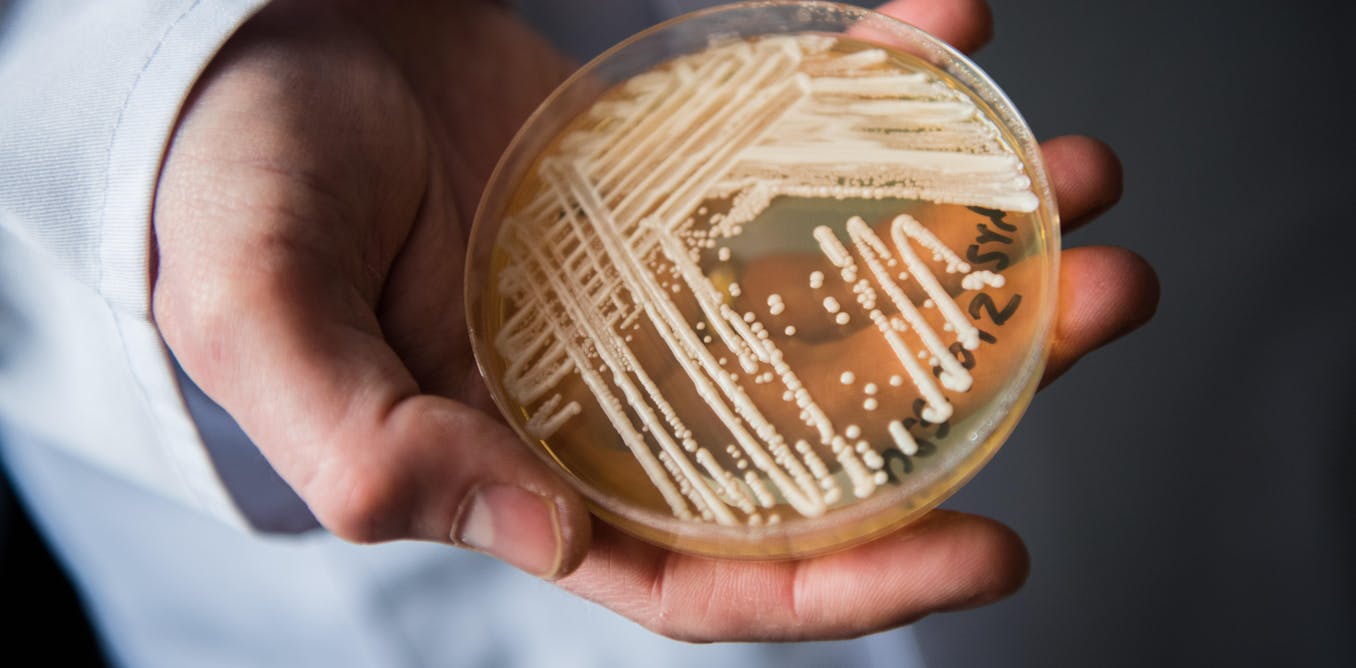
The name of the fungus that is causing such consternation for its lethality and its future spread considered a new and burgeoning "urgent threat" to humans is candida auris. Unlike most fungi that affect humans this one is able to reproduce in warm-blooded bodies and it is "intrinsically resistant" to multi antifungal drugs. Candida auris has alarmed American hospitals where it has been spreading at an alarming rate. According to the U.S. Centers for Disease Control and Prevention, candida auris cases tripled between 2020 and 2021,

People who are extremely ill or who are immunocompromised represent those at increased risk of acquiring C. auris; generally it does not represent a health threat to healthy people. Its death rate is 28 to 53 percent, According to the World Health Organization. Canada's Public Health Agency has reported a total of 43 cases. In the U.S. the total is 4,041.

Professor Wright has focused on the study of fungi for the past 40 years, beginning when the HIV crisis was peaking. "Folks were dying", because their collapsing immune systems were unable to fend off "opportunistic" infections such as fungal infections.  Candida Auris is a form of yeast first discovered in 2009 in Japan, when a 70-year-old-woman's ear canal was found to be hosting the fungus. Infections of the blood, heart, central nervous system, eyes, bones and internal organs can be caused by the organism.

CDC issues warning about increase of drug-resistant Candida ...
Candida auris, CDC
Candida Auris has been found on sinks in hospitals, on bed rails, on curtains and floors "where it can persist for up to a month", according to the University of Minnesota Centers for Infectious Disease Research and Policy. "Right now this is not something that people walking down the street should be frightened of", cautions Professor Wright. Those with weak immune systems and hospital patients with "indwelling" medical devices such as ventilators and catheters are the most vulnerable.

"We really didn't know anything about candida auris until the first report [in 2009]. But almost simultaneously, it was discovered pretty much all around the world, and it sort of emerged all at once", explained Professor Wright. According to one hypothesis, as the world's temperature increased, the fungus adapted to survive in warmer environments "and that provided it with an opportunity to infect humans", stated Dr. Wright. In the mid-1980s once antiretroviral drug cocktails became "groundbreakingly" effective against HIV, invasive fungal infections were reduced in number to a dramatic extent.

And now, Professor Wright believes the time is right to take infectious diseases as seriously as medical science takes chronic diseases like diabetes and cancer. Complacency surrounding infectious diseases because of vaccines and antibiotics has led medical science to neglect the need to focus on research that will prepare the world for ever greater numbers of emerging pathogens and the steps needed to deal with their presence either through cures, new vaccines or therapies that can prolong life, not the pathogens.

https://images.theconversation.com/files/517909/original/file-20230328-22-th38o.jpg?ixlib=rb-1.1.0&rect=0%2C738%2C6016%2C3008&q=45&auto=format&w=1356&h=668&fit=crop
dpa picture alliance/Alamy Stock Photo
"This is like the genie out of the bottle. These bugs are here,they're in our hospital systems, they're in our long-term care facilities. They're not going to get any easier to treat."
"We don't know how bad it's going to be, but people are going to die, and we need to be aware of it and find ways to detect it in the first place, but also to treat it."
"...If you're in a long-term care facility it's unlikey that you're going to be able to detect it until there's an outbreak. It's not routinely looked for. It might be in the future, as this starts to grow."
"[The result:] You have this sort of almost perfect storm. You don't have a lot of drugs available to treat a fungal infection in the first place, you've got a pathogen that has evolved the ability to infect us because it's learned how to live at higher temperatures, and that fungus happens to be intrinsically drug-resistant to begin with."
Professor Gerry Wright

Labels: , , , , , ,

 
()() Follow @rheytah Tweet