Ruminations

Blog dedicated primarily to randomly selected news items; comments reflecting personal perceptions

Thursday, July 31, 2025

Slandering Israel Comes Easy

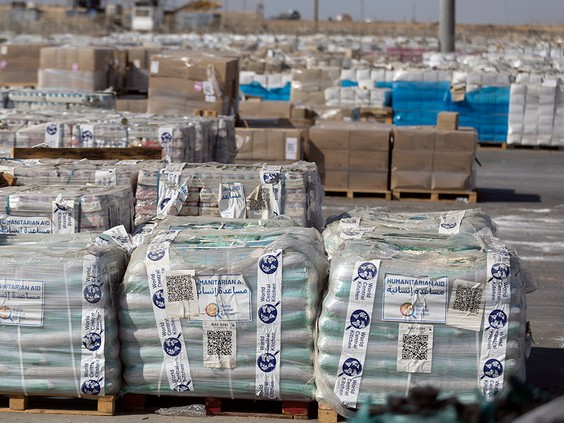
"Hundreds of aid trucks have entered Gaza with Israel's approval, but the supplies are standing idle, undelivered."
"The reason? The UN refuses to distribute the aid. Hamas and the UN prevents the aid to reach the civilians in Gaza."
"The world deserves to know the truth."
"But BBC, CNN, Daily Express and The New York Times spread a misleading story using a picture of a sick, disabled child to promote a narrative of mass starvation in Gaza -- playing into the hands of Hamas's propaganda war."
"Without proper disclosure. Without medical context. Without journalistic ethics." 
Israeli Foreign Ministry  
https://smartcdn.gprod.postmedia.digital/nationalpost/wp-content/uploads/2025/07/Gaza-aid.jpg?quality=90&strip=all&w=564&h=423&type=webp&sig=4Czgm7mJiWexzX6dHtvUlg
Humanitarian aid packages waiting to be picked up on the Palestinian side of the Kerem Shalom border crossing on July 24, 2025. “The UN refuses to distribute the aid,” Israel’s Foreign Ministry says. Photo by  by Amir Levy/Getty Images

 British investigative journalist David Collier wrote an explanation that one of the children used as a shaming condemnation against Israel purportedly failing to ensure that sufficient humanitarian aid reaches the Palestinian civilian population in Gaza, a child with the surname al-Matouq "suffers from cerebral palsy, has hypoxemia, and was born with a serious genetic disorder", data extracted from a 2025 medical file.
 
A BBC documentary titled "Gaza: How to Survive a Warzone" was discovered by Mr. Collier to have been narrated by the son of a senior Hamas official. That revelation led to embarrassment on the part of the British public broadcaster and a retraction of the documentary. The photograph of the emaciated child saw sensational use by international media testifying to the devastation brought by Israel's war in Gaza and the resulting aid crisis there.
 
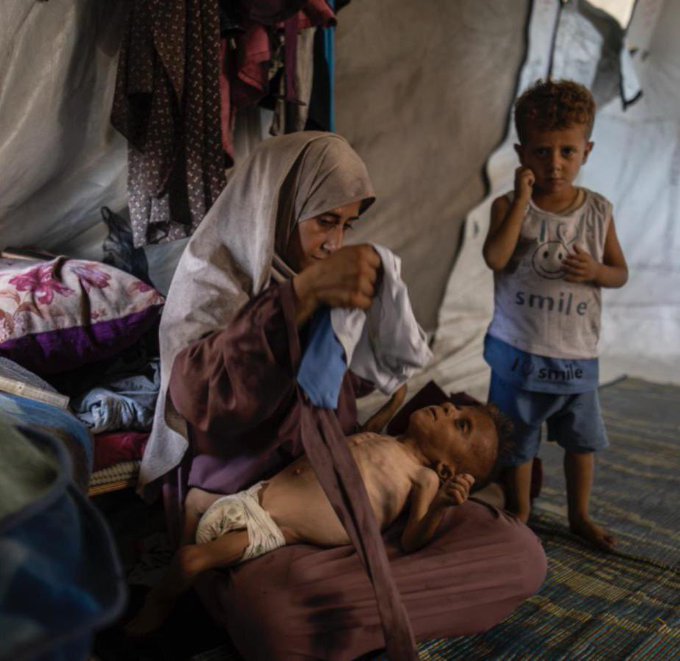
Last Thursday, the New York Times digital story was entitled "Gazans are dying of starvation", over the image of the skeletal child. "A horrifying image encapsulating the maelstrom of human misery gripping Gaza" was how the Daily Express captioned the heart-rending photograph of Muhammad Zakariya Ayyoub Al-Matouq.  
 
https://pbs.twimg.com/media/GxBAUldXYAAPeHp?format=jpg&name=small
Unlike his brother standing by his side, Muhammad Zakariya Ayyoub al-Matouq suffers from cerebral palsy.
 
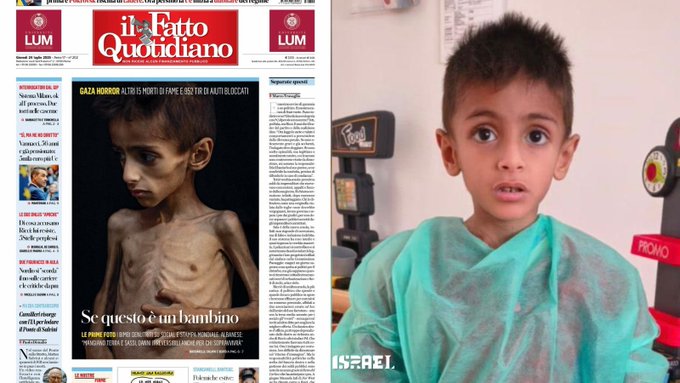
And then there is the image of five-year-old Osama al-Rakab, yet another child whose photograph saw use as an illustration of the threat of child malnourishment resulting from Israel's 'blockade' of humanitarian aid entering the Strip. Al Jazeera  featured the little boy's skeletal torso throughout a number of Italian media outlets to extract maximum disgust from news readers, holding Israel responsible for the pitiable condition of the child.
 
Israel's Coordinator of Government Activities in the Territories (COGAT), divulged that al-Rakab "suffers from a serious genetic illness unrelated to the war", and with his mother and brother had been transported out of Gaza to an airport in Israel destined for treatment abroad. "This is what a modern blood libel looks like: A sick child. A hijacked photo. A lie that spreads faster than truth", wrote the Israeli Foreign Ministry on its X account.
 
A third infant, 11-month-old Sila Barbakh was featured on Israel's official X account, who "isn't starving", but rather "suffers from a pre-existing chronic gastrointestinal illness, unrelated to the war". In none of these pathetic photos of children suffering from dread diseases were they captioned 'for illustrative purposes only', unrelated to Hamas's wildly successful public relations' campaign aimed at the gullible West.  
 
https://pbs.twimg.com/media/Gw8DQUVWgAA5rgG?format=jpg&name=small
His name is Osama al-Raqab. He has cystic fibrosis, a serious genetic illness. He’s been in Italy receiving treatment since June 12. Israel enabled his medical transfer from Gaza.
 
The Times of London found it useful when featuring tiny Barbakh's suffering from starvation to expand y explaining that the baby weighted a mere "seven-and-a-half pounds". According to data published by the Hamas-operated Gaza Health Ministry, 56 Palestinians had died in July of starvation. About half the total number reputed to have died of starvation since the war began on October 7, 2023 when Palestinian terrorists led by Hamas stormed into southern Israel to launch its campaign of rape, pillage, torture and mass slaughter. 
 
Humanitarian supplies handover was shifted away from the United Nations in May, with an U.S.-backed, Israeli-supported group, the Gaza Humanitarian Foundation (GHF), taking the initiative. Civilians in Gaza had then to travel into areas controlled by Israeli military to receive the supplies. That solved the issues involved in Hamas armed operatives taking control of aid-delivery trucks to have the goods they carried stuffed into Hamas warehouses, and withheld from the civilian population. Some of that aid ended up at open-air marketplaces selling for exorbitant prices. Most of it was sidelined for the exclusive use of Hamas operatives.
 
https://pbs.twimg.com/media/GwocvTiWcAAxpSi?format=jpg&name=small
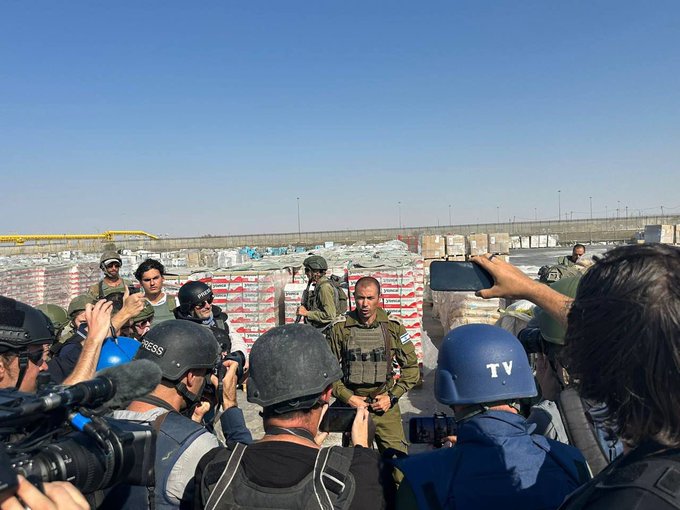
Today, the IDF invited dozens of international journalists to the Kerem Shalom crossing inside Gaza, to see for themselves. Israeli Foreign Ministry
 
Reportedly, GHF distributed close to 90 million meals to civilians while facing significant opposition from Hamas, which had attacked and murdered a dozen Palestinian employees of GHF who had been working with the group to help distribute the aid. According to the Gaza Humanitarian Foundation, Hamas offered bounties to any of their followers who kill American contractors or any Palestinians assisting their endeavours in providing aid.
 
The United Nations has accused Israel of reportedly killing hundreds of Gazans seeking aid in what is  essentially an active war zone. Many more have died resulting from stampedes in the chaos of crowds of Palestinians vying among one another to receive aid. A week ago Israel announced its intention to once again commit to airdrops of humanitarian aid, alongside Arab nations, including Jordan and the United Arab Emirates. Airdrops had been suspended in view of properties being destroyed and civilians being hit by the airdrops.
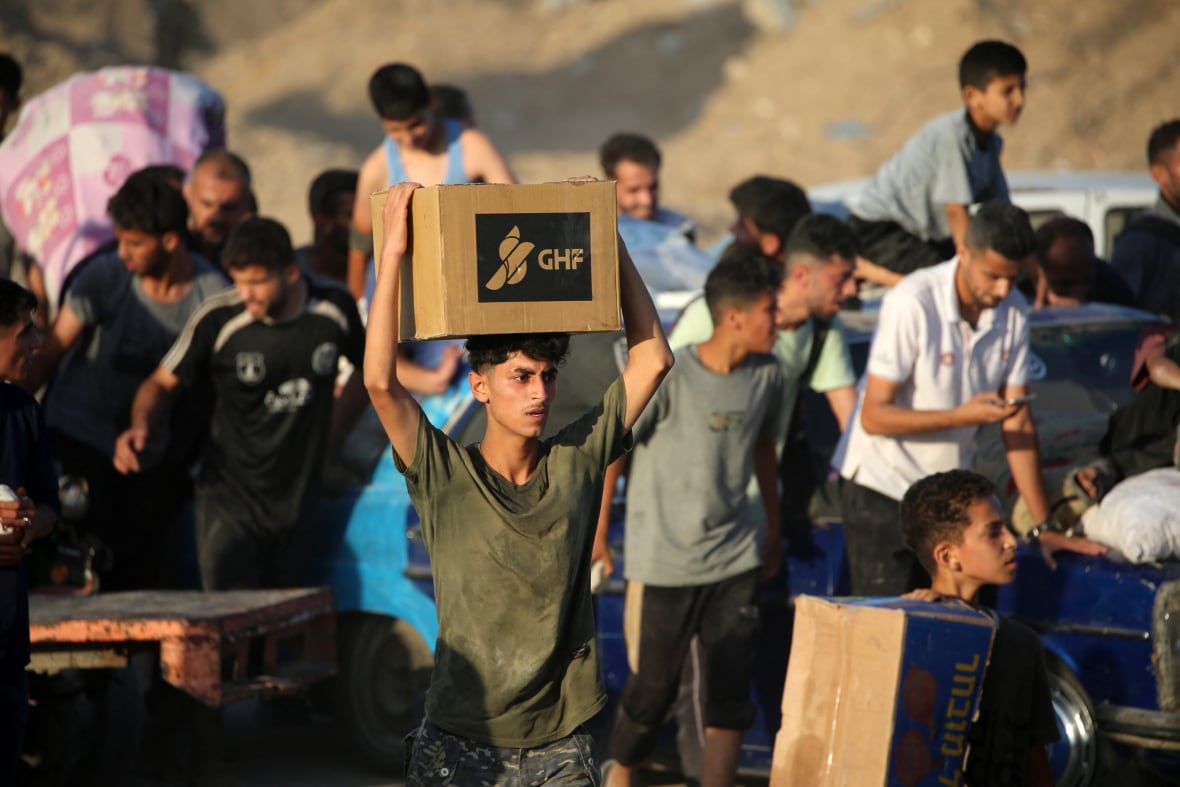
 
https://i.cbc.ca/1.7586106.1752659961!/fileImage/httpImage/image.jpg_gen/derivatives/original_1180/2221370091.jpg?im=Resize%3D1180
People carrying aid parcels from the privately run Gaza Humanitarian Foundation (GHF) walk along the Salah al-Din road near the Nuseirat refugee camp in the central Gaza Strip (Eyad Baba/AFP/Getty Images)
 
The New York Times claimed that the "Israeli military never found proof that the Palestinian militant group had systematically stolen aid from the United Nations, the biggest supplier of emergency assistance to Gaza for most of the war". In response, the Israel Defense Forces released a video showing Hamas militants with rifles "looting an aid truck", while civilians gathered about.  These same images were shared by Ahmed Fouad Alkhatib, a Palestinian-American academic, senior fellow with the Atlantic Council. Showing Hamas operatives stealing aid during an earlier ceasefire.
 
"Right here before your eyes! But according to NGOs & media, there's still 'no evidence' of theft", charged Alkhatib who has been a vocal critic of Hamas and the Netanyahu government, both. Alkhatib shared a video in another post, showing Hamas police officers who stripped, arrested and beat Palestinians who had gone out to the GHF aid distribution site, and paid the consequences, with the aid they had gathered taken from them, for their pains. 
 
https://npr.brightspotcdn.com/dims3/default/strip/false/crop/4843x3229+0+0/resize/1200/quality/85/format/webp/?url=http%3A%2F%2Fnpr-brightspot.s3.amazonaws.com%2F66%2F44%2F2a824efd4425bb1fcf8a7c7a3c7f%2Fkerem-shalom-edit-21.jpg

 A truck loaded with food on the Israeli side of the border crossing heads back into Gaza. However, the food is sitting for days or weeks before it can be distributed. The U.N. and aid groups say they face a host of problems that include a shortage of trucks and fuel due to the war, as well as criminal gangs that are looting the supplies.    Maya Levin for NPR

Labels: , , , , , ,

Sunday, March 26, 2023

Food Security as a Geopolitical Weapon

"They've just become so common. Every week, I would say, we are getting contacted by farmers or food companies. It's one of the soft bellies of our critical infrastructure."
"I think we are all waiting for disaster."
Ali Dahghantanha, Cyber Science Lab, University of Guelph, Ontario
"These are all systems that we explicitly depend on every single day, and they have become extremely vulnerable to manipulation of all sorts."
"They're vulnerable because we haven't thought carefully about the security of how we set these systems up."
"I mean, it's truly terrifying, to be honest."
Even Fraser, director, Arrell Food Institute, University of Guelph

"The interruption of the global food supply is not collateral damage from the war in Ukraine."
"It is a planned hybrid weapon to further massively destabilize the global economy and political order."
Yulia Klymenko, Ukrainian MP, first deputy chair, Transport and Infrastructure Committee, Ukraine

"There is a lot of innovation happening in agriculture in Canada."
"So we are at risk from foreign-backed espionage."
Mohamad Yaghi, Agriculture and Climate policy lead, Royal Bank of Canada
Hackers could be waiting to cause disruption, or simply just monitoring and collecting data on foreign agricultural methods.
Hackers could be waiting to cause disruption, or simply just monitoring and collecting data on foreign agricultural methods. Photo by Chung Sun-Jun/Getty Images
 
Last year Ali Dehghantanha's squad of engineers and computer scientists responded to dozens of reports from southwestern Ontario of hacks within farming and food production operations. Sometimes the incidents represent a bad link in an email with hackers demanding money to unlock a system or to return the farmer's data. In other instances hackers break into a farm system and threaten to kill livestock; chickens, cattle. 

In a third of the cases, investigators found evidence of state-sponsored hackers originating in
Russia, China, North Korea and Iran who have quietly gained access to control systems inside a farming operation. The University of Guelph is located close to Toronto in one of the province's most vital farming hubs. A group of specialists work out of the Cyber Science Lab, visiting banks, defence contractors, hospitals and farms. The lab received fifty calls from the food industry last year.

The realization dawned that the domestic food production system may be one of the most obvious cracks in Canada's national defences. Criminals or state-sponsored hackers breaking into systems to disrupt critical infrastructure like transportation or health care or food production only recently become plausible owing in part to Russia's invasion of Ukraine.
 
 Canada's Communications Security Establishment (CSE) the country's signals intelligence agency, warned that Russian-backed hackers are "exploring options for potential counterattacks" on critical infrastructure in Canada and other NATO allies supporting Ukraine.
 
A computer monitor is seen inside a tractor cab with a farm field in the background.
A computer monitor is seen inside a GPS-equipped John Deere tractor. As farm use of technology and smart devices grows, experts say more needs to be done to protect against cyberattacks that could threaten food security. (Seth Perlman/The Associated Press)
 
Farms have become complex technical operations using networks of remote monitors measuring soil moisture, or robotic milkers capable of detecting an infection in a single teat, or environmental control systems maintaining the precise indoor temperature and air filtration requirements of a poultry barn. All of which in theory could be commandeered and held for ransom by a hacker. The U.S. Department of Homeland Security identified several "hypothetical threat scenarios" in its 2018 report where hackers could compromise agricultural operations. 
 
One scenario had a terrorist lift data on the health of a large livestock herd. "They modify the data to look like the herds have foot and mouth disease, and dump the data on the internet". In such an instance it could take weeks for lab tests to confirm the outbreak was in fact false -- in the interim causing trade issues and shaking public trust in the food supply. Another scenario had hackers manipulate moisture sensors in a farmer's soil, triggering watering systems to flood the fields and destroy crops.
 
In its invasion of Ukraine an effective part of the Russian playbook has been attacking agricultural infrastructure. EU trade counsellor Maud Labat warned that Moscow strategized how to wield food as a "geopolitical weapon". Its attacks on transportation and grain storage infrastructure, its months-long blockade of ports on the Black Sea choked off access to one of the world's most important bread baskets, driving up global grain prices last spring. Food shortage concerns intensified in developing nations depending on the region for imports. 
 
National Cyber Threat Assessment's latest report stated state-sponsored hackers are not likely to disrupt or destroy critical infrastructure unless Canada enters into direct hostilioties, leaving  hackers more likely to break into Canadian systems to collect information or "pre-position" in the event of a future conflict. Released last fall, the CSE report stated adversaries could use cyberattacks as a form of "power projection and intimidation".
 
Farm worker in a red baseball hat working on a laptop as he watches a farm equipment operator working in a farm field
 
"In the absence of a significant escalation in international hostilities, we assess it is unlikely that state-sponsored actors will intentionally seek to disrupt Canadian critical infrastructure and cause major damage or loss of life", advised CSE spokesperson Kyla Borden. "This is organized crime. These folks have HR departments. They have employees of the month awards. This is big business", explained John Hewie, a national security officer at Microsoft Inc., referring to sophisticated networks focusing on "big-game hunting" -- attacks where a hacker takes control of a system or data from a major business and asks for a steep ransom.
 
In fact, the Canadian food industry alone experienced a series of high-profile incidents late last year, a "cybersecurity incident" at Maple Leaf Foods Inc., one of Canada's largest meat packers. Empire Co.Ltd., Canada's second-largest grocery chain experienced a "cybersecurity intrusion" that snarled operations, expected to cost the company $25 million. According to Janos Botschner, lead investigator of the Cyber Security Capacity in Canadian Agriculture, approximately four to 11 percent of Canada's farms have had a cyberattack attempt on their operations. "This is very much an estimate, but it's probably also an under-report", he clarified. 

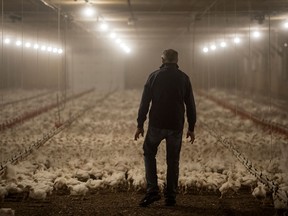
A farmer in a chicken barn in Ontario.

Labels: , , , , ,

Thursday, June 25, 2020

Community Inspiration

"Hello favourite friends -- I delivered a ton of frozen family-size lasagnas today. Now, this is not a problem by any means, lol. But you have a diehard, full Italian lasagna lover living in your town."
"If any of you want some fresh homemade, no-calorie-counting lasagna, please let me know and I will gladly prepare it."
"The world as we know it is falling apart, but my two little hands are capable of making a difference. I can't change the world, but I can make lasagna."
"I'll bet I could continue this for the rest of my life. I love creating in the kitchen, but more importantly, I love the people I've met."
"When word got out on social media, people from all over the world started donating to my cause. It's a pan of love. A lot of the people I make lasagna for have lost their jobs, and this is my way of saying, 'I understand and I'm here for you'."
"Those warm smells help people to know that somebody cares about them. You can be in the most awful place in your life, and then a big plate of lasagna will provide some peace and hope."
Michelle Brenner, Gig Harbor, Washington
Gig Harbor woman making a difference 'one lasagna at a time'
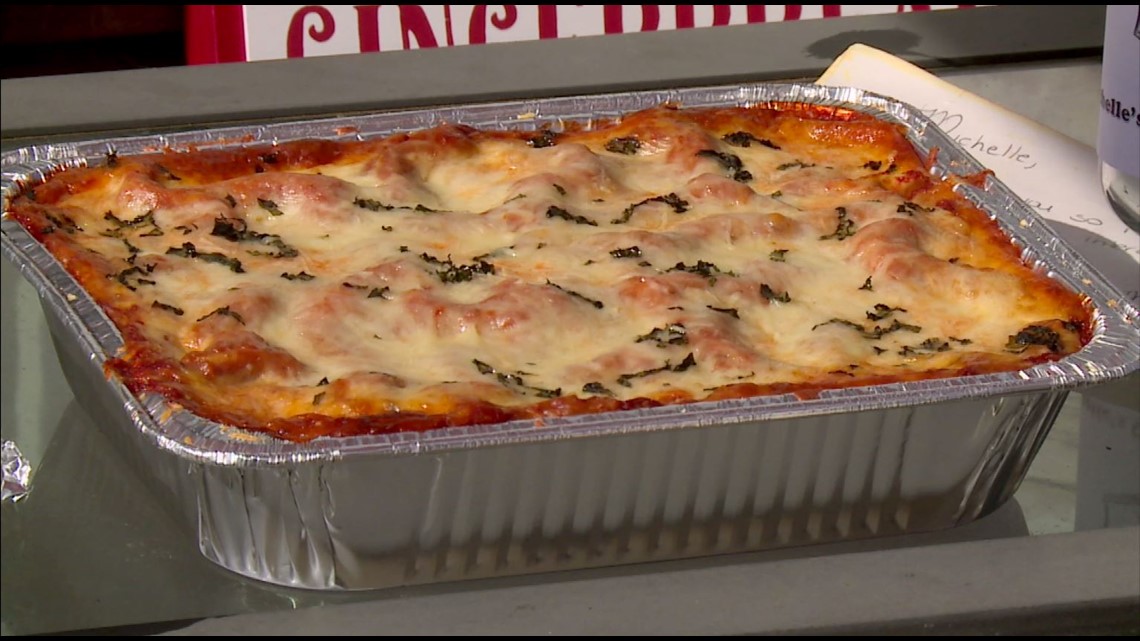
GIG HARBOR, Wash. — In the picturesque city of Gig Harbor, there's one meal that has everyone talking: Michelle Brenner's homemade lasagna. “This is by no means a diet lasagna,” she says. “I tell people do not get on the scale the next day.”
Michelle Brenner, 44, worked at a menswear store in her town, Gig Harbor, and then she was furloughed when everything closed down in a defensive move against the entry of the highly contagious novel coronavirus into the United States, threatening to devastate entire communities. She did what most people instinctively did when she was left with little option but to burrow into the confines of her home. Food, comfort food comes to mind. And for her, comfort food was what she helped her Italian grandmother prepare, when she was a little girl.

Memory of her grandmother preparing the spaghetti sauce, meatballs and lasagna she was allowed to help with in her grandmother's kitchen, flooded her mind. Like most of us when things go dreadfully wrong and depression sets in, we look for rescue, a way to lift that bleak, dark mood, and she found the solution in what she calls "a pan of love", the methodical preparation of an ethnic dish that everyone loves; a combination of pasta, cheese, ground beef and tomato sauce. It fit the bill for encouraging her to feel better about the situation roiling the world and her world in particular.

She decided she would use the stimulus cheque of $1,200 that people in her situation received in an effort to lift people out of instant poverty with job losses that resulted from lockdown. With that money she funded the purchase of lasagna ingredients to enable her to respond to the requests that began to arrive, in response to her communication to her community when she offered to supply anyone wanting it, with a pan of fresh-made lasagna.

Credit: King TV
At first it was friends and neighbours, and then it expanded to people outside her direct neighbourhood, and people just kept coming to take advantage of her offer. Three months on, she figured she had doled out 1,200 pans of lasagna. She employed herself eight hours daily, seven days a week to help feed people in need, by boiling noodles cooking ground beef, preparing tomato sauce and layering it all with mozzarella, ricotta and Parmesan. Delectable and nutritious. And she felt good about it all, being busy with her production schedule, knowing it benefited people in need.

She had set up a pantry in her front yard so people could simply pick up a lasagna dish ready to be placed in the oven at their own home. Then she began to receive so many requests she had difficulty keeping the lasagna constituents in stock. The Gig Harbor Sportsman's Club offered to help, enabling her to use their kitchen. "We saw what a great thing she was doing, and we have this nice commercial kitchen that wasn't being used because of COVID", explained the club's president.

Soon, Michelle Brenner started a fundraiser on Facebook that collected over $10,000 to allow her to continue making lasagna as giveaways. People began donating what they could afford when picking up their orders. To the present, she said, $22,000 has been contributed to enable her "to be making lasagna for many months to come". 

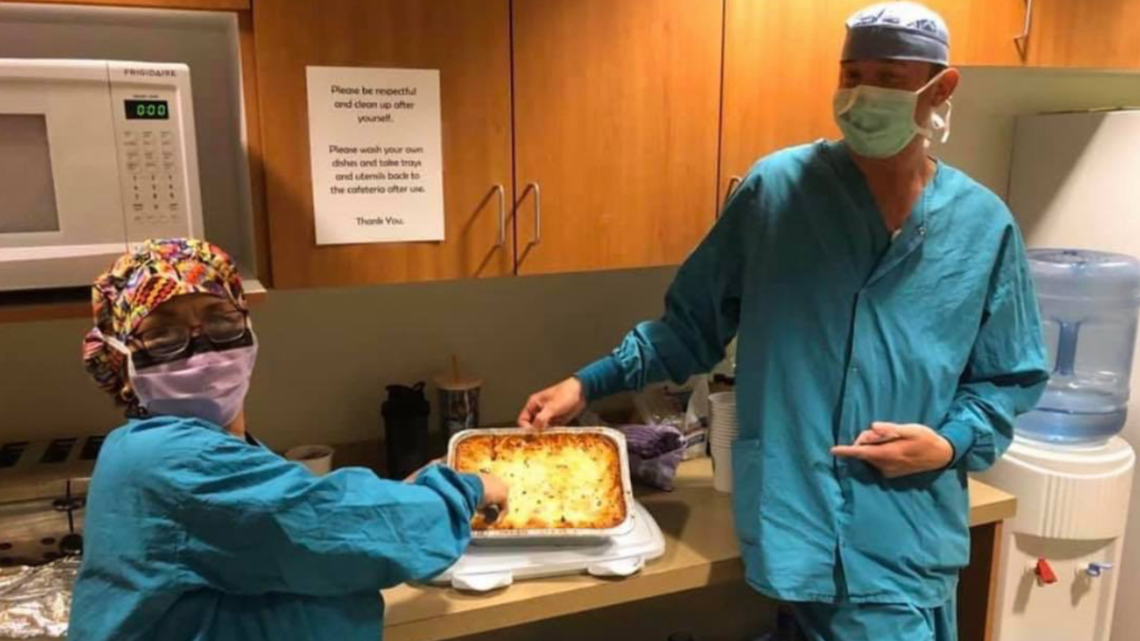
Credit: Lori Thiel/Facebook    Doctors at Swedish Edmonds with one of Michelle Brenner's Lasagna meals

Labels: , , ,

 
()() Follow @rheytah Tweet