Ruminations

Blog dedicated primarily to randomly selected news items; comments reflecting personal perceptions

Tuesday, October 22, 2019

Eating Out Tonight!

"Pancakes with syrup or cheeseburgers are never a health food, but it seems like The Cheesecake Factory, Chili's and other chains are trying to outdo each other to make them worse."
"Although the 2019 Xteme Eating winners are nutritional nightmares, plenty of other dishes are as bad or worse."
"The good news is that all chains with twenty or more outlets are now required to list calories on menus and menu boards, and expanded nutritional information upon request."
Lindsay Moyer, senior nutritionist, Center for Science in the Public Interest (CSPI)
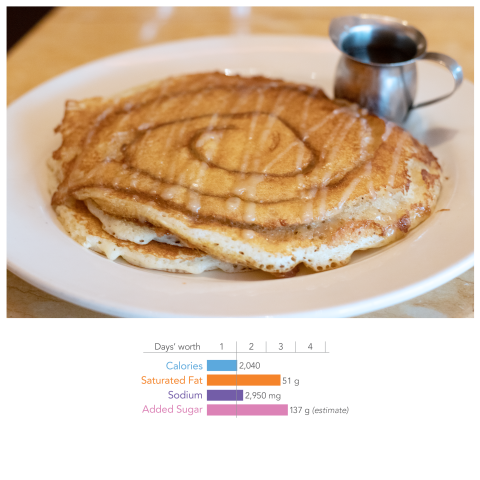
Well, as questions go, this is rather naive, but who, shopping for a calorie-dense, nutrition-absent treat would be interested to begin with in scrutinizing that nutritional information? Unless they're feeling deliberately masochistic, that is. People are drawn to the pure and rather insane allure of over-sweetened, -salted, -oily taste and texture of these folksy gourmet delights, having shed a sense of guilt, and prepared to indulge and that's the truth of it.

It is rather mind-boggling, in actual fact, that three of the Cheesecake Factory's Cinnamon Roll Pancakes contain 2,040 calories'-worth of brown sugar, white flour, icing and syrup infused with butter. What a treat! Although anyone sitting down to this special breakfast/lunch/dinner-all-in-one special might wish to think hard and deep that the ingredients and the calories contained within are the equivalent of 11 Crispy Creme Original Glazed Doughnuts....
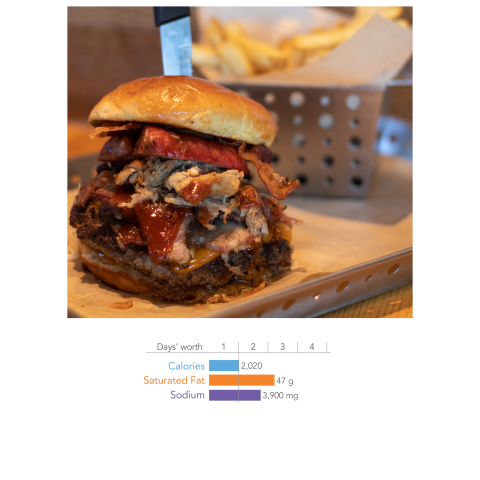

So then let's get down to the serious business of meat-on-a-bun. Would you prefer a variety of sliced processed meats or would you go for three McDonald's Triple Cheeseburgers along with an order of large fries, or might you be intrigued with its caloric equivalent at Chili's where you can order The Boss Burger, accompanied with fries and pickles. "Smoked brisket, rib meat, jalapeno-cheddar smoked sausage, bacon, cheddar, lettuce, tomato, house BBQ & house-made ranch. We.Dare.You."
Well, dare to be bold and do it often enough and you can join the prestigious ranks of the 70 percent of U.S. overweight adults, edging toward obesity. The choice, dear consumer, is yours, all yours!

And not to be outdone, there's an oversized sub at Jimmy John's Giant Gargantuan stuffed with luncheon meats; salami, capicola, turkey, roast beef and ham, along with provolone cheese, onion, lettuce, tomato, mayonnaise, oil and vinegar all stuffed into that sub whose 7,720 mg of sodium and saturated fat (29 g) is a guarantee you'll walk out of the experience feeling, um, full and smacking your greasy lips with satisfaction, wondering how you'll top that one when dinner rolls around, since you've just finished with lunch...?
Add caption
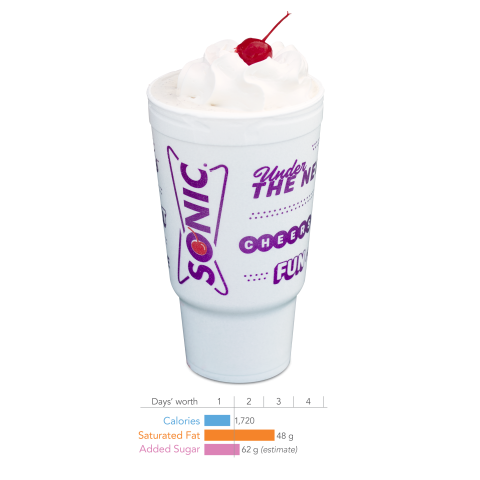
And if you're feeling really thirsty, how about giving a really great milkshake a try, and if you really like it, it can become a regular treat. That's where Sonic's Oreo Peanut Butter Master Shake takes a bow and a curtsy. It has a day's value of added sugar (62 g) for a large shake -- about a litre at 32 oz -- containing enough saturated fat (48 g) to represent two and a half days' worth. But think about how delish it'll taste to the appreciative tongue, with its topping of whipped cream, and a bright, red cherry.

Oh, there's more, there's always more as specialty purveyors of peoples' favourite taste sensations do public relations adverts and study people's tastes and psychological frailties over denying themselves the unalloyed sensuous pleasure of eating the forbidden; processed food in excess of common sense, forgetting moderation in the temptation to feel good because let's face it, eating is such a pleasure, all the more so when taste-bud-sensational cautions of salt, sugar and fat intake beyond the sensible will inevitably result in excess weight, all he more so as we grow older and no more wiser.
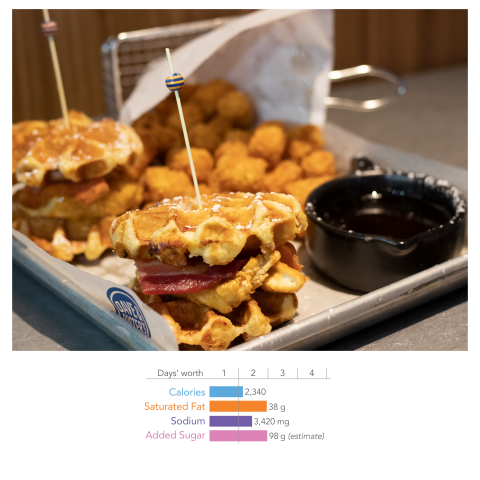


And who can resist waffles? And then there are fascinating combinations most people would likely never think of. Take that old favourite chicken, and pair it with waffles and you've got -- wait for it -- “We’re bringing in better ingredients and the best chefs to craft craveability that you’ll only find at Dave & Buster’s", boasts the arcade and sports bar’s menu of their Chicken & Waffle Sliders.  In which white flour, sugar and "better" ingredients produce fried chicken, bacon, mini-Belgian waffles, maple syrup and tater tots to the value of only 2,340 calories! Its less preciously- tantalizing equivalent? 8 Eggo waffles, 8 Jimmy Dean pork sausage patties, with 1/2 cup of maple syrup. Yum!

Labels: , , ,

Friday, August 31, 2018

Children and Vegetarian/Vegan Diets

"When my children were born, I was referred to a nutritionist because we were vegan, but when I went to the appointment I knew more than she did."
"I know how important it is to get protein, calcium, iron and vitamin B12. You can get these plentifully in plant-based foods -- so we have lots of stir fries, with tofu, which is excellent for calcium and protein, or spaghetti bolognese with a soya mince, and they have soya milk that's fortified with calcium and things like avocado and nut butters for healthy fats."
"But we also give a multi-vitamin supplement, too, just to make sure."
"I think if you compared their diets to an average two- or six-year-old, they'd probably be healthier."
"There's a lot of scare-mongering about it [plant-based diet for children], and we're always told that vegans need to be especially careful, but I find that vegans are actually more clued up about nutrition than most."
Karrie McCulloch, 32, mother of two, Glasgow, Scotland

"My children suffer from eczema and asthma and it really helped [switching to a vegan diet] -- you could see a change in their skin."
"You do need to do your research, especially with  young children, and be prepared to be inventive -- you don't want to be a junk food vegan."
Lizzy Tigh, artist, mother of four, Herefordshire, Great Britain
Is a Vegan Diet Safe for Growing Children?
"Until fairly recently, we tended to advise against vegan diets for babies. It can be done, but just not on a whim. Children need to have supplements, for example for vitamin B12, as they won't get their full requirement from food."
"Vegetables contain a lot of fibre so if a child is filling up on these, they might not end up consuming enough high calorie, high protein foods."
Mary Fewtrell, professor of paediatric nutrition, University College London
Greater numbers of people than ever are turning away from meat-based diets and adopting a vegetarian lifestyle, citing various reasons, from environmental to a refusal to eat other animals to a concern for living more healthfully. Exit meat, fish, dairy products, eggs, all healthful sources in moderation of quality protein. Quinoa, nut butters, chia seeds and soy products are introduced to the palate and valued for their special qualities. People who make these adjustments to their lifestyles are increasingly including those choices for their children from babyhood up.

Raising alarm from some nutritional experts and pediatricians who warn that "clean eating" trends could be responsible for nutritional deficiencies being seen in children. Clearing all gluten-based foods and dairy-derived foods from a diet can be fraught with problems. Researchers from France have announced their findings that non-dairy milks are in fact dangerous for babies of parents who choose to replace breast or formula milk with an alternative before their child has reached the age of one. Children studied in the June-released research were found to be suffering from malnutrition.

Reports of children raised on vegan diets being admitted to hospital suffering from malnutrition have been common in recent years. Children throughout their optimum growing years have special requirements in their diet to promote linear growth, weight gain and brain development. Nutrition in the first two years of life has a vital role for growth, a well established scientific-health reality which also plays into later life disease onset.
Vegan organisations have responded that raising children vegan isn’t about diet, but about ‘teaching them compassion’.(Picture: Getty)

Even so, experts feel that with adequate advice and careful planning it is entirely possible to safely raise children on vegetarian and vegan diets. With the proliferation of readily available information, including on the National Health Service website in Britain, and other reliable sites throughout North America sponsored by government health services and university medical colleges health education sites, parents can be educated on best practices for wholesome outcomes for their children's diets.

Where alarm bells ring is with the introduction of "clean eating" which is to say the restriction or elimination of foods containing gluten and dairy, for children. A good many people have succumbed to the appeal of celebrities and bloggers and food writers claiming the benefits in health to be gained by eschewing gluten and dairy, citing 'intolerance', when none exists save for people who legitimately suffer from celiac disease, a very small number of people who have been diagnosed by a medical professional and advised to avoid gluten.
Vegan diets could be damaging to small children’s health, nutritionists have warned. (Picture: Getty)

"We're certainly seeing adult trends in nutrition and food exclusion starting to translate to children."
"If you're cutting out something like gluten, you're cutting out a huge number of foods, which is going to make life hard."
"We're seeing a rise in true allergy and a rise in parental anxiety -- which corresponds with adults diagnosing themselves with things like gluten intolerance. But we would never recommend excluding anything without good medical reasons."
"There's a paradox where we're not picking up the right children, but also inappropriately cutting out milk in the wrong children."
"There are all these nutrition noises in the back of your head, that you might have read online or heard at the antenatal group. Lots of these symptoms can be quite normal, but people are not getting the right advice and are self-diagnosing."
"Eating should be enjoyable and sociable, and anxiety is very infectious. If they're having things whipped out of their hands, what will that do to their wider relationship with food?"
Lucy Upton, pediatric dietitian, Birmingham Women's and Children's NHS Foundation Trust, spokesperson, British Dietetic Association
Little protein can lead to stunted growth, while too much fibre can cause children to feel full too quickly, the nutritionists also warn (Picture: Getty)

A third of British parents believe, according to a 2015 study by allergy specialists, that their child has a food allergy, yet only one in 20 children would pass a clinical diagnosis. Researchers found as well, that among parents in affluent areas, allergies were more likely to be declared by parents concerned with the welfare of their children. Cow's milk protein allergy is extremely difficult to diagnose, affecting up to four percent of children and parents, anxious to relieve their children of symptoms concerning them claim improvement as soon as a dairy-free alternative was given them.

Statistics provided by the NHS indicate that formula prescriptions treating babies with cow's milk allergy rose by close to 500 percent in the last decade, a situation interpreted through parents looking for information on line. Lucy Upton recommends that parents seek medical advice prior to cutting any major food group from their child's diet, that a thorough professional medical history be taken of allergy in the family: "If you're not sure, you can try putting them on a milk-free diet for four weeks to see if matters improve."

How to safely raise your child vegan

  • When cooking for your children, use unsweetened fortified soya milk. This contains as much calcium as cows’ milk and a similar amount of protein.
  • To ensure they’re getting enough protein, provide them with beans, chickpeas, lentils, soya mince, fortified soya yoghurt and tofu.
  • The Department of Health also recommends daily vitamin A, C and D supplementation for all children aged six months to five years


Vegetarianism as a lifestyle choice is becoming more popular among Canadian families. A 2002 survey (1) in Canada revealed that 4% of adults claimed to be vegetarian. Approximately 2% of six- to 17-year-olds in the United States are described as vegetarians, and approximately 0.5% of this age group professes to be strictly ‘vegan’ (2). A variety of influences are acknowledged by vegetarians including concern for the environment, long-term health benefits, religious beliefs and economic concerns (3,4). In addition, the influence of a diverse ethnic population now seen in North America has had some effect (5). Restaurants and the retail food industry have responded to this interest by offering a great variety of products.
A PubMed search (1980 to 2008) using the key words “children”, “adolescents”, “vegetarian diets”, “growth” and “nutritional problems” was conducted on this topic.
The concept that a well-balanced vegetarian diet can provide for the needs of a growing child and adolescent is supported by Canada’s Food Guide (6), the American Dietetic Association and Dietitians of Canada (7), and the American Academy of Pediatrics (8). There is sufficient evidence from well-developed studies (914) to conclude that children and adolescents grow and thrive well on vegetarian diets that are well designed and supplemented appropriately.
However, certain components of these diets and some required nutrients may be in short supply and need specific attention. This is particularly true in the case of strictly vegan diets and other very restrictive diets in which significant medical consequences could result from inattention to nutrient needs. The present statement highlights some of these areas and recommends appropriate interventions.
M Amit, Canadian Paediatric Society, Community Paediatrics Committee 
 

Labels: , , , ,

Saturday, July 21, 2018

Gluten-Free Damnation

"The promotion of gluten-free diets among people without celiac disease should not be encouraged."
"Despite the rising trend in gluten restriction, no long term, prospective studies have assessed the relation of dietary gluten with the risk of chronic conditions."
"[Gluten can] act as a prebiotic, feeding the 'good' bacteria in our bodies."
"Changes in their amount or activity have been associated with gastrointestinal diseases including inflammatory bowel disease, colorectal cancer, and irritable bowel syndrome."
Harvard Medical School study

"Studies are needed to determine the long term effects of accumulation of these elements [toxic heavy metals resulting from consuming gluten-free foods] in persons on a GFD [gluten-free diet]."
"Persons on a GFD had significantly higher urine levels of total arsenic and blood levels of mercury, lead, and cadmium than persons not avoiding gluten."
The Mayo Clinic
Getty Images

Wheat is a complex grain grown all over the world and used for thousands of years by primitive as well as modern societies as a food staple, high in protein. Modern science has determined that wheat has six sets of chromosomes and 95,000 genes. It is a crop known for its adaptability to all kinds of environments, accounting for its ubiquity. There have been 35,000 developed varieties throughout the course of history. Five thousands of those varieties are currently agricultural staples.

Most people who have been convinced to avoid gluten believe that in so doing they will be healthier and in the process also become slender, shedding unwanted weight. Gluten-free foods, however, have higher caloric counts than their counterparts with gluten. Researchers warn they could promote obesity in fact, while gluten-rich whole grains are by their very complexity healthy == containing fibre and nutrients like B vitamins, magnesium and iron to increase life-spans.

With the removal of gluten from the diet these nutrients are absent and must be replaced to remain healthy. And isn't that the point of the exercise to begin with?


About one percent of the population has been diagnosed with celiac disease, a condition that can cause extreme fatigue, severe disorders such as intestinal damage and for these people, the avoidance of gluten is prescribed. Another one percent or slightly greater are not celiacs but sensitive to gluten; they too might be advised to minimize their gluten intake. And then there is the 98 percent of the population for whom avoiding gluten becomes a health risk they are unaware of.

High-gluten diets are known to make the risk of Type 2 diabetes less likely as far as the American Heart Association is concerned, based on their study of 200,000 subjects. Those who consume bread, pizzas and other gluten-rich foods had a 13 percent lower risk of acquiring Type 2 diabetes than those whose diets had the least amount of gluten. According to a 26-year-long Harvard Medical School study of 110,000 Americans, a 15 percent lower incidence was discovered among those eating the most gluten.

And then there is the not-inconsequential issue of the consequences of gluten-free diets, since this fad is so recent and has grown so enormously that long-term effects are unknown other than that its adherents have, without their knowledge, become subjects in a potentially dangerous experiment. In a study of 11,000 people published earlier in this year, the Mayo Clinic raised alarms respecting the trend in gluten-free diets, focusing over the concentrated levels of toxic heavy metals linked to those diets.

Now that is food for thought.


Labels: , , ,

Thursday, June 28, 2018

Celebrity-Emulation : De-Selecting Primary Food Sources

"I lived on beans and gluten-free pasta, which was disgusting, but Gwyneth was a role model -- her life seemed bright and wonderful, while I was sluggish and unmotivated."
"It was like waiting for a bus that never came. Even though I wasn't getting where I wanted right then, I kept thinking I'd feel better next week, or month."
"It was very sudden, as far as my friends and family were concerned, and eventually they got fed up and stopped inviting me out. I got very isolated with it, but at the time, I couldn't see what the problem was. I was too immersed to see logic."
Haley Wallbank, London teacher, 52

"I wasn't impressionable but when you're young, you take control over your diet for the first time; and gluten-heavy foods did make me feel really bloated."
"[The transition was expensive, up to four times more than standard foods, but] I felt better in myself."
Hanna Caldwell university student, 25

"There are food allergies, sensitivities and intolerances, and they're not all the same thing."
"There aren't many good tests for sensitivity, and a lot of people suffering with complaints don't feel they are getting satisfactory explanations from their doctors."
"It's easy to denigrate people for eliminating food groups, but if cutting something out makes you feel better, I fully understand why people do it."
"[Elimination diets] can be done to extremes. [What's of greater importance is that] our microbiomes have been decimated by modern living. The bulk of the problems I see are from people eating diets that are harming their health [from consuming highly processed foods, chiefly]."
Dr. Rangan Chatterjee, author, The Four Pillar Plan
Gluten – good or bad?
Gluten – good or bad? Photograph: Alamy
Most people don't like to admit, even to themselves, that they are suggestible, that if a recognizable name often in the news comes up with a novel theory about a brave new diet, claiming it to have altered their health immeasurably, giving them more pleasure in life while leaving them feeling in control, healthier, with more energy and a more sculpted appearance -- whatever it is they're touting finds instant recognition in people dissatisfied with their lives and a new cultish fad is born.

Alternately, someone with a series of alphabetic academic credentials following their name who writes a book claiming to have studied the issue of nutrition and human health and to have synthesized all the acquired and available data to a conclusion and sets out the do's and don'ts of dietary nutrition, what is permissible for optimum health outcomes and what will guarantee a setback, finds instant acclaim and a faithful following.

Food processors are swift to signal that they get it, and they switch instantly to giving their clients what they want; assurances that there is no saturated fat for example, in products that don't, in any event, carry any fat -- leaving the indelible impression that the corporate entity thinks the consumer is rather doltish so what harm is there in assuring such connoisseurs of fine foods that their canned peas are void of saturated fat and MSG? Reduced salt content in products remains one of the reliable indices on the other hand of good choice.
Some of the UK’s best-selling ultra-processed foods.
Some of the UK’s best-selling ultra-processed foods. Photograph: Jill Mead for the Guardian

Just as populations are no longer reliant on whole foods to make up the major content of their diets, one food fad after another and constantly evolving processing of food products removing them further and further from the nutrition that whole foods once bestowed on us, brings us to a situation where "free-from" foods are now enjoying vast popularity as consumers claim to themselves their allergies and disposition to certain food products are to be avoided as people continue to self-diagnose their food intolerances.

Gluten-free, dairy-free, egg-free, nut-free, monosodium glutomate free, and other once-prominent nutrition elements of good, balanced diets are now the rage and those foods are earning huge profits for the food processors and distributors taking advantage of people's gullibility and anxious search for solutions to whatever ails them; mostly cosmetic in nature. There's a new word that aptly describes the host of people who consider themselves fairly knowledgeable about food, and avoidance and that's 'nutrichondriac'.

Gluten, as an example, is a vital protein source and it is present in just about all types of foods; to avoid consuming gluten -- not only in bakery products but a whole slew of other products using various types of flours and grains, the fine art of label inspection must be undertaken, constantly and unremittingly to ensure whatever is put on that particular person's dinner table is absent gluten. And those products that do absent gluten are quite expensive in comparison to gluten-containing products that usually taste better and contain vastly more food value for a diminished cost.

One in five people, by popular urban legend's influence, believe they are lactic acid intolerant; allergic or intolerant to cow's milk, according to Food Standards Authority figures, while in actual fact a mere five percent of people derived from northern European descent are in fact lactose intolerant. Allergies are immune system reactions to a specific food which the body erroneously perceives as a threat. On the other hand, sensitivity or intolerance speaks to digestive complications; diarrhea, bloating or stomach cramps absent allergic reaction. The former can be life-threatening, the latter not.


Labels: , , ,

 
()() Follow @rheytah Tweet