Ruminations

Blog dedicated primarily to randomly selected news items; comments reflecting personal perceptions

Monday, January 19, 2026

"An Era of Barbarism"

"Humanity is experiencing something very complex, and [the U.S.] is governed by a president who considers himself an emperor."
"We must show him that ideas are worth more than weapons."
"This march is a message of our unity. Independence is sacred, and we will defend it tooth and nail, if necessary."
Rene Gonzalez, 64, Cuban protester, Havana demonstration
 
"The current U.S. administration has opened the door to an era of barbarism, plunder and neo-fascism."
"No one here surrenders."
"The current emperor of the White House and his infamous secretary of state haven't stopped threatening me."
"Cuba does not have to make any political concessions, and that will never be on the table for negotiations aimed at reaching an understanding between Cuba and the United States."
Cuban President Miguel Diaz-Canel 
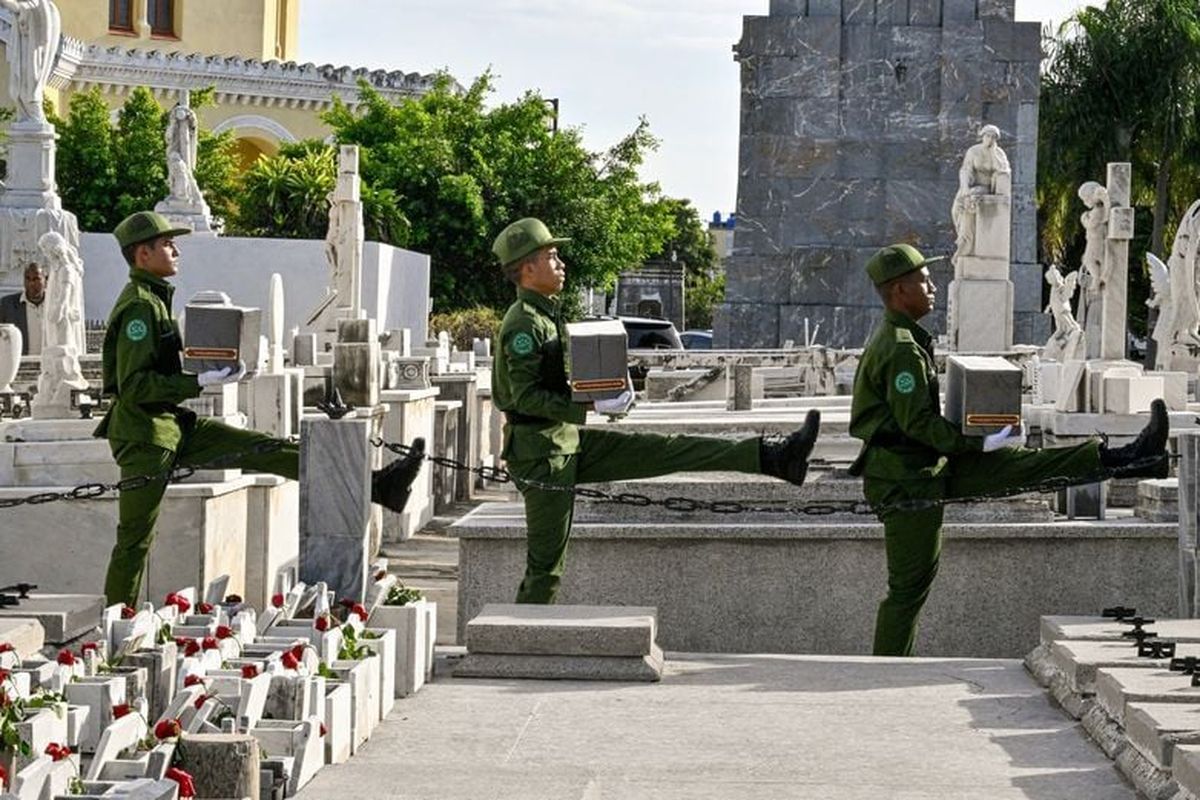
Members of the Cuban military honour guard carry urns containing the remains of soldiers killed in the U.S. strike and the capture of Venezuelan President Nicolas Maduro and his wife, Cilia Flores, in Caracas on January 3, during the funeral for Cuban soldiers at Colon Cemetery in Havana, Cuba, January 16, 2026. Adalberto Roque/Pool via REUTERS  (Adalberto Roque)
Members of the Cuban military honour guard carry urns containing the remains of soldiers killed in the U.S. strike and the capture of Venezuelan President Nicolas Maduro and his wife, Cilia Flores, in Caracas on January 3, during the funeral for Cuban soldiers at Colon Cemetery in Havana, Cuba, January 16, 2026. Adalberto Roque/Pool via REUTERS 
 
On Friday, tens of thousands of Cuban citizens demonstrated outside the U.S. Embassy in Havana, furious over the death of 32 Cuban officers, killed during the U.S. military raid that captured Venezuelan leader Nicolas Maduro two weeks before. The open-air Jose Marti Anti-Imperialist plaza across from the embassy was crowded in the rally the Cuban government organized during high tensions between Cuba and the United States, following the attack on Venezuela of January 3.
 
Cuban officers, part of President Maduro's security detail, were killed when the raid on his Caracas residence took place. The show of popular strength was Cuba's answer to U.S. President Trump's demand that Cuba 'make a deal' with him before it is "too late". Cuba, Trump crowed, could no longer depend on Venezuela's oil and money to buoy its fractured economy.  The 1960s-forward U.S. sanctions imposed on Cuba as punishment for its communist government has strained the island mercilessly.
 
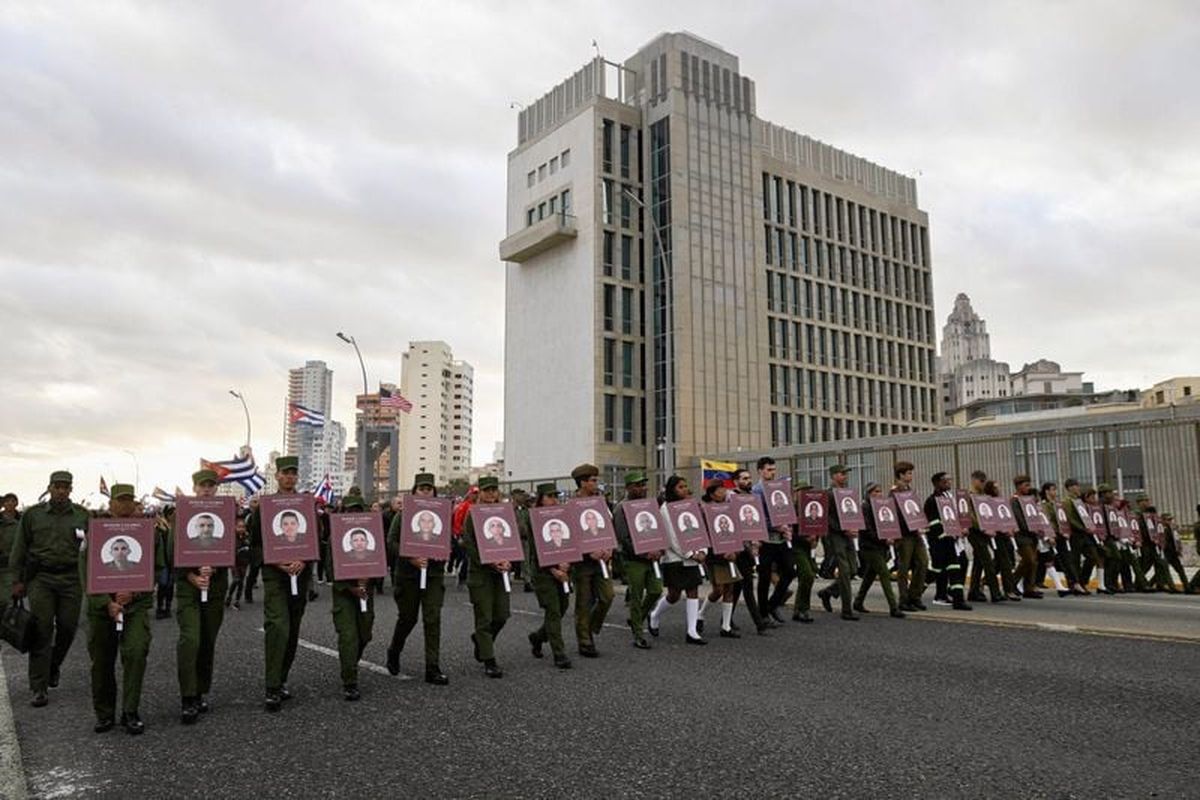
The crowd of protesters transitioned their demonstration into a "combatant march" parade, a custom hearking back to the late Fidel Castro, where a line of people led the crowd, holding up photographs of the 32 officers that were killed in Venezuela. "Down with imperialism! Cuba with prevail!", shouted the crowd. 
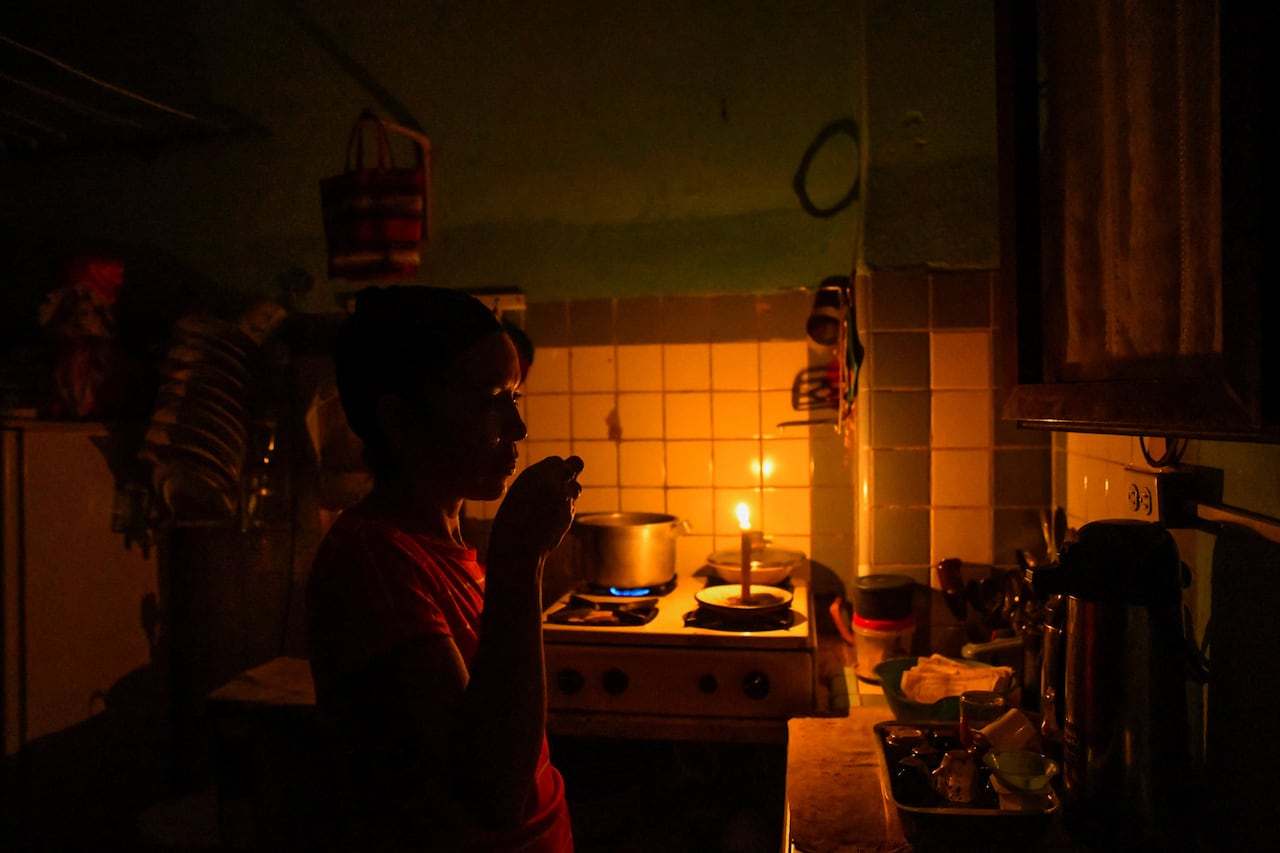
 
A woman prepares a coffee during a power outage in Havana.
A glimpse of a coffee being made by candlelight during a power outage in Havana in March. The disruptions are often blamed on Cuba's aging power generation system, which has been stressed by fuel shortages, natural disasters and economic crisis. (Norlys Perez/Reuters)
 
Cubans have faced shortages of the basic needs of daily life. The economy is now in worse shape than it has ever been. Up to the present the government had supplied the population with a monthly allotment of rice, beans and other staples through distributed ration cards. Although the rations lasted a mere ten days, now, because of food scarcity, government ration stores can barely stock the essentials, rendering the ration cards fairly worthless.
 
There is an app available where people must sign up for an appointment to buy gas, three weeks in advance of prospective purchase. Latterly the waiting queue has been three months. With scant fuel available for municipal purposes, trucks have been unable to collect trash. Pickups of domestic garbage have been faulted, and the result is outbreaks of mosquito-borne diseases like dengue fever and chikungunya. Treatment drugs are no longer locally available.
 
Venezuela once provided 90,000 barrels of oil daily to Cuba although the last quarter of  2025 saw oil deliveries dwindle to 35,000 barrels. Now, with the U.S. in control, there will be none. Private enterprises were legalized in 2021 where private stores stock consumer goods comparable to those of U.S. supermarkets, but demand exorbitant prices. In Cuba a typical monthly pension is less than $7; a carton of 30 eggs is priced at $8.
 
"The domestic economy is in a free fall", said Ricardo Torres, a Cuban economist, now a fellow at American University in Washington. People now do their cooking over firewood. Cuba now produces 25 percent less power than in 2018.  
 
https://thumb.spokesman.com/b7uB7Qs2NZnw1fZzFnsAfrhAa0g=/1200x800/smart/media.spokesman.com/photos/2026/01/16/696addb4cb086.image.jpg
Cuban military personnel carry portraits of soldiers killed in the U.S. strike on Venezuela and the U.S. capture of President Nicolas Maduro and his wife, Cilia Flores, during a march outside the U.S. Embassy to protest against what they denounce as U.S. aggression in the region, in Havana, Cuba, January 16, 2026. REUTERS/Norlys Perez (Norlys Perez)
 
 
"I, who was born there, I, who lives there, and I'll tell you."
"It's never been as bad as it is now, because many factors have come together."
"It's dark [severe lack of energy], people are sick and they don't have medicine [adequate food and medical drugs in acutely short supply]."
"There is food, and plenty of it [at MiPyMEs private enterprises] but the prices are incredible."
"Nobody with a salary, not even a doctor can hardly buy in those stores."
Omar Everleny Perez, economist, Havana resident 

Labels: , , , , , , ,

Monday, October 19, 2020

Poverty and Food Insecurity, a Humanitarian Ill

"World Food Day is calling for global solidarity to help all populations, and especially the most vulnerable, to recover from the crisis, and to make food systems more resilient and robust so they can withstand increasing volatility and climate shocks, deliver affordable and sustainable healthy diets for all, and decent livelihoods for food system workers."
World Food Day, October 16

"It infects my life I want to say affects, but it's both. It affects my life on a daily basis."
"I felt like my story should be shared because I'm not the only one going through this. Because I am them, they are me."
"But I find that lower-income people tend not to share what's happening with them because of pride. Because of embarrassment. It's not cool to say you're poor. It's not cool to sit with a bunch of people at lunch and you're like, 'wow, I wish I could buy that but I can't. I'll have the soup'."
"I don't feel ashamed anymore. I used to feel embarrassed. But I don't want it to be a sad story -- it's an empowering story."
"I'm saying this so we can get policy changed. That's why I'm talking."
Nicola Moore, singer-0songwriter, peer advocate, Hamilton Community Food Centre

"These are all key things [difficulty in finding employment, food poverty] that add up to people being pushed further to the margins and their lives being diminished -- and frankly, the data shows, shortened as a result of being food insecure."
"First-person stories, whether you're left, centre or right on the ideological or political pendulum, you can't duck a story that is so clearly showing that people are working overtime to try and make ends meet for themselves and their families." 
"Food won't solve hunger, income will. If you frame the issue as hunger, you get food responses and you get charity. If  you frame the issue as poverty, you get policy responses and you get the right to food. That's where we need to be. It's not about supply."
Nick Saul, CEO, Community Food Centres Canada (CFCC)

"I could sit here and get Ontario Works payments or I could do something about it and change my life, which is what I'm trying to do right now. Advocacy and singing are my way out", says Nicola Moore, single mother of three young children and now an avid gardener in a community plot growing cucumbers, green beans, lettuce, squash, tomatoes, herbs and kale. She advises people how to use a tin of chickpeas they are given on trips to the food bank, in a multiplicity of ways.

And she has been featured in a newly released report: Beyond Hunger: The Hidden impacts of Food Insecurity in Canada. The CFCC made a survey of 561 people on low income living across the country. Ms.Moore sticks to "a very tight budget" for food between $120 and $140 weekly. Her youngest is not yet two, and almost half of that budget goes to baby-specific needs (like diapers), with $10 spent on milk per week. "And god forbid my son has a growth spurt and drinks the whole bag at one time, which he's been known to do. That is stressful for me and I have to put on a good face for them. I don't want them to know I'm worrying about that", she allows. 
 
WFP/Mehedi Rahman
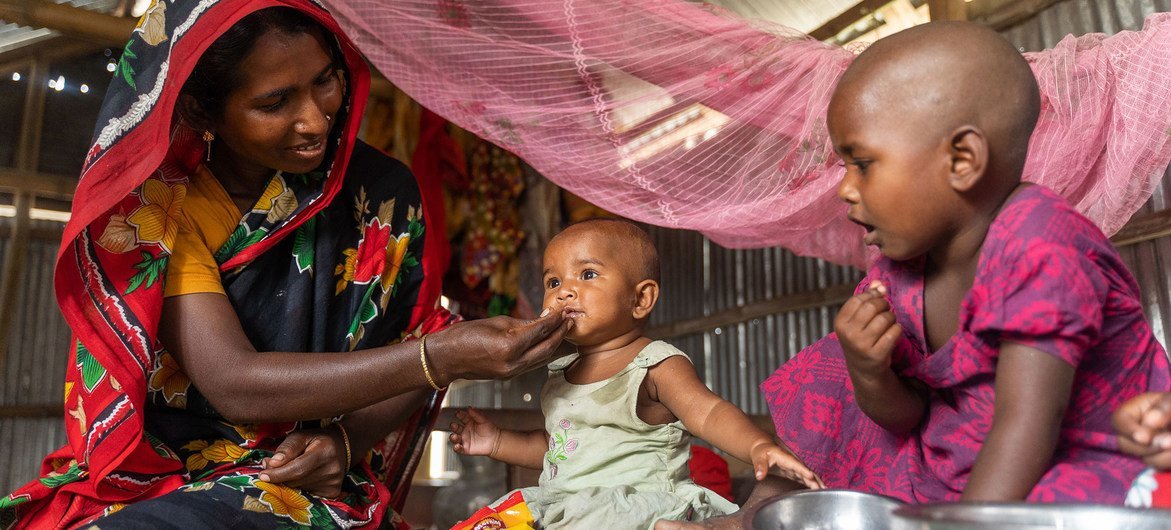
Families are being provided with food aid by the World Food Programme (WFP) after heavy monsoon rains flooded parts of Bangladesh in June 2020.

Before the onset of the pandemic an estimated 4.5 million Canadians, according to a CFCC report, experienced food insecurity. That number increased by 39 percent during the pandemic. Black, Indigenous and northern communities were disproportionately affected. Now, one in seven people is food insecure, their ability to afford sufficient food and concerns of running out without the means to purchase more, afflicting their sense of self-sufficiency and personal security. 

Poverty is the acknowledged cause of food insecurity, impacting peoples' health, leading to relationships being severed, diminishing a sense of self-worth, and eating away at opportunities for employment, according to a CFCC study. Food insecurity takes a toll on physical health, according to 81 percent of survey participants; 79 percent saying it impacts their mental health; 64 percent stating it erodes relationships, 69 percent claiming it has a deleterious effect on their children, and 57 percent that it becomes more difficult to find and retain employment.

Low wages and precarious jobs, low social assistance rates, the rising cost of living, along with  an aura of colonialism and systemic racism are all cited by the CFCC as issues relating to food insecurity in Canada. And according to Mr. Saul, preferentially the creation of an income floor that people cannot fall below would be an adequate response to an age-old problem of inequality and insecurity leading to poverty. "Making sure everyone has a dignified place at the table, should be a number one social, government-mandated priority."
 
Indisputable and necessary. On the other hand, in a country as wealthy as Canada, in comparison to Third-World countries, washable, reusable cloth diapers are far less expensive than the 'convenient' and expensive disposable diapers, a saving that could be used for food. Furthermore, aspiring to make a living through writing music is unrealistic; such artistic endeavours are for the young and unencumbered. One cannot expect to 'make a living' through such enterprises, and rare is the person who can. Even low-paid service industry employment will garner a wage, topped up by government social welfare.

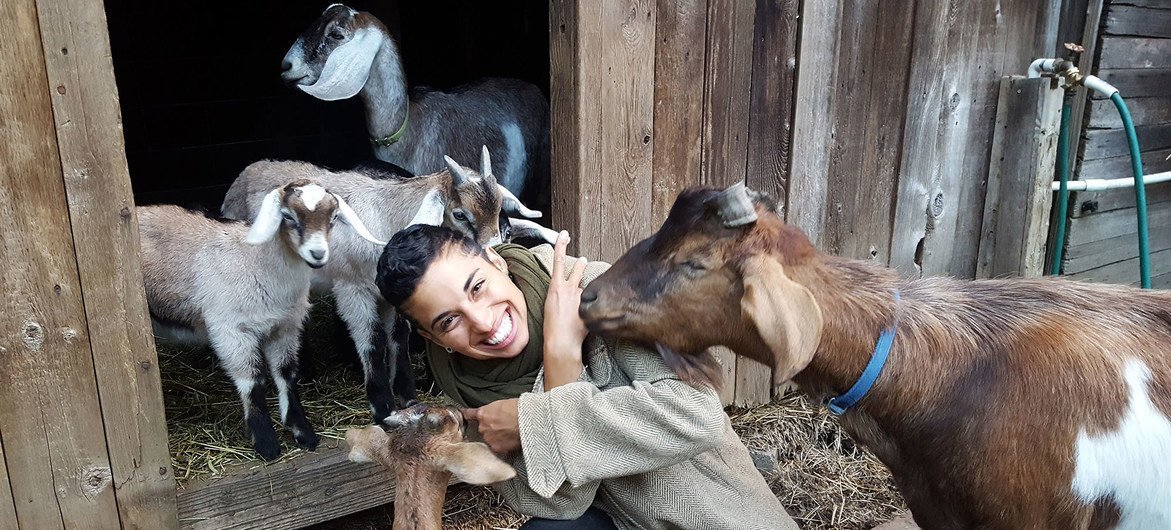
Naima is the Programme Director at Soul Fire Farm, a training farm that aims to help black, indigenous and people of colour have a greater say in, and control over, their food systems.

Labels: , ,

 
()() Follow @rheytah Tweet