Ruminations

Blog dedicated primarily to randomly selected news items; comments reflecting personal perceptions

Wednesday, July 15, 2020

Hold the Burps and Petards

"To make a real impact in the world, we need the whole industry to change. Just offering at Burger King is kind of like a drop in the ocean."
"The beauty of it, and maybe the craziness of it,  is that we are doing something ... that can make a real impact on the world by pushing the industry to adopt this new practice."
"It's not really rocket science. Adding 100 grams of lemongrass ... can have a significant impact in terms of greenhouse emissions, which is probably the biggest negative contribution that this industry has."
Fernando Machado, global chief marketing officer, Burger King
COWS'MENU_KeyVisual_July2020
Burger King debuting a Whopper made from cows that burp and fart 33% less
Burger King

The new Whopper being introduced by fast-food chain Burger King will be sourced from cows fed lemon grass to make them belch less methane; the chain's answer to the industry conundrum of sustainability in the world of environmental concern. Lemon grass is fed to cows as a diet supplement to cut greenhouse gas emissions by about a third.

The emerging and growing awareness by major food brands of the role they play in contributing to global greenhouse gas emissions has its response on the part of Burger King with the introduction of the new sandwich, meant to reassure customers that both the company and its clients are making an effort to address the issues of environmental degradation so critical to the future of the planet.

Growing public pressure on this and like issues have driven major food brands to reconsider their role in contributing to global emissions. Meat producers and retailers in particular have faced growing pressure from investors and consumers to think of innovative ways they can reduce their products' climate impacts. In terms of greenhouse gas emissions, agricultural industries are second to the energy industry in their effect on the environment.

About 14.5 percent of the global total greenhouse gas emissions are linked to raising animals. Cows are known to emit methane roughly thirty times more powerfully destructive than carbon dioxide's role in warming the planet, making the logistics of selling low-methane beef across a fast-food empire doable, while daunting. The issue is that production costs will be impacted and suppliers and retailers must be prepared for higher costs.

Modified diets and feed supplements carry additional costs for cattle farmers, themselves grappling with reduced incomes newly compounded by the issues surrounding the coronavirus pandemic. While paying more for the new product that Burger King is preparing to introduce to its waiting market, the increased cost will not, according to Mr. Machado, be passed on to the consumer; not at the present time, in any event.

Selected stores in Miami, New York, Austin, Portland and Los Angeles will feature the new burger on their menus. Suppliers in Latin America and Europe are being brought on line with the intention of expanding the new initiative. The company also sells meatless burgers in a partnership with Impossible Foods Inc. In a calculated move, the company has taken the direction of green product releases to enhance both their reputation and eventually, their bottom line.

The method of diet supplementing for cows with lemon grass has demonstrated that methane emissions are cut by an average of 33 percent, but the method awaits validation from an academic peer review following initial experiments. Lower-emission beef may ultimately require certification if sold on a mass scale, to win over consumer confidence. To that end, the company has stated it plans to share its cow diet formula in an effort to convince other companies to follow their example.

What a gas: Burger King’s methane-focused social media campaign and new Whopper rollout acknowledge a core industry challenge: the environmental impact of beef. Associated Press/Burger King

Labels: , , , ,

Tuesday, April 11, 2017

Agriculture and Climate Change

"It's a side-effect of agriculture that could be addressed with some relatively simple measures."
"We are always going to have to eat, so this is not going to go away."
Professor Claudia Wagner-Riddle, Atmospheric Sciences, University of Guelph

"It was surprising to see the results."
"I don't think anyone would have expected that."
Ron Bonnett, president, Canadian Federation of Agriculture
A horse stands on a fog-shrouded hill at a farm on Shannonville Road in Tyendinaga Township northeast of Belleville, Ont. Luke Hendry/Postmedia

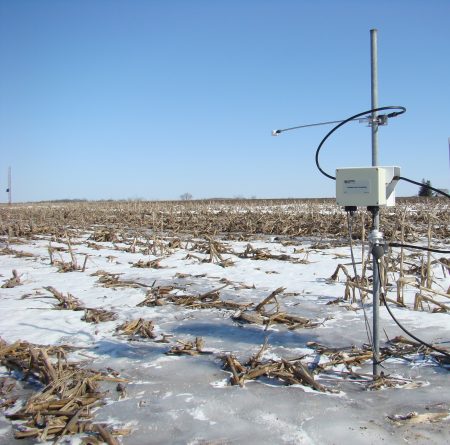
A team of Guelph researchers led by Professor Wagner-Riddle placed devices on agricultural fields in Ontario and Manitoba, to automatically analyze gases flowing upward into the atmosphere from the fields for periods of fourteen and nine years respectively. The data collected was used by the researchers to account for yearly variations in conditions. Readings were gathered as well from another ten Canadian locations. Nor were the U.S., Japan, China and Germany ignored, for data was collected from those sources as well.

The researchers took that bounty of information, then proceeded to extrapolate their findings to cropland worldwide in landscapes subject to freeze-and-thaw cycles, transiting the seasons from winter to spring. The conclusion reached in this study was that the unique process of cropland freeze-and-thaw cycles churn out a  teragram -- one billion kilograms -- of nitrous oxide annually. This data has never before been quantified.
U of G developed technology used to monitor and measure nitrous oxide emissions from thawing croplands. University of Guelph

Nitrous oxide is more commonly referred to as laughing gas, used as a dental anaesthetic. It accounts for something in the range of under ten percent of greenhouse gas emissions. Its presence in the atmosphere, however, is no laughing matter since it is close to 300 times as capable as carbon dioxide at trapping energy relating to the greenhouse gas effect believed to be at the core of our warming planet.

While it has been known for quite awhile that agriculture represents a primary source of nitrous oxide emissions resulting from the nitrogen-based fertilizer used worldwide in the production of food, the impact of fields in northern climates that freeze during the winter, then thaw has never before been evaluated. Now, the study published in the journal Nature Geoscience definitively points out that as ground defrosts, microbial activity releases nitrous oxide into the environment.

The study's conclusion quantifying the contribution of agriculture to production of nitrous oxide is that the issue has been underestimated by 17 to 28 percent. And because of its contribution to global warming, where climate change effectively reduces the amount of snow serving as an insulating layer over soil in winter, the ground may, as a result be more likely to freeze, ensuring the thaw will produce conditions leading to the release of nitrous oxide into the atmosphere.
Spring thaw of croplands is a big and overlooked contributor to global greenhouse gas emissions, according to a first-ever study by University of Guelph researchers. University of Guelph

Dr. Wagner-Riddle feels that the contribution of agricultural fields' springtime release of the gas merits countermeasures. Even recognizing that industrial sources of pollution are greater than the greenhouse-gas expelled by croplands the issue should be a source of concern. Farmers should be encouraged to leave nitrogen-absorbing "cover crops" on fields throughout the winter. Farmers, aware of their part in the climate-change phenomenon which includes methane emissions from livestock manure, are likely to want to be involved in altering the equation.

Mr. Bonnett of the Canadian Federation of Agriculture has stated that many Canadian farmers already have seen the merits involved in no-till farming, some using cover crops at the present time and recognizing the benefits of both measures being useful to farming itself, while the fact that it enhances the environment is considered an additional, valuable bonus.

So the issue of planting cover crops to remain in the earth over winter, along with no-till farming, where the ground is not ploughed up and crop remnants ploughed under, post-harvest, are known to reduce nitrous oxide emissions, while at the same time making less work for the farmer in a more efficient technique that has growing acceptance among the farming community.


Labels: , , ,

 
()() Follow @rheytah Tweet