Ruminations

Blog dedicated primarily to randomly selected news items; comments reflecting personal perceptions

Sunday, August 30, 2026

Our Warming El Nino Oceans

"[This new record being set  for hottest temperatures in the world's oceans is] very troubling." 
"An ocean this warm destabilizes weather patterns and threatens food security, economic prosperity and marine life."
"A warmer ocean is not our friend."
Jane Lubchenco, oceanographer, former chief of U.S. National Oceanic and Atmospheric Administration
 
"This is yet another sign of our climate system under strain and the ocean under immense pressure."
"When we have a warmer ocean such as we've had in Europe this summer, it amplifies the impact of heat waves because you don't get the cooler nighttime temperatures with the sea breeze coming off the ocean when the ocean is very warm."
"Samantha Burgess, strategic climate lead, Copernicus climate service, Europe
 
"The thing that makes my heart sink is that this starts so early and it's so out-of-normal that you know when it hits its peak it's going to be unprecedented."
"The ocean is not supposed to do this. It's just that there is no normal anymore."
"[With hotter water], not everybody is hit equally, obviously, but the whole system collapses."
"It's like when you pull out the rug from underneath an economy. The whole thing collapses. Some sectors may do a little bit better but, overall, everybody suffers."
Boris Worm, biology professor, Dalhousie University, Canada 
https://i.cbc.ca/ais/80a62de5-63c5-4f20-9c6c-3fb4465b7573,1787335003339/full/max/0/default.jpg?im=Crop%2Crect%3D%280%2C507%2C6500%2C3656%29%3BResize%3D860
A very strong El Niño developing in the southern Pacific Ocean will disrupt global weather patterns in the months ahead, but climate scientists say it's not something we can attribute to the heat waves and wildfires that raged across the northern hemisphere this summer, like the ones in British Columbia's interior earlier this month. (Darryl Dyck/The Canadian Press)
 
This year's El Nino has already reached the peak of other recent such appearances, and it's continuing to grow and expected to reach unprecedented levels when it does eventually peak. With the current El Nino, the oceans will keep heating  up, and it is  expected to peak at some time between November and January. That's abnormal since most of the Southern Hemisphere is ocean, and the world's sea surface temperature generally peaks around March and April as the southern summer draws to its close. But not this year.
 
El Nino is nature's temporary warming of portions of the Pacific Ocean which warps weather, raising global temperatures. This is a weather phenomenon recognized as being responsible for most of the heat that develops in the world's oceans -- along with long-term warming resulting from burning coal, oil and gas. This year, ocean waters have warmed by 0.8C, seeing the world's oceans at their hottest temperatures on record last weekend. That's bad news, but even worse is that they're entirely likely to keep warming. 
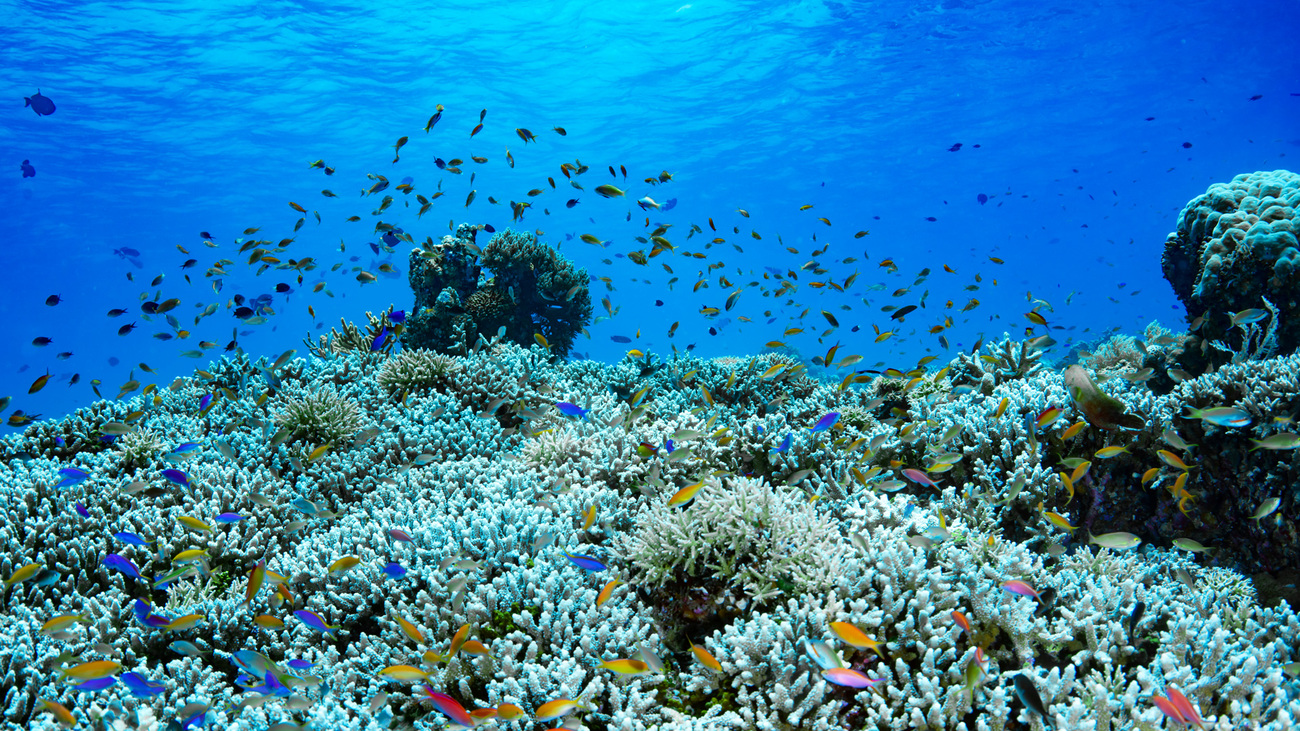
 
https://d1jyxxz9imt9yb.cloudfront.net/medialib/4744/image/s1300x1300/AdobeStock_277159209_565251_reduced.jpg
Coral in Tubbatah Reef in the Philippines.  Adobe
 
Aquatic lifeforms are placed under stress with warming water. The supersized El Nino of this year is proving to be of greater concern than the record previously set in March of 2024. A warming ocean becomes more acidic with less oxygen, inimical to the health of its sealife. Ocean currents become altered along with changed weather patterns. Storm systems are enhanced by the warming oceans, becoming wetter and producing larger storm surges.
 
According to Dr. Bruno, heat-sensitive corals now are roughly one-fifth of the levels of 1990. Some species of coral -- not the longer-lived staghorn corals -- are adapting to the hotter water, although they're 'weedy'. The current situation of warmer oceans and even warmer yet as time moves on and the heating persists, is predictive of collapsed fisheries resulting in universal food shortages.The Peruvian anchovy fishery, considered the largest world fishery, generally collapses during El Nino.
 
https://media.cnn.com/api/v1/images/stellar/prod/galapagos-reef.jpg?c=original&q=w_860,c_fill/f_avif
Corals from the Galápagos Islands contain chemical signatures that scientists were able to use to trace a 1,000-year history of El Niño events.   Greg Asner/DivePhoto.org
 
The food web becomes altered, since larger fish are able to swim off to cooler water to escape the heat, as far as halfway across an ocean. "Anchovies can't leave so they just don't reproduce, or [they] starve", explained Dr. Worm, affecting both the humans and the seabirds who depend on them. The presence of more jellyfish is being observed off Europe, stated Dr. Bruno, believing something similar will be seen on the East Coast of the United States.
 
"Jellyfish are often opportunistic and they like warm waters. So yes, I would expect them to do a little bit better", added Dr. Worm. And when's the last time you saw jellyfish on the dinner menu? "As long as we depend on a healthy ocean for our safety, prosperity and well-being, these record-breaking sea surface temperatures portend even greater challenges for us all", added Rick Spinrad, another former NOAA chief. 
"It's frightening. We're not even in October yet."
"You know, usually the Caribbean peaks at like late September, early October."
"And I think next year in the Southern Ocean, the Great Barrier Reef, yeah I'm really worried about what's going to happen in the southern hemisphere in February, March."
John Bruno, marine ecologist, University of North Carolina 
https://i.cbc.ca/ais/c42a76e4-a903-46b9-8133-c0e54027b835,1787338046703/full/max/0/default.jpg?im=Crop%2Crect%3D%280%2C0%2C1017%2C640%29%3BResize%3D796
A satellite map from the U.S. National Oceanic and Atmospheric Administration shows sea surface temperature anomalies recorded on Aug. 20, with hotter than average temperatures stretching across the El Niño region toward the west coast of South America. (NOAA)

Labels: , , , , , , ,

Tuesday, August 11, 2026

Wait For It

"[With wars around the globe in the past few years, people haven't paid much attention to climate change] because the world was on fire in different ways."
"The world is now on fire again with climate change, in a way that's increasingly difficult to ignore."
"It's going to keep getting worse."
Zeke Hausfather, climate change, Berkeley Earth
 
"The driver of the record warmth is climate change in the background."
"And it's a much larger -- much, much larger -- contribution than El Nino, which is just a tenth to two-tenths of a degree on top of that long-term trend."
Zachary Labe, climate scientist, Climate Central
 
"European heat waves are not in isolation. There's also been shocking heat waves in North America."
"There's been shockingly hot conditions in South America as well. There's been devastating heat waves in India."
"There's always heat waves somewhere in the world, sometime, but what is very unusual for Europe for this particular year is the frequency and extent of the heat waves."
Samantha Burgess, global strategic lead, Copernicus Climate Service 
https://d3i6fh83elv35t.cloudfront.net/static/2026/08/2026-08-09T182328Z_1372875178_RC23VMA4VVLO_RTRMADP_3_EUROPE-WEATHER-FRANCE-WILDFIRE-1200x800.jpg
UK and France prepare for another heat wave as western Europe has its 3rd hottest year on record so far. PBS
 
North America and Europe are experiencing wildfires while deadly heat waves hover over cities as the world's oceans have become hotter than ever recorded for this time of year. Spiked global temperatures and warped weather everywhere are attributed to a strengthening El Nino. In far too many areas of the globe, weather is hurtling the world toward a record-breaking summer of mind-bending heat. 
 
To the present, climate records demonstrate that 2026 up to now is the third-hottest year behind 2024 and 2025. In time, scientists believe chance is that by year's end, 2026 could become the hottest year on record. Should that come to pass, 2026 won't, climate scientists seem to believe, wear its hottest-year crown for long. With 2027 on the horizon bets are that the new year-to-come will take that hottest-year award as a reflection of a climate on steroids.
 
According to Dr. Hausfather, a 35 percent chance exists that 2026 will eclipse 2024's hottest record year. Still, according to his calculations, odds increase almost monthly, steadily rising from 7 percent in March. The daily sea surface temperature of the world was a tie from May forward with 2024 and since June has been recording increasing heat daily. Since oceans cover over 70 percent of the Earth's surface a month-and-a-half lag exists between heat in oceans eventually reflecting in the global heat temperature.
 
https://www.theinertia.com/wp-content/uploads/2026/08/wave-670x388.jpg
The ocean is getting hotter, and that’s not a good thing. Photo: Unsplash
 
At present, some 82 percent of the world's ocean surface is overheated this year, with marine heat waves, according to Europe's Copernicus climate service. The U.S. National Oceanic and Atmospheric Administration forecasted a month earlier of a 66 percent chance that 2025 would realize the fourth-hottest year and a 0.l percent chance to be No.1 for warmth by the end of the year. Those odds are expected to rise as the agency completes its July analysis.
 
El Nino causes a natural temporary warming of equatorial Pacific, heating up the average temperature of the globe, warping weather extremes across the planet, and this year El Nino is forecasted to become the strongest in recorded history. Releasing pent-up heat in the ocean, trapping heat as a result of greenhouse gases, with 90 percent going into the world's seas, even more heat is set to be released. This is a situation that keeps setting new record highs.
 
Wildfires, heat and extremes that dominate the summer of 2026 represent what scientists have warned of, resulting from the burning of coal, oil and gas. Traditional industrial pollution creates soot and smog which cool the planet and mask greenhouse gas-triggered warming, and it is on the decrease according to Dr. Hansen, with the climate reacting to greenhouse gases in a much more accelerated manner than scientists anticipated. 
 
The Bald Range wildfire burns near Summerland.
The Bald Range wildfire burns near Summerland, British Columbia. Craig Milton
 
"[This is what scientists have long been warning about.] These are vivid pictures of not just the future, which is what we used to say, but on the whole of what climate change is doing."
"There's no question that climate change has increased the risk of wildfires."
"There's no question that the climate change increased the probability of really hot, nasty, even  unprecedented summers around the world."
Michael Oppenheimer, climate scientist, Princeton University 

Labels: , , , , ,

Saturday, February 28, 2026

Canada: A Shy Energy Giant

"Canada holds 163,108,000,000 barrels of proven oil reserves as of 2025, ranking #4 in the world and accounting for about 9.24% of the world's total oil reserves of 1,765,151,568,000."
"Canada has proven reserves equivalent to 188.6 times its annual consumption levels (based on 2024 data). This means that, without net exports, there would be about 189 years of oil left (at 2024 consumption levels and excluding unproven reserves)."
world0meter  
Voronoi graphic of the countries with the most oil reserves in 2024, showing how a handful of nations control over half of global supply.
Visual Capitalist 
"Canada has significant reserves of conventional and unconventional oil and gas resources. Canadian oil production is focused in the west of the country, especially in Alberta. Canada’s proven oil reserves remain among the world’s largest — estimated at around 168 – 170 billion barrels (about 10 % of global reserves), with the majority in oil sands. The largest oil reserves are found in Venezuela and Saudi Arabia, which have around 18.2 % and 16.2 % of the total reserves, respectively."
"Canada also produces natural gas, with reserves and production primarily in provinces such as British Columbia, Alberta, and the Northwest Territories. Producing natural gas involves extracting gas from underground reservoirs and processing it so it is suitable for various uses, such as heating. In 2025, Canada’s natural gas production averaged about 19 billion cubic feet per day (Bcf/d), making it the fifth-largest producer globally and accounting for roughly 5 % of world natural gas supply."
"Canada is currently the fourth-largest oil producer in the world, with production near 6.0 million barrels per day in 2024, including oil sands, conventional, offshore, and liquids."
Olivia Bush, Made in CA   
albertaoilsandsstockimage
A large oil refinery along the Athabasca River in Fort McMurray, Alta.
 
New Brunswick, an eastern province of Canada was the second place in the world in 1859 to discover oil and gas would bubble to the surface when a hole was drilled in the ground. New Brunswick has a wealth of fossil fuel; an estimated 77.9 trillion cubic feet of natural gas, according to Natural Resources Canada. New Brunswick held the knowledge of its great natural resources close to its chest, making the choice not to develop its reserves. The province imposed an indefinite moratorium on hydraulic fracturing (fracking) in 2014 judging it to be environmentally unfriendly. 
 
Yet it is precisely that system of extraction that is required to draw up the provincial gas reserves. New Brunswick is not alone among Canadian provinces in the abundance of its energy resources, given the Canadian total of about 1.4 quadrillion cubic feet. And according to an analysis conducted by the U.S. Department of Energy, that plenitude of energy is sufficient for Canada to provide natural gas needs for the entire world for a period of 200 years. 
 
When Japan's prime minister travelled to Canada in 2023 and a year later Germany's chancellor followed, both leaders had a distinct and direct purpose in mind. To persuade the Canadian government of those countries' dire need for a reliable energy source in the wake of Russia's invasion of Ukraine, when the U.S. and the EU took punitive steps against Russian aggression by sanctioning Russian gas whose sale helped to fuel the war. Their persuasive efforts fell on deaf ears. Canadian Prime Minister Justin Trudeau's off-handed response was that there was no business case to be made for Canada to export gas.


Under the new Liberal government headed by Marc Carney that succeeded the Trudeau government, Canada re-elected yet another figure influential in environmental circles dedicated to ensuring that energy resources were kept underground, as a source of carbon dioxide that was adding fuel to global warming, responsible for dramatic weather changes and adding to natural disasters in extreme weather conditions. Resistance to oil pipelines to tidewater for shipping abroad, to continued exploitation of the Alberta heavy crude oil to a world hungry for energy, continues under the current prime minister.
 
A situation where a country's vast natural resources are being left underground, with the full potential of extraction not to be realized on the basis of the harm it would do to the environment already in a situation of degradation from climate change. This despite vast technical advances in the extraction of oilsands for a cleaner product. And in the face of the fact that Canada's contribution to global greenhouse gas in the atmosphere is slightly more than 1-percent of the world total. 
 
A situation that has led Canada to export its oil to U.S. refineries at a discount, and where the U.S. sells that refined oil elsewhere at a profit denied to Canada. In turn, Canada continues to import oil from the Middle East for the energy needs of New Brunswick and Quebec, lacking a pipeline that would provide them with Canadian oil from the Western provinces; pipelines are dirty words to environment-dedicated British Columbia, New Brunswick and Quebec. 
 
The Maran Gas Hector is pictured in a 2017 photo. (Courtesy: Adam Fish/ marinetraffic.com)
The Maran Gas Hector
 
And out of this impasse the absurdity of an Australian oil tanker, the Maran Gas Hector, sailing 25,000 kms from Gladstone, Australia, across the Atlantic to New Brunswick's Saint John harbour where it docked and proceeded to unload its cargo to fill the need of the very province sitting atop a wealth of untapped oil reserves.  A decade ago four LNG export terminals were proposed for Canada's Atlantic coast, but the prospect failed to resonate. Leading to the shipping across a vast distance, of Australian natural gas. 
 
Unlike Canada, Australia has exploited its reserves for export since the 1980s as supercooled liquefied natural gas through its 10 LNG export terminals and thousands of kilometres of natural gas pipelines. As opposed to Canada's single LNG export terminal in Kitimat, British Columbia, just a year old, following a lengthy process of environmental reviews and legal confrontations, amidst civil environmental insurrectionists. 
 
https://smartcdn.gprod.postmedia.digital/nationalpost/wp-content/uploads/2026/02/used4.jpg?quality=90&strip=all&w=564&h=423&type=webp&sig=eQfhXrVex-T4dqJTQF3kuw
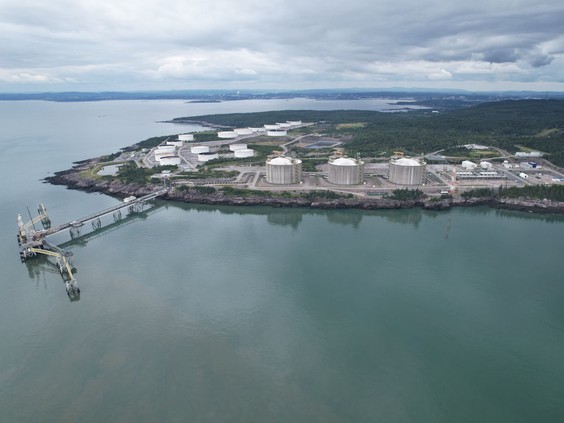
The only LNG terminal on the Canadian Atlantic coast, and it's to import LNG, rather than export it. Photo by Twelve O'Clock High Drone Services


Labels: , , , ,

Sunday, November 02, 2025

Global Heat-Related Deaths Rising

"That's approximately one heat-related death every minute throughout the year."
"So this is a really startling number."
"Were potentially reaching these limits in different parts of the world at an alarming rate or approaching them. It's something that needs urgent action."
 "We constantly emphasize to people that heat stress can affect everybody and it can be deadly – I think a lot of people don’t understand that – and that every heat-related death is preventable."
Ollie Jay, heat and health expert, University of Sydney
 
"Climate change action remains one of the greatest health opportunities of the 21st century, also driving development, spurring innovation, creating jobs, and reducing energy poverty."
"Realizing the myriad benefits of a health-centered response requires unlocking so-far untapped opportunities to mitigate climate change and build resilience to the impacts already being felt."
Tafadzwa Mahbhaudi, director, Lancet Countdown Africa 
https://time.com/redesign/_next/image/?url=https%3A%2F%2Fapi.time.com%2Fwp-content%2Fuploads%2F2025%2F10%2Fclimate-health.jpg%3Fquality%3D85%26w%3D1024&w=1920&q=75
Gary Hershorn/Getty Images
 
According to the most recent edition of the Lancet's yearly report on climate and health, rising temperatures are responsible for the deaths of close to 550,000 people globally. A startling number, considered part of a heat death phenomenon that has risen steadily by over 20 percent on a population-adjusted basis since the 1990s, when stark warnings of Climate Change began to alert governments. 
 
The medical journal Lancet has reported total numbers of global heat-related deaths for the first time, calculated to reflect advances in methodology estimating such deaths, along with improved access to detailed death data acquired in various countries. During 2025's record-breaking temperatures world-wide, these new numbers register yet another concern related to a warming climate. This year European residents and summer tourists suffered through heatwaves all summer long.
 
Extreme heat also gripped parts of Asia and North America. The report commissioned by the Lancet, its ninth such report, reflects data acquired by 128 researchers globally, across 71 organizations; findings that people around the world experienced heat wave conditions that convincingly over the last five years would never had occurred outside of climate change conditions.
https://ichef.bbci.co.uk/news/1024/cpsprodpb/eddb/live/670a44e0-b576-11f0-86b2-ed6a609e4a6c.jpg.webp
India is among the most polluted countries in the world   Reuters
 
Not only are human lives being lost on a large scale as a consequence of universal heat waves, but the global economy is also bearing its brunt of the phenomenon in lost labour productivity where heat caused an estimated $1 trillion in income losses in 2024. There is sleep lost due to heat discomfort, leaving workers tired, irritable and incapable of functioning to their full potential. These are statistics that cause scientists to believe parts of the globe are approached physiological tipping points; heat and humidity taking their toll on human survival.
 
Heat-related deaths in Latin America have more than doubled in the last 25 years; some 13,000 deaths occurring yearly. A variety of indicators were tracked to assess health threats posed by climate change and related extreme weather-caused health risks. The warming climate's influence on infectious disease transmission is yet another grave concern. Indicators of impaired health reaching record levels since monitoring began. Minuscule particles exposure through wildfires polluting the air and peoples' lungs are seen as the cause of over 150,000 deaths globally on an annual basis.
 
Tropical diseases like dengue have seen the worldwide average transmission surge through mosquito vectors by close to half since the 1950s, given warmer and wetter weather conditions that enable insects to spread and survive where they never could previously in atmospheres traditionally hostile, now having undergone change. 
 
One portion of the complex puzzle of Climate Change has seen more positive news resulting with respect to rising awareness and amelioration efforts. Global exposure to at least one kind of fossil fuel pollution has seen a 20 percent decrease in the last fifteen years, with many developing nations cutting their use of coal-based energy.  
 
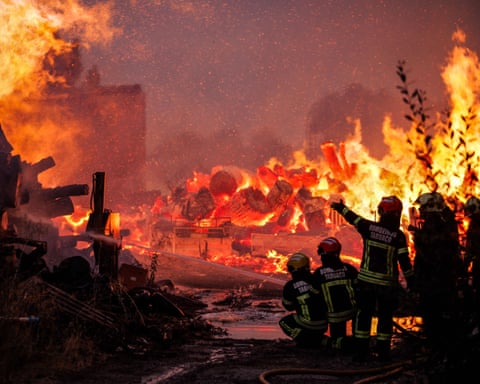
Firefighters look on at large flames
Firefighters tackle a blaze in Chaves, Portugal, in August. Photograph: Pedro Sarmento Costa/EPA
 
"This year’s health stocktake paints a bleak and undeniable picture of the devastating health harms reaching all corners of the world—with record-breaking threats to health from heat, extreme weather events, and wildfire smoke killing millions. The destruction to lives and livelihoods will continue to escalate until we end our fossil fuel addiction and dramatically up our game to adapt."
"[...Overall, the findings present a picture that is] very bleak."
"Were really, really worried from the scientific perspective because we do have the data and there's no denying how grave the situation is."
Marina Romanello, executive director, Lancet Countdown, University College London

Labels: , , , ,

Monday, November 11, 2024

The Consuming Agenda of Climate Change and Woke Genderism

"[While Trump's] false [and] outrageous [comments and behaviours were offensive and objectionable, the Harris campaign faced major ideological obstacles]."
"Put another way, the takeover of the Democratic party by progressive, so-called woke issues was devastating to Harris's campaign especially as Trump and the Republicans successfully painted her as an unreconstructed 'left-winger'."
Michael Hirsh; 'Why She Lost', Foreign Policy magazine

"Across the last decade, the defining pattern of national politics has been class de-alignment: a vast migration of working-class voters away from the Democratic Party."
Matt Karp, Princeton University

"America is a failed democracy. Our media failed us, our institutions failed us, our people failed us."
"Worst of all, we now pose a major threat to the planet."
Michael E. Mann, climate science extremist, Pennsylvania University

"We have more liquid gold, oil and gas. We have more liquid gold than any country in the world. More than Saudi Arabia. We have more than Russia."
"We're gonna have to seal up those borders, and we're gonna have to let people come into our country. We want people to come back in. But we have to, we have to let them them come back, but they have to come in legally."
President-Elect Donald Trump
https://assets2.cbsnewsstatic.com/hub/i/r/2024/11/11/46741b31-647a-4c74-9212-55d6854b74b1/thumbnail/1280x720/961a20d5405e5628c92e98d6f63671eb/ot-patheshiftfd-new-3328655-640x360.jpg?v=dc2545c4ab2eed12a36d08149f07343c
CBS News
 
The U.S. presidential election is now over, and while much of America is pleased, much of it is not. The stock market rose significantly in response to the election outcome. Investors anticipate that the U.S. economy, freshly released from anti-business constraints, largely environmental concerns and high taxes is set to boom. The election results left Democrats and aligned activists in an agony of misery with the realization that the Democrats' social and economic ideas have come to a thudding halt. Woke genderism and extreme climate agendas along with costly industrial policy interventions failed to move the electorate.

Kamala Harris was weighed down by the very ideological mainsprings she supported and spoke so glowingly of as achievements. Her chirpy happy-style along with her evasiveness when questioned and the gushing flow of meaningless words did her no favours. Nor did a tide of voter rejection of the  extreme progressive elements of the Biden agenda that she carried forward.

The Democrats really did believe that its infrastructure spending driving up debt and devotion to climate and clean energy programs would popularize them and bring them to an electoral lead in the polls. They simply failed to recognize that voters, in response to a Democratic agenda they would not support, saw their Republican adversary bathed in a new light of promising delivery from the ideology of woke in all its manifestations.

On the one hand, upper-class voters continued to gravitate to the Democrats, while working class and the middle class support for an agenda that had no appeal for them, dwindled. Their obsessive focus on climate issues and carbon control alienated voters who struggled against inflation and an economy that failed to lift them into economic security.Their concerns over the cost of living and social disruptions were simply never addressed. Polls indicated that climate concerns formed no part of that demographic's concerns.
 
https://img.i-scmp.com/cdn-cgi/image/fit=contain,width=1024,format=auto/sites/default/files/d8/images/canvas/2024/11/12/14d955c6-8156-47c8-bf8e-1c7b14c2013a_8da7d962.jpg
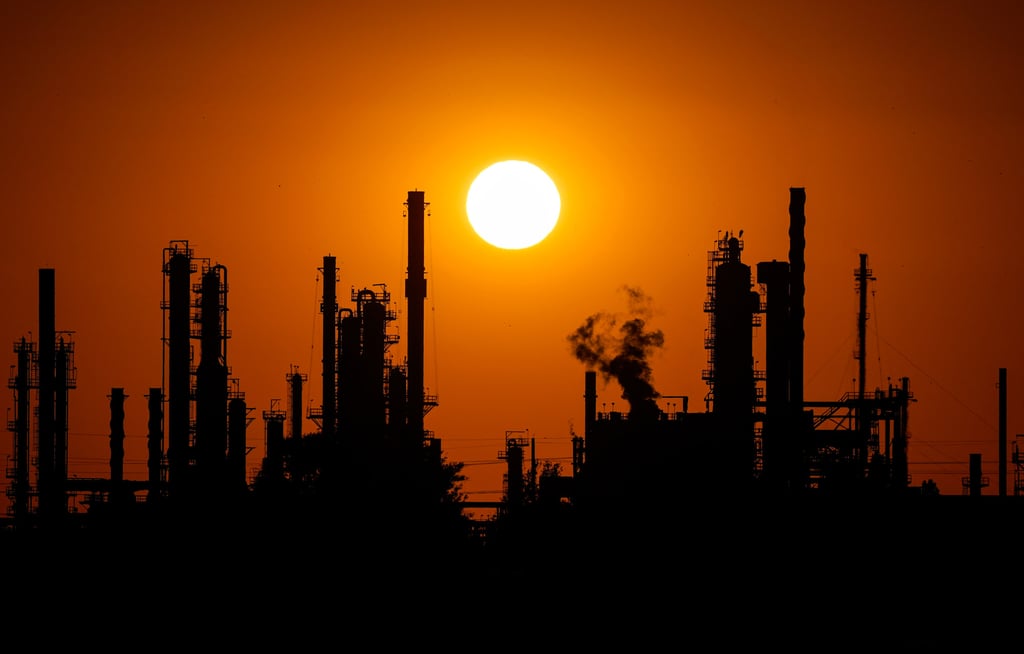
Oil refinery is silhouetted against the setting sun in McPherson, Kansas. Photo: AP
 
The existential hyperbole that environmental doomsayers spouted and the Biden administration catered to had no firm focus in the world inhabited by the average American voter. This is not an attitude solely of the American public exhausted by the constant drumming of climate change alarmism and the costs that accompany it; it is an emerging global phenomenon.

It appears that governments wherever they are located are increasingly feeling a backlash of citizen revolt against irritating and expensive climate change agendas promoted by the West and flouted by the East. America's northern neighbour has seen its Liberal government equally invested in climate change, adversarial to the trade and export potential of its vast reserves of oil and gas, insisting on keeping it in the ground for the sake of the environment rather than producing profit for the sake of the country.

https://cdn.i-scmp.com/sites/default/files/styles/1200x800/public/d8/images/canvas/2024/11/12/8e8d85ce-1bce-4c79-9284-3045c880e1be_7af95631.jpg?itok=8D8Y00Cn&v=1731381413
South China News
"This is the revenge of the regular old working-class American, the anonymous American who has been crushed, insulted, condescended to."
"They're not garbage, they're not Nazis, they're just regular people who get up and go to work every day trying to make a better life for their kids, and they feel like they have been told to just shut up when they have complained about the things that are hurting them in their own lives."
Scott Jennings, CNN

Labels: , , , ,

Tuesday, July 23, 2024

Emerging Extreme Heat Patterns and the Elderly

"Older adults are one of the populations that we classically see as being more vulnerable to the effects of climate change, specifically to the effects of extreme heat."
"As we age, our ability to adapt to heat diminishes."
"Medications can amplify some of those heat effects."
Catharine Giudice, emergency physician, climate change and human health fellow, FXB Center, Harvard 
https://www.arcgis.com/sharing/rest/content/items/be85b665cc4b47dd901547ba95e60c2d/resources/Vulnerable-Populations.png?v=1721788464588&w=800
Source: National Climate Assessment
 
Climate change is real; global average temperatures have reached 1.2C above pre-industrial levels. We have experienced heat waves that are more frequent, more intense than just a few decades earlier. Excessive heat has seen school closures, led power grids to their limits, and taken vulnerable lives around the world. Even as the planet continues to warm, global humanity itself is aging. There were 1.2 billion people 60 years of age and older in 2021 and by 2050 it is estimated that number will increase by another billion, leaving older adults exposed to levels of heat more dangerous than at present.

In June of 2020, a heat dome struck across the Western U.S. and Canada with fatalities resulting that exposed a troubling pattern leading to the realization of the extreme vulnerability of the aged. In Oregon, 56 of the 72 people who perished of heat were aged 60 and up, while in British Columbia, those 60-plus accounted for 555 of 619 fatalities due to the crushing heat. In England a year later, June, July and August saw 2,800 deaths among those 65 and older due to sizzling heat.

The human body, confronted by rising temperature, is geared toward thermoregulating to avoid overheating. Sweat releases heat when it evaporates. "Older people don't sweat as much", states Deborah Carr, professor of sociology, Boston University, whose study is aging. "They have essentially a less efficient cooling system. So they're in extreme heat and don't sweat it out", she explained.

Increased blood circulation is another cooling body response to heat, drawing heat from deep within to the skin. "The heart has to sometimes pump two to four times more blood each minute than it would on a cooler day", explains Renee Salas, with the Center for Climate, Health and the Global Environment at T.H. Chan School of Public Health, Harvard. Although a healthy heart handles the pumping, people with heart disease and allied cardiovascular issues struggle to.

Medications treating  chronic health conditions such a diabetes, hypertension and lung issues which can inhibit the body's capability to respond to heat, also impair that response, by decreasing the ability to sweat or through increasing the need to urinate, which can result in dehydration. Research shows that by the time an elderly person feels acute discomfort as a result of high temperatures, their body may already be suffering.

https://i.cbc.ca/1.4737789.1530924731!/fileImage/httpImage/image.jpg_gen/derivatives/16x9_780/france.jpg
Many elderly people don't rehydrate as often as they should and may also be on dehydrating medications, which could contribute to their higher risk of serious illness or death during heat waves. (Eric Gaillard/Reuters)

"Many susceptible people may not recognize when they are overheating, but another person can help identify a risky situation with some careful questions and observations."
"Check in as often as possible. At least twice a day and once in the evening when it is hottest indoors."
Sarah Henderson, scientific director, Environmental Health Services, B.C Centre for Disease Control

Labels: , , ,

Saturday, April 22, 2023

Health Report for Canada's Chief Public Health Officer

"Fundamental changes in our socioeconomic structures are needed to rebuild our relationships with each other and with our planet."
"Collectively, we have a deep appreciation for Indigenous Peoples' close and continuing relationship to the land and waters that we live upon and we are committed to a lifelong learning journey toward becoming good guests here."
"Canadian public health actions should focus on] decolonization, justice and equity [above all]."
"Health systems should be independently governed or at least arm's length from government structures to be free of fear of repercussions."
What We Heard: Perspectives on Climate Change and Public Health in Canada
Dr.Theresa Tam, Chief Public Health officer, Health Canada

Health Canada commissioned a report and what emerged was a paper written by three individuals, identifying as "white settlers", some 72 pages in length. It was commissioned for the purpose of studying and detailing "impacts of climate change on the health and well-being of people living in Canada". For their report the three authors surveyed thirty public health experts and academics for inclusion and perspective.
 
Warming climate does in fact have an impact on health in Canada; an example of which is an expanded range for disease-carrying mosquitoes increasing potentially the number of people who may be exposed to diseases normally associated with more tropical climates than Canada's; as example, malaria, dengue fever and West Nile virus. Despite which the report lists no condition or infectious illness that might pose a risk in Canada, with linkage to climate change.

The report features instead disparate opinions by Canadian public health professionals focusing on "less tangible determinants", equating with "legal, colonial and racist factors". Which led the report to include opinions and explanations and recommendations such as these:
  • "If we don't address capitalism, if we don't address colonialism, racism, the patriarchy, etcetera, we're going to tread water for a long time until we eventually drown."
  • "It's really about the foundations of our society, the capitalist system, the culture of extraction -- and we need to change that. How do we do that?"
  • "[The concept of] liberty and individualism advances the individual over the collective; it says 'as long as I get what I want, bugger you', and it leads to a huge number of problems, and it undermines the collective process."
The views of 30 Canadian public health officials and academics considered to "have some understanding of the role of public health systems", were distilled in the report. Many of these individuals exist at top levels in the Canadian public health establishment and include three Canada Research chairs. All of the 30 representatives were asked in focus groups or one-on-one interviews: "What roles should the public health system play and why?"

Climate change and poor public health, the report concludes, are caused by many of the same issues: "White supremacy, capitalism, colonialism and racism". Yet another theme posited that public health officials should be more "courageous" to insist on policy typically considered outside their purview be included, which would encompass the promotion of "low meat" diets, designs of housing projects and advocating against extraction and use of fossil fuels.

One respondent stated: "Practically speaking, a lot of public health people want to be making the connections, but they are literally not given the mandate or the permission to because it's not seen to be within their box." There is an admission in the report that public or official pushback to this manner of "speaking out" may result from health agencies, recommending these bodies be insulated against avenues of accountability.

One report respondent stated a belief that "Public health is under attack in some provinces ... and there's this climate change denial that we all know is being fuelled by the fossil fuel sector. So, my worry is that with public health that we won't actually be able to get out there and do what we need to do."

There was a near-unanimous pronouncement in the report that public health agencies should receive increased funding, even at the expense of the primary heath care system; if public health has more money to improve society and fight climate change, the rational goes, fewer people would be going to hospital. "Not only would the primary health-care system require less funding but staff would be less overwhelmed in their duties, especially as health issues related to climate change intensify", reads the report.

NOTICE: This is not a chapter of Lewis Carroll's "Through The Looking Glass".

The report concludes that climate change and poor public health are caused by many of the same things: “White supremacy, capitalism, colonialism, and racism.”


Labels: , , , , , , ,

Tuesday, March 21, 2023

On Thin Ice -- Climate Change

"Humanity is on thin ice -- and that ice is melting fast."
"Our world needs climate action on all fronts -- everything, everywhere, all at once."
United Nations Secretary-General Antonio Guterres

Report Cover
"The choices and actions implemented in this decade will have impacts for thousands of years. [Climate change is] a threat to human well-being and planetary health."
"We are not on the right track but it's not too late."
"Our intention is really a message of hope, and not that of doomsday."
UN science report co-author, water scientist Aditi Mukherji

"We are pretty much locked into 1.5."
"There's very little way we will be able to avoid crossing 1.5C sometime in the 2030s [the big issue is whether the temperature keeps rising or stabilizes]."
Report co-author Malte Meinshausen, climate scientist, University of Melbourne

We are those for whom the bell tolls. Once again being informed that the future harms of climate change are upon us. But, the message continues, there remains yet the opportunity -- a slight one which may be the ultimate turning point -- to prevent the most egregious of those future damages to Earth's environment. To do so would require swift action in eliminating close to two-thirds of carbon pollution by 2035,

The Intergovernmental Panel on Climate Change is adamant and their interpretation of our climate changes is not open to argument. An end to new fossil fuel exploration must be agreed upon. And it is the wealthy countries of the world that must stop the use of coal for energy, along with oil and gas by the year 2040. Action to put an end to the use of fossil fuels has a finite timeline.

Rich countries, stresses Mr. Guterres, must accelerate their target to achieve net zero emissions as early as 2040 as the most urgent of issues. Developing nations have been given slightly more leeway, by a decade. The use of coal must come to an end by 2030 and 2040 respectively. Carbon-free electricity generation must be achieved at the earliest possible date as well as the elimination of gas-fired power plants. The developed world is given to 2035 for this signal goal.
 
Image
 
Nations are expected to arrive at goals for pollution reduction by 2035, in accordance with the Paris climate agreement under which 60 percent of greenhouse gas must be cut by 2035 -- representing a new time-target not previously mentioned in the panel's previous six such reports -- reflecting the urgency of the new declarations. 

Only a few tenths of a degree distant from the globally accepted goal of limiting warming to 1.5C since pre-industrial times, scientists now stress a sense of urgency, alerting the world community. Adopted as part of the 2015 Paris climate agreement, the world has reached the warming point of 1.1 degrees Celsius.

"Tipping points" surrounding that temperature linked to species extinction, includes coral reefs, irreversible melting of ice sheets, and sea level rises of several metres. Reaching the dread 1.5 degrees of warming is inevitable, according to many scientists, in particular at least three co-authors of this latest climate report.
https://ane4bf-datap1.s3-eu-west-1.amazonaws.com/wmocms/s3fs-public/ckeditor/files/Screenshot_2023-03-20_122237.jpg?bv8jhBvPP04aDKB2vq0KZF7kBDCTc98N

Labels: , ,

Sunday, December 25, 2022

Canadian Hudson Bay Western Arctic's Diminishing Polar Bear Population

"The actual decline is a lot larger than I would have expected."
"It certainly raises issues about the ongoing viability [of the area to provide food for struggling female bears to enable them to nurse and rear offspring]."
"That is the reproductive engine of the population."
Andrew Derocher, biology professor, University of Alberta

"Those are the types of bears we've always predicted would be affected by changes in the environment."
"[The capacity for polar bears in the Western Hudson Bay to reproduce will diminish] because you simply have fewer young bears that survive and become adults."
Stephen Atkinson, polar bear specialist, lead author, government polar bear survey
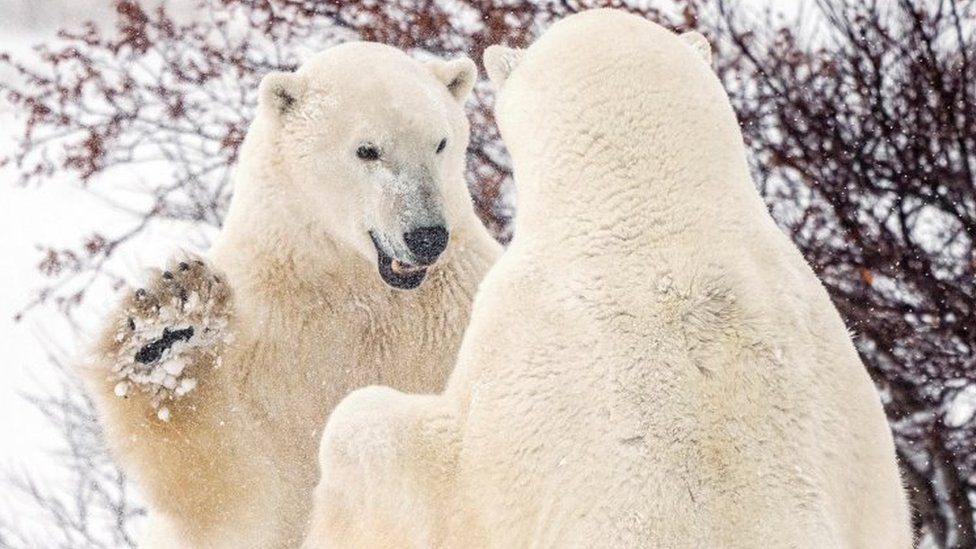
Polar bears spar near the town of Churchill, Canada. File photo
Polar bears are the most studied specimens in the world   Reuters

Western Hudson Bay in the Canadian Arctic on its southern edge are dying in large numbers according to a newly released government survey. In particular the survey points out, female bears and their cubs are experiencing a particularly difficult time. Churchill in Western Hudson Bay, called the Polar Bear Capital of the World, is the locale where a 2021 air survey was undertaken, leading to an estimation of 618 bears in comparison to the 842 found in the 2016 survey.

Biology Professor Andrew Derocher has studied the polar bears at Hudson Bay for close on to four decades and he is alarmed by these revelations. The number of bears in the region since the 1980s fell by close to 50 percent, according to the authors of the study, of which Dr. Derocheer was not a part. The issue comes down to the disappearance of the Polar ice essential to the survival of polar bears reliant on Arctic sea ice -- frozen ocean water -- which in the summer with warmer temperatures, shrinks, to form again in the next long winter.
 
A polar bear near Churchill on the western coast of Hudson Bay
A polar bear near Churchill on the western coast of Hudson Bay, where sea ice has been disappearing at an alarming rate. Photograph: Olivier Morin/AFP/Getty Images
 
The ice enables polar bears to hunt, as they perch astride holes in the thick ice to spot seals coming up for air. The bears are carnivores, seals their favorite food. The Arctic, however, has warmed twice as quickly as the rest of the world, as a result of climate change. And sea ice is cracking earlier while taking longer to freeze back in the fall, leaving many polar bears living across the Arctic with less ice where they can live, hunt and reproduce.

It is the death in numbers of young bears and females in Western Hudson Bay that is most alarming to the future of the species according to the researchers.  The problem centres around the fact that young bears require energy to enable them to grow. They cannot survive long periods in the absence of enough food. In the same token, female bears face a difficult struggle in their expenditure of massive amounts of energy that it takes to nurse and rear their offspring. The future appears drear for the species.

A mother polar bear and cub near Churchill, Man. (Elisha Dacey/CBC)

Labels: , , ,

Sunday, June 19, 2022

A Little Knowledge is a Dangerous Thing

F1 driver Sebastian Vettel -- Getty Images
"I think what happens in Alberta is a crime because you chop down a lot of trees and you basically destroy the place just to extract oil, and the manner of doing it with the tarsands, oilsands mining, is horrible for nature."
"There's so much science around the topic that fossil fuels are going to end, and living in a time that we do now, these things shouldn't be allowed anymore, and they shouldn't happen."
"It's just to think about future generations and the world we leave in their hands ... I think it's only fair to look after it and not destroy it."
Sebastian Vettel, German Formula One driver
 
"A race car driver sponsored by Aston Martin, with financing from Saudi Aramco, complaining about the oilsands."
"Rather than demonizing the oilsands, which is on a path to net-zero, people could look to lowering their own personal carbon footprint."
"Perhaps a pedal-car for Formula 1?"
Sonya Savage, Alberta energy minister
Germany's vital energy dependency on Russian oil and gas has vastly complicated its reaction and that of other Western European nations all hugely in debt to Moscow, paying the Kremlin the rubles for its natural resources that enable it to continue pounding Ukraine into the ground. While castigating Vladimir Putin for his 'special operation', with the Russian military tasked to bring Ukraine to its knees, destroying towns and villages, killing thousands of civilians, sustaining huge military personnel and munitions losses on both sides, a German national finds it prudent to criticize Canadian oil extraction in Alberta.
 
The Formula One driver is struggling with his environmental demons, looking for some entity to blame for his future environmental fears revolving around Climate Change. Like others before him he has found it useful not to question his own country's dependence on fossil fuels that creates an indebtedness of necessity between it and a country whose political-military ideology it abhors and focuses instead on natural resource extraction in a country whose leaders have strangled their own industry, even as that industry is itself committed to cleaner, less polluting extraction methods.
 
Sebastian Vettel's commitment was front row and central when he arrived, as a driver for Aston Martin, on a bicycle at the site of the Montreal Grand Prix with a T-shirt featuring an anti-oilsands slogan. With absurd optics, given that he did not bicycle to Canada from Germany, but picked up his bicycle after flying from Germany to Canada wearing a T-shirt that proclaimed "Stop mining Tar Sands", below which was a picture of a pipeline with the title "Canada's Climate Crime".

In a later interview the Formula One driver wore a green team T-shirt which across from the Aston Martin label on his chest bore the word Aramco, representing the state-owned oil giant owned by Saudi Arabia. Known as Aston Martin Aramco Cognizant Formula One Team, in February motorsport.com reported that Vettel's team had signed a deal with Aramco.

The team owner had explained that the sponsorship would "showcase the sustainability and performance of Aramco's products". The team, in other words, acts as a giant approving billboard featuring its sponsor, an oil producer that ships its product all over the world, including to Canada and the United States. Early in 2022 Sebastian Vettel mused during a BBC interview, Question Time, whether he should be travelling the world to race cars, in view of the global energy crisis prompted by Russia's invasion of Ukraine.

"Every time I step in the car, I love it. When I get out of the car, of course I'm thinking as well: 'Is this something we should do, travel the world, wasting resources'?" Arriving at the Miami Grand Prix a week earlier, he wore a shirt that captioned: Miami 2050 - 1st Grand Prix Underwater -- Act Now or Swim Later. His is an ultimate level of hypocrisy; forgiving his own gas-guzzling choices to further his career, while attacking one source of energy supply, effectively approving another.

France's Sebastien Loeb, left, celebrates with Germany's Sebastian Vettel after winning the world final of The Race of Champions on ice, in Pite Havsbad, Sweden, Sunday, Feb. 6, 2022. (Par Backstroem/TT via AP)

Labels: , , , , ,

Thursday, March 31, 2022

Landscape-Altering Climate Change

"[The landslide was not the largest ever in Canada, but it was] very, very enormous."
"Imagine a landslide with a mass equal to all of the automobiles in Canada travelling with a velocity of about 140 kilometres an hour when it runs into a large lake."  
"This drained most of the lake water, which then travelled down [a 10-km]-long channel causing widespread channel erosion and loss of salmon habitat,"
"It took about 30 seconds from when the rock started to detach on the slope for that mass of rock to enter the lake and, that produced a huge displacement wave. And everything was removed, all the trees and the soil, and so that was pretty spectacular." 
Marten Geertsema, adjunct professor, University of Northern British Columbia
 
"What we don't know is whether the final straw that broke the camel's back, for lack of a better phrase, was a rainstorm or unusually wet conditions during 2020."
"The ability to have perhaps half of the lake volume drained within ten minutes or less, I mean, it was tremendously powerful and disruptive."
"It feels very small [as a human], studying things with such power."
Professor Brian Menounos, Canada Research Chair in glacier change, University of Northern British Columbia
Brian Menounos, a professor of geography at the University of Northern British Columbia, surveys a debris field caused by a landslide and outburst flood off the coast of B.C. (Briar Stewart/CBC News)

A massive landslide presumed to have been caused by a retreating glacier located in a remote valley in British Columbia, caused a 100-metre-tall tsunami to occur, wiping out kilometres of salmon habitat. The earth tremors caused by the landslide was powerful enough to be detected by sensitive scientific equipment located as distant as Australia, according to a study published in Geophysical Research Letters.
 
An immense load of 18 million cubic metres of rock was sent cascading down a mountainside on November 28, 2020, as a result of the landslide uprooting trees and displacing soil, on its way to slamming into Elliot Creek. In Germany, Japan and Australia, earthquake sensors detected the landslide, the study points out, emphasizing its powerful effect. 

Salmon spawning habitat was destroyed over 8.5 kilometres of the creek runway, sending a plume of mud and organic matter over 60 kilometres into Bute Inlet located around 150 kilometres from Vancouver. At Columbia University in New York, a professor simultaneously measured a magnitude-5 earthquake in the area.

Dr.Geertsema described most of the lake water being drained and forced down a 10-kilometre-long channel when the massive slide fell, causing widespread erosion and loss of salmon habitat. Roughly four million cubic metres of material was removed from the creek within a stunning ten minutes. An event that would naturally have consumed thousands of years, should the stream have continued its normal flow.
 
The landslide scoured the Elliot Creek bed, creating this canyon, after an initial outflow into a glacial lake triggered an outburst flood. (Bastian Fleury/49 North Helicopters)
 
 Members of the Homalco First Nation who brought their intimate knowledge of Elliot Creek's salmon habitat, contributed to the research. Landslides, while not uncommon, are known to have carved the landscape of continents for millennia creating or diverting water bodies and rivers.

According to Professor Menounos, several factors would have occurred for the slope's instability and the landslide to have eventuated. Deglaciation, however, is being pinpointed as an accelerating cause of landslides. Scientists now have the required research methodology and accumulated data to map topography under glaciers, allowing them to estimate such events, inclusive of new lake formations.

20220330160344-308822733f60450fea4d91f790554ae39e477a4fd93093228d286c895ffe4762
Study: A retreating glacier in a remote British Columbia valley caused a massive landslide that crested a 100-metre-tall tsunami, wiped out kilometres of salmon habitat and was detected as far away as Australia. ElliotlakeToday

Labels: , , , , ,

Monday, July 26, 2021

Wildfires and Planned Burns ... Tidying Up The Forest

"Even if we were able to turn back the dial on climate change we would still have wildfires that are severe and would burn people's houses down."
"Climate change just makes everything worse." 
"We're learning that by protecting our forests we're really just building a bigger bomb."
Jesse Zeman, director, fish and wildlife restoration, B.C.Wildlife Federation
Vegetation and fuel management.
Vegetation and fuels management plays a vital role in wildfire prevention. One of the best ways to mitigate wildfires in high-risk areas is to treat the landscape ahead of time. B.C.Forests

In Oregon ecologists spent years setting low-level fires to bolster stands of Ponderosa pines. They cleared away underbrush through localized, controlled burns which removed much of the fuel that wildfires grow on when they erupt in dry forest atmospheres. As a result of that clearing, when wildfires surged into Sycan Marsh Preserve in the state they failed to burn as widely and wildly as they might have and were easier for firefighters to control. 
 
"Generally speaking, what firefighters were reporting on the ground is that when the fire came into those areas that had been thinned ... it had significantly less impact", explained Pete Caligiuri, one of the preserve researchers. 
 
On Vancouver Island in British Columbia Walter Grant was one of the first settlers. He wrote complaints that "the savages have an abominable habit of burning the woods", and he persuaded upon the-then colonial government the impression that controlled burns should be banned as a condition of treaty negotiations. 
 
Wildfire ecologist Robert Gray, based in Chilliwack B.C. at the present time has vocally advocated for increasing the number of prescribed burns in the forests of British Columbia. Typically, the province's Ministry of Forests earmarks a mere 5,000 hectares for controlled burning annually a number badly needing to reflect tens of thousands of hectares to be effective against wildfires.
 
Smoke billows from a wildfire near Osoyoos, B.C., on July 19, 2021, in this picture obtained from social media.
British Columbia began experiencing fire seasons from 2017 that were far more serious than any such events in the recorded history of wildfires in the province. That was the year 1.2 million hectares burned by wildfires;fully 40 percent higher than the previous record of 855,958 hectares that burned in 1958. Wildfires surged through 1.35 million hectares in 2018. 
 
Last year saw a quiet wildfire season unusually when 14,000 hectares burned, the lowest in a decade. And then 2021 arrived and the wildfire season is now in competition to shatter previous records. Thanks to climate change, British Columbia was recently assailed by record-breaking heat, courtesy of a heat dome that began the 2021 fire season. Where Lytton, B.C. famously posted the highest temperature in Canadian history and hours later was rendered uninhabitable by the destruction of a follow-up wildfire.
 
Forests have become drier as a result of warming temperatures, the result of which has been the mountain pine beetle able to weather the winter months, their resulting numbers and appetite destroyed entire forests, turning them into flammable stands of dead trees. The severity of thunderstorms as a result of climate change saw British Columbia this summer of 2021 being hit by ten times more lightning strikes as 'normal'.
 
All of these incidentally vital circumstances are aided by the forests in British Columbia being sinks of "fuel load", a term used by wildfire experts represented by the presence of accumulated debris, deadwood, and untreated clearcut areas, all of which are capable of dramatically accelerating the speed and ferocity of a wildfire. 

Following the fire season of 2017, an open letter was sent to B.C.Premier John Horgan by the University of B.C.'s Department of Forest & Conservation Science emphasizing that more prescribed burns were needed to curb fuel load. "In the area of fuels and forest practices, which is the largest component necessary to reduce wildfire severity and threats to communities, there has been little action", the letter read in part.

Before the presence of Europeans, many Indigenous groups practised prescribed burns by tradition in forest management to encourage the growth of edible plants and making forests easier to navigate also resulted from the practise. Now, for obvious reasons, the wisdom of Indigenous ecological practices are being recognized for their proven potential for an entirely other reason; removing the fuel on which wildfires thrive.

Wildfire ecologist Robert Gray points out that in the pre-contact era, the common practise of clearing fires affected areas no larger than 40 hectares, within forests regularly being burned. Their size and the experience Indigenous peoples acquired in controlling them meant that forests rarely acquired the fuel firestorms needed to become the ferocious beasts they now appear as. "Fire inoculated the landscape against large fires", he said.

A prescribed burn can help regenerate species of grasses and woody vegetation that are native to an area and push back the growth of non-native vegetation. (Alex Denonville/CBC)


Labels: , , ,

 
()() Follow @rheytah Tweet