Hugely Cutting the Risk of Acquiring Human Papillomavirus
 |
| A 12-year-old girl gets a series of vaccines, including one for HPV, at a back-to-school clinic in Westminster, Calif., on Aug. 19. A new study out of the U.K. says that giving the Cervarix HPV vaccine at age 12 or 13 dramatically reduces the risk of cervical cancer. (Lucy Nicholson/Reuters) |
"Our findings should greatly reassure those still hesitant about the benefits of HPV vaccination.""We have shown that HPV vaccination with high coverage in 12-13 year old girls has almost eliminated cervical cancer and cervical precancer up to age 25 [the extent of the observed data]."Study researchers"It's a very exciting study, because it's the first study that's actually shown the HPV vaccine can prevent cervix cancer.""All previous studies have shown that the vaccine can prevent the precancers.""Many of us assumed it prevented cancers, but there were non-believers who wanted to see the cancer data. So here it is. Now we have it."Dr. Amanda Selk, obstetrician-gynecologist, Mount Sinai Hospital, Toronto
 |
| This undated image provided by Merck in October 2018 shows a vial and packaging for the Gardasil 9 vaccine. Gardisil and Gardisil 9 are more commonly used in Canada. (Merck/The Associated Press) |
According to a long-running British study, young women vaccinated against human papillomavirus (HPV) in their teen years with a vaccine called Cervarix produced by GlaxoSmithKline gained up to 87 percent lower risk of developing cervical cancer linked to HPV. In their 20s, those who had been inoculated with that series of shots between age 12 and 13 saw cervical cancer rates 87 percent lower than unvaccinated women screened for the malignancy.
When the shots were given between ages 14 and 15 the cancer rate was 62 percent lower, and further reduced by 34 percent for women whose vaccination took place between the ages of 15 and 18, statistics revealed by research reported in The Lancet medical journal. In addition, precancerous condition rates were reduced by 97 percent when shots were given at ages 12- and 13-year time frame.
Funded by Cancer Research UK, the study looked at registry data from January of 2006 to June 2019 carried out on women screened for cervical cancer between ages 20 and 64. Women who received the Cervarix vaccine after it became available in 2008 were included in the study. Within that 13-year time frame approximately 28,000 diagnoses of cervical cancer and 300,000 of the precancerous condition, cervical intraepithelial neoplasia (CIN3) were recorded in Britain.
Some 450 fewer cases of cervical cancer and 17,200 fewer cases of CIN3 emerged in the young women who were vaccinated than might have been expected in unvaccinated women of the same age cohort. "We hope that these new results encourage uptake as the success of the vaccination program relies not only on the efficacy of the vaccine but also the proportion of the population vaccinated", noted study co-author, Kate Soldan of the UK Health Security Agency.
Two types of HPV are responsible for roughly 70 to 80 percent of all cervical cancers, protected by Cervarix, developed by GSK. Merck & Co's quadrivalent vaccine Gardasil protects against four HPV types linked to cervical, head and neck cancers and has been used instead of Cervarix, in Britain. The study authors point to the future need to follow up as women age, to more fully assess the impact of the vaccines.
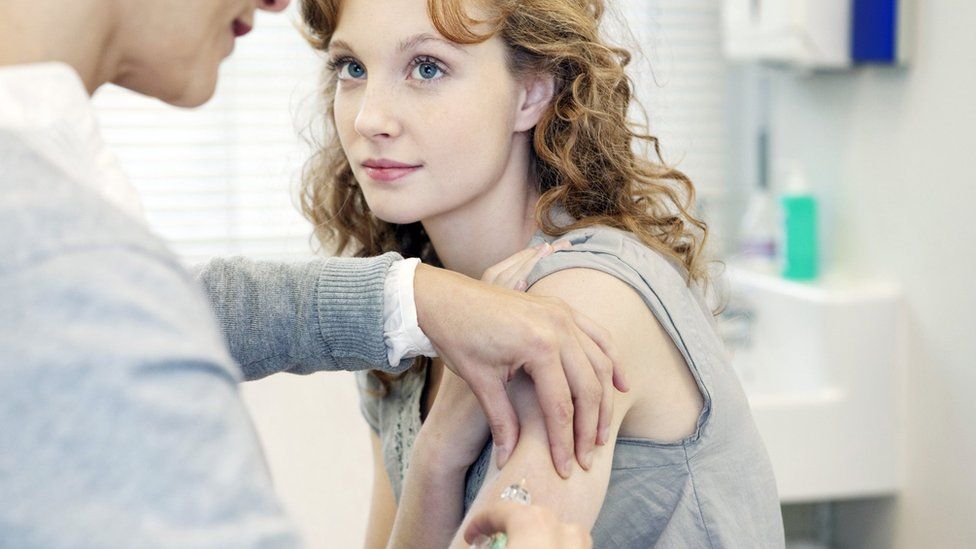 |
| The human papillomavirus, or HPV, vaccine is cutting cases of cervical cancer by nearly 90%, the first real-world data shows. Getty Images |
Labels: Britain, Cervical Cancer, Diminished Risk, HPV Vaccine, Study
posted by Pieface @ 6:53 PM
0 comments


