Ruminations

Blog dedicated primarily to randomly selected news items; comments reflecting personal perceptions

Saturday, October 09, 2021

Prevention is the Cure

"We have an amazing, safe vaccine to prevent cancer and we offer this to every student in every province and territory through public health."
"[Because of the pandemic] there has been a  huge decrease in immunization. We have to catch up and protect people from the risk of HPV, the risk of cancer."
Dr.Vivien Brown, past president, Federation of Medical Women of Canada, chair, co-founder HPV prevention week in Canada

"One woman in three who get cervical cancer will die from it. People don't seem to understand how lethal this cancer can be."
"Those who survive it can become unable to bear children because of [cancer] treatment."
"It's not a nice cancer to get."
Dr.Jennifer Blake, CEO, Society of Obstetricians and Gynaecologists of Canada
All Ontario children normally receive two doses of the HPV vaccine in Grade 7, first in the fall and then in the spring. (Harry Cabluc/Associated Press file photo)
 
Dr. Blake, obstetrician and gynaecologist at The Ottawa Hospital group is a clinician treating young patients with cervical cancer. Her experience has given her a deep understanding of the value inherent in cervical cancer prevention -- as the second-most-common cancer in women between age 20 and 44. All cancers are alarmingly devastating to the health, quality of life and longevity of those who contract them, cervical cancer in particular can be life-altering and lethal.

Childhood vaccines routinely offered to teen-age girls through public health at school-based clinics have turned statistics around, protecting girls and women from a dread cancer diagnosis. The delivery of that vaccine, however, has been interrupted during this time of the global pandemic when schools have been closed and remote learning has become the default in the public education system -- which has meant a vacuum now exists, the numbers of vaccinated have drastically dropped as vaccine delivery was halted.
 
Image
 
The concern arising among medical experts is that a rise in cervical and other cancers may result from the lapse in the aggressive HPV (human papillomavirus) vaccine injections. As the most common sexually transmitted viral infection, HPV can be harmless and usually is, fading of its own volition, but for some unfortunates it can lead to cervical or head and neck cancers. Avoidance of that occurrence is of huge importance.

Widespread use of the HPV vaccine has had a dramatic effect in reducing cases of cervical cancer, according to studies, particularly among girls vaccinated before age 17. Some HPV-caused head and neck cancers in both men and women are believed to be forestalled by the vaccine, as well. School closures resulting in a lapse of the vaccine delivery is now a matter of some alarm for what the future may bring.

In 2019, 410 of the 1,350 Canadian women who developed cervical cancer died from its effects. A new HPV test to detect the virus prior to it causing precancerous changes is replacing the conventional Pap test, long in use. Australia has made the HPV vaccine available to everyone and in so doing has just about eliminated cervical cancer cases there.
 
A study published last year in the New England Journal of Medicine found that girls vaccinated before turning 17 were significantly less likely to develop cervical cancer. (Joe Raedle/Getty)
 

Labels: , ,

Wednesday, April 21, 2021

The Children Are Not All Right

https://cmho.org/wp-content/uploads/iStock-1251183248-scaled.jpg
"Kids are not doing well. This is really taking its toll."
"They spend 24/7 in their bedrooms. They are not getting out of bed. Even when schools open up, they have no motivation."
"They are so far behind, they can't even bring themselves to go to school." 
"These kids are on a downhill trajectory."
Dr.Jane Liddle, pediatrician, Ottawa Community Pediatricians Network

"[Closing schools might have been the right response to the pandemic], but it is having some pretty big implications on the pediatric situation on a daily basis."
"All of us are seeing an increased referral volume from family physicians [for eating disorders] that is out of proportion to what we typically would see."
Dr.Kelley Zwicker, founder, Ottawa Community Pediatricians Network

"We are the doorkeepers. We are the ones who keep children from coming to CHEO [Children's Hospital of Eastern Ontario]."
"What CHEO is seeing is the tip of the iceberg in terms of what we see in our practices."
"In a situation where everything is taken away, including the routine of school, this makes very much sense that these children who see a complete loss of control concentrate on the one thing they can do [refuse food or eat too much food]."
Dr.Andrzej Rochowski, chief of pediatrics, Queensway Carleton Hospital
Mental Health During COVID-19: Signs Your Teen May Need More Support
Discipline, purpose, opportunities for physical exertion, playtimes, school routines, exposure to other children in their peer group, casual decision-making, have all been extracted from the daily lives of children living under the new life-rules of COVID-inspired restrictions. Parents are pressed to expose their children to opportunities for learning, at a time when the home has become the learning centre, with the closure of public and private schools as part of an effort to maintain distancing to tamp down rising numbers of COVID cases and more infectious transmission with the presence of new variant strains.

Children are now increasingly exhibiting symptoms of mental disturbance in the most troubling of ways, going from puzzlement to reaction and graduating to severe mental health crises. Some children have been left feeling suicidal, suffering from major depression and extreme anxiety. Their world has been overturned and nothing is the same as it always has been. An exponential rise in young patients presenting with clear signs of increasing mental disturbance has alarmed area pediatricians, and what they are experiencing is obviously occurring everywhere that COVID has locked down entire communities.

Medical professionals belonging to the recently-inaugurated Ottawa Community Pediatricians Network are raising the alarm over frightening levels of mental and physical illness being seen among children and teens in reaction to a pandemic stretching into its second year of disrupting daily life. Their concerns are not only for the current situation which appears to be growing in the numbers of children presenting for care, but for the prospect of what lies ahead as the situation continues to grow.
 
Children in a playground outside Hastings Elementary School in Vancouver. Anxiety, depression, behavioural issues and post-traumatic stress could become far more common in children both during the pandemic and in its aftermath, the research review found. (Ben Nelms/CBC)
 
When the schools are opened, children find support in the presence of others like themselves. When they close, during lockdowns occasioned by the upward swings of coronavirus cases, physicians start seeing growing numbers of patients, as mental health disorders begin to surge. Some of these doctors specialize in caring for patients under the age of six. Doctors are witnessing alarming signs of poor mental health, including anxiety and clinical depression in five-year-olds.

In some of these children body mass index has rapidly increased, partially as a result of the children spending so much more time at home and parked in front of computer screens. Many of these children have completely lost any interest in schools, and have no wish to return when they do re-open for in-person classes. The concern over their academics, over eating disorders which have rapidly increased during the pandemic is shared by family, family physicians and the specialists these ailing children are referred to.
 
A volunteer takes a call at the Crisis Centre B.C office in Vancouver. (Ben Nelms/CBC)
 
The Children's Hospital of Eastern Ontario reports a fifty percent increase in emergency assessments for eating disorders, pandemic-induced, even while community pediatricians see many more cases, not yet admitted to hospital. Some of these children presenting with eating disorders represent a much younger cohort than seen in the past, becoming sicker more quickly than in the past. Food is something youth and children feel they can control, explains Dr.Rochowski, reflecting the dangerous spike in severe eating disorders seen now nation-wide.
 
The group of pediatricians have in mind the need to dispel a prevailing attitude that children have not and will not be severely affected by the fallout of the pandemic. "There has been a false sense of security that kids were going to be fine out of this. Kids are not fine", stressed Dr.Liddle. All of the doctors concerned agree that the detrimental effects of the pandemic will be seen for months and years into the future, for the children so badly affected.

Often, children will present signs of mental illness in ways that are not quite the same as adults. You may observe changes in behaviour, mood, sleep patterns, appetite and/or interactions with others that are having a negative effect on your child’s day to day activities. It is important to seek help.

Is your child experiencing any of these?

  • Extreme outbursts or excessive mood swings
  • Worrying so much that they are getting stomach aches or headaches
  • Persistent nightmares and a lack of sleep that are affecting your child’s day
  • Avoiding formerly enjoyable activities, including spending time with friends
  • Unusually quiet, sad or reserved, preoccupied
  • Change in appetite – eating considerably less, or more.
CMHO Family Health Centre


Labels: , , , , ,

Tuesday, April 07, 2020

COVID-19 Interrupting Students' Learning Cycles Worldwide

"These are contexts of extreme poverty, economic vulnerability and crisis where gender disparities in education are highest. In Mali, Niger and South Sudan -- three countries with some of the lowest enrolment and completion rates for girls -- closures have forced over four million girls out of school."
"For girls living in refugee camps or who are internally displaced, school closures will be most devastating as they are already at a disadvantage."
"Refugee girls at secondary level are only half as likely to enrol as their male peers."
Stefania Giannini, assistant director general for education, UNESCO
Anne-Birgitte Albrectsen, chief executive for Plan International
https://en.unesco.org/sites/default/files/styles/extra_large_1600x1600/public/if_covid-1-37billion-students_04.jpg?itok=WcQ3DYLa
UNESCO

In late March UNESCO (UN Educational, Scientific and Cultural Organization) brought together education ministers representing Costa Rica, Croatia, Egypt, France, Iran, Italy, Japan, Mexico, Nigeria, Peru and Senegal in a virtual meeting organized for the purpose of discussing measures geared toward ensuring that with schools shut due to the novel coronavirus emergency, how to maintain future education for students whose formal education has been interrupted.

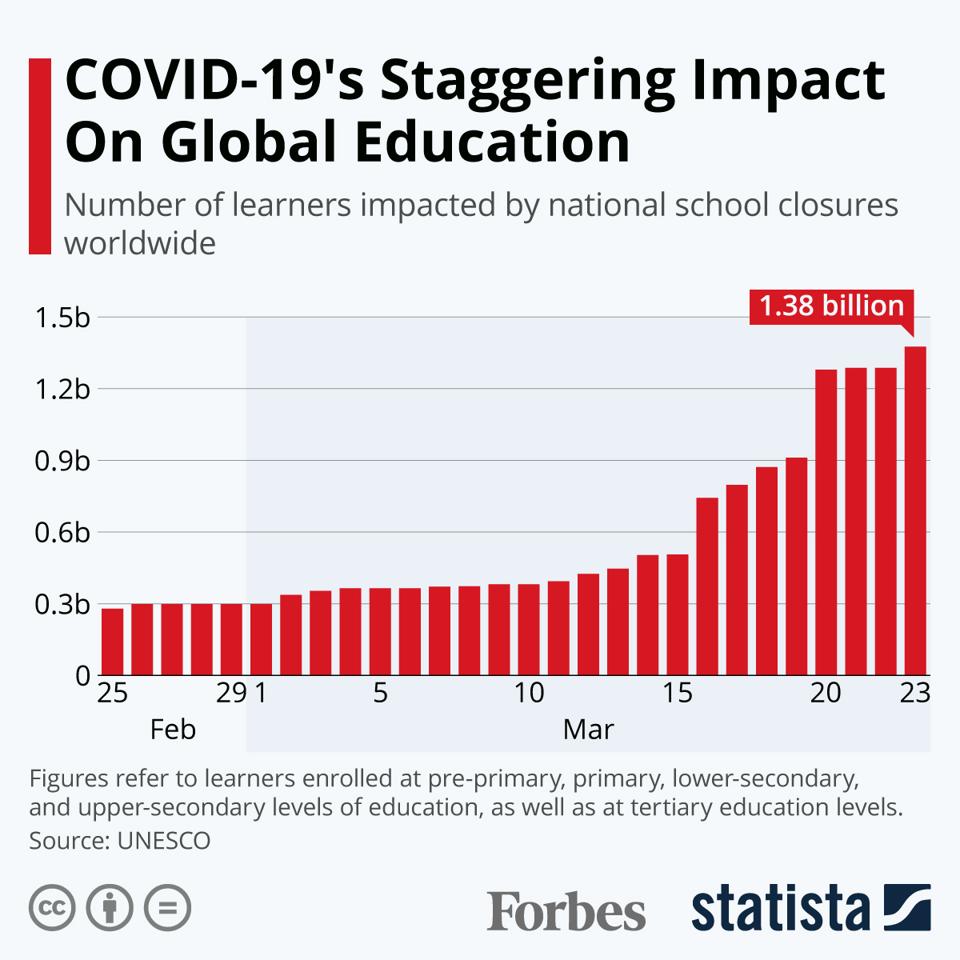
Fully 188 countries of the world by March 4 had shut down their educational facilities, a move that has affected a colossal number of children world-wide. The global pandemic has struck all metrics of advanced society and none more heavily than children's educational futures, leaving 91.3 percent of the globe's children from primary grades through to college and vocational school at academic loose ends. In some advanced countries of the world the slack has been taken up temporarily through online e-classes.
COVID-19's Staggering Impact On Global Education

Understandably that option is limited to countries that are wealthy and who have the structure and capacity to undertake such alternatives, along with a population that is computer-savvy and able to afford both the technology and the maintenance costs. An estimated 1,576,021,181 students have been affected across the globe, and according to UNESCO, it is girls whose futures will be most affected.

A mere 0.1 percent of the world's students had been affected by school shut-downs by mid-February, about a million. At that time it was only China that took steps to shutter their schools as it coped with the first emergence and surge of the SARS-CoV-19 virus that causes the novel coronavirus. As the virus made it's swift and steady spread from China to the global community, continent to continent government authorities began to close schools to protect children and control the epidemic's astonishing spread.

More than 1.2 million cases of the coronavirus have been confirmed worldwide, with the understanding that the true figure may be well in excess of that number, given the lack of adequate testing in many affected countries. Of the students out of school, over 111 million represent girls from the world's least developed countries "where getting an education is already a struggle", for them.

https://en.unesco.org/sites/default/files/styles/extra_large_1600x1600/public/covid-school-closures-girls-c-plan_international.jpg?itok=AJTDJG74
UNESCO

Labels: , ,

 
()() Follow @rheytah Tweet