Ruminations

Blog dedicated primarily to randomly selected news items; comments reflecting personal perceptions

Sunday, February 02, 2025

Necrotizing Fasciitis on the Rise

"We've all had some tough cases. 'Nec fasc' [necrotizing fasciitis] isn't just among the scariest diagnoses for emergency physicians. [The life-and-limb threatening infections] scare the daylights out of everyone."
"[Most doctors will see a handful, if that, in their entire career] and yet there's this huge pressure to make the diagnosis quick. [The infections progress fast], like, right in front of  you."
"[Most urgently require cutting away layers of dead skin and tissues, big surgeries people don't want to get wrong], because the consequences of getting it wrong are huge. I think that strikes fear in everyone's hearts."
Dr. Stephanie Mason, general and burn surgeon, Sunnybrook Hospital, Toronto

"[The challenge is that people often show up in emergency] not super obviously sick, until they're very late into their course [of infection]."
"You're talking higher mortality with every organ that fails [by the time the necrosis -- dead tissue -- has spread extensively, vital organs can shut down]."
"But otherwise, they don't necessarily have classic signs of infection [like fever, or an elevated white blood cell count].
Dr. Shannon Fernando, critical care doctor, Lakeridge Health, Oshawa

"There's likely some level of reduced immunity on a population level due to lack of exposure and that would translate into more infections."
Dr. John McCormick, biomedical researcher, Western University
https://i.cbc.ca/ais/1.7086047,1717221642773/full/max/0/default.jpg?im=Crop%2Crect%3D%280%2C0%2C1920%2C1080%29%3BResize%3D620
Doctors say they’re seeing significantly more invasive strep A infections, caused by a bacteria that usually leads to milder illnesses. But in some cases it can enter the bloodstream and quickly become deadly.     Still from video/CBC
 
Flesh-eating disease infections are frequently caused by invasive group A streptococcus, a bacterium increasing globally, including Canada, the reason for which is as yet unknown. For those who survive an infection which has a frightening 50 percent mortality rate -- the still-rare infection is a growing cause of concern for doctors in the medical community. Response to the infections -- diagnosis and surgery -- must be quick to prolong life. The urgency is to cut away layers of dead skin and tissues to stop the spread.

https://i.cbc.ca/ais/1.7088467,1717221856233/full/max/0/default.jpg?im=Crop%2Crect%3D%280%2C0%2C1920%2C1080%29%3BResize%3D620
Strep A, a normally relatively harmless bacterium causing throat infections like strep throat or tonsillitis has the potential to enter the skin through a wound; alternately it can occur at sites of "non-penetrating trauma" according to researchers; even a minor muscle sprain. IGAS -- Invasive group A streptococcus has caused a resurgence of cases in recent years. Cases in the United States reached a 2-year high in 2023. Canada too has seen a rise in cases from province to province.
 
Group A strep is a major cause of the flesh-destroying disease, a bacteria that becomes life threatening when the blood is invaded, or when it spreads along the tissues surrounding muscle. Known risk factors include diabetes or other chronic diseases, along with a weakened immune system, adults past age 60 and the  use of  injection drugs. On the other hand, roughly 30 percent of cases occur in people who tend to be otherwise healthy.
 
A rough in appearance and exquisitely tender rash is one of the symptoms of the presence of he bacterium, "But otherwise, they don't necessarily have classic signs of infection." Numerous body areas can be affected; arm, legs, chest wall, neck. Group A strep is exclusively a human infection transmitted person-to-person  through direct contact with, or inhalation of, droplets from a person's nose or mouth in the winter months and early spring -- December through April.
 
https://i.cbc.ca/1.7095069.1706296189!/fileImage/httpImage/image.jpg_gen/derivatives/original_1180/colin-hunter.jpg?im=Resize%3D1180
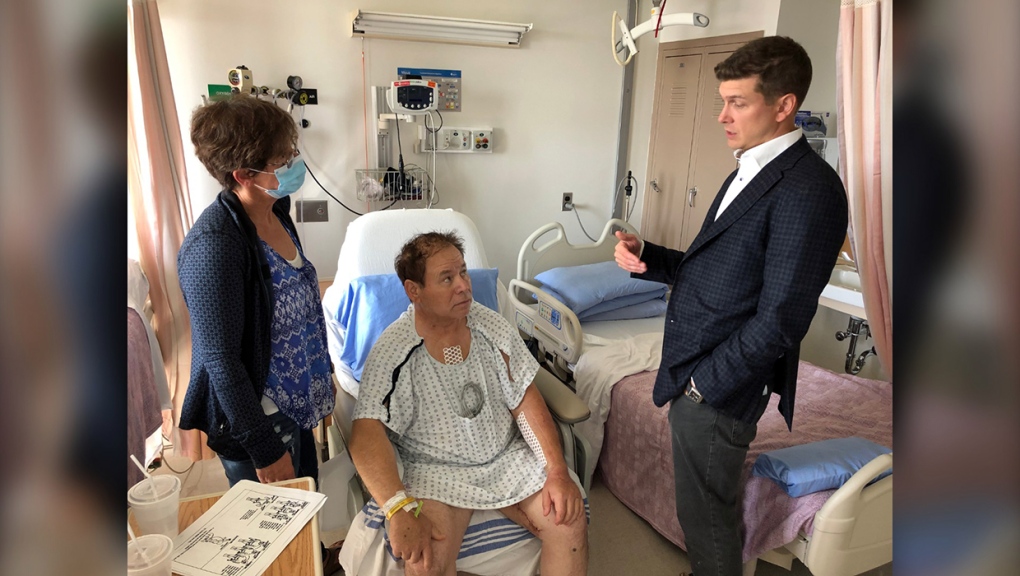
Doctors used black marker to track the infection's route
As people grow older they tend to get fewer strep infections due to natural immunity built over the years. Up to ten percent of children carry strep in their throats harmlessly, with no disease resulting. And then there's the fact that a new strain of strep -- M1UK -- surfaced in 2019 in Britain, that is now taking the lead from the older strain. M1UK is more aggressive, dangerous, and produces nine times more of a toxin that can overstimulate the immune system, potentially causing streptococcus toxic shock syndrome and multi-organ failure.
 
It is this hyper-toxic strain that has staged a prevalence in Canada, causing greater numbers of cases of invasive group A strep. Once inside the body from perhaps a scrape on a knee, the bacteria can enter the bloodstream causing blood supply to tissue to become compromised, so the tissue dies, and dead tissue acts as fuel to the fire, according to Dr. Mason, since dead tissue helps bacteria to thrive.
 
People generally, said Dr. Mason, "have enough things to worry about and this doesn't need to be one of them. But if you are very unwell, you should seek medical attention, especially if you notice a new wound or a new change in your skin that wasn't there before."
 
https://i.cbc.ca/ais/1.6813839,1717135233962/full/max/0/default.jpg?im=Crop%2Crect%3D%280%2C0%2C1280%2C720%29%3BResize%3D620
Doctors are seeing an increase in the number of patients experiencing an invasive form of group A strep. The illness is common but can be serious when bacteria spreads to the blood or deep tissue, and needs to be treated quickly.     CBC
 

Labels: , , ,

Tuesday, November 09, 2021

Saving Two Lives, Four Times

"He was face down. Nobody else was around and we pulled over. He didn't have a pulse so I started
CPR and and we called people and all that stuff."
"If he [had been] ten feet down the road or in the woods -- nobody would have seen him, and they would have found him dead."
"The odds are astronomically not in favour of it. Eric is really lucky. Having a valve that doesn't open properly, to come back from CPR and then not have a neurological problem is really rare."
Dr.Corey Adams, cardiac surgeon, Libin Cardiovascular Institute, University of Calgary

"I really kind of lost my breath and had to stop fully and went over to the side of the path. I figured this is nothing... I started running again and that's the last thing I remember."
"The next thing I remember, I woke up in the emergency room of Foothills Hospital [in Calgary] surrounded by doctors."
"I feel incredibly lucky that someone was there to give me CPR [who] just happened to be an expert."
Eric McVeigh, 34, collapsed runner
Dr. Corey Adams, a cardiac surgeon at the University of Calgary's Libin Cardiovascular Institute, has saved two men in the past 18 months by first performing CPR on them in public and then, days later, operating on them. (Helen Pike/CBC)
Dr.Adams is the talk of his colleagues in medical care. From his recent experiences in encountering people in grave medical distress; when on two occasions he happened to come across serious medical collapses caused by potentially lethal heart events, he is adamant that society would be far better off if more people took CPR courses to enable them to respond with confidence should they come across people requiring rescue from death for any number of medical causes who are unconscious and unresponsive.

His colleagues think it's great good fun to tease him about the events he was featured in by fate on his part, good luck on the part of others requiring his professional expertise to save their lives, by jocularly posing the puzzle that for an esteemed professional busy enough in his trade with so many people suffering heart collapses that he really doesn't need to go out of his way to drum up more business. Even he, at the centre of the jokes, feels it to be beyond strange that those two events occurred and he just happened to be there to take charge...

A year and a half earlier he had been out for a hike with another doctor, who happened to be his wife. They had set out for a hiking trail located close to Canmore, Alberta and heard someone calling for help. When they investigated they found that an older man had collapsed. His condition was clear enough from the blue hue his skin was turning. That called for 20 minutes of CPR, until their emergency calls brought a responding ambulance and paramedics arrive to take the 60-year-old man in medical duress to hospital.
 
Shirley Parker, Darrell Parker and Dr.Corey Adams in May 2020 at Foothills Hospital in Calgary following five bypass surgeries performed by Dr.Adams who saved his life by performing CPR on him near Grassi Lakes Trail
 
It was some days on when Dr.Adams realized that the man he was performing a quintuple heart bypass in surgery happened to be the very same man he and his wife had come across during that hike. In essence, his expertise combined with the anomaly of treating this man twice; the initial CPR to restore his heart and lungs to begin breathing and the follow-up surgery to free up his clogged arteries, saved the man's life. An odd experience, to say the very least.

Yet one that repeated itself incredibly, this past August when the Adams family were out with their children to connect with nature. It was Dr.Jennifer Adams this time who realized a man who had been out on a run had collapsed nearby and with no one else around. They learned later that the young man whose aid they quickly assumed, was born with a heart defect. 

Again, Dr. Adams performed cardio-pulmonary resuscitation. Again paramedics took over when the ambulance arrived. and once more Dr.Adams performed surgery for the 34=year-old McVeigh who required a heart valve replacement. And who is alive and well because of his great good fortune in having been found by a husband-and-wife medical team who secured his life for him. 
 
Medical emergencies can happen anywhere at any time. When they happen in remote and isolated settings it takes great good luck to survive them when the miracle of a health professional just happens to be passing by.

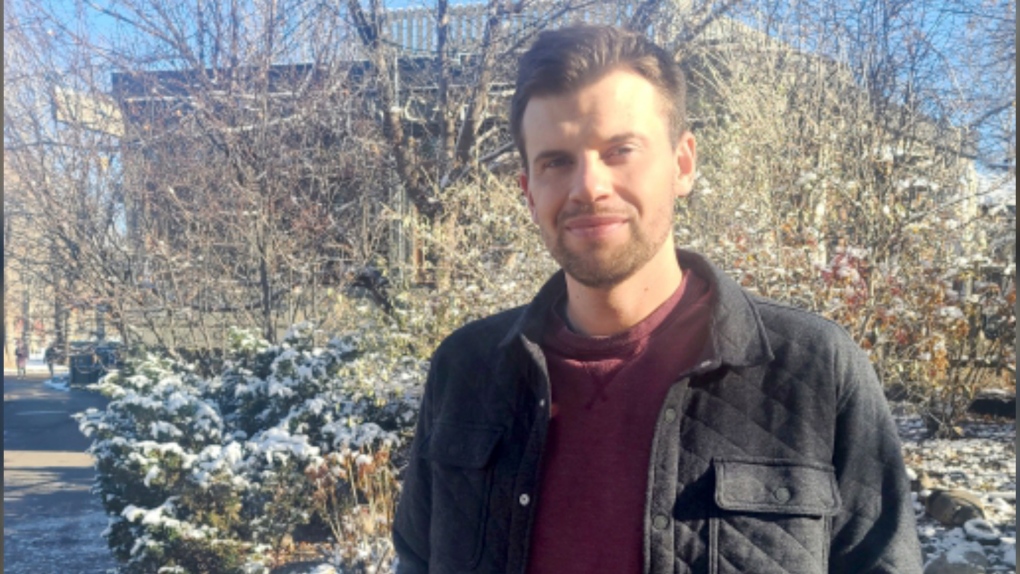
Eric McVeigh poses in this undated handout photo. McVeigh is lucky to be alive after he collapsed while running in Calgary in August. Calgary heart surgeon Dr. Corey Adams and his wife spotted McVeigh and performed CPR on him until he was taken to hospital. Adams then performed his heart surgery days later. It's the second time it's happened to Adams who did the same thing with another man in June of 2020. (Courtesy Eric McVeigh/The Canadian Press)

Labels: , , , ,

 
()() Follow @rheytah Tweet