Ruminations

Blog dedicated primarily to randomly selected news items; comments reflecting personal perceptions

Tuesday, August 01, 2023

Five Victims, One Murderer

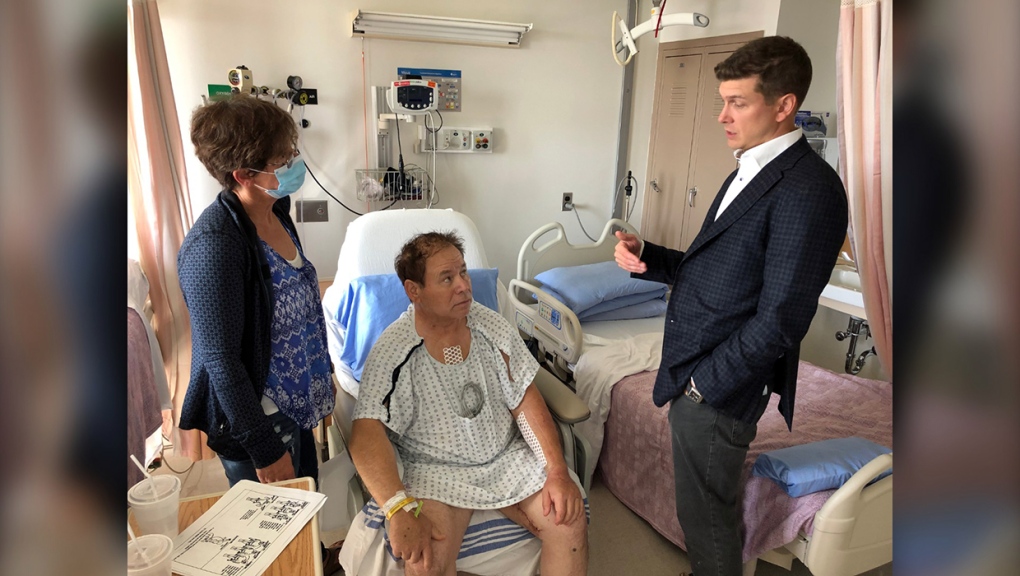
"If you know Matthew, he's not the monster people like to believe he was."
"Mental illness hit him hard. But he has recovered. That's the most important part -- that he has recovered. He's very remorseful and cognizant of what he needs to do to keep himself in that position."
"It was an undiagnosed mental illness, and nobody knew."
"We're just fighting to [have him] progressed the way he's supposed to be progressed."
"[Those in the system, including doctors, are fearful of granting new privileges to Matthew], not because of his progress, [but] because of what they think the public will say."
"We feel great sympathy [for the victims], but we also have to protect our son. There are six families impacted by this, not just five."
Susan de Grood 
A young man with dark hair smiles while holding up a medal around his neck that says "10K."
Matthew de Grood, shown in this file photo, was found not criminally responsible after stabbing five people to death at a Calgary house party in April 2014. (The Canadian Press)
 
Matthew de Grood was charged with five counts of first-degree murder. Following a trial in 2015, Justice Eric Macklin came to the conclusion that while he had certainly killed the victims, de Grood was not criminally responsible since his untreated schizophrenia "rendered him incapable of appreciating or knowing that his actions were wrong". 

In 2014 Matthew de Grood stabbed five people to death at a house party in Calgary. His parents spoke publicly when a court ruling dismissed political bias claims on the part of the Alberta Review Board governing the man's fate since the ruling of 2015 when a court found him not criminally responsible for the murders of Lawrence Hong, Joshua Hunter, Kaitlin Perras, Zackariah Rathwell and Jordan Segura.

Under 24-hour surveillance, Mathew de Grood now lives in a group home in Edmonton following the review board's having deemed him a "significant" threat to public safety. His parents don't believe the review board is committed to upholding theirs or their son's rights, believing in the existence of a campaign to maintain the board's authority over their son for the rest of his life.

As a 22-year-old University of Calgary psychology graduate in preparation to begin attending law school, Matthew de Grood grabbed a knife at an end-of-semester house party in a Calgary neighbourhood. While the party was winding down, de Grood stabbed Rathwell, then attacked Segura and Hunter, chasing the latter down the street. He also stabbed Perras as she attempted to escape, and Hong, while he dozed on a sofa.

De Grood was finally disarmed by another, intervening party guest, then he fled into the night. Hiding in a dumpster, he slashed his wrists. With the use of a dog team, Calgary police eventually tracked him down, arresting him after a brief struggle. In custody, de Grood uttered bizarre statements about religion, politics, prophecies and aliens, claiming to have defended himself against "medusas and werewolves" and had in his possession a clove of garlic.

Following his 2015 trial and its ruling of not criminally responsible, the sentence to an indefinite period in a psychiatric facility elicited controversy, with critics suggesting that de Grood's father Douglas's status as a Calgary police inspector afforded his son special treatment. Critics suggested Matthew de Grood's academic background left him well equipped to fake mental illness.

By 2019, the Alberta Review Board allowed de Grood to apply for unsupervised day passes to the city, the initial step to transitioning to a supervised group home. The provincial justice minister of the time stated his intention to formally ask the review board to "ensure a maximum possible role for victims" in the hearing process. Privileges ended up being revoked by the board in 2020, then restored by the Court of Appeal a year later.
"The focus of the board isn't now about what Matthew did and  how he's supposed to get better."
"The focus is still trying to make him pay for what he did and reminding him every year of what a horrible person he is."
Susan de Grood
The review board in 2022 opted to continue restricting de Grood to a group home. While he is in some respects a "model" patient, Board members acknowledged he lacks any history of independently taking his medication, suffering two instances of "decompensation" in 2019 and 2021. Furthermore, a doctor concluded that while Matthew is a low risk to reoffend, any violence if he does, would likely be severe.
"[De Grood] is undoubtedly much less dangerous now than he was then. However, his transition to unrestricted life in the community will not happen overnight."
"However, on the evidence on this record, it was reasonable for the review board to conclude that the appellant still poses a risk of serious violent behaviour."
Three-person panel of judges' unanimous decision
Five young people appear in side by side photos. All are smiling.
Zackariah Rathwell, 21, Lawrence Hong, 27, Kaitlin Perras, 23, ​Jordan Segura, 22, and Joshua Hunter, 23, died after Matthew de Grood, 22, stabbed them at a party in Calgary's Brentwood community in 2014. (Facebook)

Labels: , , , ,

Tuesday, November 09, 2021

Saving Two Lives, Four Times

"He was face down. Nobody else was around and we pulled over. He didn't have a pulse so I started
CPR and and we called people and all that stuff."
"If he [had been] ten feet down the road or in the woods -- nobody would have seen him, and they would have found him dead."
"The odds are astronomically not in favour of it. Eric is really lucky. Having a valve that doesn't open properly, to come back from CPR and then not have a neurological problem is really rare."
Dr.Corey Adams, cardiac surgeon, Libin Cardiovascular Institute, University of Calgary

"I really kind of lost my breath and had to stop fully and went over to the side of the path. I figured this is nothing... I started running again and that's the last thing I remember."
"The next thing I remember, I woke up in the emergency room of Foothills Hospital [in Calgary] surrounded by doctors."
"I feel incredibly lucky that someone was there to give me CPR [who] just happened to be an expert."
Eric McVeigh, 34, collapsed runner
Dr. Corey Adams, a cardiac surgeon at the University of Calgary's Libin Cardiovascular Institute, has saved two men in the past 18 months by first performing CPR on them in public and then, days later, operating on them. (Helen Pike/CBC)
Dr.Adams is the talk of his colleagues in medical care. From his recent experiences in encountering people in grave medical distress; when on two occasions he happened to come across serious medical collapses caused by potentially lethal heart events, he is adamant that society would be far better off if more people took CPR courses to enable them to respond with confidence should they come across people requiring rescue from death for any number of medical causes who are unconscious and unresponsive.

His colleagues think it's great good fun to tease him about the events he was featured in by fate on his part, good luck on the part of others requiring his professional expertise to save their lives, by jocularly posing the puzzle that for an esteemed professional busy enough in his trade with so many people suffering heart collapses that he really doesn't need to go out of his way to drum up more business. Even he, at the centre of the jokes, feels it to be beyond strange that those two events occurred and he just happened to be there to take charge...

A year and a half earlier he had been out for a hike with another doctor, who happened to be his wife. They had set out for a hiking trail located close to Canmore, Alberta and heard someone calling for help. When they investigated they found that an older man had collapsed. His condition was clear enough from the blue hue his skin was turning. That called for 20 minutes of CPR, until their emergency calls brought a responding ambulance and paramedics arrive to take the 60-year-old man in medical duress to hospital.
 
Shirley Parker, Darrell Parker and Dr.Corey Adams in May 2020 at Foothills Hospital in Calgary following five bypass surgeries performed by Dr.Adams who saved his life by performing CPR on him near Grassi Lakes Trail
 
It was some days on when Dr.Adams realized that the man he was performing a quintuple heart bypass in surgery happened to be the very same man he and his wife had come across during that hike. In essence, his expertise combined with the anomaly of treating this man twice; the initial CPR to restore his heart and lungs to begin breathing and the follow-up surgery to free up his clogged arteries, saved the man's life. An odd experience, to say the very least.

Yet one that repeated itself incredibly, this past August when the Adams family were out with their children to connect with nature. It was Dr.Jennifer Adams this time who realized a man who had been out on a run had collapsed nearby and with no one else around. They learned later that the young man whose aid they quickly assumed, was born with a heart defect. 

Again, Dr. Adams performed cardio-pulmonary resuscitation. Again paramedics took over when the ambulance arrived. and once more Dr.Adams performed surgery for the 34=year-old McVeigh who required a heart valve replacement. And who is alive and well because of his great good fortune in having been found by a husband-and-wife medical team who secured his life for him. 
 
Medical emergencies can happen anywhere at any time. When they happen in remote and isolated settings it takes great good luck to survive them when the miracle of a health professional just happens to be passing by.

Eric McVeigh poses in this undated handout photo. McVeigh is lucky to be alive after he collapsed while running in Calgary in August. Calgary heart surgeon Dr. Corey Adams and his wife spotted McVeigh and performed CPR on him until he was taken to hospital. Adams then performed his heart surgery days later. It's the second time it's happened to Adams who did the same thing with another man in June of 2020. (Courtesy Eric McVeigh/The Canadian Press)

Labels: , , , ,

Wednesday, August 26, 2020

Alberta Hyperloop : Enthusiasts and Naysayers

https://i.ytimg.com/vi/2RnsMv63qdI/maxresdefault.jpg

"There are some very obvious better ways to do it [construct a time-efficient transportation link between Edmonton and Calgary]. I think we need to focus on what we know already works."                                                                           "There's a lot of evidence out there showing regular high-speed rail already works. In reality I think it is a distraction tactic that can allow them [provincial authorities] to put off connecting Edmonton and Calgary indefinitely."                                               Ashley Salvador, Edmonton urban planner

"The Government of Alberta should not invest in a high-speed rail transit system in the Edmonton-Calgary corridor at this time because the population of the corridor is not sufficient to support the profitable operation of such a system."                      Feasibility study, Alberta economic standing committee, 2014

"Most of the high speed rail around the world are not profitable. It's not to fill up the train -- which is important -- it's to fill up the infrastructure."                              "That's the main difference compared to a conventional rail track."                    "Best-case scenario ... we could have a line operational by 2030."                Sebastien Gendron, CEO, co-founder, TransPod, Toronto

"The MOU [memorandum of understanding between the transit builder and the province of Alberta] facilitates the process of attracting private investment to the province, in order to build a multi-billion-dollar infrastructure project."                        TransPod, hyperloop project startup, Toronto

Artist renderings of the hyperloop the pod and its interior. Photo by TransPod illustrations

A provincially commissioned 2014 study estimated that by the time 2031 rolls around 105 million trips between Edmonton and Calgary annually would materialize, requiring for optimum efficiency that some type of high-speed transit between the two cities be considered, and there is no time like the present to consult beyond theorization, to weigh options and to commit to the future in necessary transit options.

What the province brought into view under a magnifying glass of potentials is a super-transit, high-tech link, a futuristic vision of a pod that literally sucks passengers through a tube to reduce the current three-hour drive from one city to the other to a preferential half-hour commute. "Electrically-driven magnetic propulsion" would whisk a transit pod within a tube suspended on pillars from point A to point E in record time.

That would be accomplished at speeds of up to 1,000 km/hr, roughly a speed similar to that of a jetliner. Artwork meant to convey what such a system would look like shows a tansluscent tube adjacent the side of a highway and in the tube, whistling along at breakneck speed, is a pod hosting travellers, commuting from one city to the other. By no means a spanking-new vision, but one that has been under discussion for decades.

Artist renderings of hyperloop infrastructure Photo: TransPod illustrations

The combined population of the two cities, 300 kilometres distant from one another, is roughly 2.3 million at the present time. Back in 2014 the study undertaken by an economic standing committee, reached the conclusion that the hyperlink could be set aside, as not a good idea. Conveying passengers alone, given the relatively sparse population simply didn't justify the outsize investment in a hyperlink.

To which, at the present time, TransPod's CEO responds that to make the system ever more practical it could be used as well to haul freight. Solar panels placed along the line could realize an added source of revenue. As the future moves ever closer, TransPod and the Alberta government agreed there would be no financial commitment, but for the time being additional study would be undertaken on the feasibility of a project such as the 1,000 km/h hyperloop duorail link.

According to the company, the project would be responsible for creating 38,000 jobs in the province through the course of ten years; construction and operation. The current provincial premier, Jason Kenney and the mayor of Calgary are both enthusiastic about the potential for such a link. "I'm excited about it. I don't know if it's real, I don't know=if it's science fiction, but we'll never know unless we continue to do more testing with folks other than one entrepreneur who talks about stuff a lot in the U.S.", commented Calgary Mayor Naheed Nenshi.

Labels: , ,

Monday, March 21, 2016

"Cured" 2-Year Post-Treatment for Testicular Cancer

Testicular cancer patients can expect a clean bill of health if they stay disease-free for two years, meaning they won't need more CT scans.


 "Cured" 2-Year Post-Treatment for Testicular Cancer

"This is a paradigm shift for men with advanced testicular cancer."
"For many cancers, the five-year mark has been the gold standard. Only when you've passed the five-year mark are you thought to be at a very low risk of relapse."
"Now with metastatic testicular cancer, after the two-year mark you're considered golden. This is much more reassuring for patients as opposed to waiting five years."
Dr. Daniel Heng, clinical associate professor, University of Calgary, Dept. of oncology

The results of a study bankrolled by the Calgary charity Oneball is now set to be published in the March edition of the Journal of Clinical Oncology. The findings will be recognized as bringing huge hope and relief to men who have been diagnosed with testicular cancer, the most common form of cancer in young men. Some thousand men are annually diagnosed with testicular cancer. If the cancer is found at a early period, it has a survival rate of 99 percent.

The finding of this new study out of the University of Calgary reflects a cure rate of almost 100 percent in those patients who are deemed to be free of cancer after a two-year period following diagnosis and treatment. Where the cancer has spread to other parts of the body, there is a varied prognosis. Scientists agree that survival rates for men with advanced metastatic testicular cancer can be anywhere from 40 to 90 percent.

University of Calgary researchers synthesized data over a twelve-year period based on about a thousand metastatic testicular cancer patients to reach their conclusion. Typically, post-recovery patients undergo a CT scan every three months in the first year following treatment. That becomes less frequent in the second year, with scans every four to six month. Following that two-year protocol, annual CT scans are given for up to five years following treatment.

The results of the new study, however, now leaves scientists free to recommend that such frequent monitoring of patients after two years of disease-free survival can be dispensed with, including the associated blood tests and physical exams. The fear and suspense that people live with each time another scan appointment approaches will now, in theory be lifted.

In a cautionary note, doctors emphasize that whether or not someone has experienced testicular cancer, awareness of it should not be relaxed, and regular self-examination is strongly recommended to ensure that if it does exist, it is found and treatment given as soon as possible for best possible outcomes.

Labels: , , ,

Saturday, March 28, 2015

The Short, Trauma-Filled Life of a Child

"Meika was covered in bruises. She was dirty and her hair was matted. Chunks of it were missing. There was a dirty bandage on her left hand."
"Our theory is that Spencer Jordan and Marie Magoon committed many of the acts of violence against Meika between Thursday and Sunday, November 10 to 13, 2011."
"The medical team... determined quickly that Meika had serious head injuries with extensive bleeding and swelling, and they knew she would not survive."
Crown prosecutor Susan Pepper, Calgary
Lorraine Hjalte/Postmedia News
Lorraine Hjalte/Postmedia News   Father Spencer Jordan and stepmother Marie Magoon are facing first-degree murder charges in the death of Meika Jordan. An autopsy determined she died as a result of multiple blunt-force trauma.
"I know I've done nothing wrong. And I don't understand why I'm the biggest suspect here. I wasn't the only one there, and I've also read that blunt force trauma could happen years before death."
"How ... how would I have been involved in doing this? No, I didn't do any of this. I'm sorry, but I did not. I did not do this. And you're wrong. And this is just wrong. I'd never have hurt her. Trust me. I never have."
"I don't know who could've done this. Meika came home bruised all the time. She ... her shins, for example ... she always had bruised shins."
Marie Magoon, charged with first-degree murder

She was a bright six-year-old child, a beautiful child, inclined to be friendly, once a happy child, with long blond hair, who lived with her biological father and her step-mother. She did visit with her biological mother. Who, on the stand, described a week-end her daughter spent with her in November of 2011 when she walked into the bedroom where her children were jumping on a bed.

Family photo
Family photo   Meika Jordan

"Hey, what are you doing?" she challenged them cheerfully. Her daughter Meika, on hearing those words appeared intimidated, backing into a wall: "I'm sorry, mommy, I'm sorry. Don't give me big trouble ... I just don't want big trouble, like Daddy and Marie give me", the child pleaded with her mother. What mother wouldn't pursue the issue, ask her former husband, ask his new wife, what was behind her child's reaction?

What mother wouldn't enquire gently of her frightened child just what it was that so inspired fear in her. What were the experiences alluded to, living with her father and her step-mother? Perhaps that is precisely what Meika's mother Kyla Woodhouse, did. And perhaps, when she heard the paramedics speak of the condition in which they found her little girl, "clinically dead" from severe injuries, eyes partly open, that earlier incident threatened to haunt her for the rest of her natural life.

The prosecuting attorney in the trial taking place in Calgary before Court of Queen's Bench Justice Rosemary Nation, outlined what the medical examiners and the prosecution feel happened to the child, based on the evidence. That her father pushed his daughter to the floor, and her head was traumatized, punched her in the stomach, dragged her by her ankles up a flight of stairs, and caused her to hit her head on a stove.

As for Meika's step-mother, to her is attributed Meika's hand being forced over the flame of a lighter, and that she slammed the child's head into the kitchen floor, and forced her to run up and then down stairs, hands tied in front of her, and tripped the little girl while she was thus running, causing her to fall. Meika suffered a third-degree burn to her hand, head trauma, abdominal injuries and multiple bruises and cuts.

The six-year-old died as a result of blunt-force trauma to her head, caused by five significant impacts, according to the prosecutor. She was struck with a flat object or her head struck against a flat surface. But there were reasonable explanations for all of these injuries, beyond what the prosecution in its zeal to see a pair of victims convicted, contended to be their cause.

For as it happened, on the final weekend of her very short life, according to Meika's step-mother -- and shouldn't she know? -- Meika fell down the stairs at their home, she burned her hand while she was playing with the electric hair-straitening iron, and she was hit in the head with a basketball. Of course, when the detective questioning her insisted the injuries were inconsistent with a fall down stairs and asked her how that could be, Ms. Magoon had a response for that, too.

"I have no idea."

Labels: , , , ,

Saturday, July 05, 2014

Waiting ... and Hoping

"We're only five days in. We have done a lot of work but there's still a lot of work to be done. ... We have well over 200 tips that we're going through and that takes time because we have to follow up on each tip."
Staff Sgt. Doug Andrus, Calgary Police
Grandson Nathan O'Brien, Grandparents Alvin and Kathryn Liknes

The mysterious disappearance of a pair of grandparents and their five-year-old grandson continues to bedevil logic. On the other hand, perhaps not? The grandparents, Alvin and Kathryn Liknes, after all had held a week-end 'estate sale', basically putting everything in their middle-class home up for sale. Hundreds of people, perfect strangers for the most part, wandered through their home, assessing their belongings to determine whether they might make an offer and carry the object away with them.

The couple planned to pull up roots and leave Canada, to retire to Mexico. The sale of their worldly goods was a way of disposing of things they felt they would no longer need. A secondary purpose was to gather in some additional funding for the purchase of a new home in Mexico, presumably. Police are attempting, through a laborious process of vetting what was sold and for how much, how much money the couple had taken in and might have had in their possession in their house that evening.

The very evening when their daughter had left with them her son Nathan O'Brien for a sleep-over with his doting grandparents. Police, according to news reports are "keeping an open mind" with respect to whether the abducted couple knew their abductor/s. Some details are being kept close to the investigators' vest, as it were, as for example, whether a weapon that might have been used on the couple to subdue them when they put up a struggle against the invader to their home, had been found.

It appears to be assumed on the basis of some evidence uncovered that one of them might have suffered an injury during the struggle. Adding to the mystery is the finding that no evidence exists the abductors had to force their way into the house. They might have been invited in, known to the residents, they might simply have walked in because the doors may have been unlocked. Police remain hopeful that the three missing people, grandparents and grandson are still alive.

Evidence has been taken from the home and is being analyzed. But analytical processes take time, and it may well be that a week will lapse before all the evidence has been sufficiently examined and drained of their meaning. The search is on for the driver of a green Ford F150, a pickup truck dating between the 1980s or early 1990s. Someone driving a clunker because they cannot afford anything more recent, or someone having a love of old vehicles and restoring them ... ?

Sgt. Andrus advised there are "no suspects I can name", a rather ambiguous statement that could mean he is unable to name the suspects that appear to have been involved without further evidence, or alternately no suspects appear to have been isolated as potential abductors in the case, and therefore there are no names to be revealed. In any event, how could the names of any who could be suspected in this case be revealed before they are apprehended?

So far, investigators have interrogated roughly 75 people who had been present at the estate sale. People were invited to appear at a local community centre where police took their fingerprints to match them against prints discovered within the home, ruling out possible suspects. Police are attempting to discover what items were purchased in the hopes that clues will present themselves and the murky aspects of the case will be clarified to reveal something of value.

And the family of the three missing people, wait in an agony of hope.

Labels: , , ,

 
()() Follow @rheytah Tweet