Ruminations

Blog dedicated primarily to randomly selected news items; comments reflecting personal perceptions

Sunday, September 17, 2023

Lucidity During Cardiopulmonary Resuscitation

What happens to the brain during near-death experiences
"[In some cases, brain activity returned to near normal physiological levels at different points up to an hour into CPR], suggestive of the emergency of consciousness and resumption of a network-level of cognitive activity."
"[A new study of cardiac arrest survivors reporting lucid experiences, including a] purposeful review of their lives [during revival by CPR despite their brains having] flatlined [with no visible signs of consciousness] is leading researchers to new insights where they describe their findings as the] first report of biomarkers of consciousness during CPR -- cardiopulmonary resuscitation]."
Research report
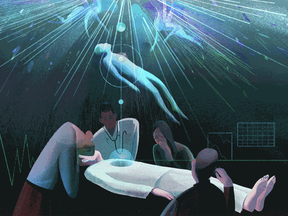
An illustration showing the moment of death
Photo by Cornelia Li for National Post
"[The aim of the study is to better understand] what's happening in the brain as people transition from life to death, and while we're trying to revive them, and to see if we can find any markers of these lucid experiences of death."
"Brakes [are removed while the brain is deprived of blood flow and oxygen, allowing access to deep memories and] hidden dimensions of reality that they would otherwise not be able to access under ordinary circumstances. [An experience that] only comes to the fore in death."
"Millions of people have reported having lucid recalled experiences of death and nobody understood what was going on in this phenomenon."
"The brain does not have resilience when it comes to oxygen deprivation."
"We were able to show that, yes, the brain does lose function, it does flatline. But that for even up to an hour after they have been oxygen deprived, and they're getting resuscitation, that you can see signs of normal brain activity emerge from the flatline state."
"[The flatlined brain stays flatlined, for a long period of time, but in between it shows spikes of normal activity] which shows it can mount a normal response. It hasn't permanently died."
Dr. Sam Parnia, senior study author, critical care and resuscitation specialist, NYU Langone Health
Published online in the journal Resuscitation, 25 British and American hospitals were involved in the study. The issue was that despite it has always been assumed that people lose consciousness or awareness at least ten minutes after their hearts stop beating, some cardiac arrest survivors, the study revealed, reported lucid experiences. 

The study involved 567 patients who, while they were in hospital experienced their hearts stopping. Of that total 43 only survived, were discharged and returned home. Of the discharged patients 28 were sufficiently fit and healthy to take part in an interview. Since so few patients survived, the researchers analyzed testimony from another 126 people separately, who had previously survived cardiac arrest.

Dr. Parnia, lead researcher in the study, believes his team may have discovered a mechanism that explains the seemingly unbelievable claims of near-death experiences: a disinhibited dying brain. "Brakes", he explained, in the brain that restrain information overload are removed while the brain is deprived of blood flow and oxygen. The claims of people having lucid thoughts during these crises have been dismissed by science with the assumption of hallucinations.

The assumption has always been that following ten minutes or so of oxygen deprivation the brain dies. What the study has done is differentiate between losing function immediately within seconds, and the brain's permanent death.  A dynamic process where the flatlined brain remains flatlined but spikes of normal activity erupt. Patterns consistent with when we're normally conscious, stresses Dr. Parnia.

When "code" for an in-hospital cardiac arrest was called, participating researchers dispatch to the resuscitation room carrying backpacks holding a portable EEG monitor and portable brain oxygen monitor. Patients were fitted with headphones and a tablet computer was stationed above their heads. The names of three fruits; apple, pear and bananas had been prerecorded on an app installed on the tablet along with ten "visual stimuli", pictures of people, animals, monuments and newspaper clippings.

365 people in total had headphones and computer attached. Of that number some 200 also had brain oxygen monitoring, with 85 having oxygen and EEG monitoring along with a consciousness test. 53, or 9% of the 567 people who went into cardiac arrest survived. Twenty-eight were interviewed, and 11 had memories or perceptions during CPR. And while no one described explicit recall of seeing the tablet images or hearing the recording, when asked to guess randomly, one chose the correct three fruits.
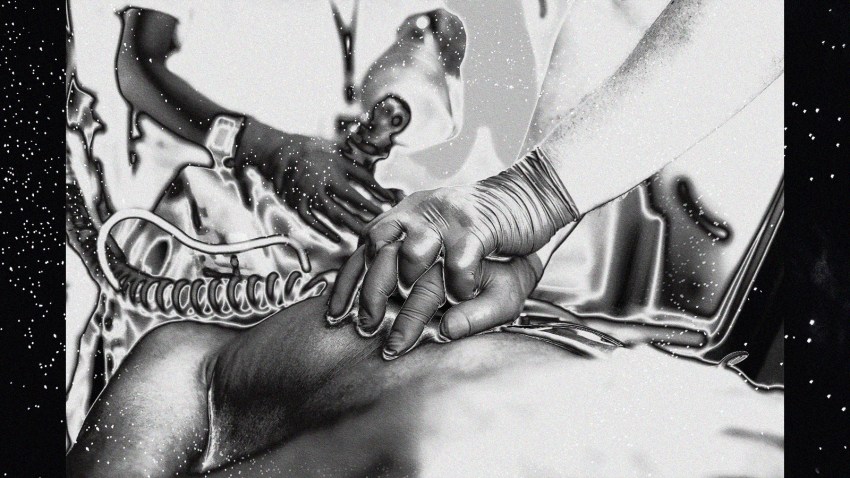
A black and white photo of a person in a hospital bed.
FreeThink

"What we realized is that there is a spectrum of consciousness. [At one end, vague perceptions.] At the other end of the spectrum, we have full visual and auditory awareness where people recalled specific details of what was happening to them."
"[People reported feeling] as if I was being lifted."
"I saw my entire life in great detail. My life and all its events started to play in my mind."
Dr. Sam Parnia 

"That would not have happened 10 years ago, and it would never have happened 20 years ago. We’re living in a different world, and now, this study opens up a new vista and we just have to learn more about it."
"My hat is off to Dr. Parnia because he’s trying to seriously study something that we all wonder about. Every one of us who’s taking care of a dying patient — I’ve taken care of thousands — and you wonder, could they be conscious? Might they have a near-death experience?"
Dr. Lance Becker, chair, emergency medicine, resuscitation researcher, Northwell Health System, Manhasset, New York


Labels: , , ,

Tuesday, November 09, 2021

Saving Two Lives, Four Times

"He was face down. Nobody else was around and we pulled over. He didn't have a pulse so I started
CPR and and we called people and all that stuff."
"If he [had been] ten feet down the road or in the woods -- nobody would have seen him, and they would have found him dead."
"The odds are astronomically not in favour of it. Eric is really lucky. Having a valve that doesn't open properly, to come back from CPR and then not have a neurological problem is really rare."
Dr.Corey Adams, cardiac surgeon, Libin Cardiovascular Institute, University of Calgary

"I really kind of lost my breath and had to stop fully and went over to the side of the path. I figured this is nothing... I started running again and that's the last thing I remember."
"The next thing I remember, I woke up in the emergency room of Foothills Hospital [in Calgary] surrounded by doctors."
"I feel incredibly lucky that someone was there to give me CPR [who] just happened to be an expert."
Eric McVeigh, 34, collapsed runner
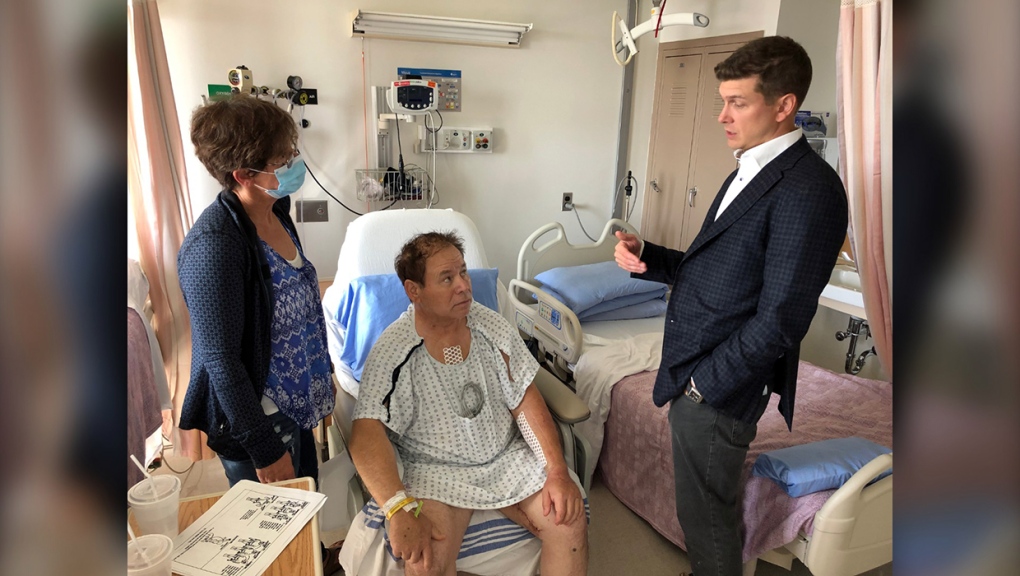
Dr. Corey Adams, a cardiac surgeon at the University of Calgary's Libin Cardiovascular Institute, has saved two men in the past 18 months by first performing CPR on them in public and then, days later, operating on them. (Helen Pike/CBC)
Dr.Adams is the talk of his colleagues in medical care. From his recent experiences in encountering people in grave medical distress; when on two occasions he happened to come across serious medical collapses caused by potentially lethal heart events, he is adamant that society would be far better off if more people took CPR courses to enable them to respond with confidence should they come across people requiring rescue from death for any number of medical causes who are unconscious and unresponsive.

His colleagues think it's great good fun to tease him about the events he was featured in by fate on his part, good luck on the part of others requiring his professional expertise to save their lives, by jocularly posing the puzzle that for an esteemed professional busy enough in his trade with so many people suffering heart collapses that he really doesn't need to go out of his way to drum up more business. Even he, at the centre of the jokes, feels it to be beyond strange that those two events occurred and he just happened to be there to take charge...

A year and a half earlier he had been out for a hike with another doctor, who happened to be his wife. They had set out for a hiking trail located close to Canmore, Alberta and heard someone calling for help. When they investigated they found that an older man had collapsed. His condition was clear enough from the blue hue his skin was turning. That called for 20 minutes of CPR, until their emergency calls brought a responding ambulance and paramedics arrive to take the 60-year-old man in medical duress to hospital.
 
Shirley Parker, Darrell Parker and Dr.Corey Adams in May 2020 at Foothills Hospital in Calgary following five bypass surgeries performed by Dr.Adams who saved his life by performing CPR on him near Grassi Lakes Trail
 
It was some days on when Dr.Adams realized that the man he was performing a quintuple heart bypass in surgery happened to be the very same man he and his wife had come across during that hike. In essence, his expertise combined with the anomaly of treating this man twice; the initial CPR to restore his heart and lungs to begin breathing and the follow-up surgery to free up his clogged arteries, saved the man's life. An odd experience, to say the very least.

Yet one that repeated itself incredibly, this past August when the Adams family were out with their children to connect with nature. It was Dr.Jennifer Adams this time who realized a man who had been out on a run had collapsed nearby and with no one else around. They learned later that the young man whose aid they quickly assumed, was born with a heart defect. 

Again, Dr. Adams performed cardio-pulmonary resuscitation. Again paramedics took over when the ambulance arrived. and once more Dr.Adams performed surgery for the 34=year-old McVeigh who required a heart valve replacement. And who is alive and well because of his great good fortune in having been found by a husband-and-wife medical team who secured his life for him. 
 
Medical emergencies can happen anywhere at any time. When they happen in remote and isolated settings it takes great good luck to survive them when the miracle of a health professional just happens to be passing by.

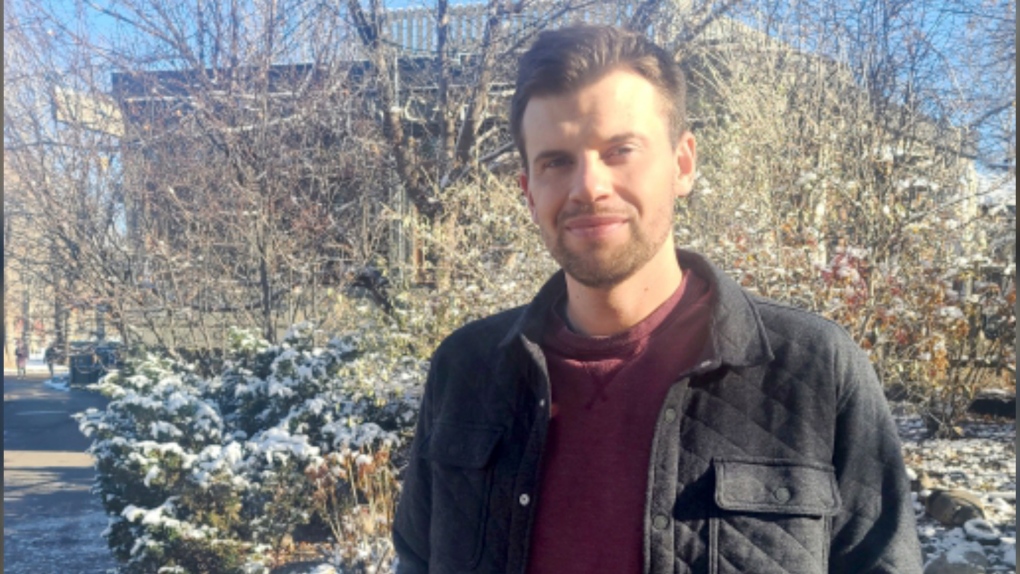
Eric McVeigh poses in this undated handout photo. McVeigh is lucky to be alive after he collapsed while running in Calgary in August. Calgary heart surgeon Dr. Corey Adams and his wife spotted McVeigh and performed CPR on him until he was taken to hospital. Adams then performed his heart surgery days later. It's the second time it's happened to Adams who did the same thing with another man in June of 2020. (Courtesy Eric McVeigh/The Canadian Press)

Labels: , , , ,

Tuesday, April 18, 2017

Trauma in Emergency Cardio Events and Among Responders

"We ask a lot of them [bystanders] to respond, and then we just say, 'thanks'. The ambulance comes and takes the patient away and they're [the bystander giving medical aid] sort of left standing there, like, 'What just happened'?"
"[CPR training on mannequins or "Annie", the CPR doll] is nothing, nothing like it is in real life. It can be just a completely chaotic and unpredictable environment [when a medical emergency outside a hospital occurs]."
"It's your husband, your wife, a loved one, it's happening in your home -- maybe you're doing CPR on your bed. That scene may play in your mind for the rest of your life."
"And if you don't react [paralyzed with inaction], then there's the trauma of not reacting."
Katie Dainty, Li Ka Shing Knowledge Institute, St.Michael's Hospital, Toronto

"It doesn't matter how well they [reacting bystanders] do it, or how perfect it is [their technique], just that they're doing something -- pushing that blood around to that heart and that brain and giving that person the chance of surviving."
"It's life or death [for the victim]. It's a highly emotional situation."
"We need to better understand that and better support people that are witnesses to that."
Dr. Farhan Bhanji, professor of pediatrics, McGill University, Montreal

"Tell them [911 operators] he's gasping."
"[I don't know whether he -- man in medical distress whom she responded to by using CPR -- survived] but I hope he did and, if he didn't, I hope his family knew he wasn't alone, that he wasn't not touched, and left on the street until the ambulance came."
"I didn't want to talk to anybody about it. I worried about his family. I was upset with myself and disappointed that I really didn't want to do it [CPR] at first, because I was afraid. But I'm so glad I did, I'm so glad I did."
"I still cry [thinking about it] and I shouldn't, right? I think we have to find new ways of talking about that."
Toronto woman trained in CPR
CPR Lesson at City Hall
Paramedics and members of the Toronto Paramedic Services’ Safe City team demonstrated cardiopulmonary resuscitation (CPR) and the use of an automated external defibrillator (AED) to members of the public and City staff members today at Toronto City Hall. The event was part of Toronto Paramedic Services’ 2016 Heart Month activities. Toronto Paramedic Services
Research suggests the experience of a witness to someone suffering a medical emergency, who then intervenes in a desperate attempt to provide some measure of relief until paramedics arrive, suffers consequences as a result of their altruism; the irresistible urge to help someone survive a medical emergency, and to give comfort to someone in dire medical straits. The lay person attempting to administer emergency medical help can find the experience results in strong emotional reactions.

Nightmares, flashbacks and fearful thoughts that one cannot control may plague the volunteer for months and years after the event. One limited study published in BMJ Open last year concluded: "the main concern was whether their actions had led to severe injury, a vegetative state, or death". In other words, whether their amateur reaction turned out to be harmful to the survival of the person in distress, rather than helpful.

Each year in Canada an estimated 40,000 out-of-hospital cardiac arrests occur, and swift bystander CPR intervention can increase the opportunity of survival threefold. Yet, despite studies proving the indisputable value of such intervention, few researchers have undertaken studies to evaluate the outcome for "lay rescuers", onlookers to dire health events who react in the best interests of a positive outcome. And who may experience, while attempting to resuscitate someone, an event unfolding that leads nonetheless to death.

Canadian researchers have now launched a virtual support network (www.bystandernetwork.org) to enable the public to share their first-hand experiences after having responded to, or witnessed a cardiac arrest. This is an effort to examine and try to understand the psychological side-effects of cardio-pulmonary resuscitation. With the best of intentions people do want to do what they can to help others. And public entreaties for people to become familiar with the technique of CPR to enable the public to spring into action if and when needed makes the case for intervention as a public good.

The reality is that bystander CPR rates are low, with many cardiac arrests witnessed, but a mere third receiving bystander CPR. Though people sincerely do want to help, when they're faced with a sudden health emergency many tend to freeze; fear and panic immobilizes reaction; that in contemplating   how they would react, people may confidently visualize themselves doing so, but when the real thing occurs, they are frozen with indecision, polarized between need and fear.

The new guidelines that were publicized and published in 2010 now recommend that untrained bystanders witnessing an adult collapse, set aside the mouth-to-mouth breathing component of CPR and rather, focus simply on deep and rapid chest compressions solely. That simplification appears to have done little to help people feel a little more confident about their ability to do the necessary despite the mental strain they may be suffering. People still fear being the author of harm to others.

Yet, as medical scientist Katie Dainty stresses, it is always best to react and do something rather than stand back and commit to nothing. Doing nothing, the victim will likely die, while chest compressions double or triple the chances of survival through the circulation of oxygenated blood through the body, to ensure the brain and other organs can be kept alive.


Labels: , ,

 
()() Follow @rheytah Tweet