Ruminations

Blog dedicated primarily to randomly selected news items; comments reflecting personal perceptions

Monday, July 14, 2025

Restoring Syria, Stabilizing the Middle East

"[Syria is at a] turning point [as is the rest of the Middle East]."
"If we can now all come together to support the Syrian people and the Syrian government in actually taking charge, and building a prosperous stable secure Syria, that will impact all of the region."
Prince Faisal bin Farhan, foreign minister of Saudi Arabia 
 
"[Gulf countries see an opportunity to] reshape the regional order, [as Syrians devote  themselves to rebuilding lives for themselves out of the rubble of 14 years of civil war]."
"[We still have Yemen that's in trouble -- Sudan, Libya -- but for one time in many years, one story is not one of blood and war and destruction and that's where we want to go."
"A healthy region means a healthy Gulf."
Bader Al-Saif assistant professor of history, Kuwait University 
https://www.stimson.org/wp-content/uploads/2025/07/Ahmed_al-Sharaa_and_his_delegation_visited_the_United_Arab_Emirates_July_2025-1024x574.jpg
Ahmed al-Shara and his delegation welcomed in the UAE  Stimson
 
While now-ousted Alawite Syrian President Bashar al-Assad was still barrel-bombing and chemical weapons-spraying majority Sunni Syrians, the Arab League which had banished him from their midst, did a U-turn and welcomed him back to be seated amongst them as a member in good standing. This, while Assad continued his loyalty to the Islamic Republic of Iran which sponsored Syria's persecution of its defiant majority Sunni population, when Russia had entered the civil war to aerially bombard Sunni strongholds in Syria.
 
The sectarian violence that internally displaced millions of Syrians, with millions more becoming refugees reflected traditional violent antipathy between the two major branches of Islam, Sunni and Shia. While Iran established its two-pronged 'axis of resistance' by cultivating, training and arming proxy militias in Lebanon, Iraq, Yemen and Gaza for its long-range aspiration of Shi'ite conquest of the Middle East, its plans also included the destruction of the sole non-Muslim state in the region, the Jewish state of Israel.
 
When Hamas took agency to invade southern Israel with thousands of its terrorist operatives to launch a massive bloodbath among Israeli farming communities near the Gaza border, deliberately and with detailed planning to impose a horrendous savagery of mass rape, mutilation, and widespread carnage that saw entire families burned to death in their  homes -- children, the elderly, women and foreign farm workers violently abducted to serve as hostages, an unprepared Israel while mourning its losses responded by invading Gaza to root out and destroy the Palestinian terror groups to completely neutralize their functionality.
 
Iran's related terror proxies attacked Israel in defence of Hamas; Hezbollah on the northern border, and the Houthis from Yemen. Shia militias in Iraq, and Assad's Syrian forces as well as the Islamic Republican Guard Corps al Quds division driving Iran to send missiles into Israel posed a pincer threat to the Jewish state. The Israeli military fought them all, and decimated both Hezbollah and Hamas, targeting their leaders, their command posts and their weapons caches, leaving them utterly diminished as organized fighting forces. 
 
The Israeli aerial bombardment of Iran neutralized many of the terror state's primary political, scientific and military figures, targeted military bases destroying missile production sites, and bombing the country's nuclear sites and facilities with the intention of destroying its capacity to further enrich uranium to weapons-grade state. Israel, in the course of several years militarily responding to the Hamas imposition of conflict was able to dismantle and neutralize the rabid threat of Islamist terrorism cultivated by Iran.
 
An opportunity that was grasped by a coalition of Syrian 'rebels' comprised of Syrian Islamist groups that were themselves terrorists, events leading to Bashar al-Assad fleeing to Russia for haven, and a former terrorist linked to al-Qaeda and ISIL, Ahmed al Sharaa, ensconced as Syria's new president, seeking to present as a moderate, a reformer, to take Syria into a new direction and restore it as a fulcrum of the Middle East, taking its place among the other nations with full accreditation. 
"I am 'ordering the cessation of sanctions against Syria to give them a fresh start'." 
"It gives them a chance for greatness. The sanctions were really crippling, very powerful." 
"I felt very strongly that this would give them a chance. It's not going to be easy anyway, so gives them a good strong chance. And, it was my honour to do so."
"We made a speech last night, and that was the thing that got the biggest applause from the room."
U.S. President Donald Trump at Gulf Cooperation Council
https://i.cbc.ca/1.7534470.1747216376!/fileImage/httpImage/image.jpg_gen/derivatives/original_1180/trump-mideast.jpg?im=Resize%3D1180
In this photo released by the Saudi Royal Palace, Syria's interim President Ahmed al-Sharaa, left, shakes hands with U.S. President Donald Trump in Riyadh. (Bandar Aljaloud/Saudi Royal Palace/The Associated Press)
 
Saudi Arabia and Qatar paid off Syria's $15.5 million World Bank debt, a pittance for them, but enabling Syria to be once more eligible for grants to fund reconstruction. The Mediterranean port of Tartus in Syria once handed to Russia as a naval base, is now to be developed by D World owned by the gulf emirate of Dubai. Once an integral part of Tehran's 'crescent of influence' along with Iraq and Lebanon, Syria is now poised to return to the Sunni Islam majority world of the Middle East. 
 
The hostility between the Sunni states and Iran, fearing that the Islamic Republic's brand of Islam could penetrate their own minority Shia populations with its  revolutionary ideology zeal leading to mass instability is being put to rest. As is the fear that Iran could succeed in its conquest aspirations to become the premier influence in the region. Iran's interference in Saudi Arabia, bombing its oil fields, its missiles shot at Qatar to hit American bases there, signed its influence death-warrant.
 
And now that the Arab majority Sunni Muslim states recognize Israel's critical role in vanquishing the aspirations of the Persian Shi'ites, and greater cooperation leading to normalization between them with Israel through membership in the Abraham Accords has been accepted, their mission to restore relations within the Arab League and to establish opportunities for economic development and political stability has sprung into action.  
 
https://gulfif.org/app/wp-content/uploads/2025/07/25033551106004-2048x1366.jpg
In this photo provided by the Saudi Ministry of Media, Saudi Crown Prince Mohammed bin Salman greets Syria's interim President Ahmad al-Sharaa, left, during his arrival at the royal palace in Riyadh, Saudi Arabia, Sunday, Feb. 2, 2025. (Saudi Ministry of Media via AP)
 

Labels: , , , , , ,

Wednesday, June 26, 2024

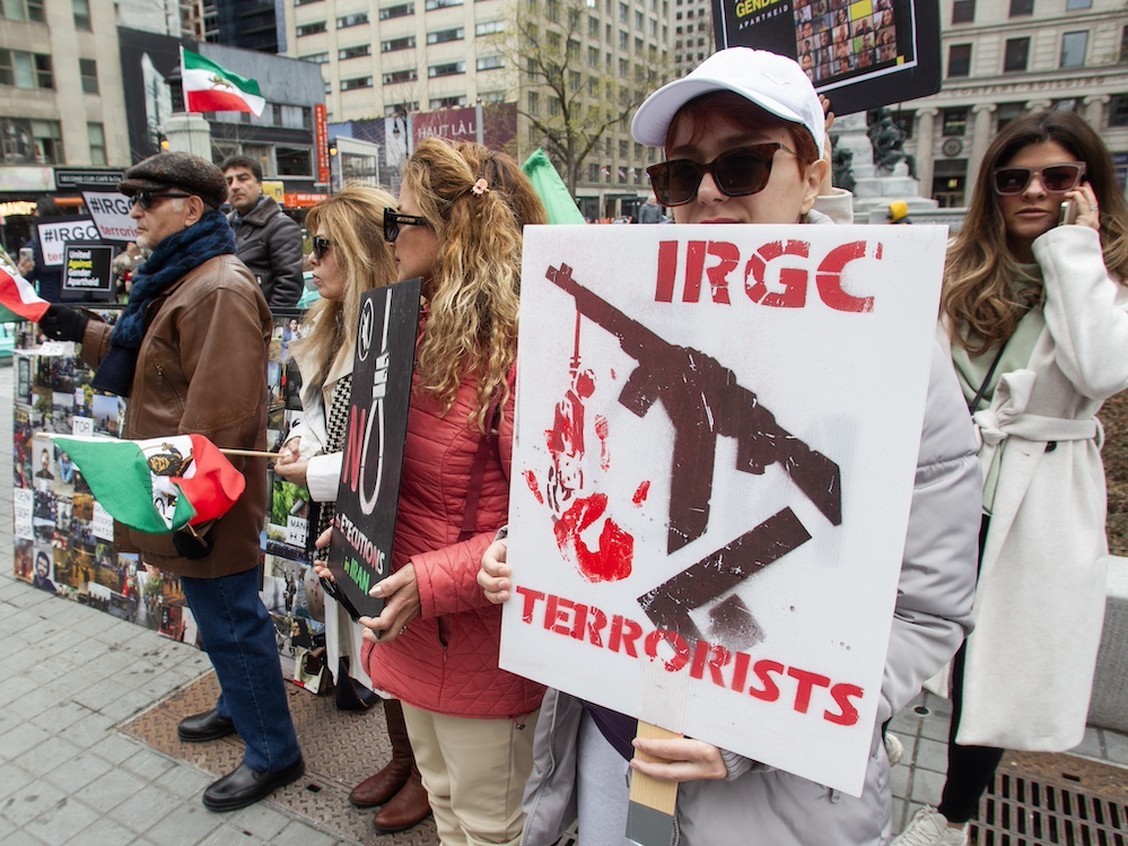
Outlawing the Islamic Revolutionary Guard Corps/Terrorist Central

"It's influencing the political and the social landscape of Canada. It's influencing the youth and mobilizing them against Western values against Canadian security, in very subtle ways and sometimes in very overt ways." 
"It's the same issue with respect to China, how they have been operating. The Islamic Republic is no different."
"In terms of the evidence before the Liberal government, nothing substantial has changed since six years ago. We all know that in 2020 the IRGC shot down [Ukrainian Airlines] PS752, killing all 175 passengers, including 55 Canadian citizens. If that wasn't sufficient evidence, I don't know what else the Liberal government was looking for."
"We welcome the change in the government's attitude after six years of not doing anything about it and giving all sorts of excuses why they were not listing IRGC as a terrorist entity despite all the evidence that they admitted existed. The evidence was there. It was just a question of political will."
"[Six years of inaction has allowed the IRGC to] spread their tentacles in Canada. Their numbers have increased. Their influence has increased. We are going to feel that influence and the impact of them being in Canada and within our systems and institutions for decades to come."
Mojdeh Shahriari, Vancouver human rights lawyer, co-founder, Stop IRGC
https://smartcdn.gprod.postmedia.digital/nationalpost/wp-content/uploads/2024/06/0620-na-IRGC.jpg?quality=90&strip=all&w=1128&h=846&type=webp&sig=Z028aDJyxHm6s5GMc0LzRw
People take part in a a protest against the Iranian government on April 21 in Montreal (John Kenney / MONTREAL GAZETTE)
 
In 1976 when Ayatollah Ruhollah Khomeini returned from exile in France to head a revolution that removed the Shah of Iran from power, in turn installing a theocratic regime with himself at its head, it was understood that a fundamentalist Islamist Shiite government had taken power in the country, with Khomeini as its Supreme Leader. Despite which, the extent of the reach of the Islamic Republic of Iran since that time in influencing Middle East affairs and international relations far afield might never have been imagined.
 
In the close aftermath of the revolutionary change in government in Iran, many Iranians knew they could not remain in their country of birth. From a fairly open society, with good international relations with non-Muslim countries -- including Israel -- the Islamic Republic was destined to become a divisive power broker in the Middle East. Under the ruling Ayatollahs and their Islamic Republican Guard Corps the intention was to restore Iran to its historical influence as the supreme regional power. 
 
In the predominately Arab Muslim Middle East, Iranians, though Muslim, are not Arab but Persians, the Aryans that Adolf Hitler was adamant were a superior 'race'. There is also a sectarian divide between Iran and the other Muslim countries of the Middle East which are majority Sunni Muslim, while Iran is Shiite, a relative minority. From its very inception in 1976 the Islamic Republic set out to gain a commanding influence within the Middle East, and to elevate the status of Shiite Islam. An unsubtle state of confrontation between Iran and Sunni Saudi Arabia ensued.

Iran's ambitions rose to challenge Saudi Arabia as custodian of the holy cities of Mecca and Medina in its aspirations to become the supreme Islamic authority commanding the Middle East. Iran's animus toward the Jewish State of Israel surpassed that of any Arab state by a wide margin. And Iran courted the disaffected populations of minority-status Shiites in Arab countries. The al-Quds division of the IRGC founded an Islamist Shiite group in Lebanon, training and arming it as a proxy militant arm it could control.
 
https://ichef.bbci.co.uk/news/1024/cpsprodpb/e6b7/live/13b0a610-2e75-11ef-ba8d-a9b9bfa74cb0.jpg.webp
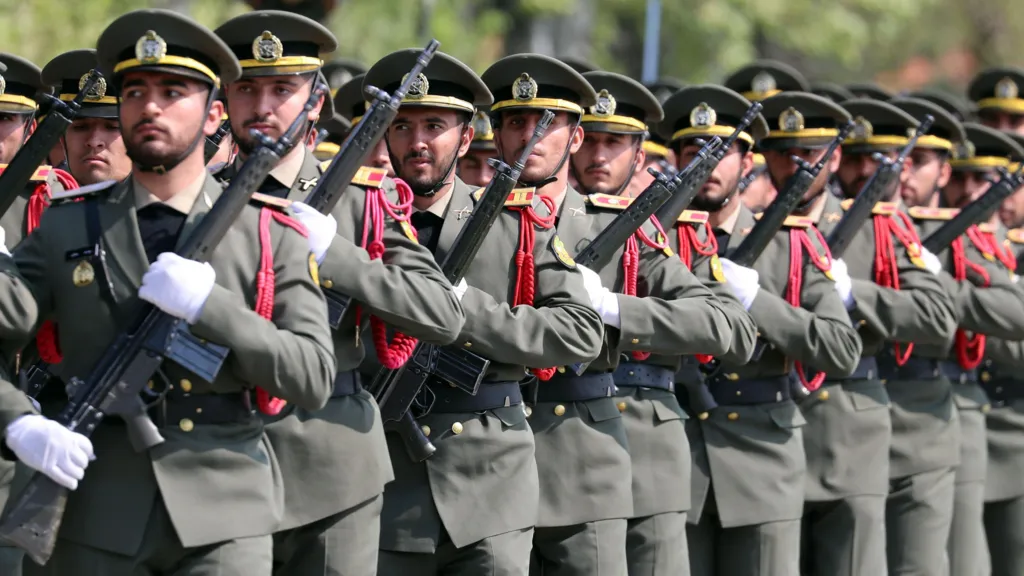
The IRGC is a major military, political and economic force in Iran   EPA

Hezbollah came to world notice when in 1983 it undertook a truck-suicide bombing on an American military base, a marine corps barracks in Beirut against UN-affiliated peace envoys, killing 241 American soldiers. Another suicide bomber soon afterward killed 58 French UN-assigned paratroopers. This was Hezbollah, a newly-minted terrorist group, doing the bidding of its masterminds in Tehran. Since that time, Hezbollah has been a terror-creation of Iran, tasked to do its bidding, with a major focus on Israel, and on suicide-mission attacks abroad on Jewish enclaves.

 
There is also a Western infiltration component to the Islamic Republic's aspiration for dominance. Those Iranians who fled a revolutionary Islamist Iran they had no wish to live within, have found themselves, in the past decade, being targeted for their anti-Islamist, anti-Ayatollah, anti-terrorist attitudes. The Trudeau government in Canada has allowed the infiltration of Iranian agents and personnel, including senior leaders of the IRGC to have easy access to Canadian society at all levels, to enter on visas, to establish residency and to undermine the democratic freedoms of the Iranian expatriate population.
 
Their scheme in Canada, as it is elsewhere in the free world, is to destabilize all the institutions that make the West a free world, undermining the social and cultural values of nations of the West. Although Iranian-Canadians have made it clear to the Trudeau government that they have reason to fear the entry of representatives of the Iranian regime to Canada who intimidate and threaten them, the very fact that those involved in the most extremes of human rights abuses have entry to Canada is in and of itself inexcusable.
 
Finally, although all parties in Canada's Parliament have long supported a move to outlaw the presence of Iranian regime representatives in Canada, on a number of occasions voting unanimously to place them on a terror list and impose sanctions, the Trudeau government chose not to take appropriate action. Until last week, when it finally did. "Based on their actions, there are reasonable grounds to believe that the IRGC has knowingly carried out, attempted to carry out, participated in or facilitated a terrorist activity", explained the government's minister of public safety. Stating something that has long been known.
"This process of IRGC spreading its influence throughout the Western world has been going for a very long time, unfortunately, and they have been able to infiltrate many of our academic institutions, our professional institutions and they have been money-laundering [in Canada]."
"Everyone is looking for an assassination plot or something like that, and of course they do that, and they are known for it and their terrorist activities all over the world, but they have been infiltrating and interfering with our institutions for decades and in the past six years this has intensified."
"So it has been a huge disaster, in my view. In 2018, Parliament unanimously voted to immediately list the IRGC and I never heard any reasonable explanation from the Liberal government why they were dragging their feet. Something political has changed for them in terms of their calculation of the cost benefit of listing the IRGC."
Mojdeh Shahriari, Vancouver human rights lawyer

https://www.cfr.org/sites/default/files/styles/immersive_image_3_2_desktop_2x/public/image/2019/05/RevolutionaryGuards_0.webp
Members of the Revolutionary Guards attend a parliamentary session in Tehran. Atta Kenare/AFP/Getty Images

Labels: , , , , , , , , , , ,

 
()() Follow @rheytah Tweet