Ruminations

Blog dedicated primarily to randomly selected news items; comments reflecting personal perceptions

Friday, May 08, 2026

Keeping the Fiction Alive

https://images.theconversation.com/files/731318/original/file-20260421-57-6d210u.jpg?ixlib=rb-4.1.0&q=45&auto=format&w=754&h=500&fit=crop&dpr=1
In central Tehran, a poster with the words: ‘The Strait of Hormuz remains closed’ spells out Iran’s uncompromising position. EPA/Abedin Taherkenareh


"Mojtaba Khamenei, the proclaimed Supreme Leader, has not been seen or heard from directly since February 28, when the U.S. and Israel launched their air campaign."
"One Iranian journalist in Germany claims Mojtaba is dead and that the delay in announcing his death reflects an internal struggle among senior regime figures over control of the vast financial empire worth tens of billions of dollars associated with his father's office."
Winfield Myers, Middle East Forum 
 
"Mojtaba is managing the country as though he is the director of the board."
"He relies heavily on the advice and guidance of the board members, and they collectively make all the decisions."
"The generals are the board members." 
Abdoireza Davari, former senior advisor to Mahmoud Ahmadinejad 
 
"Mojtaba is not yet in full command or control."
"There is, perhaps, deference to him. He signs off or he is part of the decision-making structure in a formal way."
"But he is presented with fait accompli presentations right now."
Sanam Vakil, director, Chatham House policy institute, London 
 
"Mojtaba is not supreme; he might be leader in name, but he is not supreme the way his father was."
"Mojtaba is subservient to the Revolutionary Guards because he owes his position and he owes the survival of the system to them."
Ali Vaez, Iran director, International Crisis Group 
https://www.reuters.com/resizer/v2/EQ3EOBMHDFOLLBTC3WBYTRQJIQ.jpg?auth=f77d1f6702d110c07270d42bb28c0389155757ee07fd169ad7f46cbb0ff9d3f2&width=640&quality=80
People ride motorcycles near a billboard featuring an image of Iran's new Supreme Leader Mojtaba Khamenei, amid a ceasefire between U.S. and Iran, in Tehran, Iran, April 20, 2026. Majid Asgaripour/WANA (West Asia News Agency) via REUTERS)
 
The absolute power wielded by Ayatollah Ali Khamenei as Iran's Supreme Leader is a matter of the past. The IRGC was Khamenei's tool, whatever he ordered they carried through. He was the decision-maker, they implemented his decisions. With his son purportedly now replacing him, the roles have been reversed; while professing to take their direction from Ayatollah Mojtaba Khamenei, it is now the Islamic Revolutionary Guard Corps leaders who are the decision-makers planning the future of the Islamic Republic, and negotiating with the United States for a ceasefire.
 
If he is in actual fact still alive, Mojtaba Khamenei, is in a secret place and  has been there since American and Israeli aerial forces bombed the Khamenei compound the very first day of their Invasion on February 28. Living with his family in that compound, the junior Khamenei lost his wife and son to the bombs that killed his father, and just incidentally, injured him so badly that he has been incommunicado since, cared for by doctors treating his injuries from the airstrikes.
https://i0.wp.com/alhurra.com/wp-content/uploads/2026/03/irann13-1.jpg?fit=1200%2C675&ssl=1 
The Iran-Iraq war saw a then-17-year old Mojtaba deployed to a brigade of the IRGC, the Habib Battalion. During that war, and through his close association with the Guards and its members, lifetime friendships ensued as battalion members became influential military and intelligence figures, while Mojtaba had followed his father into a theological seminary to graduate with the rank of ayatollah, following which he coordinated military and intelligence operations at his father's compound. A position that brought him ever closer to the IRGC leadership.
 
Rumours had begun circulating not long after the airstrikes that killed his father, that the son, gravely wounded, had succumbed to his injuries and died. That the IRGC, mindful of the influence of a supreme leader assumed to be the voice of Shia Islam with millions of devout followers, was needed to give them the political/religious authority required to continue their enforcing role as custodians of the Islamic Republic. 
 
As matters now stand, it was agreed to acknowledge the grave physical condition that the February 28 airstrike left Mojtaba in. That surgery to amputate one of his legs occurred and he awaits a prosthetic. There were ostensibly other surgeries, but his physical functions are gradually returning though the severe burns on face and lips made it difficult for him to speak clearly, and thus his voice has not been heard. The messages 'written' by him have been circulated widely, for his 'comprehensive intelligence' has not been impaired.
 
https://i.cbc.ca/ais/4f0fe92b-1d6e-40e1-a9bc-471f7ece0ae6,1776802271583/full/max/0/default.jpg?im=Crop%2Crect%3D%280%2C437%2C8640%2C5016%29%3BResize%3D796
Women members of the Basij paramilitary, affiliated with Iran's Revolutionary Guard, march through Tehran with their weapons during a state-organized rally in support of Supreme Leader Mojtaba Khamenei. (Vahid Salemi/The Associated Press)
 
The story is that messages to him and back from him are discreetly carried hand-to-hand over long distances by trusted couriers. His condition mandated the delegation of decision-making temporarily to the generals for the time being. Nothing has disturbed the power of the IRGC whose elite leaders are known to control vast industrial empires, including the nuclear program of the Islamic Republic. The decision to close the Strait of Hormuz was not Mojtaba's, but it has served the fiction of his commanding role well.
 
The Guards have directed the strategy of attacking Persian Gulf states, and Israel. Those who are said to speak from positions of knowledge maintain that Motaba Khamenei decided since his leadership role was one he had to accustom himself to, to delegate critical decision-making, as per the ceasefire talks to the Guards. The generals now in charge; Mohammad Bagher Zolghadr, Yahya Rahim Safavi, Ahmad Vahidi, Mohsen Rezaei, and cleric Hossein Taeb, have a singular goal; to safeguard the existence of the Islamic Republic.
 
And they do so in direct opposition to foreign minister Abbas Araghchi, and president Masoud Pezeshkian concerned with sanctions relief, with the economic losses caused by the war, the need for reconstruction, and to rethink the closure of the Hormuz Strait.  
 
https://static.jns.org/dims4/default/e52dafd/2147483647/strip/true/crop/1050x591+0+12/resize/1000x563!/format/webp/quality/90/?url=https%3A%2F%2Fstatic.jns.org%2Fad%2Fda%2Fabe565a94372b8742f42ff78b1f7%2Firgc-terrorists.jpg
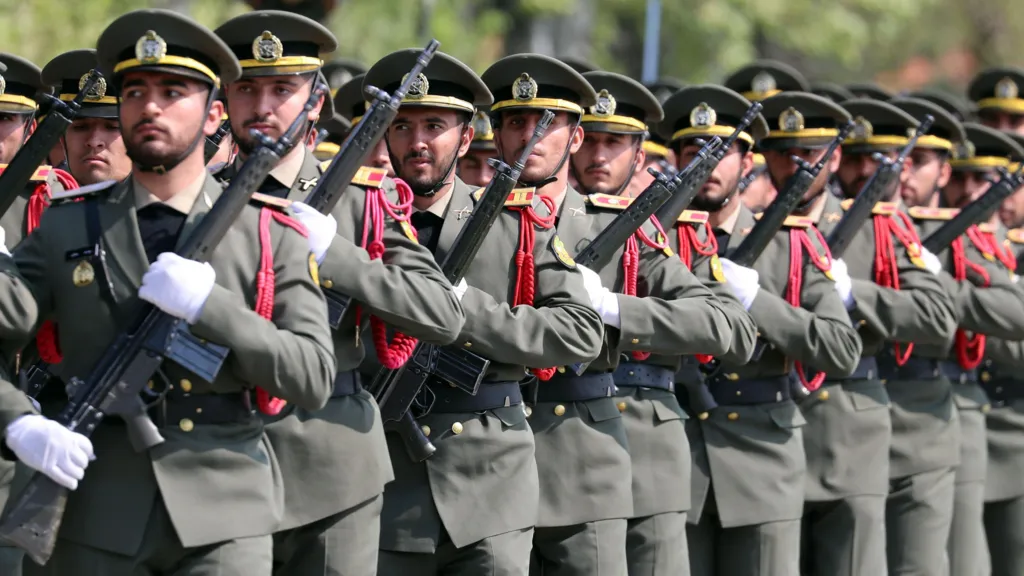
Islamic Revolutionary Guard Corps members at an IRGC ground forces military drill in the Aras area, East Azerbaijan Province, Iran, Oct. 17, 2022. Credit: Fars News Agency


Labels: , , ,

Saturday, January 10, 2026

Iran : The Will Of The People

"Trump should know that intervention by the U.S. in the domestic problem corresponds to chaos in the entire region and the destruction of U.S. interests."
"The people of the United States should know that Trump began the adventurism."
"They should take care of their own soldiers." 
Ali Larijani, secretary, Supreme National Security Council, Tehran
 
"Any interventionist hand that gets too close to the security of Iran will be cut."
"The people of Iran properly know the experience of 'being rescued' by Americans: from Iraq and Afghanistan to Gaza."
Ali Shakhani, adviser to Supreme Leader Ayatollah Ali Khamenei
https://ichef.bbci.co.uk/news/1024/cpsprodpb/42b0/live/e740c480-ed30-11f0-a422-4ba8a094a8fa.jpg.webp
Protests were also reported in several other provinces, including Kermanshah - AFP via Getty Images
 
As the street protests throughout Iran against the theocratic regime of the Islamic Republic grow ever more vehement in a chorus of declarations that Iranians will no longer tolerate being governed by a religious dictatorship that has made a misery of their lives for almost half a century, with widening public participation in rallies approaching two weeks of aggravated and totally fed up Iranians excoriating their rulers, officials lash out at external interference as the cause of the riots. Not the years of repression, persecution, forced sacrifice and risk of imprisonment under a version of Shi'ite Islam that exemplifies theocratic Fascism.
 
There was an attempted rebellion -- the Green Revolution in 2009 -- that failed to accomplish its goal, another in 2019-2020 of Bloody November when thousands were killed and yet another in 2022 spurred by the murder of 22-year-old Kurdish Iranian Mahsa Amini, killed in police custody whose casual hijab insulted the strict dress code the morality custodians religiously police, none of them were quite the equal of these current street protests, in dedicated numbers, outright hostility to the regime and calls for the death of the Supreme Leader, as well as attacks by ordinary Iranians on members of the IRGC.
 
This time, Iranians were initially responding to the economic straits they face with rising prices and a failed currency. As the days went on repeating the protests on a wider scale, not only in major cities but smaller towns, country-wide with more agitated and angered citizens deciding it was now or never to express their rage against the government machinery that has turned their country into terror central, produced a strained internal economy while financially supporting the regime's terror proxies abroad, the regime struggles to contain the will of the people it thought it had completely broken.
 
https://cdn.theatlantic.com/thumbor/FQOot7nJrBp7iUEzAU_fG4EdCdo=/0x0:2000x1125/976x549/media/img/mt/2026/01/2026_1_10_Iran/original.jpg
MAHSA / Middle East Images / AFP / Getty
 
President Donald Trump has warned Iran that should it "violently kill peaceful protesters", the United States "will come to their rescue. We are locked and loaded and ready to go", he wrote on his social media site. Statements that enraged the regime, happy to attribute the chaos that now reigns and the resulting threat to the regime's stability to an outside source, in the hopes that they might persuade the population that there is an existential threat from the United States, in concert with Israel -- to produce cohesion and solidarity against their nation's enemies.  
 
Much too late for that, however; it is the regime itself that Iranians view as their enemy, and it is Israel and the United States toward which they look for assurances and empathetic support, despite this past summer's brief attacks by both against their government's nuclear and rocketry programs that have made Iran an outlier, supported by Russia, China, Cuba and Venezuela. And now that Venezuela is out of the picture, Cuba's future is in doubt, and Russia's source of drones and China's source of oil for which they are both reliant on Iran, is in jeopardy
 
Israel's 12-day war on Iran to disrupt its nuclear program and the U.S. bombing of Iranian nuclear sites saw Iran attack the U.S. Al Udeid Air Base in Qatar; Laranjani's reference to the event failed to stir a U.S. response, other than Mr. Trump's placing the country on notice, should a massacre of protesters take place. In a desperate move to bring the protests to a halt before complete destabilization rules the day, President Masoud Pezeshkian signalled his willingness to negotiate with protesters, but the protests have no leader, they are massive, spontaneous kinetic reactions to a half-century of repressive, violent governance.
 
And they are the voice of a people who will no longer tolerate conditions under which they have been forced to live. They want their lives returned to what can only be considered normal, and they want their country to shed itself of the forces that have demanded they enslave themselves to an ideological fundamentalist that is alien to their history and heritage. What the government can offer them is nothing at all that would appeal to reason, since it is an unreasonable expectation that they would now withdraw their demands for freedom, liberty from coercive dictatorship.  
 
https://ichef.bbci.co.uk/news/1024/cpsprodpb/6799/live/8da3c320-ecde-11f0-bba2-5b0f4fc81c5e.jpg.webp
In videos from Mashhad, protesters can be heard chanting "Long live the shah"  X
"Though the grievances that fuel these and past protests are due to the Iranian government's own policies, they are likely to use President Trump's statement as proof that the unrest is driven by external actors."
"But using that as a justification to crack down more violently risks inviting the very U.S. involvement [that] Trump has hinted at."
Naysan Rafati, analyst, International Crisis Group 
 

Labels: , , , , , , ,

Friday, August 29, 2025

Australian-Iran Diplomatic Relations ... Pfft!

"Strongly consider leaving as soon as possible, if it is safe to do so."
"Foreigners in Iran, including Australians and dual Australian-Iranian nationals, are at a high risk of arbitrary detention or arrest."
"DO NOT TRAVEL TO IRAN."
Government of Australia: Alert to Australians 
 
"ASIO [Australian Security Intelligence Organization] has now gathered enough credible intelligence to reach a deeply disturbing conclusion."
"The Iranian government directed at least two of these attacks. Iran has sought to disguise its involvement but ASIO assesses it was behind the attacks."
"These were extraordinary and dangerous acts of aggression orchestrated by a foreign nation on Australian soil."
"They were attempts to undermine social cohesion and sow discord in our community. It is totally unacceptable."
"[ASIO and the federal police had been] able to trace the chain of command, if you like, right back to the IRGC [Islamic Revolutionary Guard Corps]."
"It is important that people understand where some of these attacks are coming from, and it would appear, as the AFP commissioner said yesterday, that some of these are being perpetrated by people who don’t have a particular issue, aren’t motivated by an ideology, but are paid actors." 
Australian Prime Minister Anthony Albanese 
ASIO Director-General Mike Burgess and Prime Minister Anthony Albanese
ASIO Director-General Mike Burgess and Prime Minister Anthony Albanese, Foreign Minister Penny Wong and Home Affairs Minister Tony Burke in the background, announcing the expulsion of Iran’s ambassador to Australia, on Tuesday, 26 August 2025. (Photograph by Callum Flinn / ABC News)
 
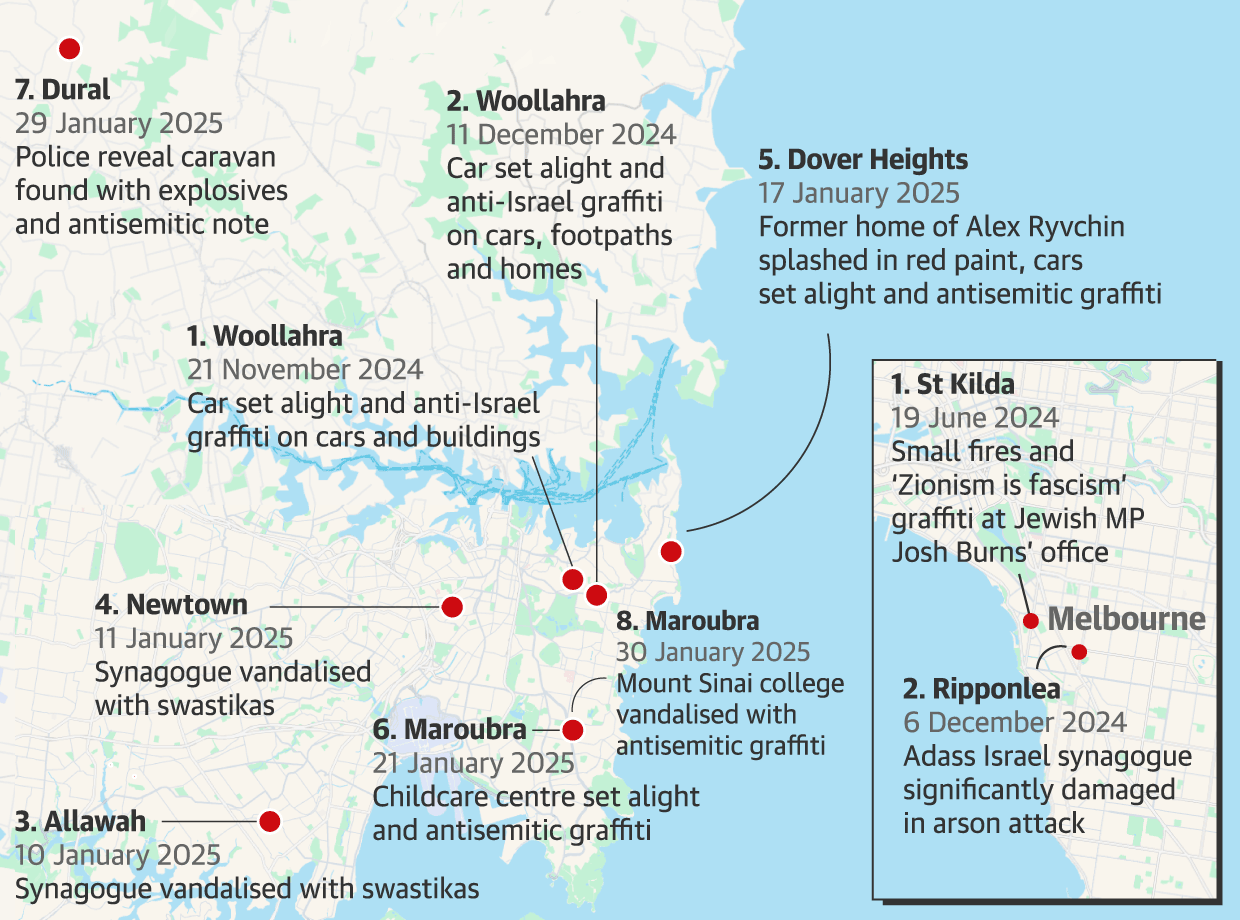
The Islamic Republic of Iran has been accused by Australian Prime Minister Anthony Albanese of organizing two attacks in Australia; represent due cause for Australia to cut off diplomatic relations with Tehran. Iran, according to the Australian Security Intelligence Organization, had directed arson attacks on the Lewis Continental Kitchen in Sydney and on Melbourne's Adass Israel Synagogue in October and December of 2024, respectively. 
 
The Australian government had relayed to Iranian Ambassador to Australia Ahmad Sadeghi that the decision had been made to expel him. At the same time, Australian diplomats posted in Iran have also been withdrawn. A diplomatically hostile action that required Australia's government to also post travel warnings to its citizen passport-holders, as it raised a warning to its highest level of "Do not travel".
 
The Iranian foreign minister responded by naming Albanese as a "weak politician". The second time in a two-week period that Mr. Albanese was singled out thusly for actions taken on behalf of his government, when Israeli Prime Minister Benjamin Netanyahu branded his Australian counterpart as a "weak politician who had betrayed Israel", following the August 11 announcement of preparations to recognize a Palestinian state to be formalized at the September UNGA. 
 
https://interactive.guim.co.uk/uploader/embed/2025/01/archive-zip/giv-4559lx1vPZc2w0f0/Antisemitic-attacks-map_DURAL-inArticle_620.png 
 
At least one suspect has been arrested by Australian police, related to the Sydney cafe fire investigation; and another two suspects accused of torching the synagogue in Melbourne. A 32-year-old Sydney resident, Sayed Mohammed Mousawi, formerly president of the Nomads biker gang chapter in the city, was charged with directing the fire bombing of the cafe, along with the nearby Curly Lewis Brewery, mistakenly targeted for an antisemitic attack.
 
Another man, 22-year-old Giovanni Laulu from Melbourne, was charged as one of three masked arsonists causing extensive damage to the synagogue. An unnamed 20-year-old man, allegedly the second arsonist, is due to appear in court, according to a police statement. 
 
According to Australian Foreign Minister Penny Wong, this is the first time since the Second World War that Australia has expelled a foreign diplomat. Even so, Canberra plans to maintain a level of diplomacy with Iran to ensure Australia's interests can be advanced. In the interim, Australia is legislating Iran's Revolutionary Guard Corps as a terrorist organization, even though it has hesitated to do so in the past in view of its being a government entity.  
 
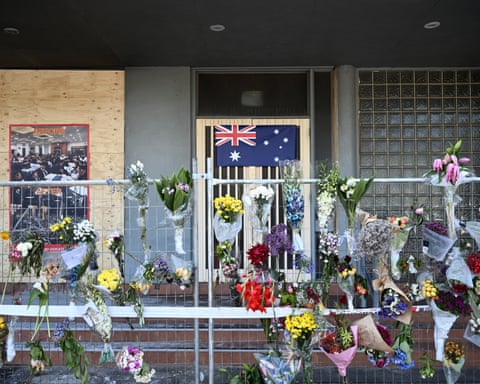
Floral tributes and an Australian flag at the Adass Israel synagogue in Melbourne after it was firebombed in December 2024.
Floral tributes at the Adass Israel synagogue in Melbourne in December 2024. Photograph: Joel Carrett/AAP
 
While denying any involvement, the paramilitary Revolutionary Guard has been accused of attacks abroad in the past. The Quds Force of the IRGC is Iran's expeditionary arm, accused by the West of using local militants and criminals in targeting dissidents and Israelis abroad. "Foremost, these were attacks that deliberately targeted Jewish Australians, destroyed a sacred house of worship, caused millions of dollars of damage, and terrified our community", read a statement from the Executive Council of Australian Jewry.
 
Sydney and Melbourne have seen a steep rise in antisemitic incidents since the Israel-Hamas conflict was initiated in 2023 when the Hamas terrorist group crossed from Gaza into southern Israel and thousands of terrorist operatives launched a sadistic savagery of mass rape, mutilations, kidnapping and murder of 1,200 mostly civilian Israelis, although foreign farm workers and Israeli-Palestinians were also caught up in the murder maw of the Palestinian terrorist hordes.
 
According to Australian authorities, it is suspected that foreign actors have hired local criminals-for-hire to carry out instructions of attack on Jewish businesses and houses of worship in Australia. Whatever evidence exists of Iranian involvement in these events, was not shared by either ASIO director-general Mike Burgess or P.M. Albanese, although Burgess stated there was no evidence of involvement by Iranian diplomats themselves.   
"The latest credible intelligence aside, there have been concerns for some time now about Iran working through proxy networks and engaging in forms of diaspora repression. For example, Iran’s ambassador to Australia, Ahmad Sadeghi, has previously posted inflammatory social-media comments — such as urging that “wiping out the Zionist plague out of the holy lands of Palestine happens no later than 2027” and praising Hassan Nasrallah, the slain leader of the terrorist organisation Hezbollah, as “a great personality ... and an unparalleled leader” — for which he was formally rebuked by Australia’s Department of Foreign Affairs in 2024. And there are Australians who have ties to Iran’s international propaganda network, Al Tajamu."
"The IRGC’s motivation to instigate terror attacks against Jewish targets in Australia is related to its conflict with Israel. Since the 1979 Islamic revolution, Israel has been regarded as the archenemy of Iran, the “little Satan” in service of the “Great Satan” — namely, the United States. Over the years, Israel has operated openly and secretly against Iran, its proxies and its nuclear weapons project, including carrying out assassinations of top Iranian officials, scientists and public figures. The recent twelve-day US-Israeli war on Iran included precision strikes that killed senior IRGC commanders and damaged key facilities linked to the IRGC’s regional networks."
"As a result, Tehran is forever looking for ways to take revenge against Israel, including by trying to recruit spies within the State of Israel to perform acts of violence and espionage. The regime has, moreover, never abandoned attempts to target Israelis and members of the Jewish community and Jewish organisations abroad." 
Australian Broadcasting Corporation 
Commemoration for victims of the AMIA Jewish community centre bombing
People hold pictures of the victims of the bombing of the AMIA Jewish community centre during a ceremony commemorating thirty years after the attack, on 18 July 2024, in Buenos Aires, Argentina. (Photograph by Cristina Sille / picture alliance via Getty Images)


Labels: , , , , ,

Wednesday, June 26, 2024

Outlawing the Islamic Revolutionary Guard Corps/Terrorist Central

"It's influencing the political and the social landscape of Canada. It's influencing the youth and mobilizing them against Western values against Canadian security, in very subtle ways and sometimes in very overt ways." 
"It's the same issue with respect to China, how they have been operating. The Islamic Republic is no different."
"In terms of the evidence before the Liberal government, nothing substantial has changed since six years ago. We all know that in 2020 the IRGC shot down [Ukrainian Airlines] PS752, killing all 175 passengers, including 55 Canadian citizens. If that wasn't sufficient evidence, I don't know what else the Liberal government was looking for."
"We welcome the change in the government's attitude after six years of not doing anything about it and giving all sorts of excuses why they were not listing IRGC as a terrorist entity despite all the evidence that they admitted existed. The evidence was there. It was just a question of political will."
"[Six years of inaction has allowed the IRGC to] spread their tentacles in Canada. Their numbers have increased. Their influence has increased. We are going to feel that influence and the impact of them being in Canada and within our systems and institutions for decades to come."
Mojdeh Shahriari, Vancouver human rights lawyer, co-founder, Stop IRGC
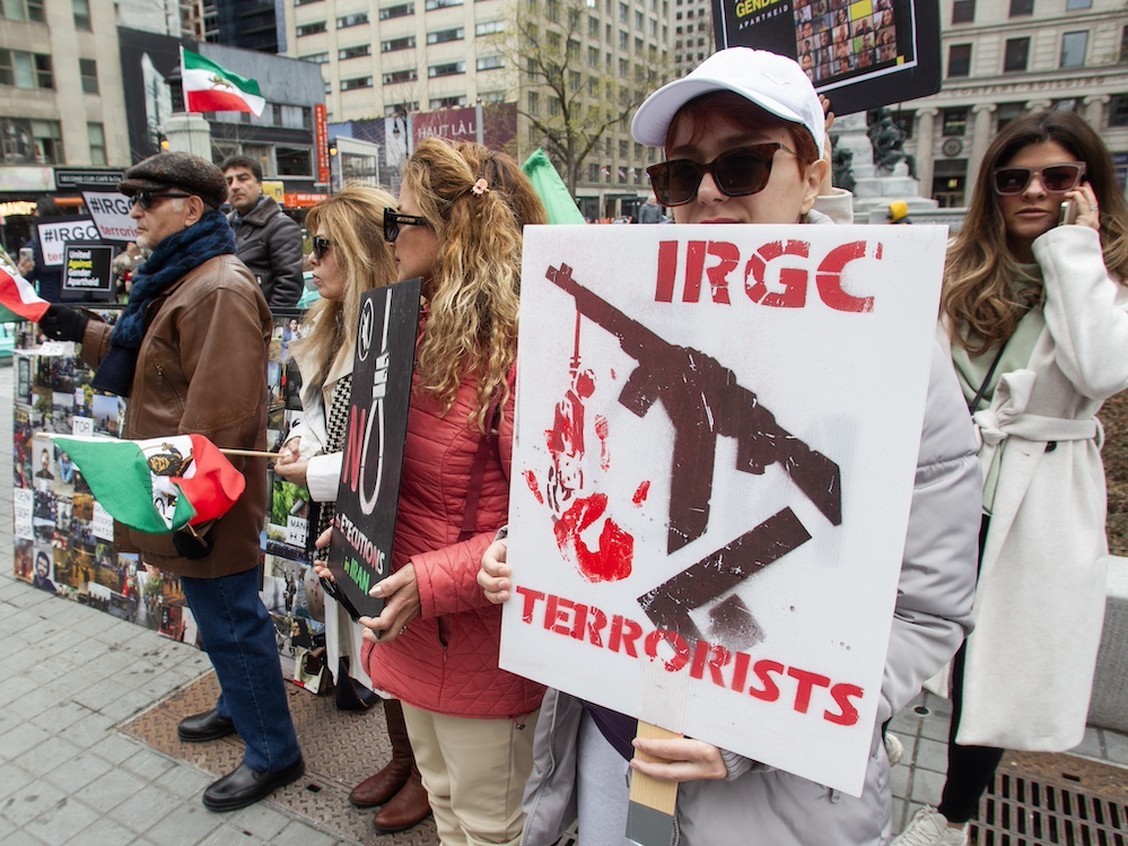
https://smartcdn.gprod.postmedia.digital/nationalpost/wp-content/uploads/2024/06/0620-na-IRGC.jpg?quality=90&strip=all&w=1128&h=846&type=webp&sig=Z028aDJyxHm6s5GMc0LzRw
People take part in a a protest against the Iranian government on April 21 in Montreal (John Kenney / MONTREAL GAZETTE)
 
In 1976 when Ayatollah Ruhollah Khomeini returned from exile in France to head a revolution that removed the Shah of Iran from power, in turn installing a theocratic regime with himself at its head, it was understood that a fundamentalist Islamist Shiite government had taken power in the country, with Khomeini as its Supreme Leader. Despite which, the extent of the reach of the Islamic Republic of Iran since that time in influencing Middle East affairs and international relations far afield might never have been imagined.
 
In the close aftermath of the revolutionary change in government in Iran, many Iranians knew they could not remain in their country of birth. From a fairly open society, with good international relations with non-Muslim countries -- including Israel -- the Islamic Republic was destined to become a divisive power broker in the Middle East. Under the ruling Ayatollahs and their Islamic Republican Guard Corps the intention was to restore Iran to its historical influence as the supreme regional power. 
 
In the predominately Arab Muslim Middle East, Iranians, though Muslim, are not Arab but Persians, the Aryans that Adolf Hitler was adamant were a superior 'race'. There is also a sectarian divide between Iran and the other Muslim countries of the Middle East which are majority Sunni Muslim, while Iran is Shiite, a relative minority. From its very inception in 1976 the Islamic Republic set out to gain a commanding influence within the Middle East, and to elevate the status of Shiite Islam. An unsubtle state of confrontation between Iran and Sunni Saudi Arabia ensued.

Iran's ambitions rose to challenge Saudi Arabia as custodian of the holy cities of Mecca and Medina in its aspirations to become the supreme Islamic authority commanding the Middle East. Iran's animus toward the Jewish State of Israel surpassed that of any Arab state by a wide margin. And Iran courted the disaffected populations of minority-status Shiites in Arab countries. The al-Quds division of the IRGC founded an Islamist Shiite group in Lebanon, training and arming it as a proxy militant arm it could control.
 
https://ichef.bbci.co.uk/news/1024/cpsprodpb/e6b7/live/13b0a610-2e75-11ef-ba8d-a9b9bfa74cb0.jpg.webp
The IRGC is a major military, political and economic force in Iran   EPA

Hezbollah came to world notice when in 1983 it undertook a truck-suicide bombing on an American military base, a marine corps barracks in Beirut against UN-affiliated peace envoys, killing 241 American soldiers. Another suicide bomber soon afterward killed 58 French UN-assigned paratroopers. This was Hezbollah, a newly-minted terrorist group, doing the bidding of its masterminds in Tehran. Since that time, Hezbollah has been a terror-creation of Iran, tasked to do its bidding, with a major focus on Israel, and on suicide-mission attacks abroad on Jewish enclaves.

 
There is also a Western infiltration component to the Islamic Republic's aspiration for dominance. Those Iranians who fled a revolutionary Islamist Iran they had no wish to live within, have found themselves, in the past decade, being targeted for their anti-Islamist, anti-Ayatollah, anti-terrorist attitudes. The Trudeau government in Canada has allowed the infiltration of Iranian agents and personnel, including senior leaders of the IRGC to have easy access to Canadian society at all levels, to enter on visas, to establish residency and to undermine the democratic freedoms of the Iranian expatriate population.
 
Their scheme in Canada, as it is elsewhere in the free world, is to destabilize all the institutions that make the West a free world, undermining the social and cultural values of nations of the West. Although Iranian-Canadians have made it clear to the Trudeau government that they have reason to fear the entry of representatives of the Iranian regime to Canada who intimidate and threaten them, the very fact that those involved in the most extremes of human rights abuses have entry to Canada is in and of itself inexcusable.
 
Finally, although all parties in Canada's Parliament have long supported a move to outlaw the presence of Iranian regime representatives in Canada, on a number of occasions voting unanimously to place them on a terror list and impose sanctions, the Trudeau government chose not to take appropriate action. Until last week, when it finally did. "Based on their actions, there are reasonable grounds to believe that the IRGC has knowingly carried out, attempted to carry out, participated in or facilitated a terrorist activity", explained the government's minister of public safety. Stating something that has long been known.
"This process of IRGC spreading its influence throughout the Western world has been going for a very long time, unfortunately, and they have been able to infiltrate many of our academic institutions, our professional institutions and they have been money-laundering [in Canada]."
"Everyone is looking for an assassination plot or something like that, and of course they do that, and they are known for it and their terrorist activities all over the world, but they have been infiltrating and interfering with our institutions for decades and in the past six years this has intensified."
"So it has been a huge disaster, in my view. In 2018, Parliament unanimously voted to immediately list the IRGC and I never heard any reasonable explanation from the Liberal government why they were dragging their feet. Something political has changed for them in terms of their calculation of the cost benefit of listing the IRGC."
Mojdeh Shahriari, Vancouver human rights lawyer

https://www.cfr.org/sites/default/files/styles/immersive_image_3_2_desktop_2x/public/image/2019/05/RevolutionaryGuards_0.webp
Members of the Revolutionary Guards attend a parliamentary session in Tehran. Atta Kenare/AFP/Getty Images

Labels: , , , , , , , , , , ,

 
()() Follow @rheytah Tweet