Ruminations

Blog dedicated primarily to randomly selected news items; comments reflecting personal perceptions

Saturday, June 27, 2026

Venezuela's Quake Rescues: "It's all Improvisation"

"There is no planning, it's all improvisation."
"This is a state that is lacking in security services to deal with this type of emergency."
"Our firefighters and first responders don't have the proper equipment." 
Vicente Villarroel, a former federal lawmaker from the city of La Guaira 
 
"With everything that has happened to Venezuela in the past few years, we thought that nothing worse could happen."
"But what has happened is a real catastrophe, a tragedy."
Javier, Barquisimeto 
 
"What motivates me to become part of this movement is the empathy I feel for all Venezuelans who have lost their homes, their families, their will to live because they have been left with nothing."
"I think, as Venezuelans, more than ever, we are united for different reasons."
"Many of us have families in the impacted zones, others do it from a desire to help, but in the end it's all the same objective."
Raquel Mercedes Contreras Manrique, president, student centre, University of Los Andes, San Cristobal  
https://i.cbc.ca/ais/847e09fc-3be2-4971-99e7-ba5590c3af35,1782524245139/full/max/0/default.jpg?im=Crop%2Crect%3D%280%2C711%2C1179%2C1443%29%3BResize%3D796
Raquel Mercedes Contreras Manrique, president of the student centre at the University of Los Andes in San Cristobal, packs donated supplies on Friday. (Submitted by Raquel Mercedes Contreras Manrique)
 
 A day ago, shortly after Venezuela was hit with two, back-to-back earthquakes President Delcy Rodriguez announced that at least 164 deaths and 971 injured had resulted at that point of reckoning. The U.S. Geological Survey which had pegged the temblors at 7.2-magnitude and 7.5 magnitude following, warned that "high casualties and damage are probable". The death count from the earthquakes has risen a day later, to 1,400 -- and counting. Two aftershocks were recorded; one of 4.5- and the other 4.4-magnitude, close to Caracas, the country's capital.
 
On the Richter scale, a 7.5-magnitude quake is almost twice as powerful as one at 7.2 magnitude. When they struck, one after the other, it took altogether 30 seconds that the ground wobbled after 6:00 p.m. on Wednesday. Glass from nearby windows fell to shatter on streets below. Los Palos Grandes, a seismic area of eastern Caracas was hit directly. Three buildings on one block, one of 13-storeys in height, collapsed. A state of emergency was declared. 
 
U.S. President Donald Trump wrote: "I have instructed all agencies of our government to get ready to move quickly. We will be there for our new and great friends. Early reports are not good." Emergency rescue teams have arrived from Venezuela's regional neighbours, El Salvador, Ecuador, Brazil and Chile, and other seasoned teams, including one from Israel and the much-storied and well-experienced White Helmets from Syria were also dispatched to do what they know best; rescuing those still alive in hazardous life conditions. 
 
https://i.cbc.ca/ais/1245454f-40ca-45dd-91ae-b7c7a150afdb,1782521318064/full/max/0/default.jpg?im=Crop%2Crect%3D%280%2C0%2C5472%2C3648%29%3BResize%3D796
Venezuelans have rallied to support their fellow citizens, some travelling hundreds of kilometres to join relief efforts. (Susy Peña/CBC)
 
The boundary between the Caribbean and South American tectonic plates is where the sequence occurred when two giant sections of the Earth's crust slid sideways past each other along a fault. That action released the massive energy that caused the quakes. A figure of 4,300 injured people was released, but is certain to rise as rescue operations continue. The number of those missing is also growing, while first responders and volunteers desperately search for survivors. Over 200 people are still trapped in the rubble with Venezuelans in a "race against time" to rescue them, amidst ongoing aftershocks.
 
The number of buildings that collapsed: 250 in all. Dozens of apartment buildings in La Guaira were shaken to the  ground. In many areas of the state heavy machinery is scarce; volunteers were forced to make use of whatever tools they could locate in hopes of carving through the collapsed concrete rubble. It was almost a full day that passed before government responders arrived to help dig through debris.
 
The main health facility, Jose Maria Vargas Hospital, saw injured people lying on thin mattresses outside on the ground of the hospital premises. Its emergency department was swamped with people presenting with all manner of injuries. Some of the patients held their IV drips aloft on their own. Across the country Venezuelans crowdsourced websites and social media in search of missing family members. Over 42,000 names with photos and descriptions were listed on one website alone. 
 
While first responders and volunteers worked amidst the collapsed buildings interspersed with rubble, family members waited in high suspense, for outcomes. The Altamira neighborhood of Caracas was one such venue. A rescue team searched the rubble, unable to use the equipment at hand because the electric generator wasn't responding. For that team even basic tools like hammers were not available. The government, in economic crisis, lacks the capacity to respond to such disasters.
 
https://i.cbc.ca/ais/db878755-391b-4d6a-8d36-8244abeac56d,1782586163538/full/max/0/default.jpg?im=Crop%2Crect%3D%280%2C0%2C5472%2C3648%29%3BResize%3D796
A building rocked by two earthquakes is seen Friday in the beachfront neighbourhood Playa Grande in Catia la Mar, a city in the Venezuelan state of La Guaira. (Susy Peña/CBC)


Labels: , , , , , ,

Tuesday, November 03, 2020

A Repulsive Terrorist Attack

A Repulsive Terrorist Attack

"During the last 24 hours, we arrested 14 people,. Now we will find out in the next days if he is part of a broader network or not."
"What we know is that he is a supporter of the Islamic State."
"We all know in our country this is not a fight between Christians or Muslims or Austrians and people from other countries."
Austrian chancellor Sebastian Kurz
 
"We have brought several special forces units together that are now searching for the presumed terrorists."
"I am therefore not limiting it to an area of Vienna because these are mobile perpetrators."
"[Several] heavily armed and dangerous [attackers are still on the loose with large parts of central Vienna shut down and sealed off in a manhunt]."
Austrian Interior Minister Karl Nehammer
Police cars and ambulances in central Vienna on Monday night.
"We are living in the compound of the synagogue. Upon hearing shots we looked down [from] the windows and saw the gunmen shooting at the guests of the various bars and pubs."
"The gunmen were running around and shooting at least 100 rounds or even more in front of our building."
Rabbi Schlomo Hofmeister, Stadttempel synagogue
 
"I was cleaning up and suddenly I heard shots. A lot of them, from a machine gun. I looked outside, someone ran past and probably shot someone in front of the synagogue."
"He was wearing a white jogging suit or something similar and he kept shooting."
Owner of a restaurant on the Seitenstettengasse, close to the synagogue
Screengrabs of footage appearing on various social media sites showing terrorist attack in Vienna, Nov. 2, 2020. Photo by Screengrab
The attack began at around 8:00 p.m. local time in a central area of Vienna, the Austrian capital. The country  prepared to go back into lockdown, and this night before lockdown, people were out in droves at local bars, hotels and restaurants on the street, in close proximity to the city's central synagogue. It was immediately assumed that the synagogue was the initial target. It might have been, no one can now interrogate the sole attacker, he is dead, one of five who died last night, the four others victims of Fejzulai Kujtim, a 20-year-old Austrian man from the town of St. Poelten, 33 miles west of Vienna. 
 
Immediately the attack began, bedlam prevailed. Six discrete sites were declared to be under attack, each by different gunmen, professionally organized and equipped with high-powered rifles, shooting at random, shouting out 'Allahu Akbar!' as they consigned total strangers to death in their mission to shock and terrorize, and likely avenge the Prophet Mohammad whose image had been mocked in neighbouring France, where two deadly knife attacks had just taken place in the past several weeks stemming from a French teacher using Mohammad cartoons illustratively in a middle-school class on civics and freedom of speech.
 
As the evening wore on it was assumed that the attacker, by then shot dead by police, had an accomplice, perhaps more than one, and whoever they were, they were escaping, armed and dangerous.  Police urged the population to remain indoors, sheltered, that danger stalked anyone unaware and vulnerable out in the open. Borders were closed, a massive search was launched for the co-perpetrator or perpetrators, the henchmen who had been involved in the murder spree alongside Fejzulai Kujtim.
 
Until, finally, it was determined that in all likelihood he had acted alone in a powerful frenzy of religiou-inspired fervour. There was no one else. He also happened to be a convicted felon, imprisoned on a charge of terrorism, he had attempted to leave Austria for Syria to join the Islamic State. While in prison he had undergone deradicalization training and was deemed by authorities to have passed with flying colours, earning him an early release from detention. Presumably, Austrian security is too man-short keeping tabs on its identified extremists to fully cover them all and obviously Eajzulai Kujtim, as a public threat, was overlooked.
 
He had succeeded in wounding another 15 people, among them a police officer, with seven of the total wounded remaining hospitalized in critical condition.Not that the manhunt for possible Islamist collaborators is over; thus far 14 people have been investigated as possible conspirators with the attacker, and are in custody while their suspected links to the atrocity are being probed. The witnesses too were convinced that a number of attackers were involved, steering their excited narratives.
 
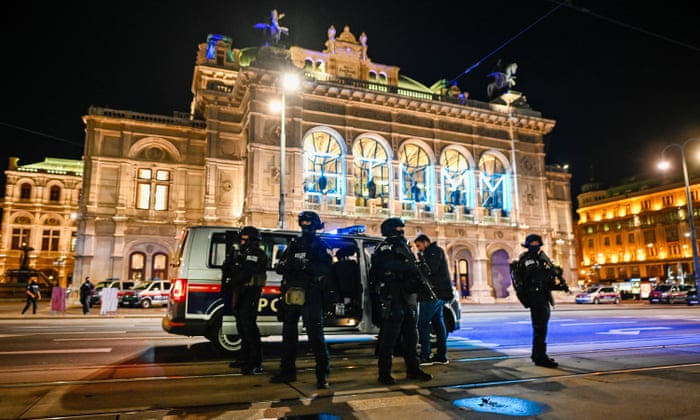
Armed police stay in position at the scene of the attack in the Austrian capital.
Armed police stay in position at the scene of the attack in the Austrian capital. 
 
Last night the Vienna police tweeted an alert to the general public: "There are several injured persons. We are on site with all available forces. Please avoid all public squares in the city". The army, assured Austrian Chancellor Sebastian Kurz, would see to the protection of vulnerable capital sites leaving the police to focus on anti-terror operations. Today is another day. There have been other revelations, chief among them that this was a sole-actor terrorist event. There was but one active shooter. A man with Macedonian-Austrian citizenship, although he was born in Austria.

An empathetic and terrorism-seasoned French President Emmanuel Macron gave his full and unstinting support to Austria; it is debatable whether the compliment had been initiated in reverse weeks earlier. "This is our Europe. Our enemies must know with whom they are dealing. We will not retreat", stated President Macron, of the destructive malevolence of the extremist Islamists harbouring in safety in progressive-minded Europe.

In Austria, as in the United States, private gun ownership is fairly high, though not in competition with U.S. numbers. Although Austria has of late not been the recipient of large-scale terrorist attacks such as Paris, Berlin and London have been vulnerable to in recent years, in August a 32-year-old Syrian refugee was arrested, suspected of trying to attack a Jewish community leader in Graz, one of Austria's larger cities. 
 
Armed police stand outside the Vienna State Opera amid a terrorist attack in the Austrian capital. Photograph: Michael Gruber/Getty Images    


Labels: , , , , , ,

 
()() Follow @rheytah Tweet