Blog dedicated primarily to randomly selected news items; comments reflecting personal perceptions
Wednesday, April 15, 2026
Cancer Statisics for 2026 in Canada
"[Projected estimates] underscore the substantial impact cancer will continue to pose in Canada [in 2026]."
"Since the early 2000s, the incidence of pancreatic cancer has bee moderately increasing while no progress has been made in reducing mortality rates."
"Pancreatic cancer is expected to remain the third-leading cause of cancer-related death in 2026, with a similar number of males [3,400] and females [3,100] expected to die from the disease."
Research report, published in the Canadian Medical Association Journal
Doctors say
Canada is facing a silent health crisis of HPV-related cervical cancer
that could be prevented if more people got vaccinated against human
papillomavirus, the virus that can cause the disease. Still from video, CBC
A mix of 'good' and 'bad' news comes out of a newly-published study on the state of cancer in Canada, anticipating that diagnoses and mortality are expected to remain at 'high levels' in 2026. Survival rates are improving for a number of cancers, yet emerging trends for other types of cancer give cause for concern. The report's authors point out that at some point in their lives, close to half the country's population (42 percent) is forecasted to be diagnosed with some form of cancer.
To put it more plainly; an estimated 254,100 individuals will be diagnosed with some kind of cancer, while from among that number 87,900 will die in 2026, as an outcome of their cancerous condition. Lung, breast, prostate and colorectal cancers are identified as the most potentially diagnosed cancers; within that group, 47 percent of all cancers account for new cases estimated to be diagnosed throughout 2026. The third most common cancer killer behind lung and colorectal cancer has been named as pancreatic.
Higher risk of pancreatic cancer has been linked to excess body size; 49 percent of Canadian adults measure a waist circumference -- and abdominal fat -- that raises risk of pancreatic and other cancers, according to Statistics Canada. The incidence and death rates for colorectal cancer, common among both men and women, continues to fall, possibly as a result of increased screening related to colonoscopies and stool sample tests begun in the early 2000s. Incidence rates have diminished by 32 percent in men and 29 percent in women since then, given "the removal of pre-cancerous lesions and earlier diagnoses", along with improved treatments. Concerns have been raised, however over under 50s being increasingly diagnosed with colorectal cancer.
Lung cancer is expected, as the deadliest of all cancers for men and woman, to take 19,200 lives in Canada in 2026. Lung cancer rates and deaths have been on the decline for males, only more recently among women when historically males were more susceptible to lung cancer, suffering greater deaths than women; a gap that has since been narrowed "over the last 40 years". In 2026, a greater number of women than men are in line to be diagnosed with lung cancers. "A higher proportion of lung cancers among females are not explained by tobacco consumption", according to the report, suggesting there are risk factors that have yet to be addressed and studied.
Radon gas is invisible, toxic & lurks in Cdn.homes
Exposure to radon -- a radioactive gas that cannot be seen or smelled -- is the second-leading cause of lung cancer in Canada, according to Statistics Canada; as well as the leading cause of cancer onset in non-smokers. Some one in five people in Canada live in homes posting radon levels at or above the guidelines, as reported by a national radon survey.
Cancer remains the leading cause of death, accounting for 26 percent of all deaths in 2023 in Canada, also the leading cause of premature death especially for women. Among a number of 'concerning trends' is the rise of uterine and cervical cancer, following decades of decline. It has now risen "well above the World Health Organization's elimination target" of less than 4 cases per 100,000 women, while increasing among younger females. It is almost always caused by the HPV virus for which a vaccine is available, making it preventable.
Colorectal cancer screening
In the same token, the incidence of uterine cancer is expected to reach a state 53 percent higher in 2026 than two decades earlier. Rising rates of obesity and women having fewer or no children, or delaying childbirth until they are older than what was previously the case. "The total number of cancer cases and deaths are expected to remain at high levels" resulting from the country's growing elderly population, wrote the researchers.
"On its own, lung cancer is expected to account for one in 5 cancer-related deaths in 2026."
"A higher proportion of lung cancers among females is not explained by tobacco consumption."
"[Canada's population grew by about 9.5 percent between 2020 and 2025, primarily due to immigration], and continues to age, with a record percentage (19.5 percent) of people aged 65 and older in 2025 [where the risk of cancer is elevated with age]."
"[Advances in treatment translates to] a rapidly growing population of people living with and surviving cancer."
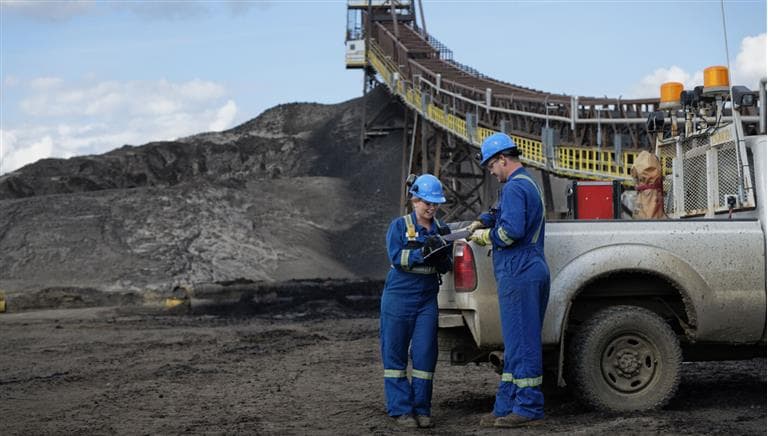
"Suncor, a large company, is continually looking at quality control and improvement and yet there continues to be tragedies."
"So what happens to the small employer who doesn't have the same resources as a Suncor? There's more and more promotion around workplace safety so what is that puzzle piece that we're missing?"
"If a worker sees something that they feel is unsafe, they have to feel free to bring that to their supervisor. [Many workers are still reluctant to be the] squeaky wheel."
"And if they're not being heard, they have to have the confidence to step aside -- or, if necessary, leave their job. But that is hard to do."
Shirley Hickman, founder, executive director, Threads of Life
Suncor Canada
Shirley Hickman's son Tim, almost 22 years old, working part-time for the City of London, Ontario in March of 1996 was fatally injured in an arena explosion. It is her belief that many organizations still struggle with embedding safety in their workplace culture. The rules may be there and procedures written and accessible, but nothing seems to stop shortcuts on the job.
In 2011, Wynny Sillito of Calgary was a 23-year-old paramedic with a team responding to reports of an accidental chemical release at an oil and gas site near Grande Prairie, Alberta.She was exposed and suffered chemical burns all over her upper body while attempting to come to the assistance of the worker who had been injured on the call her team was responding to. She recovered physically from injuries sustained but was diagnosed with post-traumatic stress disorder that has lingered to this day.
"You don't have to be the one who loses a limb or loses a piece of themselves to have your life forever changed." "Oil and gas is this big, broad industry and so many people are connected to it in some way."
"Every time there's a fatality, it doesn't matter what caused it -- anyone who loves someone who works in oil and gas will end up feeling that stress."
Wynny Sillito, Calgary
Canada has some of the most stringent occupational health and safety laws in the developed world. Despite which workplace accidents and deaths have seen no meaningful decline over the years. This, in view of ever-increasing awareness campaigns, improved technology and corporate protocols. In 2008, 1,035 workers died of work-related causes in Canada according to statistics from the Association of Workers' Compensation Boards of Canada.
On average, since then, 945 workers have died from workplace injuries or illnesses yearly in the country. One of those victims was Kevin Grocutt, 40, who had been working for ten months as a heavy duty mechanic contracted to Suncor Energy Inc. The broken-down haul truck he was attempting to repair rolled, catching him under a tire.
"I often hear people say 'Oh, with new technologies, we must be seeing these numbers go down'. But we're not."
"When we look at it over time, we're seeing these numbers either stable or increasing"
Alyssa Grocutt, 11 years old when her father was killed, is now working toward her doctorate at Queen's University researching the impact workplace injuries and fatalities have on the family of the victim, on colleagues, and supervisors.
A high-profile number of workplace deaths have occurred in recent months at Suncor with resulting criticism of the company by U.S.-based activist investor Ellott Investment Management. The Calgary-based company has had at least a dozen fatalities at its oilsands facilities in northern Alberta, accounting for a greater number of fatalities than all of its industry peers combined. The company's former CEO pledged to address the problem.
An independent safety review was carried out for Suncor. The resolve was to cut these accidents out of the workplace environment. Those efforts were deflatd when anothr Suncor contract worker died on the job in July. The CEO resigned the following day.
Alyssa Grocutt poses with pictures of her father Kevin who died when she
was 11 years old in a workplace accident at Suncor Energy Inc., in
Kingston, Ont. (Lars Hagberg/The Canadian Press)
"Oil and gas is this big, broad idustry and so many people are connected to it in some way. Every time there's a fatality, it doesn't matter what caused it -- anyone who loves someone who works in oil and gas will end up feeling that stress."
"It's hard hearing of another fataiity, especially when it's in a similar location to where my dad was."
"Some are even in similar situations. Always I think about the families that are left behind and also the co-workiers who had to witness it."
"Based on a comparison of coronavirus deaths in 210 countries relative to
their population, Peru had the most losses to COVID-19 up until April
26, 2022. As of the same date, the virus had infected over 510.2 million
people worldwide, and the number of deaths had totaled more than 6.2
million."
"Note, however, that COVID-19 test rates can vary per country. Additionally, big differences show up between countries when combining the number of deaths against confirmed COVID-19 cases."
"The source seemingly does not differentiate between "the Wuhan strain"
(2019-nCOV) of COVID-19, 'the Kent mutation' (B.1.1.7) that appeared in
the UK in late 2020, the 2021 Delta variant (B.1.617.2) from India or
the Omicron variant (B.1.1.529) from South Africa."
Statista
Performing last rites before the cremation of a family member who died of COVID-19 in India.
Anupam Nath/AP
According to new research out of the World Health Organization, a newly-issued report concludes that official data accounting for the number of people who have died resulting from COVID infections are a third of the actual numbers. The WHO presents this latest report as representing the most comprehensive study at the actual toll globally of the pandemic to date. Their study team expressed confidence in the accuracy of a total listing 14.9 million excess deaths to the end of 2021.
In that period, from January 2020 to the end of December 2021, the official count directly attributable to COVID reporting to the WHO numbered just over 5.4 million. In the WHO's accounting, excess mortality figures include those who died ofCOVID-19 along with those who died indirectly resulting from the outbreak. Encompassing people unable to access health care to treat other conditions when hospitals were overwhelmed during the waves of pathogenic infection.
Included were those deaths that would normally have occurred during the pandemic but did not; ie., owing to lower risk of traffic accidents taking place during lockdowns. Deaths missed in countries lacking adequate reporting account for lower official numbers being reported, according to the WHO. They pointed out that under-reporting did not arrive exclusively with COVID, but represented a situation where an estimated six in ten deaths globally failed to be registered officially, overall.
Close to half of the globally numbered deaths, it is now suggested, occurred in India with the report suggesting that 4.7 million people died there as a result of the pandemic, mostly in the May and June 2921 surge. The Indian government's official figure is put at 480,000 in the period January 2020 to December 2021, finding fault with the calculation methodology utilized by the WHO study.
It must also be borne in mind that India has an immense population of 1.3 billion, right behind China's 1.4 billion. Beijing's figures for COVID-related deaths would be hard to come by. Even given its comfortable relations with the WHO, China prefers to keep such data from prying international eyes. It is also notable that the United States, with an official death rate of 991,000 and 81-million infections, has a population about one quarter the size of India's; their numbers fairly well match.
Relatives carry a body for cremation past corpses
partially exposed in shallow sand graves. In May, rains washed away the
top layer of sand at a cremation ground on the banks of the Ganges River
in Shringverpur, India. Ritesh Shukla/Getty Images
Comprised of international experts working for months amassing data, the WHO panel made use of a combination of national and local information, along with statistical models to estimate totals when dealing with incomplete data. Independent assessments also place the Indian death toll higher than the official government tally. A report published in Science suggested three million people could have died of COVID in India. While other models reached similar conclusions regarding the global death toll, higher by far than the recorded statistics.
A large study in the United States found the Omicron variant of the SARS-CoV2 virus to be intrinsically as severe as previous variants, whereas the assumption has been that Omicron, reflecting previous studies, was more transmissible, yet less severe. "We found that the risks of hospitalization and mortality were nearly identical between periods", was the consensus of the four scientists who conducted the study.
Previous studies assuming Omicron to be less threatening in severity took place in a number of areas including South Africa, England and Canada. The current study undergoing peer review at Nature Portfolio, posted on May 2 on Research Square, was adjusted for confounders (demographics, vaccination status and the Carlson comorbidity index) predicting risk of death within a year of hospitalization for those with specific comorbid conditions.
"It seems that the Oxford-AstraZeneca vaccine initially induces higher levels of T-cells than the mRNA vaccines."
"These T-cells are important for long-term immune memory and also for inhibiting virus replication and killing infected cells once an infection becomes established."
"Since the AZ vaccine is slightly better at inducing these T-cells, the implication is that it may provide longer-term protection against hospitalization and death."
"I think this is the point that Dr.Soriot was making."
Eleanor Riley, professor of immunology and infectious disease, University of Edinburgh
A woman receives her covid-19 vaccination booster jab, London, UK Leon Neal/Getty Images
The chief executive of AstraZeneca, Pascal Soriot on Tuesday responded to a puzzle that scientists are mulling over. That while the defences of Europe are crumbling against COVID-19 with steadily mounting infections and deaths related to the coronavirus, Britain in contrast is managing to keep its serious cases relatively low in both hospitalizations and resulting deaths. The explanation he offered was that the Oxford vaccine produces a more durable T-cell response, which could be what is ensuring that older people in Britain are safer than their continental counterparts in the prevention of hospitalization and death.
Cases remain high in Britain, the country is struggling just like other parts of Europe, with rising numbers but hospitalization and death appears under a firmer control than elsewhere. The AstraZeneca vaccine has been hugely unpopular in Europe, viewed with great suspicion. Leading to France, Germany, Spain and Belgium restricting its use to those under 65 in the early roll-out stage. Suspicion was aroused that there was insufficient data to ensure it was effective in older people.
Now, Dr.Soriot suggests that data demonstrate the AstraZeneca shot offers long-term protection, with a response that appears more durable than the mRNA vaccines produced by Pfizer and Moderna. The data of which he speaks is not yet published and has not as a result been reviewed by any outside sources for whom it would be of consuming interest. T-cells, without a shadow of a doubt, have an important role to play in protection against COVID. Antibodies wane over time, but T-cells remain able to trigger powerful immune responses, and to directly destroy infected cells, as well to work against new variants.
Closed Christmas stands in the city centre, Vienna, Austria. Lisa Leutner/AP/Shutterstock
The University of Birmingham in April found five weeks following a first dose people over 80 given AstraZeneca or Pfizer showed similar antibody responses. In the AstraZeneca group, double T-cell response was observed. Along with the strength of the T-cell response held to be three times higher than for the Pfizer group. Oxford University researchers found, in mid-June a still robust T-cell response from AstraZeneca doses at six months that even with a single dose; antibody immunity drops aside.
Scientists from Oxford and Switzerland in July concluded that long-term immunity could be greater for adenovirus vaccines like AstraZeneca resulting from "cellular training camps" for T-cells that they create. On the other hand, in the long term, mRNA vaccines also produce strong T-cell responses, perhaps more so than AstraZeneca, according to more recent research. A new paper published in Nature found Pfizer produced close to a six times greater number of T-cells than AstraZeneca, some 18 to 42 days following the second dose.
Data collected in real-world situations consistently indicate that the mRNA vaccines gain a slight improvement in prevention of infection and avoidance of serious disease than does AstraZeneca, an inconsistency with claims better protection is provided by the Oxford vaccine. Another interpretation of the situation could be that Britain has had so much recent infection that COVID is near to becoming an endemic virus. In the United Kingdom the booster program began earlier so that at present over 12 million adults now have had their third, 'booster' dose, which is recognized as having prevented tens of thousands of deaths.
A wall in London commemorates people who died of COVID-19.Credit: Toby Melville/Alamy/Reuters
"It's a good vaccine. But it's not an mRNA vaccine, and we have approved it."
"It's not a bad idea, as long as you have an honest conversation with people about what the risks and benefits are, and one of the risks, of course, is a pretty severe blood-clotting event."
"If it would get more people vaccinated, and people can make an informed decision, I think it would be really wise to have an alternative, if people wanted it."
Dr.Isaac Bogoch, infectious diseases specialist, Toronto
"Your body doesn't have the cellular machinery to reverse from RNA to DNA. It's kind of like speculating you can flap your arms and fly without feathers."
"[All vaccines authorized in Canada are] really, really good. Humans are made of twisted timbers. [Some say the technology is] too new [though researchers worked on it since the 2003 SARS-1 outbreak]."
"There's always an excuse for hesitation that can be built around any technology. I just see this as the latest in that long history."
Dr. Amir Attaran, professor of law and health policy, University of Ottawa
(Dirk Waem/BELGA/AFP via Getty Images)
A desperate solution is sought to an impasse between health authorities and the millions of Canadians still uncertain, along with hard-core anti-vaxxers who refuse to be inoculated against COVID-19 imperilling plans to vaccinate sufficient numbers of eligible people to produce the hoped-for 'herd-effect' that would neutralize the menace of contagion by SARS-CoV-2 causing COVID. Those in government who rely on the professional advice of medical experts see agreement that the one-shot Johnson & Johnson vaccine might fill part of the vacuum.
In Saskatchewan and Alberta, the two western provinces of Canada with the lowest vaccine uptake rate and the commensurately higher infection rate hope is that in offering the Janssen single-shot those who are hesitant might be convinced to being vaccinated. The J&J vaccine is a viral vector like AstraZeneca. The National Advisory Committee on Immunization had advised in May that Pfizer and Moderna represented preferred vaccines in view of a rare risk of a blood-clotting disorder.
Following that, thousands of AZ appointments were never met, attributed to news reports of its potential side effects. March saw authorization of the Janssen vaccine and months later the government of Canada announced its donation of ten million unused doses to low-income countries in view of plentiful supplies of Pfizer and Moderna with little demand for any other vaccine. Offering the J&J single-shot vaccine is a gamble, with uncertainty over how many people will express interest in "a vaccine but not an mRNA" vaccine.
Johnson&Johnson, however, recently recommended a booster shot, in other words a second dose, to increase antibody levels. Blood-clotting potential in these vaccines is a concern. Thrombosis with thrombocytopenia syndrome causes unusual blood clotting and low platelet levels in blood which increase risk of strokes or heart attacks. U.S. data reveal an estimated one in 300,000 people vaccinated with Janssen's COVIDvaccine have the potential to develop TTS in comparison to one in 100,000 with AstraZeneca.
mRNA vaccines on the other hand, are not seen to risk TTS events. Which hasn't stopped misinformation that mRNA vaccines have the potential to modify DNA, permanently altering people's attributes, including causing sterility in women. That Pfizer and Moderna make use of genetically engineered messenger RNA instructing body cells in producing spike protein that SARS-CoV-02 uses to latch onto and invade cells makes people suspicious of its supposed intrusion into other areas of cell integrity.
J&J has been used in the U.S. to vaccinate 15 million Americans, where the largest concerns motivating the unvaccinated to become inoculated against COVID have been, understandably, rising hospitalization rates and death rates, according to the Kaiser Family Foundation. According to Health Canada -- of 15,090 reports of adverse events after vaccination representing 0.029 percent of all doses administered, 4,288 (0.008 percent of all administered doses) were rated to be serious complications.
Some Albertans are demanding access to the Johnson & Johnson vaccine
for faster access to full immunity - particularly now the province has
adopted an opt-in vaccine passport system. (Christophe Gateau/dpa/The Associated Press)
"I think burnout and trauma looks like dreaming about those deaths or seeing those faces [of former patients who died]."
"When I heard 34 deaths [in Alberta, Wednesday], that's what triggered it. I heard, oh my goodness, so many deaths. Now I'm remembering every -- every-- story that I could remember."
"What bothers us -- or torments us, I guess -- is that these patients often are alone, and nobody should die alone. But it's also difficult that we have the volume that we have -- you can't be with every single patient."
"I think more and more physicians, particularly, and health-care workers are speaking about how they're feeling, how exhausted they're feeling, and there's some comfort in that -- misery likes company."
"You feel better that you're not the only one going through it."
Dr.Neeja Bakshi, internal medicine ward, Royal Alexandra Hospital, Edmonton, Alberta
"What's become really clear is it's really the people, the workforce, that becomes a critical issue."
"It's been tough on morale and people are tired, lots of people are off, being burnt out, and such and it's put a lot of demand on the people that are here."
Dr.Paul Boucher, intensive care, president, Alberta Medical Association
"By the time they come in to us they're so sick that they just can't focus on anything other than just trying to stay alive. This one is hitting us hard and fast every time we turn around and we can barely keep up with the patients."
"Right up to the point where we're saying 'Listen, we're getting to the point where we're going to have to put a breathing tube into you', they're denying that they have COVID."
"Part of that denial is what's bringing them in so sick in the first place, because they've spent so much time at home trying to ignore the fact they're sick."
Carlene Cooke, emergency room nurse, Royal Alexandra Hospital, Edmonton
"Every time there's been a wave, the ICU becomes increasingly more involved."
"Pretty much anybody, when you come to ICU, you're scared. That's a bad day. So they're unhappy."
"The families, they're fearful, too, no matter what the situation is, and it's made worse by the fact they can't visit."
Dr.Erika MacIntyre, Edmonton Zone Medical Staff Association president, intensivist and respirologist, Misericordia hospital, Edmonton
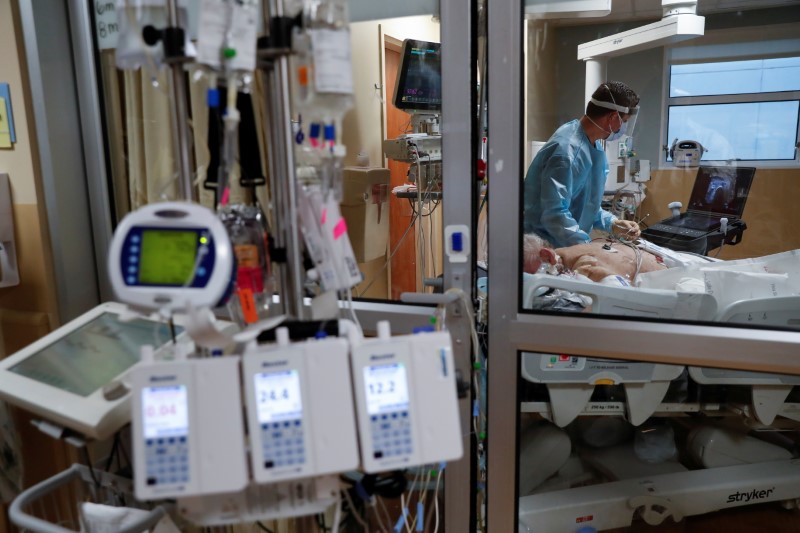
A staff member works in an Alberta hospital ICU during the COVID-19
pandemic. On Wednesday, there were 1,084 people being treated for COVID
in hospital, 268 of whom were in intensive care beds. (AHS)
Of all of Canada's provinces, Alberta is facing the most extreme episodes of hospitalization and deaths due to the Delta variant of COVID, and the fact that it has the highest rate of vaccine rejection among its population, particularly in rural areas. Anti-vaxxer pushback against government and medical authorities' efforts to convince Albertans that the contagion will ebb only when enough people are vaccinated fall on deaf ears. And these are the very people, most vulnerable in the province, who are clogging the health-care system.
A shocking 34 COVID patients died on Wednesday alone, in Alberta representing the highest death toll due to the SARS-CoV-2 virus since the pandemic began, to take place within a 24-hour stretch. The internal medicine ward at the Royal Alexandra Hospital is where patients are admitted for treatment when they're not yet sufficiently ill to be transferred to the intensive care unit. The former is where patients are told to lay on their stomach, to heave deep breaths, to walk if they can manage it, in an effort to assist the body fighting off the disease.
There are 1,084 people in Alberta Hospitals, according to provincial statics, 268 of whom are now fighting for their lives in intensive care units. The total number of active cases stands at 20,306 in the province where its premier, Jason Kenney speaks of it as a "crisis of the unvaccinated". Seriously ill patients unable to be accommodated in COVID-crammed hospitals have been air-lifted elsewhere, to other provinces willing to take them because their hospitals are in a less parlous state.
Hospitals in Alberta with cases rising since mid-August, are on the verge of implementing a triage protocol which would lead to doctors having to determine who would receive hospital treatment and who would be turned away in a situation where, over the past two weeks, case rates are escalating in rural areas and among school-age children. Modelling predicts that cases will peak some time around mid-October, leaving hospitals expecting at least another two weeks of continuing pressure on their services.
The crisis is multi-faceted given the reality of a space crisis with patients requiring beds, ventilators, oxygen. Multiple patients are placed together per room doctors and nurses applying their skills in cramped spaces checking on patients keeping up with increasing rates of vital signs reflecting the unpredictability of the virus. All that being a given, the crisis's real and most serious shortage is medical personnel. Morale among medical staff is low, and there are fears that the strain will lead ultimately to people leaving their jobs and their profession.
What strikes doctors on the front lines is not quite only the number of increasing mortalities, but that this is an illness that is preventable, and those who succumb to it without taking the most basic of precautions -- inoculation -- present at hospital seriously ill. And then there is the crux of the problem; misinformation absorbed by people refusing vaccines, demanding instead alternative treatments such as ivermectin, the anti-parasitic many are led to believe represents an effective COVID treatment.
"The ones that are really gung-ho about sometimes refusing intubation, demanding ivermectin, for example, and really not accepting the diagnosis of COVID, those are very, very rare circumstances, but because they're so extreme they're really the ones that stand out."
"You can see the emotional drain that everybody has been facing. The physical exhaustion of managing these patients, managing the current environment in terms of ongoing staff shortages, and people working harder than they normally would be working."
Dr.Shazma Mithani, intensive care unit, Royal Alexandra Hospital, Edmonton
Bernie
Cook was hesitant to get the vaccine when he caught COVID. His sickness
gave him first-hand experience through one of Alberta's crowded ICUs.
Now he's warning others to take action to avoid the same fate. CBC
Stress and Strain in the U.S. Medical System With the Delta Variant of COVID-19
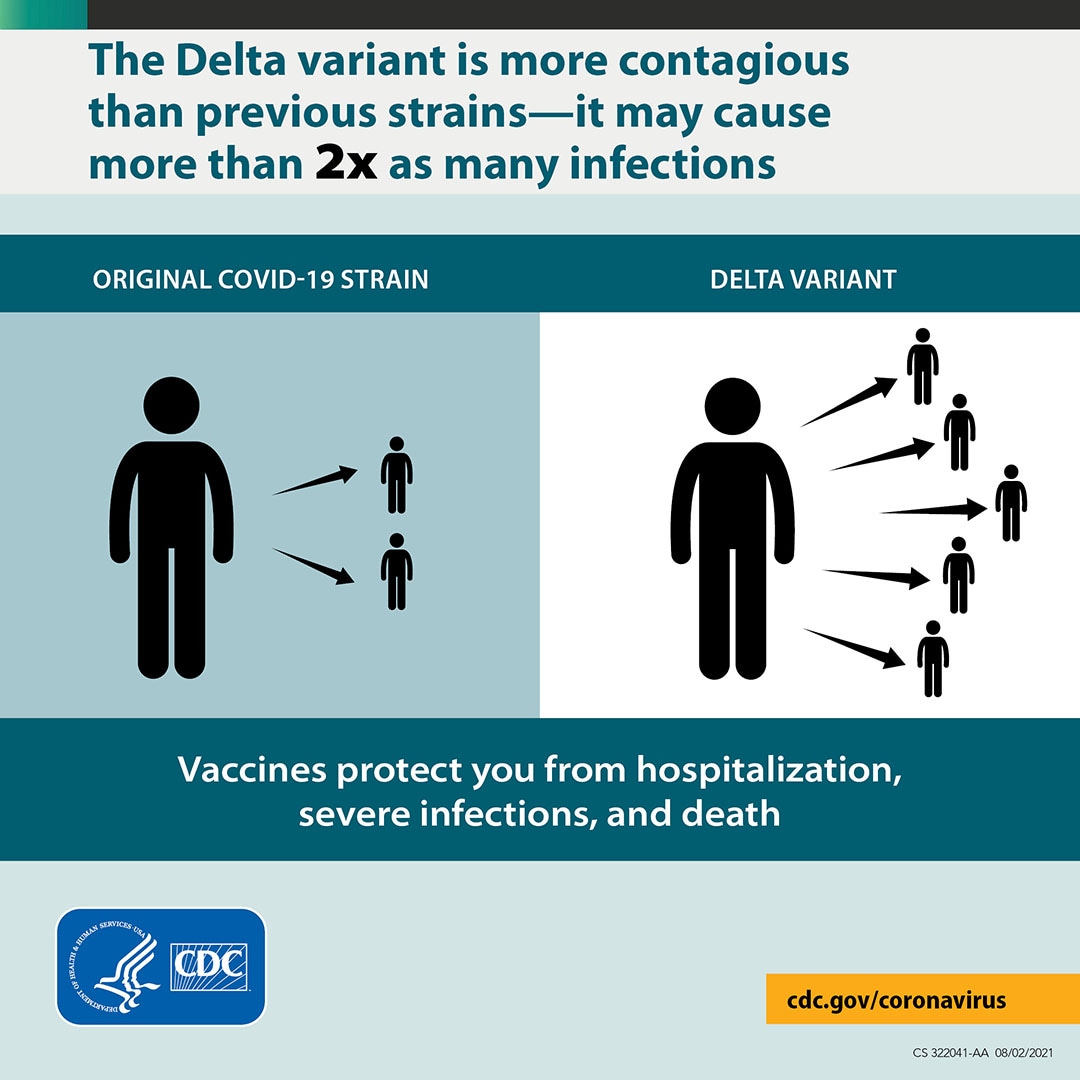
The Delta variant causes more infections and spreads faster than early forms of SARS-CoV-2
The Delta variant is more contagious: The Delta variant is highly contagious, nearly twice as contagious as previous variants.
Some data suggest the Delta variant might cause more severe illness than previous strains in unvaccinated persons.
In two different studies from Canada and Scotland, patients infected
with the Delta variant were more likely to be hospitalized than patients
infected with Alpha or the original virus strains.
Unvaccinated people remain the greatest concern:
Although breakthrough infections happen much less often than infections
in unvaccinated people, individuals infected with the Delta variant,
including fully vaccinated people with symptomatic breakthrough
infections, can transmit it to others. CDC is continuing to assess data
on whether fully vaccinated people with asymptomatic breakthrough
infections can transmit. However, the greatest risk of transmission is
among unvaccinated people who are much more likely to contract, and
therefore transmit the virus.
Fully vaccinated people with Delta variant breakthrough
infections can spread the virus to others. However, vaccinated people
appear to be infectious for a shorter period: Previous variants
typically produced less virus in the body of infected fully vaccinated
people (breakthrough infections) than in unvaccinated people. In
contrast, the Delta variant seems to produce the same high amount of
virus in both unvaccinated and fully vaccinated people. However, like
other variants, the amount of virus produced by Delta breakthrough
infections in fully vaccinated people also goes down faster than
infections in unvaccinated people. This means fully vaccinated people
are likely infectious for less time than unvaccinated people. Centers for Disease Control and Prevention
"We saw the largest single-day increase in hospitalizations and have
eclipsed our previous high of COVID hospitalizations,"
"There are currently only eight ICU
beds available in the state."
Arkansas Governor
Asa Hutchinson
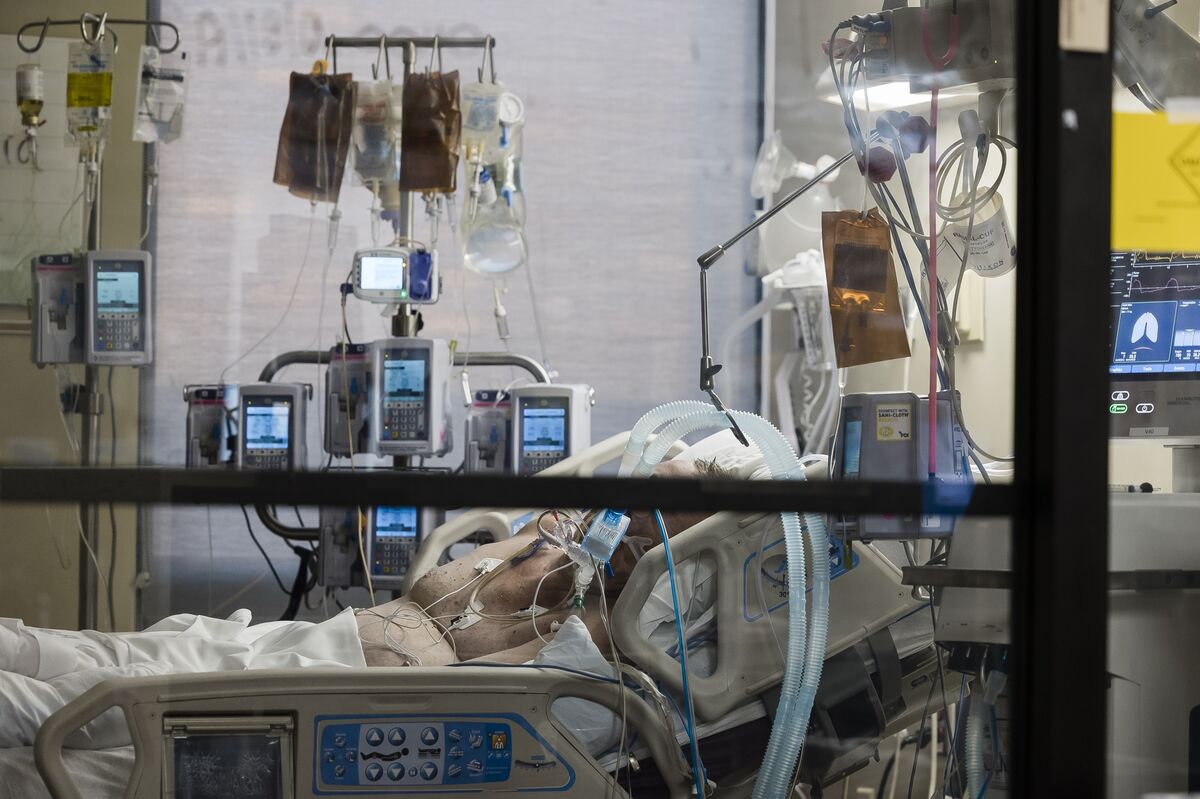
An intubated patient inside a negative pressure room in the Covid-19 ICU at a hospital in Joplin, Missouri, on Aug. 3.Photographer: Angus Mordant/Bloomberg
The United States, which suffered the worst case load, hospitalization and death rates of any country, undertook a massive vaccination campaign to reduce the malignity of the SARS-CoV-2 virus and the first wave abated to the point where a sigh of collective relief relaxed the overall vigilance against the infectious and sometimes-deadly virus causing COVID-19. The horizon looked brighter everywhere until the virus began producing variants of the original strain that promised to be more infectious, slightly resistant to vaccines and producing more serious outcomes.
One of those variants is the Delta strain which certainly turned out to be more communicable in a population and this is the strain that has been wreaking havoc in a return wave of COVID all over the world. In the U.S., a six-month high of new cases is being realized, thanks to the rapid spread of the variant, all the more in those areas of the country where low vaccination uptake has taken place. COVID cases now average 100,000 nationwide three days following each other, an increase of 35 percent over the week before.
A nurse prepares to enter a room to treat a patient in the Covid-19 ICU ward at a hospital in Jonesboro, Arkansas, on Aug. 4. Photographer: Houston Cofield/Bloomberg
The state of Arkansas has the misfortune of representing the greatest number of fatalities by population in a nation where a rise of 40 percent has been seen in hospitalizations -- and deaths registering an increase of 18 percent. Records for hospitalization were set in Florida over an eight-day period. The second-largest teaching union in the country announced it is backing mandated vaccinations for American teachers with a view to protecting students too young for inoculation.
The reason for that precaution is obvious enough, seeing that the number of children with COVID-19 being hospitalized is rising country-wide, representing a trend which, according to health experts recognizes the Delta variant as more likely to infect children, as opposed to the original Alpha strain of the virus. The reduction in cases overall in the country in late spring into summer led to pressure to ensure that parts of the population remaining uncertain or uneasy or reluctant to be vaccinated, is gaining momentum.
California, New York and Virginia have mandated vaccinations for their populations; failing that, that weekly testing be undertaken for state employees. Several cities have stood out for their firm position requiring municipal employees to be vaccinated for the public good. New rules were set out last month by the Biden administration that federal workers must provide proof of having been vaccinated, or alternately undertake regular testing, while a mask mandate has been reimposed, along with travel restrictions.
A critical care respiratory therapist works with a coronavirus disease (COVID-19) positive patient in the intensive care unit Reuters
Private enterprise is also choosing to become involved, mandating COVID-19 vaccinations for their employees. Large national employers like United Airlines, Tyson Foods Inc. and Microsoft are among those corporations mandating vaccination for their employees. Large-scale events have been cancelled, although some events plan to carry on -- like the small town in South Dakota, where the annual Sturgis Motorcycle Rally is set to carry on as usual, preparing to welcome hundreds of thousands of motorcycle enthusiasts.
"There are about 13 million children born each year in various areas of Africa that could really benefit from the malaria vaccine."
"There are three doses per schedule and a booster dose so 200 million [the number the pharmaceutical manufacturer in India has agreed to produce yearly] is a very good number."
"That's a real technical challenge. The vast majority of vaccines haven't worked because it's very difficult."
"[However the trial results meant the vaccine was] very deployable [and] has the potential to have a major public health impact."
Adrian Hill, director, Jenner Institute Oxford University
"[The results were] very exciting [and showed] unprecedented efficacy levels".
"We
look forward to the upcoming 'phase III' trial to demonstrate
large-scale safety and efficacy data for a vaccine that is greatly
needed in this region."
Halidou Tinto, professor in parasitology, principal trial
investigator, Clinical Research Unit of Nanoro, Burkina Faso
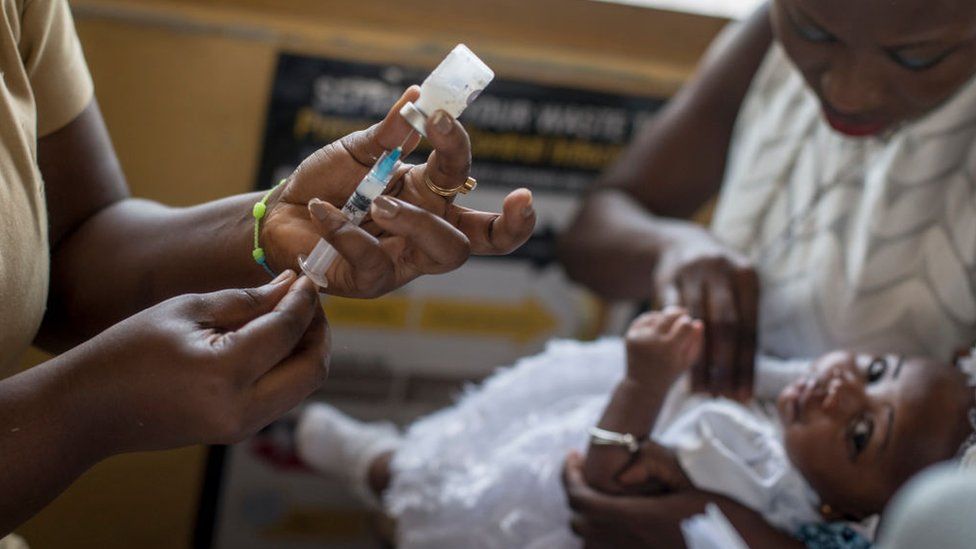
Vaccines against malaria have been rolled out before, such as this one in Ghana Getty Images
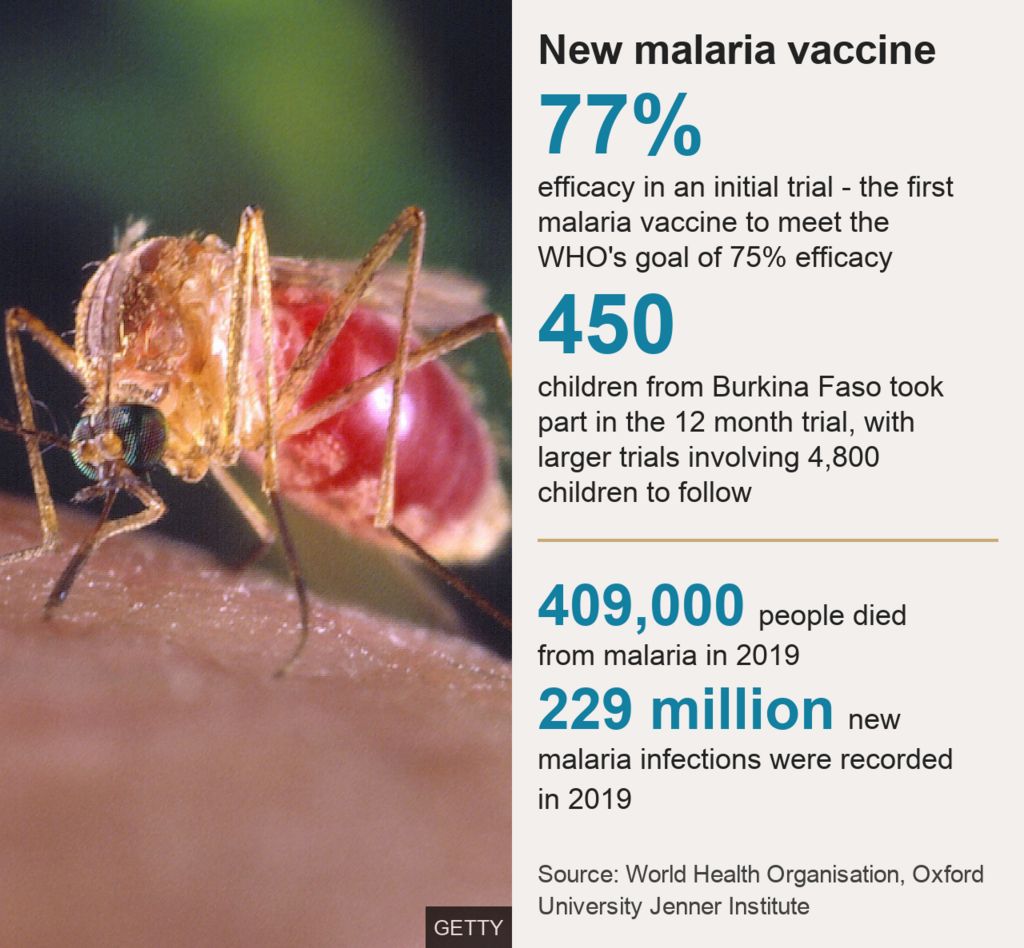
Malaria is a mosquito-borne disease that plagues the hot and humid areas of the world from Asia to Africa, the cause of sub-Sahara Africa losing approximately 400,000 people annually. Now, preliminary results of a phase two trial undertaken with 450 children in Burkina Faso indicates that the vaccine produced by scientists at Oxford University's Jenner Institute is 77 percent effective against malaria. The vaccine, called R21, is the first of its kind to rate such a high efficacy rate.
An agreement with the Serum Institute of India, one of the world's largest and most productive vaccine manufacturers, assures that they are committed to producing 200 million doses annually as soon as the vaccine has gained official approval. When that happens, the researchers anticipate that the vaccine doses will be available widely, and at low cost, to solve one of the world's most vexing environmental health risks through a vector that has always plagued humanity.
The existing anti-malaria vaccine, of promise, the RTS.S vaccine produced by GlaxoSmithKline, its efficacy rate came out to 50 percent in late-stage trials, the barest minimum to declare it a success. While this vaccine has completed phase three clinical trials it has not yet been fully licensed as a result of safety concerns. It is, however, being administered at the present time in Kenya, Malawi and Ghana, representing part of a World Health Organization-led pilot project.
Having a second vaccine in circulation would represent an immense assist to efforts geared toward eliminating malaria. Other preventive measures which are moderately effective include bed nets, indoor spraying, and preventive drugs, their use hampered by insufficient funding to ensure these methods are widely available where they are badly needed.
Children aged five to 17 months were given the R21 vaccine in three doses a month apart, with a booster dose a year later, in this latest trial. Three phase-three trials with 4,800 subject-participants for the vaccine are on the cusp of initiation in Africa. Challenge trials where volunteers in the U.K. were given the vaccine, then subjected to bites by malaria-carrying mosquitoes have earlier been completed.
Successful Malaria vaccines have been the goal of researchers for the past century, a goal that has been difficult to achieve. Partially as a result of the disease being seasonal, where 90 percent of deaths happen three to four months following the rainy season, emphasizing the vital importance of inoculating with vaccines at the precise right opportunity.
"All you have to do is look at the places that have had big lockdowns."
"You can see that the peak in the number of cases is a few days after the lockdown, and then the cases just keep dropping."
"There's no easy answers. No cheap, magic bullet."
Dr.Mark Jit, epidemiology professor, London School of Hygiene and Tropical Medicine, United Kingdom
"We must open up society to save many more lives than we can by attempting to avoid every case [or even most cases] of COVID-19."
Dr.Ari Joffe, critical care physician, University of Alberta
"This is not to deny the terrible health outcomes of COVID-19 infections."
"Among my patients, however, the acute challenges created by lockdowns are much more apparent."
Dr.Sonia Malhotra, family physician, Toronto
Scientists are scrambling to work out what effect
specific measures, such as social distancing, have in slowing the spread
of COVID-19. Credit: Ivan Romano/Getty
When the novel coronavirus struck it was with a vengeance. Governments and their health advisers knew they were facing a strange new threat. The immediate reaction was to go into stark defensive mode; lockdown. Not universally by any means. It was the reactive position of Chinese authorities, where the SARS-CoV-2 virus first struck, to isolate and issue stern orders to remain in situ. And most countries did the same once the virus infiltrated their negligible defences. Those that did not, hoped to save their economies while trusting their populations to exercise the care of physical distancing.
Since then, a year has brought millions of deaths attributable to the effects of COVID-19, hospitals and health personnel stretched their limits, and national economic meltdowns. Society has been left to pick up the pieces of shuttered-for-good businesses, ailing economies, high unemployment, fears of food scarcity, and the need to stretch state treasuries in an effort to cushion the blow both for government and business enterprises. And in support of families facing financial desperation.
Through it all, the mental and physical side effects of the coronavirus, the billions that governments have had to shovel out, the businesses hanging on by a thread of hope, medical experts remain uncertain just what reaction was the right choice universally. Dr.Joffe of the University of Alberta published a paper arguing the lockdowns to curb the spread of COVID resulted from 'group-think' not rational decision-making, he argues in the journal Frontiers of Public Health.
However, orders to restrict human-to-human contact has its champions and they are legion; the fact is, this is what has worked to set back the spread of the virus. It alone stands out as the most singular weapon in the 'non-pharmaceutical interventions' (NPIs) playbook of government-enacted COVID-preventive orders, according to Peter Klimek, a Medical University of Vienna, Austria physicist. It has been, in fact, policy combinations; border restrictions to banning gatherings, that succeeded in curbing cases.
Early preventive actions the key to long-term or repeated lockdown avoidance according to his research. "If you wait for too long, you have to use higher and higher measures to gain control of the situation." University of Greenwich, England researchers reviewed 348 other studies to discover them to "universally show" the importance that NPIs have in pausing the spread of COVID-19.
South Korea both controlled case numbers and deaths, permitting its economy to remain open, by and large; a study estimates infections would have exploded 27-fold in the early stages of the pandemic had the country not taken strict counter-measures which succeeded. There is no hard-and-fast formula however; whether to order people to remain at home or wear masks in public spaces, according to a University of Toronto epidemiologist, and head of the Centre for Global Health Research, Dr. Prabhat Jha.
The journal Nature Scientific Reports published a Brazilian paper recently where head-to-head comparisons were made between similar places globally which in the view of the authors were either 'controlled' or 'uncontrolled' when respect to ensuring populations were ordered to remain within their homes. No evidence surfaced that lockdowns reduced numbers of COVID deaths per capita, according to the scientists. Peculiarly enough Australia -- with among the lowest death rates from COVID in the world -- was rated by the study as uncontrolled.
Yet Australia imposed strict measures including hard border closures, mandatory hotel quarantine for arriving travellers and targeted lockdowns, while avoiding long-term stay-at-home orders. Then there is Florida where relatively few social restrictions were imposed and where the per-capita death rate is 2.5 times higher than Canada's following a series of lockdowns reflecting its 'controlled' designation.
Dr.Jlt and his colleagues had a paper published in the journal BMC Medicine which studied 130 countries by comparing their COVIDstrategies in the first months of the coronavirus to the rise and fall of cases, concluding that closing schools and restricting internal movement of people resulted in a strong effect on halting the spread of the virus, along with shuttering workplaces and providing income support to those whom the measures affected.
Researchers from Oxford University published a study in the journal Science verifying that eliminating small gatherings, closing non-essential businesses and restricting the size of family get-togethers headed a list of measures taken in over 200 countries slowing the virus's transmission. Including imposing border restrictions, increasing mask use and closing educational institutions.
Hong Kong and Chinese academic researchers studied 190 countries in the pandemic's early stage suggesting that social distancing with school closures, restricted restaurant use, and shutting non-essential businesses were the most effective in restraining the virus contagion. Yet it is undeniable that these measures, while meeting the virus head-on working to slow its advance, came at a steep price, reducing peoples' emotional and financial well-being in the process.
According to Dr.Malhotra, lockdowns contributed to social fatigue, an emotion that has continued to grow as the situation wears on and a third wave headed by mutated viruses producing variants that surfaced in the United Kingdom, South Africa and Brazil have continued to take a heavy toll. Too little attention, she contends, has been given to the health impact of "blunt, sweeping" containment tactics.
"The count that worries me? Over 100,000 COVID-19 cases yesterday. Deaths up 21 percent."
"There has been silence on this from the White House and the Dems. This is a tsunami ..."
"Pay attention."
Gregg Gonsalves, epidemiologist, assistant professor of public health, Yale
"Hospitals are full. don't look at 'beds' available on websites. Hospitals are already running at capacity."
"Health care workers are burning out. If all we needed were beds, we could just put people into hotels."
"[There should be a legislated] mask mandate [across the country to prevent further deaths]."
"People are dying, hospitals are collapsing ... We can survive with good leadership."
Eli Perencevich, epidemiologist M.D. University of Iowa
"I got news for you, pal. COVID-19 is over. It's done. We have therapeutics, so deaths are way down; we are very close to a vaccine. We've got to ride it out now."
"But if we don't have a strong economy there is no way we can do anything. Trump is correct. Without a good economy, there is no way to dig our way out of this."
Nick Arnone, owner, HLSM software, Plains, Pennsylvania
Cases and hospital admissions have been steadily rising EPA
A poll taken just prior to November 3 resulted in a surprising result, given that the election pundits were confident that the number one issue in this U.S. general election that would decide whether President Donald Trump would be given a second four-year term, was COVID-19 uppermost in most people's minds as the foremost concern in popular opinion. What was discovered was that roughly 35 percent of voters responded that the economy was their most important issue.
Correspondingly, about 17 percent cited the pandemic, while roughly two in ten polled said they were most motivated by racial inequality. Slightly over fifty percent of voters stated containing the virus is more important despite that it does harm to the economy, and at the same time slightly over four in ten felt that the most critical issue would be to rebuild the economy -- even if that process impairs ongoing work to control the virus. A country in wild and wide disagreement on every issue front and centre to the nation's cohesion.
Cohesion? There is no 'united' on the issues, parked sloppily on opposite sides of the political divide. The new view is that of the Disunited States of America. On entitlements, on race issues, on equality, on how to best handle a raging infection rate that is reaping huge benefits for the Angel of Death. A record number of new COVID cases was reported on Wednesday, tipping over 100,000 for the very first time, and all indications prevail that it will not be the last time.
Over 9.4 million Americans infected with the SARS-CoV-2 virus to date, a staggering 233,000 of whom have died of COVID effects. Totals that distinguish the United States as having the worst tolls globally, in absolute terms. In one day alone 102,831 new infections were logged accompanied by 1,097 deaths in a 24-hour period Wednesday, numbers provided by the Johns Hopkins University case trackers.
More cases have been recorded in the past seven days than in any other week in twenty-three states. Another five states; Colorado Indiana, Maine, Minnesota and Nebraska; all set new single-day case records and while the number of daily deaths remains considerably less than in April, their incidence has increased by 21 percent in the last two-week period.
In some states, health officials have sounded the claxon warning their ability to handle an influx of new hospital admissions as winter flu season approaches will be impeded with dual demands staggering he health care system. For many people, however, a larger concern than COVID troubles their lives, the daunting prospect of an inability to pay their bills or send their children to school. Normalcy has been turned on its head o spin helplessly.
And then came Friday, with the revelation that Wednesday's troubling statistics have been outdated and outdistanced as the United
States set yet another record of 122,000 daily
coronavirus infections surpassing the previous record, and Covid-19 hospitalizations continue to
climb, even as health experts issue dire predictions.
Friday's 122,626 new coronavirus cases -- the highest single day
reporting since the pandemic began also marked the third straight
day the country has surpassed 100,000 daily coronavirus cases, with an additional 1,110 deaths.
Members of the Wisconsin National Guard operate a mobile COVID-19 test
centre on the grounds of Miller Park on Oct. 29, 2020 in Milwaukee,
Wisc. (Scott Olson / Getty Images / CNN)
"During the last 24 hours, we arrested 14 people,. Now we
will find out in the next days if he is part of a broader network or
not."
"What we know is that he is a supporter of the Islamic State."
"We all know in our country this is not a fight between Christians or Muslims or Austrians and people from other countries."
Austrian chancellor Sebastian Kurz
"We have brought several special forces units together that are now searching for the presumed terrorists."
"I am therefore not limiting it to an area of Vienna because these are mobile perpetrators."
"[Several]
heavily armed and dangerous [attackers are still on the loose with
large parts of central Vienna shut down and sealed off in a manhunt]."
Austrian Interior Minister Karl Nehammer
Police cars and ambulances in central Vienna on Monday night.
"We
are living in the compound of the synagogue. Upon hearing shots we
looked down [from] the windows and saw the gunmen shooting at the guests
of the various bars and pubs."
"The gunmen were running around and shooting at least 100 rounds or even more in front of our building."
Rabbi Schlomo Hofmeister, Stadttempel synagogue
"I
was cleaning up and suddenly I heard shots. A lot of them, from a
machine gun. I looked outside, someone ran past and probably shot
someone in front of the synagogue."
"He was wearing a white jogging suit or something similar and he kept shooting."
Owner of a restaurant on the Seitenstettengasse, close to the synagogue
Screengrabs of footage appearing on various social media sites showing terrorist attack in Vienna, Nov. 2, 2020.Photo by Screengrab
The
attack began at around 8:00 p.m. local time in a central area of
Vienna, the Austrian capital. The country prepared to go back into
lockdown, and this night before lockdown, people were out in droves at
local bars, hotels and restaurants on the street, in close proximity to
the city's central synagogue. It was immediately assumed that the
synagogue was the initial target. It might have been, no one can now
interrogate the sole attacker, he is dead, one of five who died last
night, the four others victims of Fejzulai Kujtim, a 20-year-old
Austrian man from the town of St. Poelten, 33 miles west of Vienna.
Immediately
the attack began, bedlam prevailed. Six discrete sites were declared to
be under attack, each by different gunmen, professionally organized and
equipped with high-powered rifles, shooting at random, shouting out
'Allahu Akbar!' as they consigned total strangers to death in their
mission to shock and terrorize, and likely avenge the Prophet Mohammad
whose image had been mocked in neighbouring France, where two deadly
knife attacks had just taken place in the past several weeks stemming
from a French teacher using Mohammad cartoons illustratively in a
middle-school class on civics and freedom of speech.
As
the evening wore on it was assumed that the attacker, by then shot dead
by police, had an accomplice, perhaps more than one, and whoever they
were, they were escaping, armed and dangerous. Police urged the
population to remain indoors, sheltered, that danger stalked anyone
unaware and vulnerable out in the open. Borders were closed, a massive
search was launched for the co-perpetrator or perpetrators, the henchmen
who had been involved in the murder spree alongside Fejzulai Kujtim.
Until,
finally, it was determined that in all likelihood he had acted alone in
a powerful frenzy of religiou-inspired fervour. There was no one else.
He also happened to be a convicted felon, imprisoned on a charge of
terrorism, he had attempted to leave Austria for Syria to join the
Islamic State. While in prison he had undergone deradicalization
training and was deemed by authorities to have passed with flying
colours, earning him an early release from detention. Presumably,
Austrian security is too man-short keeping tabs on its identified
extremists to fully cover them all and obviously Eajzulai Kujtim, as a
public threat, was overlooked.
He
had succeeded in wounding another 15 people, among them a police
officer, with seven of the total wounded remaining hospitalized in
critical condition.Not that the manhunt for possible Islamist
collaborators is over; thus far 14 people have been investigated as
possible conspirators with the attacker, and are in custody while their
suspected links to the atrocity are being probed. The witnesses too were
convinced that a number of attackers were involved, steering their
excited narratives.
Armed police stay in position at the scene of the attack in the Austrian capital.
Last night the Vienna police tweeted an alert to the general public: "There are several injured persons. We are on site with all available forces. Please avoid all public squares in the city".
The army, assured Austrian Chancellor Sebastian Kurz, would see to the
protection of vulnerable capital sites leaving the police to focus on
anti-terror operations. Today is another day. There have been other
revelations, chief among them that this was a sole-actor terrorist
event. There was but one active shooter. A man with Macedonian-Austrian
citizenship, although he was born in Austria.
An
empathetic and terrorism-seasoned French President Emmanuel Macron gave
his full and unstinting support to Austria; it is debatable whether the
compliment had been initiated in reverse weeks earlier. "This is our Europe. Our enemies must know with whom they are dealing. We will not retreat",
stated President Macron, of the destructive malevolence of the
extremist Islamists harbouring in safety in progressive-minded Europe.
In
Austria, as in the United States, private gun ownership is fairly high,
though not in competition with U.S. numbers. Although Austria has of
late not been the recipient of large-scale terrorist attacks such as
Paris, Berlin and London have been vulnerable to in recent years, in
August a 32-year-old Syrian refugee was arrested, suspected of trying to
attack a Jewish community leader in Graz, one of Austria's larger
cities.
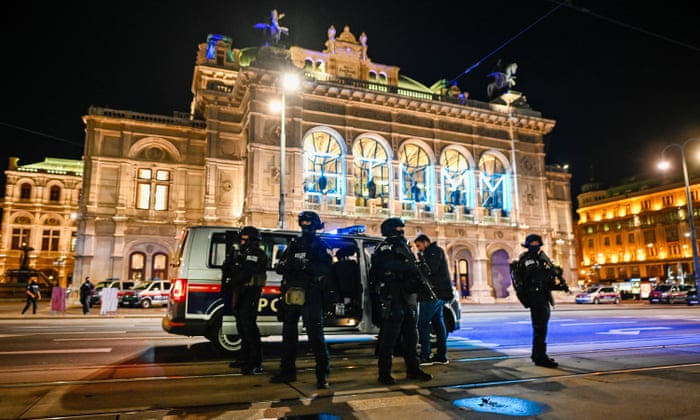
Armed police stand outside the Vienna State Opera amid a terrorist attack in the Austrian capital.
Photograph: Michael Gruber/Getty Images