Ruminations

Blog dedicated primarily to randomly selected news items; comments reflecting personal perceptions

Saturday, June 27, 2026

Venezuela's Quake Rescues: "It's all Improvisation"

"There is no planning, it's all improvisation."
"This is a state that is lacking in security services to deal with this type of emergency."
"Our firefighters and first responders don't have the proper equipment." 
Vicente Villarroel, a former federal lawmaker from the city of La Guaira 
 
"With everything that has happened to Venezuela in the past few years, we thought that nothing worse could happen."
"But what has happened is a real catastrophe, a tragedy."
Javier, Barquisimeto 
 
"What motivates me to become part of this movement is the empathy I feel for all Venezuelans who have lost their homes, their families, their will to live because they have been left with nothing."
"I think, as Venezuelans, more than ever, we are united for different reasons."
"Many of us have families in the impacted zones, others do it from a desire to help, but in the end it's all the same objective."
Raquel Mercedes Contreras Manrique, president, student centre, University of Los Andes, San Cristobal  
https://i.cbc.ca/ais/847e09fc-3be2-4971-99e7-ba5590c3af35,1782524245139/full/max/0/default.jpg?im=Crop%2Crect%3D%280%2C711%2C1179%2C1443%29%3BResize%3D796
Raquel Mercedes Contreras Manrique, president of the student centre at the University of Los Andes in San Cristobal, packs donated supplies on Friday. (Submitted by Raquel Mercedes Contreras Manrique)
 
 A day ago, shortly after Venezuela was hit with two, back-to-back earthquakes President Delcy Rodriguez announced that at least 164 deaths and 971 injured had resulted at that point of reckoning. The U.S. Geological Survey which had pegged the temblors at 7.2-magnitude and 7.5 magnitude following, warned that "high casualties and damage are probable". The death count from the earthquakes has risen a day later, to 1,400 -- and counting. Two aftershocks were recorded; one of 4.5- and the other 4.4-magnitude, close to Caracas, the country's capital.
 
On the Richter scale, a 7.5-magnitude quake is almost twice as powerful as one at 7.2 magnitude. When they struck, one after the other, it took altogether 30 seconds that the ground wobbled after 6:00 p.m. on Wednesday. Glass from nearby windows fell to shatter on streets below. Los Palos Grandes, a seismic area of eastern Caracas was hit directly. Three buildings on one block, one of 13-storeys in height, collapsed. A state of emergency was declared. 
 
U.S. President Donald Trump wrote: "I have instructed all agencies of our government to get ready to move quickly. We will be there for our new and great friends. Early reports are not good." Emergency rescue teams have arrived from Venezuela's regional neighbours, El Salvador, Ecuador, Brazil and Chile, and other seasoned teams, including one from Israel and the much-storied and well-experienced White Helmets from Syria were also dispatched to do what they know best; rescuing those still alive in hazardous life conditions. 
 
https://i.cbc.ca/ais/1245454f-40ca-45dd-91ae-b7c7a150afdb,1782521318064/full/max/0/default.jpg?im=Crop%2Crect%3D%280%2C0%2C5472%2C3648%29%3BResize%3D796
Venezuelans have rallied to support their fellow citizens, some travelling hundreds of kilometres to join relief efforts. (Susy Peña/CBC)
 
The boundary between the Caribbean and South American tectonic plates is where the sequence occurred when two giant sections of the Earth's crust slid sideways past each other along a fault. That action released the massive energy that caused the quakes. A figure of 4,300 injured people was released, but is certain to rise as rescue operations continue. The number of those missing is also growing, while first responders and volunteers desperately search for survivors. Over 200 people are still trapped in the rubble with Venezuelans in a "race against time" to rescue them, amidst ongoing aftershocks.
 
The number of buildings that collapsed: 250 in all. Dozens of apartment buildings in La Guaira were shaken to the  ground. In many areas of the state heavy machinery is scarce; volunteers were forced to make use of whatever tools they could locate in hopes of carving through the collapsed concrete rubble. It was almost a full day that passed before government responders arrived to help dig through debris.
 
The main health facility, Jose Maria Vargas Hospital, saw injured people lying on thin mattresses outside on the ground of the hospital premises. Its emergency department was swamped with people presenting with all manner of injuries. Some of the patients held their IV drips aloft on their own. Across the country Venezuelans crowdsourced websites and social media in search of missing family members. Over 42,000 names with photos and descriptions were listed on one website alone. 
 
While first responders and volunteers worked amidst the collapsed buildings interspersed with rubble, family members waited in high suspense, for outcomes. The Altamira neighborhood of Caracas was one such venue. A rescue team searched the rubble, unable to use the equipment at hand because the electric generator wasn't responding. For that team even basic tools like hammers were not available. The government, in economic crisis, lacks the capacity to respond to such disasters.
 
https://i.cbc.ca/ais/db878755-391b-4d6a-8d36-8244abeac56d,1782586163538/full/max/0/default.jpg?im=Crop%2Crect%3D%280%2C0%2C5472%2C3648%29%3BResize%3D796
A building rocked by two earthquakes is seen Friday in the beachfront neighbourhood Playa Grande in Catia la Mar, a city in the Venezuelan state of La Guaira. (Susy Peña/CBC)


Labels: , , , , , ,

Friday, May 08, 2020

COVID's Deadly Impact on Care Home Residents

"They [Hong Kong] applied what they learned from the SARS outbreak. That learning from experience, learning from each other, is one of the goals of this report."
"The virus spread so quickly in places like Italy and New York that there was a lot of focus on what was happening in the community. We did a good job on that, but now we're seeing what the repercussions are of not placing as much emphasis on long-term care."
"As we start to think about re-opening business and returning to normalcy, we are now looking at what is the impact of community transmission on long term care? That's something that we missed initially. That's something we have to continue to explore."
Dr.Amy Hsu, researcher, Bruyere Research Institute, Ottawa
Ambulance attendants transport a resident from Centre d'hebergement de Sainte-Dorothe, a seniors' long-term care centre, amid the outbreak of the coronavirus disease (COVID-19), in Laval, Quebec, Canada April 16, 2020. REUTERS/Christinne Muschi ORG XMIT: GGG-MON104


"The authors of this report are fully aware of the limitations of existing data and do not consider that the data presented here are directly comparable."
"However, it is important to share these data as, if the levels of infections and deaths of care residents and staff are not measured in a timely (even if imperfect) manner, there is a danger that opportunities to alert policy-makers to the scale of the impact of COVID-19 in care homes will be missed."
"This may result in allocations of scarce resources (including testing, personal protection equipment, medical personnel and medicines) that leave out the settings that are experiencing some of the biggest challenges in relation to COVID-19."
Study: Mortality associated with COVID-19, Bruyere Research Institute

According to a newly-released study, it would appear that Canada has racked up the highest percentage of COVID-19 deaths taking place in long-term and old-age care homes for the elderly and the health-compromised among thirteen countries included in a survey in an academic study. Titled Mortality associated with COVID-19 outbreaks in care homes early international evidence, the study shows that of Canada's COVID-19 deaths, fully 62 percent have taken place in long-term care or retirement homes.

This astonishing percentage of deaths striking the elderly and health-impaired in Canada ranks as slightly in excess of what Norway and Ireland have experienced -- each of which registered 60 percent of their death counts having taken place in care homes. Hungary appeared to have experienced the lowest rate, at 19 percent, of countries surveyed which had recorded at least 100 COVID-19-related deaths in their populations.

Confoundingly, Hong Kong -- despite its next-door proximity to mainland China where SARS-CoV-2 ravaged Hubei province and the city of Wuhan, then made its devastating way through to Beijing and beyond -- recorded a mere four deaths attributable to COVID, and none of those occurred in care homes. The measures undertaken by Hong Kong following its experience in the 2003 SARS outbreak appears to reflect their relatively light occurrence of deaths due to COVID contagion.

Data, so vital to understanding the course and impact of the disease within any community, is collected differently by various countries, making comparisons between countries difficult to understand. Difficulty in understanding or interpreting data led to the decision that some countries hit hard by the pandemic, including the United States, United Kingdom, Spain and Italy would not appear in the study.

The study, as explained by one of its researchers, Dr.Hsu, who is chair in primary health care dementia at University of Ottawa Brain and Mind-Bruyere Research Institute, led to the conclusion that overall, Canada appears to have done a credible job at collecting information relating to long-term care, even while the study points out that many countries were simply blindsided by the impact and deadly reach of the virus into long-term care homes.

Broken down by provinces, the death rate in the country has Quebec recording the highest rate of care-home deaths at 79 percent of its 1,849 deaths as of April 29. The rate in Ontario stood at 49 percent as of May 2, with 590 long-term care deaths among the 1,215 COVID-19 deaths n the province, yet delays in reporting on the part of Public Health Ontario indicates that the number of deaths could be quite higher in actual fact.

The National Institute on Ageing's Long-Term Care COVID-19 Tracker indicates that Ontario has more than 6,300 cases and 1,021 deaths in long-term care settings, representing a 62 percent mortality rate. The purpose of the study is to be regarded as an important tool aiding policy-makers to reach an understanding of the devastating effect of the disease on care homes, the researchers emphasized.

Laurier Manor
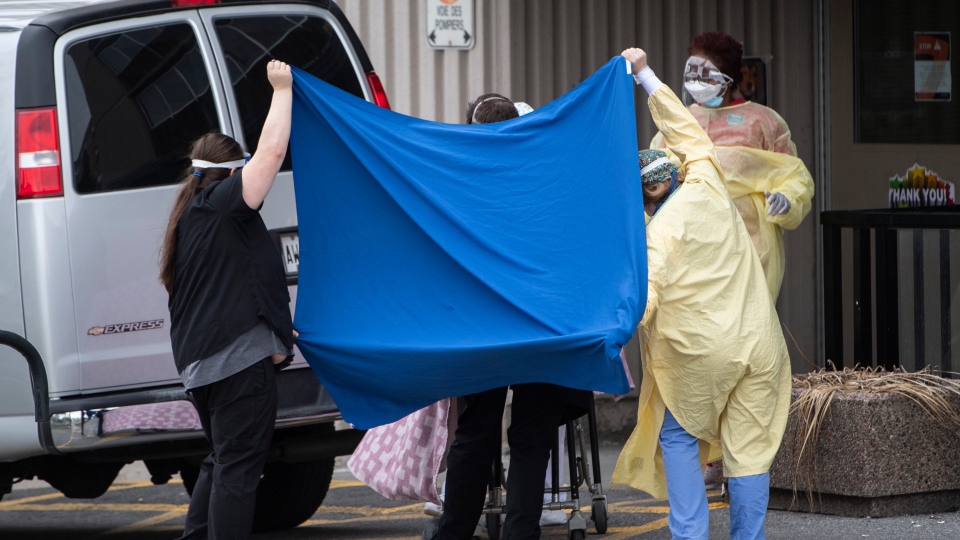
Health-care workers use a sheet to obscure a stretcher as it is placed in an unmarked van outside the Laurier Manor in Ottawa, a long term care facility experiencing an outbreak of COVID-19, on Sunday, April 26, 2020. (THE CANADIAN PRESS / Justin Tang)

Labels: , , , , ,

 
()() Follow @rheytah Tweet