Ruminations

Blog dedicated primarily to randomly selected news items; comments reflecting personal perceptions

Wednesday, October 03, 2018

If You Can't Beat Them, Eat Them : Queasy You?

"Insects have consumed something like one out of every eight loaves of bread before it even gets made."
"If we warmed four degrees, which is what climate models typically predict for the end of this century, then that amounts to insects eating two of our eight loaves of bread instead of one."
Curtis Deutsch, professor, University of Washington

"This online resource tells us that there are an estimated 10 quintillion insects on Earth. That's 10 followed by 18 zeros. Taking the Earth's human population at seven billion, that means there are 1,428,571,428.57 insects for every person on the planet. Let's round it out to say there are about 1.4 billion insects for every human. (Incidentally, this doesn't include spiders, because they're arachnids, not insects.)"
"This got us wondering about approximately how much humanity is outweighed by all those little critters. So we did the following, very rough calculation: Assuming the weight of an average insect is 3 milligrams (as is the case with ants) and the average weight of a person is 60 kilograms, then the weight of the world's insect population is about 70 times that of its human population."
Collected Wisdom, The Globe and Mail, Toronto
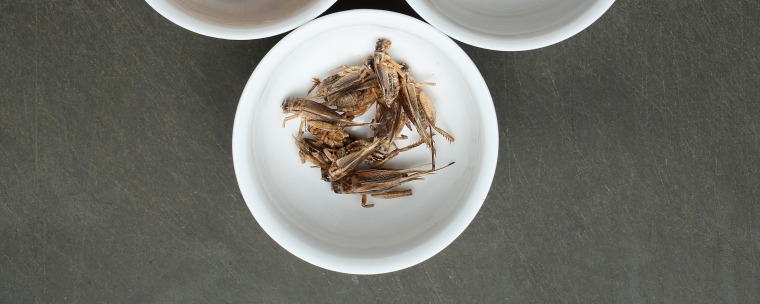
Insects: Our Food Of The Future?
Crickets seasoned with spices are presented in a dish.   Sean Gallup / Getty Images

In a warming climate on this planet of ours, insects multiply. Warming makes them hungrier, and shortens their lifespan, while instigating them to then reproduce at a faster rate. Not that we really notice yet, or that we've lately been overcome with their presence. Give it time. And more warming. Doubtless science will consider what solutions may exist to discourage all those insects from depriving humans of agricultural crops required to keep us alive, and which just incidentally keep those pests alive, as well.

One solution may be: humans eat insects. Many already do. Just not in the West, so much.

Globally an estimated two billion people regularly consider insects a vital and delicious part of their daily diet. In Peru for example, Amazonian weevil grubs sprinkled with palm oil and then caramelized to a turn charred over a fire is to die for. Which is to say, the grubs die for the purpose of feeding appreciative humanity. And while in Peru this may be standard and considered delicious it has yet to make its way onto plates regularly in Europe and North America. But wait, once word gets out that this type of diet is really cool, it may take off.
Ramen Nagi
Courtesy of Ramen Nagi  Insect Ramen, Ramen Nagi, Japan

Eventually the West may consider that locusts simmered in tsukudani represents a sublime sweet-and-salty snack, just as they do in Japan. The appetite lacking for these delicacies in the West may just be turned around with the right publicity and public relations to convince people that this represents the ultimate in haute cuisine. Eventually a plate of hexapods or a bowl of larvae may join the fine dining repertoire of exalted French restaurants.

In fact, that transition may have already started. In the United States last year, Americans spent over $55 million on edible insects, proof-positive that palates are amenable to succumbing to curiosity, exploration and change. The health and environmental benefits of entomophagy is being extolled as a responsible and delicious way to fill one's mouth and belly. Baked products relying on flour milled from roasted and pulverized crickets (gluten-free!) have gained in popularity in places like (where else?!) Silicon Valley.
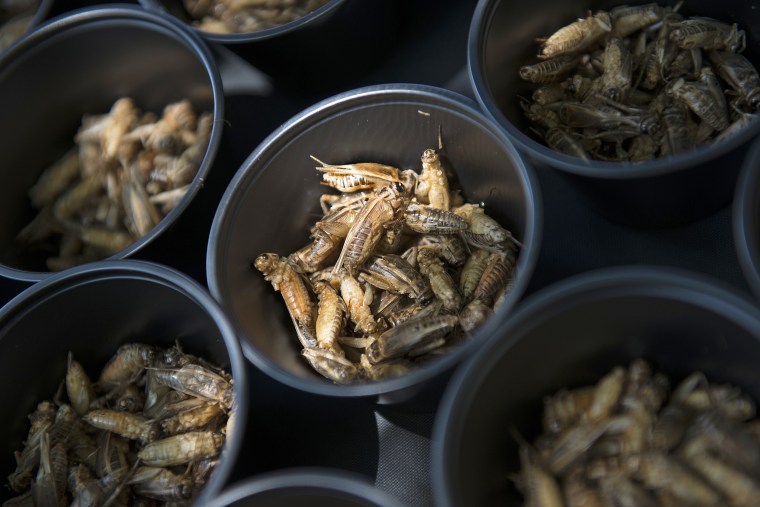
Local Pest Control Business Hosts Bug Eating Fundraiser For DC Central Kitchen
Cups of crickets await contestants at a bug-eating contest at Occidental Grill in Washington, D.C. in 2014.  Linda Davidson / The Washington Post via Getty Images
In Seattle, as yet another example of trend-setting, Mariners' stadium baseball fans have taken to grasshoppers, or chapulines, bugs imported from Oaxaca, Mexico, boiled, dried and shucked, then served with chiles and drizzled with lime. Gastronomic tourists in Mexico City aren't averse to paying steep tabs at Quintonil, a restaurant that features grasshopper adobo charred avocado tartare with escamoles (ant larvae).

"The most iconic ingredients in Mexico" are served at Quintonil, boasts chef Jorge Vallejo; avocado and insects. "When people come to Mexico, they're always curious about eating insects, because in our culture, it's part of the everyday." As for the taste of escamoles, Mr. Vallejo compares them to caviar with a nutty, grassy flavour; their texture has been described as that of a marshmallow. That pique your gustatory interest?
Grub Kitchen

Cricket, Mealworm, and Grasshopper Burger, Grub Kitchen, UK


"We really don't use ingredients that are very expensive. The real value comes from the stories you can tell." Got that? The ingredients are readily sourced, and when they've been transformed into a colourful, spice-sheltered unidentifiable food, a sheen of delicate uniqueness blooms over them arousing a diner's sense of adventure, anxious to give them a try and then boast of the experience for which they were dinged a pretty penny.

The Black Ant
Paul Wagtouicz   Black ant guacamole, The Black Ant, NYC

Labels: ,

Monday, April 30, 2018

Martyrdom Ants

"Amongst the countless fascinating plants and animals inhabiting the tropical rainforests of Southeast Asia, there are the spectacular 'exploding ants', a group of arboreal, canopy dwelling ants nicknamed for their unique defensive behavior."
"When threatened by other insects, minor workers can actively rupture their body wall. Apart from leading to the ants’ imminent death, the ‘explosion’ releases a sticky, toxic liquid from their enlarged glands, in order to either kill or hold off the enemy."
"They're really nice to watch in their exploding behaviour. They do it quite readily. We have some species who don't really like to explode as much."
"[They only do it in response to attack, a] form of active self-sacrifice [that kills them. The ants need to] really be provoked."
"Imagine a single ant is like a cell in a human body. The exploding workers work as immune cells, they sacrifice their lives to hold off danger."
"The explosion is not as dramatic as people think it is. [The sticky substances they exude has a] spice-like, curry-like] scent."
Alice Laciny, entomologist, Natural History Museum, Vienna, Austria
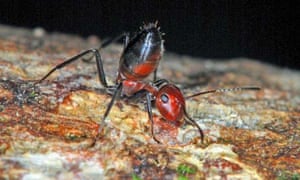
The Colobopsis explodens ant, a new species discovered in Borneo, which explodes when threatened.
The Colobopsis explodens ant, a new species discovered in Borneo, which explodes when threatened. Photograph: Zookeys/ Alexey Kopchinskiy

The world has an abundance of insect species, and among them are various types of ants, none perhaps as specialized as a newly discovered species of ant belonging to the group Colobopsis cylindrica, or "exploding ants". A team of researchers studied these newly-discovered ants in the jungles of South-east Asia and published their findings recently in ZooKeys, an open access scientific journal.

The colloquial name of the ants is actually "Yellow Goo". It is the researchers that named these tree-dwelling ants Colobopsis explodens. In defence mode the ant bites its enemy angling its backside as close as possible while contracting muscles so effectively its skin splits open and the sticky goo is then released. The substance functions to either kill the intruder, or interrupt its attack. It is the colony's worker bees that respond to threats or invasions of the colony, sacrificing themselves for the good of the whole.

The ants are small, with a red-brown colour. Otherwise their appearance is that of any other ant. But their bodies contain glandular sacs containing the deadly fluid. The colony's minor workers are detailed to explode when an attack threatens; expendable and reliable martyrs. Sensing danger, the ants explode, coating adversaries in the resulting toxic yellow goo, fulfilling the function for which their existence is mandated by nature.

Major worker of Colobopsis explodens with characteristically enlarged head. Image credit: Heinz Wiesbauer.

Should an enemy manage to survive this first line of defence the colony's major workers come into play with their enlarged, plug-shaped heads characterizing them as "doorkeepers" who hasten to barricade the nest's entrance. Dr. Laciny with a group of researchers, set out in 2014 to document  details of the exploding ants whose presence has been known for a century, but not much else about them. Now, through the investigative efforts of Dr. Laciny's group it is known that at least fifteen various types of these self-sacrificing ants exist.

The research group considered the newly-identified species to be "particularly prone to self-sacrifice when threatened by enemy arthropods, as well as intruding researchers". The research group nominated these newly-identified ants as their model species, serving as a reference point for future research geared to understanding more about these peculiar exploding ants.

No mention was made in their research of any similarities to the exploding ants and the cult of martyrdom with suicide-belts full of explosives now seen in use by various species of human beings.
Exploding behavior of the ant in an experimental setting with a weaver ant. (Alexey Kopchinskiy/Pensoft Publishers)

Labels: , ,

Wednesday, March 21, 2018

Entomophagy: The Evolution of Food

"When you read books by [European] travellers in the 1700s or 1800s, if they went to Africa or somewhere like Mexico where they saw people eating insects, it would be like, 'Their hunger's so great, their access to meat so scarce that they resorted, horrifically, to eating insects'."
Julie Lesnik, Assistant Professor of Anthropology, Wayne State University, Detroit

"That wasn't the case whatsoever. They were doing it because it was healthy and good for their environment."
"It's delicious, it's nutritious and it's sustainable."
"This opportunity with Loblaw is massive validation for the category [insect eating], for our industry. We're excited to see what comes out of it in that respect. Hopefully it's just that first step toward further acceptance and normalization."
Jarrod Goldin, Entomo Farms, Norwood, Ontario
Loblaw Cricket Flour 20180306
Roasted crickets are shown at the Entomo Farms cricket processing facility in Norwood Ont., in this April 2016 photo. (Fred Thornhill/Canadian Press)
"It's one thing for us to be educating people and telling them, 'You can get these products from this website'. It's another thing for them to see it on their grocery shelf."
"That legitimizes it so much more. It gives the consumer the trust and confidence to try that product because their trusted grocer is carrying it." 
"There is a variety of different applications and, as the industry has grown -- even in the last two years -- the diversity of applications has grown. So we've seen more and more ways that these start-up companies are looking at using the insects in their products and ingredients.
"...Their value statement is: every jar of [insect protein] pasta sauce saves 18 bathtubs [1,900 litres] of water compared to the beef. To be able to put that impact into perspective for consumers after they do a blind taste test and can't even tell -- that's really powerful."
"It's an incredibly wholesome food source that should be available to anybody who wants to utilize it. We don't need everybody to eat it, because not everybody eats shrimp, not everybody eats pork and not everybody eats broccoli -- but those are thriving industries. We only need to have a very small percentage of the consumer base actually add this into their diet to create a very robust and thriving industry. And to be able to show some very outsized environmental impacts."
Robert Nathan Allen, president, Little Herds 

"We're actually looking for a supplier that would help make those [nutritional bars], and then of course Entomo would supply the raw material."
"The [cricket] powder made more sense because people could incorporate it into food ... It's helping bridge people that have a bit of the 'ick' factor. You see the powder and it looks quite benign, and looks like something you could add into anything you're cooking."
Kathlyne Ross, VP, product development and innovation, Loblaw Companies Ltd. grocers
Plates of fried crickets. Roughly 80 per cent of the global population is known to eat a range of bugs. Hoang Dinh Nam/AFP/Getty Images
It's been rumoured, talked about, wondered at, tried out for many years. The 'ick' factor is certainly there, but so is a good number of people with the will and the curious interest to give them a try, to be persuaded that eating insects of various types in intriguing presentations is of value in feeding the world of humans with protein to build strong bodies. In particular this source should be of interest to vegans and vegetarians since animal products identify as the prime source of B12. And then the case can be made that insects are part of the animal kingdom.

"It's hard to wrap my mind around because, if you're using cricket, you're not a vegan or vegetarian anyway", stated Amanda Li, a registered dietitian. "In my opinion, if you're going to be eating fish, chicken, or turkey ... you probably don't need to add more protein on top of that unless you're trying to be more sustainable"; her perception that seems to question the need for yet another animal source of protein. She is likely in the minority, however; the prospect of opening up new food markets to a source that is the most abundant of all life on Earth appeals to many more involved in the food industry.

The Food and Agriculture Organization (FAO) of the United Nations has been forthrightly praising and attempting to further a consumer dietary market comprised of insects, identifying them as a hugely sustainable high quality protein source. Which just incidentally needs six times less feed to produce the equivalent amount of protein than does cattle. People living in northern global regions where cold winters limit the presence of insects to seasons tend not to consider bugs as food, unlike those in Mexico, Central and South America whose plentiful natural resources include insects and where eating them is culturally established.

An estimated two billion people globally consume insects, regarding them to represent a normal proportion of their daily diet. The worldwide market for insects for the dinner plate was valued in 2015 at close to $43-M and it is anticipated that this is due to gain momentum, up to 40 percent growth by 2023. As many as two thousand edible insect species flourish around the world; ants, grasshoppers, beetles and caterpillars and countless others in a world where consuming bugs has now crept into the Western world.

Now that Loblaw grocers has added cricket to their shelves, it can be considered that the eating of insects is finally on stream to become accepted as part of the North American diet. Entomo's cricket powder is sold at all Loblaw grocery stores throughout Canada, having been added to the PC Insiders Collection. Protein powder produced from crickets is readily available at the local supermarket. Research published by the journal Global Food Security in 2017 concluded that insects and plant-based meats "have the highest land use efficiency". 

If people exchanged half of the traditional animal products they consume, such as beef, or lamb for bugs "the land required to produce the world's food would be slashed by a third", according to The Guardian in the U.K. And Loblaw promotes cricket powder as a food source with strong sustainability, nutritional properties, diverse applications and palatability. A boon for the mass market. The very concept of entomophagy in the West; insect-enriched pancake mixes, cookies, crackers are promoted as added protein nutrients.

The rule of thumb for their use in savoury or sweet baking is ten percent substitution of total flour with cricket powder. Protein powder is becoming a popular choice among athletes, along with those people involved in weight management. It is viewed as convenient, either used as a meal in itself, or to balance and fortify a meal or snack otherwise not containing protein. Cricket powder, a whole food, makes a perfect addition. The insects are harvested at the conclusion of their natural life cycle; rinsed, roasted and ground.

Because of economies of scale, in comparison to other products on the grocery shelves, insect protein is not cheap. A 113-gram (quarter pound) bag of PC-brand cricket powder sells for $13.99, while a 573-mL (16 fl.oz) jar of cricket Bolognese is priced at $9.99. Once insect eating becomes mainstream and production rises full-scale, the costs of the products at the retail level will moderate, as it does with the introduction of any new products.

Cricket powder contains calcium iron and 100 percent of the daily values for vitamin B2 as well as being high in protein, with 13 g per 2-1/2-tbsp/19 -serving.

 Loblaw Companies Ltd. says it is adding cricket powder to its lineup of President's Choice products.
Loblaw Companies Ltd. says it is adding cricket powder to its lineup of President's Choice products. (Jessica Doria-Brown/CBC)

"From a nutrition standpoint, it is really interesting because, not only are crickets a source of protein, but they also have other vitamins and minerals in there."
"Because cricket powders are still holding the full cricket, you're getting the iron, vitamin B2 and the calcium that's in the cricket itself, whereas you might not be getting that with a protein powder."
Vincci Tsui, registered dietition


Labels: , ,

 
()() Follow @rheytah Tweet