Ruminations

Blog dedicated primarily to randomly selected news items; comments reflecting personal perceptions

Friday, September 02, 2022

James Webb Opening Up the Universe to Closer Scrutiny

"We've never seen Jupiter like this. It's all quite incredible."
"We hadn't really expected it to be this good, to be honest."
"It's really remarkable that we can see details on Jupiter together with its rings, tiny satellites, and even galaxies in one image."
Imke de Pater, astronomer, professor emerita, University of California at Berkley 

"This one image sums up the science of our Jupiter system program, which studies the dynamics and chemistry of Jupiter itself."
Thierry Fouchet, astronomer, professor, Paris Observatory
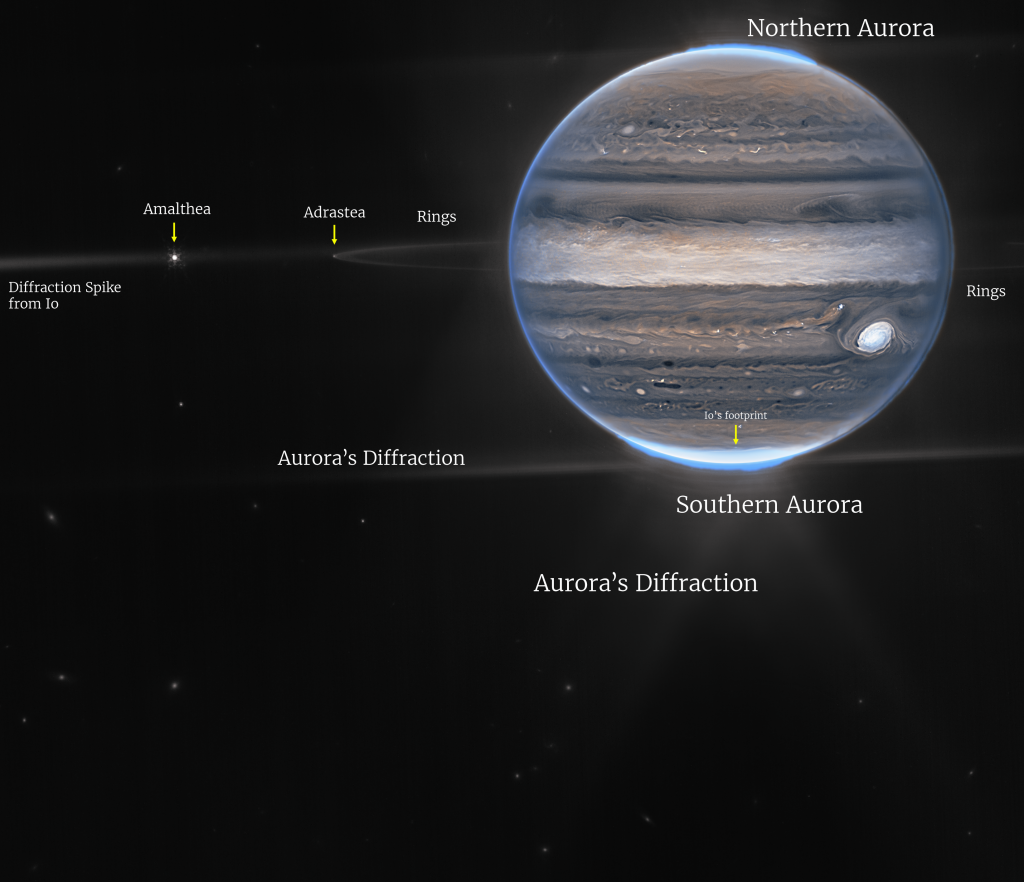
A wide-field view showcases Jupiter in the upper right quadrant. The planet’s swirling horizontal stripes are rendered in blues, browns, and cream. Electric blue auroras glow above Jupiter’s north and south poles. A white glow emanates out from the auroras. Along the planet’s equator, rings glow in a faint white. At the far left edge of the rings, a moon appears as a tiny white dot. Slightly further to the left, another moon glows with tiny white diffraction spikes. The rest of the image is the blackness of space, with faintly glowing white galaxies in the distance.
Webb NIRCam composite image from two filters – F212N (orange) and F335M (cyan) – of Jupiter system, unlabeled (top) and labeled (bottom). Credit: NASA, ESA, CSA, Jupiter ERS Team; image processing by Ricardo Hueso (UPV/EHU) and Judy Schmidt.
 
Photographs taken in July by NASA's James Webb Space Telescope and recently released identifies Jupiter in all its glory, the photographs labled "giant news from a giant planet", by NASA The largest planet in our solar system, Jupiter is fifth in line from the sun, over two times larger than all other planets combined. If Earth can be imagined as having the size of a grape, Jupiter would assume the size of a basketball, explained NASA.

The newly-released Webb telescope photographs record in close detail giant storms on Jupiter -- as well as auroras and faint rings in detail. Both Drs. Pater and Fouchet led the observations of the giant planet, part of an international collaboration. 

Named for James E. Webb, chief of the then-fledgling U.S. space agency from 1951 to 1958, the $10 billion telescope represents his legacy to the world of astronomy. An international collaboration led by NASA, along with the European Space Agency and the Canadian Space Agency, launched in 2021. The first set of full-colour images and data courtesy of the revolutionary telescope was released in July, revelations of a glittering cosmic theatre of colliding galaxies and a dying star.

More recently released photographs of Jupiter represent composites from several Webb images, shot by the telescope's Near-Infrared Camera with its infrared filters showcasing details of the planet. The images were artificially coloured to translate them into the visible spectrum, making Jupiter's features stand out because  infrared light is invisible to the human eye.

Jupiter, unlike most other planets in our galaxy, is comprised of gas, mostly hydrogen and helium; basic ingredients of a star, which Jupiter never grew sufficiently massively to become. Unlike Saturn's rings Jupiter's are fainter and comprised of space dust, and not ice. A wide-field view of the new images show faint rings and two tiny moons around Jupiter.

A day on Jupiter is comprised of about ten hours, and there are at least 50 moons. Io, Europa, Ganymede and Callisto were first observed by Italian physicist Galileo Galilei in the year 1610; Jupiter's four largest moons. Jupiter's Great Red Spot appears white in the photographs, a storm larger than Earth, raging over the planet for centuries.
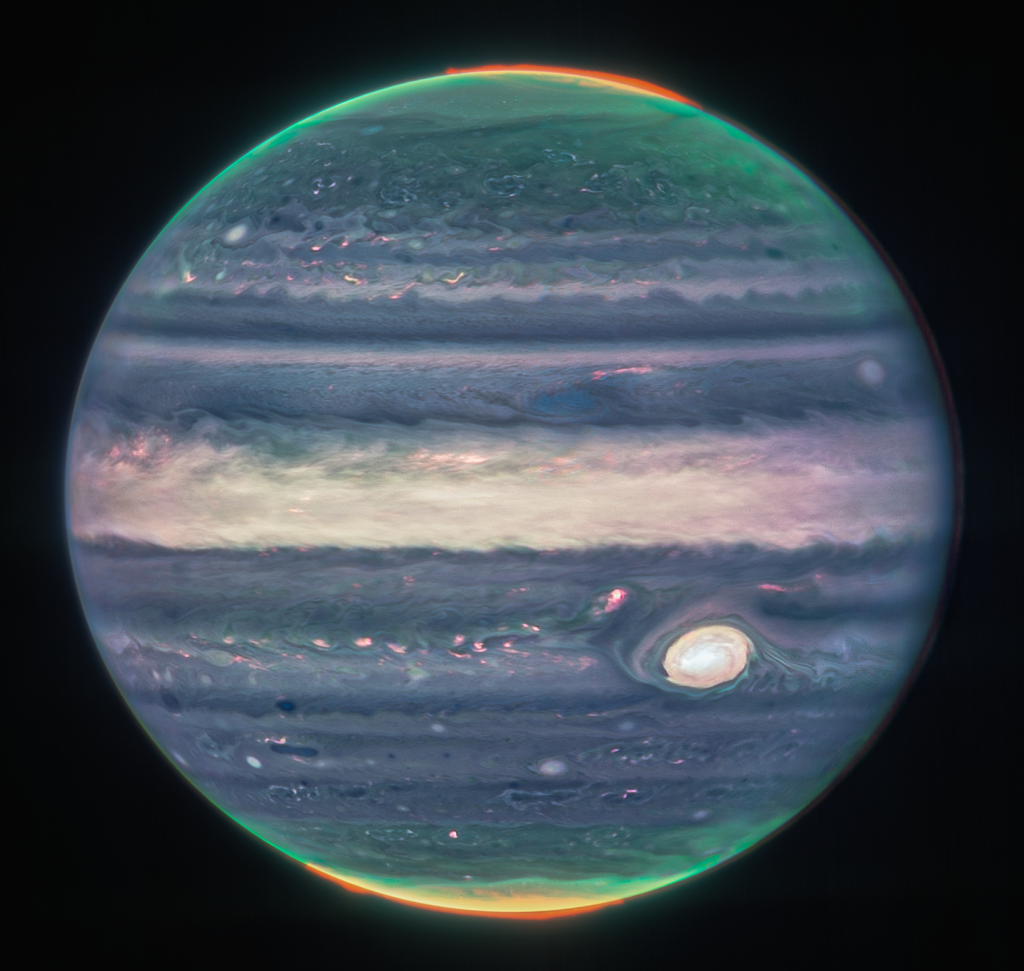
Jupiter dominates the black background of space. The planet is striated with swirling horizontal stripes of neon turquoise, periwinkle, light pink, and cream. The stripes interact and mix at their edges like cream in coffee. Along both of the poles, the planet glows in turquoise. Bright orange auroras glow just above the planet’s surface at both poles.
Webb NIRCam composite image of Jupiter from three filters – F360M (red), F212N (yellow-green), and F150W2 (cyan) – and alignment due to the planet’s rotation. Credit: NASA, ESA, CSA, Jupiter ERS Team; image processing by Judy Schmidt.

Labels: , , ,

Friday, July 22, 2022

The Young Universe and Its Offspring

"We found two very compelling candidates for extremely distant galaxies."
"If these galaxies are at the distance we think they are, the universe is only a few hundred million years old at that point."
Rohan Naidu, graduate student, astronomy department, Harvard and Smithsonian Centre of Astrophysics, Massachusetts
 
"It was dark for a long time until you started to get an accretion and what they call the age of ionization. And, then the first stars started to form."
"So we don't know exactly when that happened, the models show somewhere between 150 million and 300 million years after the Big Bang."
"So we think that looking about 300 million years after the origin of the universe, what we will be seeing is the first stars and the first galaxies forming."
Pam Melroy deputy administrator, NASA/former shuttle commander
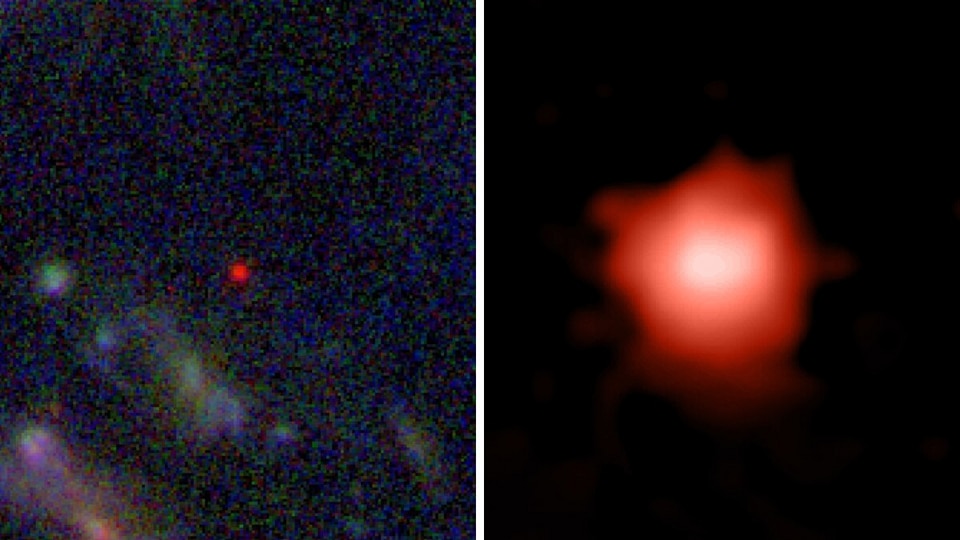
Here is all you need to know about the galaxy GLASS-z13 that was found by the new NASA James Webb Space Telescope.
Dr.James O'Donoughue, Twitter

In just the first week of its operation in sending back extraordinary images of the far reaches of the university the James Webb telescope has revealed undreamt-of leaps of visual acuity from distant space; much further than its predecessor which itself had ushered the world of astronomy and astrophysics into a new era revealing nature's time-distant origins of the universe. The revelations just keep rolling in, astonishing in their breadth, filling knowledge gaps and prompting new questions as scientific enquiry struggles to comprehend the full meaning of the revealing images.

In the initial images, themselves revelations of unimaginable time and space, fainter distant light sources even more intriguing than the closer aspects of those distant stars and their presumed worlds -- unseen specks of probability in the formation of the minute details of the universe where ongoing investigation may yet answer that eternal question: is there anyone out there? -- the suspense of discovery and the analytical minds of scientists are grinding overtime in excited hypotheses.

Now, NASA's James Webb Telescope has captured images of the assumed earliest formation of a galaxy brim with stars -- named GLASS-z13 -- that may date back as far as 13.5 billion years. The hard-working Hubble Space telescope's earliest image was seen to date 100 million years later. "We're potentially looking at the most distant starlight that anyone has ever seen," Rohan Naidu of the Harvard Centre for Astrophysics stated.

NASA
 When the universe formed 13.5 billion years ago everything was dark before matter began to clump in dense formations sufficiently so, to allow stars to burst into life. GLASS-z13's actual age of formation cannot yet be known with confidence, but it is hypothesized by the Harvard team analyzing the data received that it could have formed at any time within the first 300 million years of the existence of the universe.

When the early telescope data was released a week ago from the James Webb Observatory scanning the universe from about a million miles from Earth, its presence was identified. The James Webb telescope incorporates instruments designed to capture light in the infrared spectrum which, since the universe is expanding, sees light emitted by faraway objects as it stretches distantly, increasing in wavelength and becoming more red until finally reaching the infrared spectrum human eyes can no longer discern.

This is known as a cosmological redshift, similar to the Doppler effect where sounds, as they move further away, are heard differently.

Image

Labels: , , , ,

Tuesday, July 12, 2022

Wonder of Wonders -- Behold the Universe!

"From the data I've seen so far, from the work we've seen in commissioning and then this first week of science, yeah, this is going to be revolutionary."
"These are incredible capabilities we've never had before."
Jane Rigby, Webb operations project manager, Goddard Space Flight Center, Greenbelt, Maryland.
 
"Those releases represented five days of observation with this observatory."
"And they include something that is a deeper infrared image than has ever been taken in history, deeper than Hubble images that required weeks to acquire. That was done in half a day with Webb."
Randy Kimble, Webb project scientist, Goddard. 
 
"I am so thrilled, and so relieved."
"It's just impossible to convey how hard it really was. We risked so much to say we're going to go do this, and it's so near impossible. But we did it."
John Mather, Nobel Prize winner, senior scientist, Webb project.
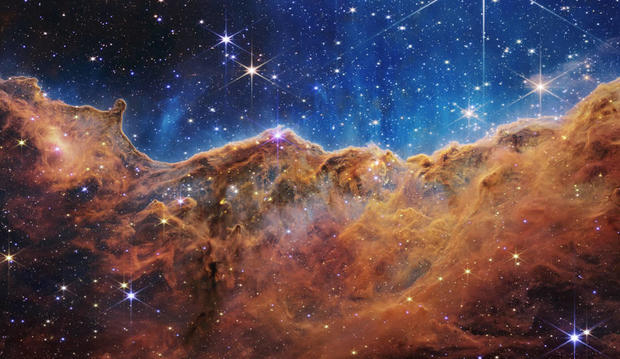
The James Webb Space Telescope's view of the Carina Nebula.
The James Webb Space Telescope's view of the Carina Nebula.  NASA

 Astronomers have awaited the results of the first photographs to be released, taken by the James Webb Space Telescope, the most powerful such telescope yet to search the Universe beyond our solar system, beyond our Milky Way Galaxy. The clarity of the photographs and the wide scope of far distant galaxies will in due time explain much about the Universe. Photographs are now being seen that reflect the birth and death of stars, nature's most mysterious secrets now on the verge of being unlocked through observation of what could never be imagined might be possible to analyze.
 
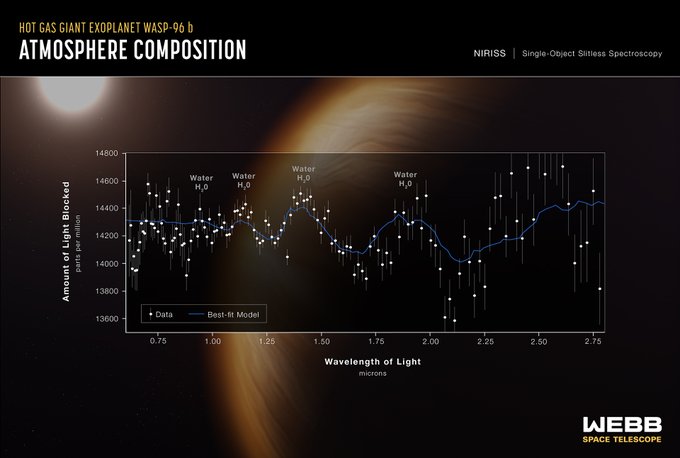
Graphic titled “Hot Gas Giant Exoplanet WASP-96 b Atmosphere Composition, NIRISS Single-Object Slitless Spectroscopy.” The graphic shows the transmission spectrum of the hot gas giant exoplanet WASP-96 b captured using Webb's NIRISS Single-Object Slitless Spectroscopy with an illustration of the planet and its star in the background. The data points are plotted on a graph of amount of light blocked in parts per million versus wavelength of light in microns. A curvy blue line represents a best-fit model. Four prominent peaks visible in the data and model are labeled “water, H 2 O.”
Clouds on another world.
@NASAWebb
Webb captured the signature of water on giant gas planet WASP 96-b, which orbits a star 1,150 light-years away. For the first time, we've detected evidence of clouds in this exoplanet's atmosphere: nasa.gov/webbfirstimages #UnfoldTheUniverse
"[The initial deep look unveiled on July11 is] proof of concept ... whetting our appetite for the record-breaking results we now know will come from this exceptional facility."
Heidi Hammel, planetary astronomer, scheduled to use the Webb

"[The telescope, the successor to the Hubble which is still in operation] has capabilities that far surpass my most optimistic dreams."
"The capabilities of Webb are truly out of this world."
Garth Illingworth, astronomer, University of California, Santa Cruz
A world-achievement, expectations were high for the success of this new eye in the sky that would send back messages and photographs from the most distant areas of the Universe. And what was revealed in those exceptional photographs of never-imagined detail was beyond extraordinary and exciting beyond measure to the fertile, now febrile minds of the world's greatest astronomers and astrophysicists. The $10-billion investment in the James Webb Telescope sent the world of space science into orbit yesterday.
 
The first image to be revealed at the White House is that of a cluster of galaxies called SMACS 0723. which only the massive lens of the Webb could have penetrated and portrayed so stunningly. Behind the magnification of the cluster are seen faint objects of vast cosmic distance. The "highest resolution images of the infrared universe ever captured", in the words of the American president who presided over the unveiling of the images.
 
the galaxies in Stephan's Quintet appear as purple-pink swirls against the blackness of space in this JWST image; some foreground stars appear with diffraction spikes from the telescope's mirrors; numerous other galaxies and stars bespangle the image
Stephan's Quintet   Credits: NASA, ESA, CSA, and STScI
 
The European Space Agency and the Canadian Space Agency partnered with NASA, maintaining a close grasp on the first images derived from the Webb during its initial sequence of observations as it orbits the sun a million miles from Earth. A few testing-phase images of the telescope were previously released, astounding astronomers with their detailed clarity. The newly-released photographs, however, were in full colour.

This initial first scrutiny deep into the universe by the Webb has excited the appetite of the world of astronomy for what is yet to come; revolutionary views of the universe crossing cosmic distances with unrivalled resolution. The coming months will transform what is currently known and assessed as an expansion of the understanding of the most basic rules and origin of the universe will gradually be resolved.

Now the formation of the earliest galaxies will be enabled by the Webb toward more intensive study along with the evolution of the expanding universe. Even our own solar system, hosting small worlds we hardly are aware of beyond the orbit of Neptune will come under scrutiny as nature's genius is examined and understood in time and space.

distant galaxies appear as bright glowing spots in this Webb telescope image, with some smeared by gravitational lensing; foreground stars appear bright with six-pointed diffraction spikes, owing to the shape of Webb's mirrors
SMACS 0723  Credits: NASA, ESA, CSA, and STScI


Labels: , , ,

 
()() Follow @rheytah Tweet