Ruminations

Blog dedicated primarily to randomly selected news items; comments reflecting personal perceptions

Monday, April 06, 2026

From the Sublime to the Mundane ... Moon Mission 2026
https://cdn.mos.cms.futurecdn.net/LsJZRQXXGFMUjzjkrvoEo-840-80.jpg.webp
(Image credit: Space.com / Josh Dinner)
 
"That's one of the big, big events in the mission. Really leaving Earth's orbit ... to conduct the rest of the mission ... I think that will definitely make a number of people both up on the Orion and here on Earth breathe a little easier."
"Depending on the precise timing when they get there [dark side of the moon], they will probably see some parts of the lunar surface on the far side sunlit that the Apollo astronauts did not have an opportunity to see." 
Jake Bleacher, chief exploration scientist, NASA
 
"Humanity has once again shown what we are capable of, and it's your hopes for the future that carry us now on this journey around the moon."
Jeremy Hansen, Astronaut, Artemis II 
 
"With this burn to the moon, we do not leave Earth, we choose it."
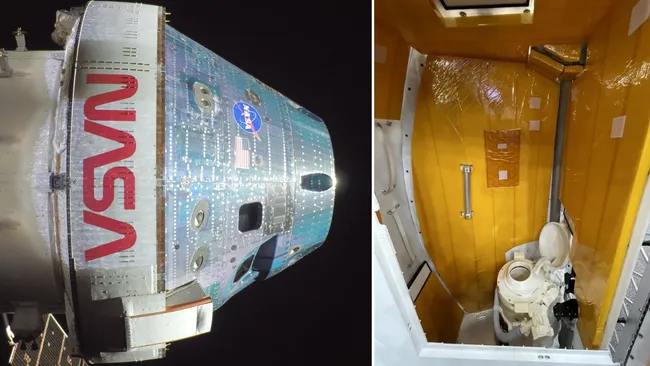
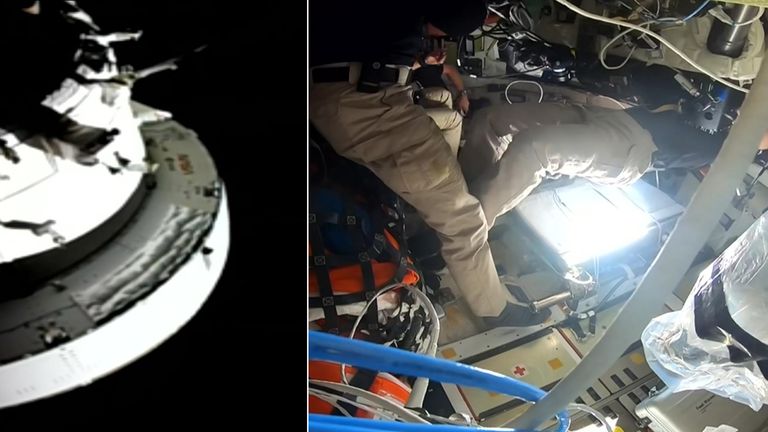
"[I] was proud to call myself the 'space plumber' after fixing Orion's toilet."
"I like to say that it is probably the most important piece of equipment on board, so we were all breathing a sigh of relief when it turned out to be just fine." 
Christina Koch, Astronaut, Artemis II 
https://cdn.mos.cms.futurecdn.net/XhYwpeuFZFXywkGEqVuReJ-650-80.png.webp
NASA's Artemis 2 Orion space toilet is taking a starring role on the historic astronaut mission to the moon. (Image credit: NASA/Canadian Space Agency)
 
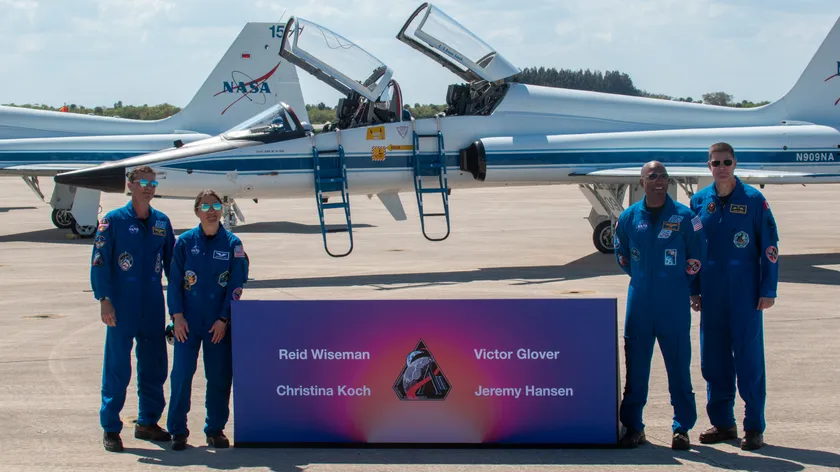
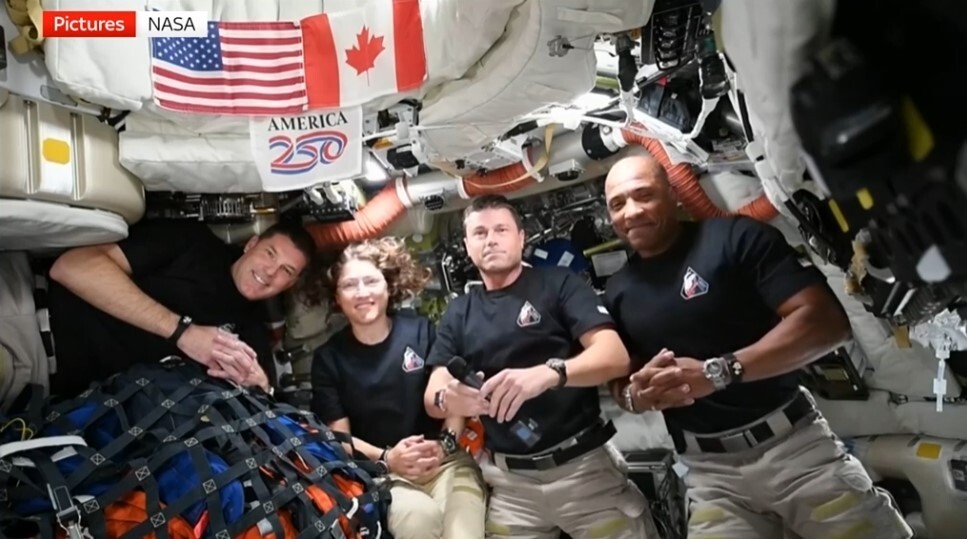
Orion's mission to the moon, around the moon, taking the four astronauts aboard -- Reid Wiseman, Victor Glover, Christina Koch and Jeremy Hanson -- to the furthest, highest point that humans have ever soared to beyond Earth, is to take ten days in total, from blast-off Thursday to eventual return the following Friday. On the mission, astronauts are to test scientific operations while on the far side in a bid to assist NASA in comprehending how human crews at the site can collaborate with Earth-bound science teams. 
 
It will be the gravitational pull of the moon and the Earth that will facilitate the return trajectory, without the requirement of mechanical propulsion, when Orion slingshots around the moon in a figure eight. The crew on its return will then experience one of the most tense-expectancy moments of the mission with re-entry into Earth's atmosphere, when splashdown in the Pacific Ocean brings their precedent-setting mission to a conclusion next Friday.
 
On Thursday evening, before sendoff, the Orion took six minutes to burn its engine for liftoff. In the general excitement of the mission proceeding, thoughts may have momentarily drifted to the sheer isolation the crew would be experiencing in outer space beyond Earth's orbit; a distance so vast that the crew would be totally dependent on their own resourcefulness should anything go awry, when no outside source could be depended on for reaction. 
 
https://liveblog.digitalimages.sky/lc-images-sky/lcimg-889a1d3b-60a4-4fc3-9e1d-6371d0b1b781.jpeg
Jeremy Hansen, Christina Koch, (mission commander) Reid Wiseman, Victor Glover   NASA
 
However, the minds within the spacecraft no doubt disciplined to focus on the minutiae of the mission, would not linger on exposure to deep-space radiation from solar activity or cosmic rays once they reached beyond the protection of Earth's magnetic field, and how that experience might affect the state of their health. They are themselves a living experiment.
 
Following meticulous checks of life-support systems sufficed for confidence the Orion spacecraft was prepared and ready to leave, the order NASA officials gave to the "translunar injection" manoeuvre was finalized and Integrity fled the surly bonds of Earth, taking four courageous, prepared souls with it.  "When the engine ignites, you embark on humanity's lunar homecoming arc and set the course to return Integrity and her crew safely home", Chris Birch, a NASA astronaut, said to the crew from mission control in Houston. 
 
Four days to reach the moon and each day of the 10 aboard the Orion capsule has its roles to be played out by each of those aboard. It took speed of 1,275 feet per second in liftoff to initiate the spacecraft's sojourn to the moon. Once on the far side, which they reached on Monday they will witness the effects of an eclipse. When the moon blocks the sun they will have the opportunity to observe the outermost layer of the sun's atmosphere, the corona in a brilliant display of jetting gases.
 
https://ichef.bbci.co.uk/news/1024/cpsprodpb/62f7/live/d3a93f70-2fb0-11f1-9885-91ba338bedfd.jpg.webp
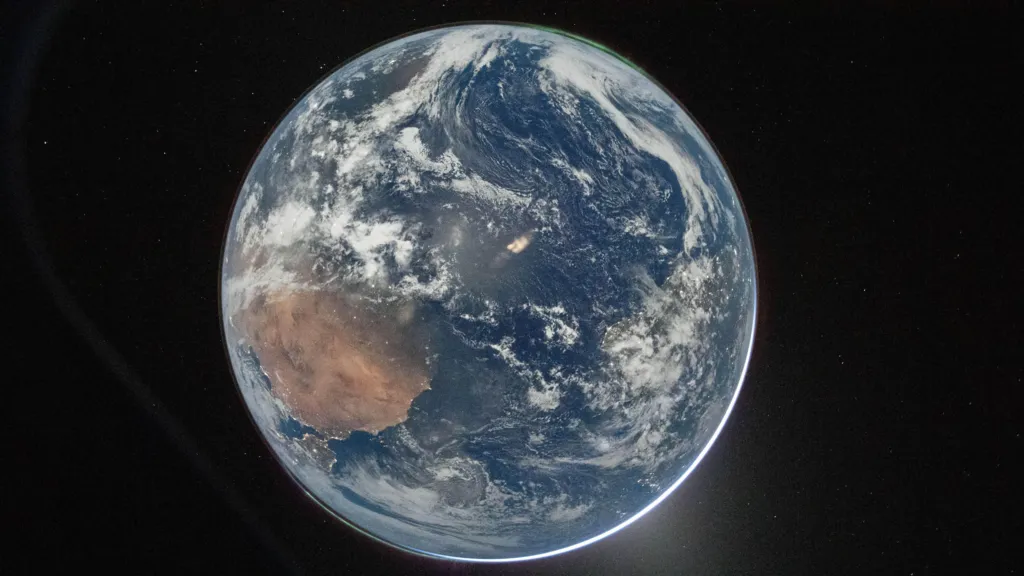
Earth as seen from the Orion capsule in a new image taken last week   Reid Wiseman/NASA
 
"On the far side of the Moon, 252,756 miles away, Reid, Victor, Christina, and Jeremy have now traveled farther from Earth than any humans in history and now begin their journey home."
"Before they left, they said they hoped this mission would be forgotten, but it will be remembered as the moment people started to believe that America can once again do the near-impossible and change the world."
"[The mission] isn't over until they're under safe parachutes, splashing down into the Pacific."
NASA Administrator Jared Isaacman
https://e3.365dm.com/26/04/768x432/skynews-artemis-comp_7212812.jpg?20260407012805
NASA
 

Labels: , , , ,

Thursday, June 08, 2023

Crewing a Mars Voyager Spacecraft with Female Astronauts

"On average, women tend to be smaller than men, and so this metabolic advantage may be greater in women, as suggested by our calculations."  
"This is why we concluded that there may be specific metabolic or life support resource operational advantages to all-female crews during future human space exploration missions."
"At this point in time, I don't think our study will have any influence [on the gender of the crew for a Mars mission], and I don't think it should."
"The two studies we performed, one on theoretical male and one on theoretical female astronauts, are just that — theoretical."
Jonathan Scott, researcher, French Institute for Space Medicine and Physiology
https://cdn.mos.cms.futurecdn.net/HQN4xAtnNMhVqf3G6EuWGb-1200-80.jpg
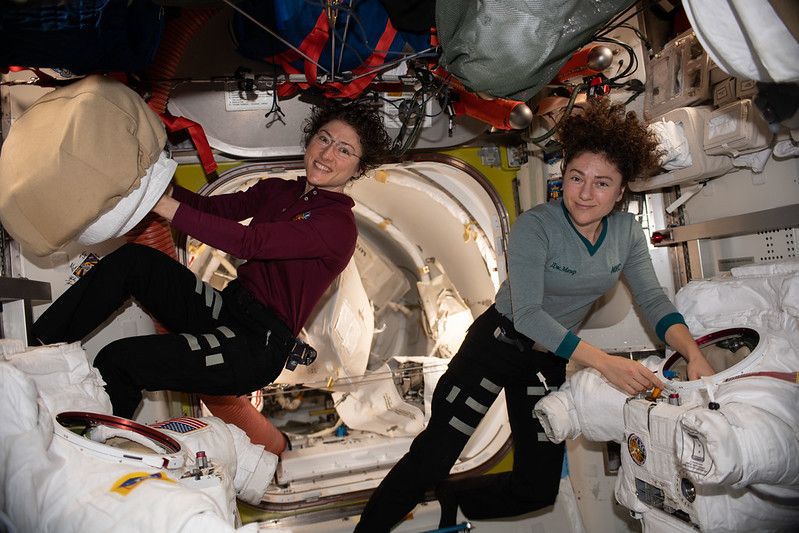
NASA astronauts Christina Koch (left) and Jessica Meir prepare their spacesuits for a series of spacewalks in January 2020. (Image credit: NASA)
Lead author of a new study published in April in the journal Scientific Reports -- Jonathan Scott and his colleagues -- found that female astronauts' requirements for food, water and oxygen are significantly less than needed by their male astronaut-counterparts. Their study looked at requirements for a four-person crew on a hypothetical three-year trip to Mars and back.
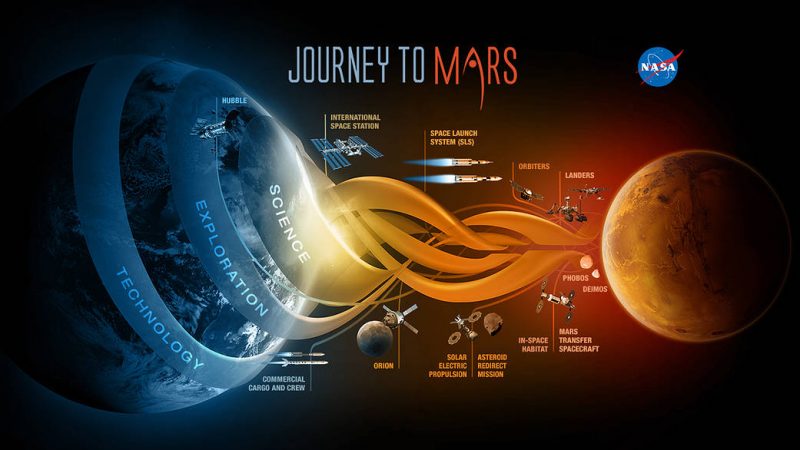
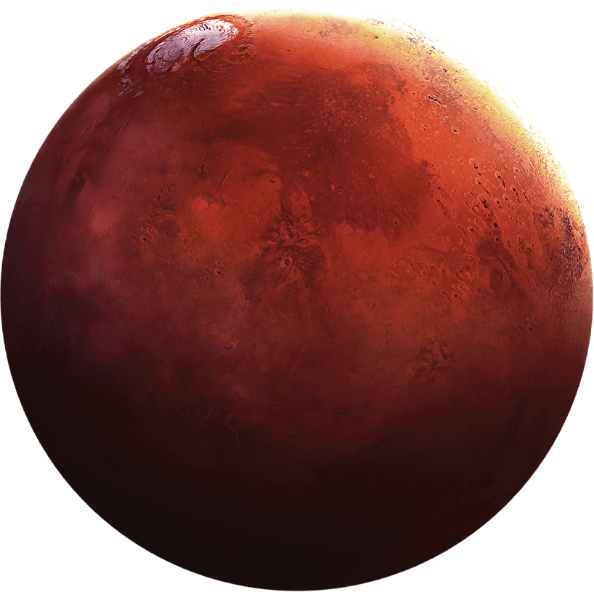
This study is one of a growing body of research that suggests female astronauts use far fewer resources of necessity than males. Any reduction in the amount of food, water and oxygen required to sustain life on a years-long journey to Mars and back would generate considerable savings, even to the degree that a mission might become a success, evading failure.

The Scientific Reports study calculated an all-female crew would have a total energy expenditure of between 5 and 29 percent less than would an all-male crew of similar stature, a differential accountable by female astronauts being lighter than males of a similar height, and requiring lower oxygen resources. The study team drew on astronaut data for both sexes back to the 1950s

Early NASA planners had considered female astronauts for the same reason of resource consumption, accompanied by the  belief that females might cope with more tolerance to the tight spaces and isolation linked to such an epic journey. Since that early period of space exploration dating back 70 years, the idea of all-female flights was periodically considered.

In the year 2000, NASA had seriously considered deploying an all-female space shuttle flight. In that same year a paper was published, entitled "An all-woman crew to Mars: a radical proposal", but one that has remained a proposal with dim expectations it would be carried out from its status as a potential to a commitment.

From left, astronauts Jessica Meir and Christina Koch aboard the International Space Station in 2019.
"[International Space Station modules have a diameter of about 4.2 metres; three metres in diameter. might represent the dimensions of a Mars ship.] As such, crews composed of individuals with smaller statures may also have potential habitability benefits (i.e., perceived volume and sensation of ‘crowdedness’) when co-working in the same module."
"In addition, there may also be reduced crew ‘traffic interactions’ where crew members need to move to allow another to pass and/or share equipment or workstations."
Scientific Reports-published study

Labels: , , ,

Tuesday, December 06, 2022

From Medicine To Space Flight

"[Going into space is like going into a hospital emergency room]. You have to prepare yourself for anything and everything."
"[Pilots prepare themselves of course but] for space missions to be successful, you've got to have that health-care component."
Dr. Farhan Asrar, assistant professor of medicine, University of Toronto

"[There are] Striking parallels between the challenges and constraints of rural medical practice and medical care for on-orbit astronauts; isolation, self-reliance, limited equipment, and impractical or impossible medical evacuation."
"Similar problems often have similar solutions; that's why medical technology developed for space crews is usually relevant to medicine on Earth. And vice versa."
Dafydd (Dave) Williams, emergency physician, Canadian astronaut 

"[Astronauts and physicians both use distinctive language] Acronyms and jargon pepper our conversations with colleagues. I smile to myself whenever I encounter a new space acronym that shares a meaning from my medical past."
"[Space agencies are called upon] to recruit physicians for our unique training experiences and for the operational capabilities that we hone on hospital wards."
Bob Thirsk, family physician, Canadian astronaut
https://www.nasa.gov/sites/default/files/thumbnails/image/jsc2021e064218_alt.jpg
NASA
 
Among individuals chosen to wear the Canadian flag into orbit, military pilots and flight instructors leap to mind as the seemingly most appropriate personnel to have aboard a space flight. Chris Hadfield commanded the International Space Station and distinguished himself by his photographs and communications back to Earth through his awe of space and his manner of conveying to an interested general public just how inspiring and vast space is, along with the views back down to Earth.

But there is also the seeming anomaly of people from the general population chosen more latterly to venture where few have gone before. And in Canada's selection of astronauts, medical personnel tend to feature as prominently as pilots. In fact there has been an even selection between physicians and pilots in Canada's opportunities to choose 14 people over the past years with the potential to become astronauts; among them four pilots and four medical doctors.

Community physician Dr. Farhan Asrar, who works out of Toronto area hospitals speaks of the synergies between the mindset of concerns of a community doctor and a space flight crew member. According to Dr. Asrar, astronaut choices transitioned from the early American space programs that focused on the military and pilots, to eventually begin selecting private citizens with specialized non-military careers.

A new paper published in the journal Canadian Family Physician, co-written by Saint-Jacques and Williams states: "Outer space assets offer benefits to health care". Each of the authors contributing reflections on the comparison and lessons drawn from their own parallel careers in both medicine and space flight. Their paper underlines benefits that space technology offered to health care. 

"The Canadian Space Agency's Bio-Monitor, which provides continuous health monitoring, and its Bio-Analyzer, which tests blood and other bodily fluids and provides results within minutes", among them. Sketching out as well complex conceptual similarities in medical education and training for astronauts. The strategy of trapping errors, to "contain and fix" them "before they have mission consequences."
 
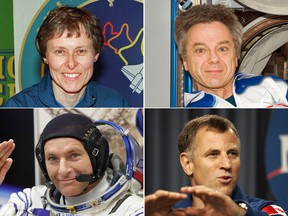
Out of the nine Canadian astronaut candidates who have actually made it to space, four have been physicians. They are, clockwise from top left: Roberta Bondar, Bob Thirsk, Dave Williams and David Saint-Jacques.

Labels: , , , , ,

Friday, September 02, 2022

James Webb Opening Up the Universe to Closer Scrutiny

"We've never seen Jupiter like this. It's all quite incredible."
"We hadn't really expected it to be this good, to be honest."
"It's really remarkable that we can see details on Jupiter together with its rings, tiny satellites, and even galaxies in one image."
Imke de Pater, astronomer, professor emerita, University of California at Berkley 

"This one image sums up the science of our Jupiter system program, which studies the dynamics and chemistry of Jupiter itself."
Thierry Fouchet, astronomer, professor, Paris Observatory
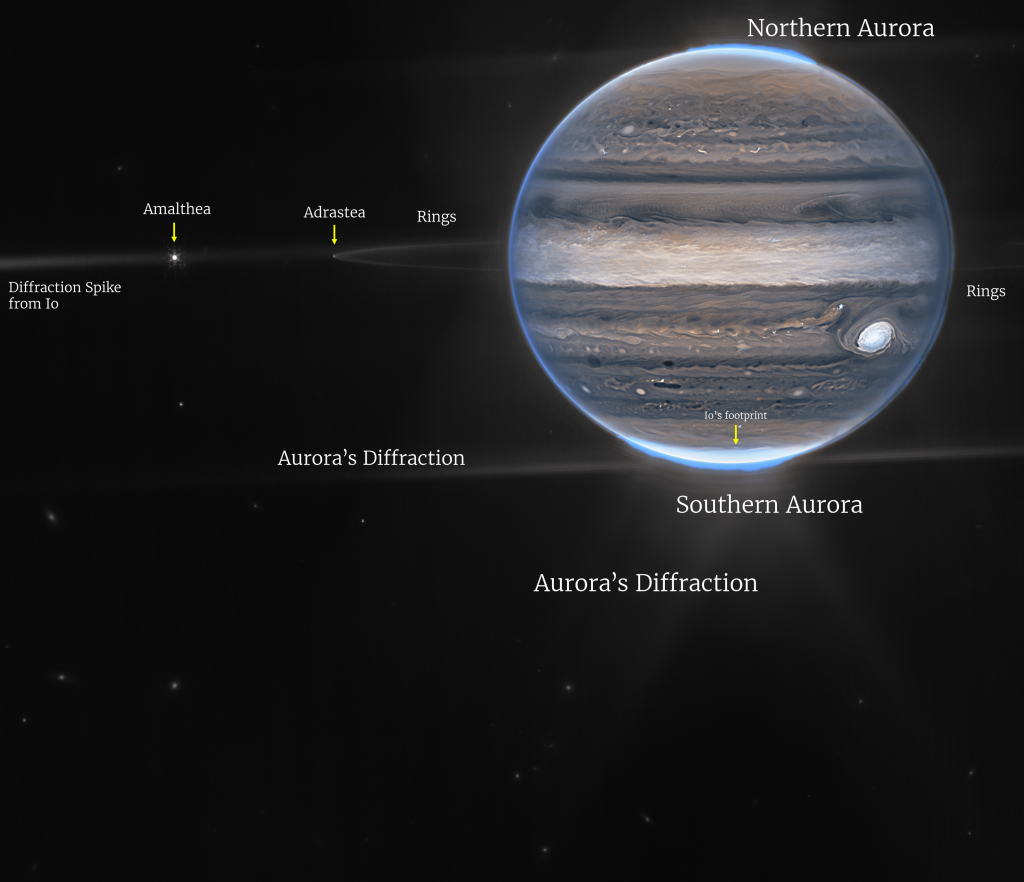
A wide-field view showcases Jupiter in the upper right quadrant. The planet’s swirling horizontal stripes are rendered in blues, browns, and cream. Electric blue auroras glow above Jupiter’s north and south poles. A white glow emanates out from the auroras. Along the planet’s equator, rings glow in a faint white. At the far left edge of the rings, a moon appears as a tiny white dot. Slightly further to the left, another moon glows with tiny white diffraction spikes. The rest of the image is the blackness of space, with faintly glowing white galaxies in the distance.
Webb NIRCam composite image from two filters – F212N (orange) and F335M (cyan) – of Jupiter system, unlabeled (top) and labeled (bottom). Credit: NASA, ESA, CSA, Jupiter ERS Team; image processing by Ricardo Hueso (UPV/EHU) and Judy Schmidt.
 
Photographs taken in July by NASA's James Webb Space Telescope and recently released identifies Jupiter in all its glory, the photographs labled "giant news from a giant planet", by NASA The largest planet in our solar system, Jupiter is fifth in line from the sun, over two times larger than all other planets combined. If Earth can be imagined as having the size of a grape, Jupiter would assume the size of a basketball, explained NASA.

The newly-released Webb telescope photographs record in close detail giant storms on Jupiter -- as well as auroras and faint rings in detail. Both Drs. Pater and Fouchet led the observations of the giant planet, part of an international collaboration. 

Named for James E. Webb, chief of the then-fledgling U.S. space agency from 1951 to 1958, the $10 billion telescope represents his legacy to the world of astronomy. An international collaboration led by NASA, along with the European Space Agency and the Canadian Space Agency, launched in 2021. The first set of full-colour images and data courtesy of the revolutionary telescope was released in July, revelations of a glittering cosmic theatre of colliding galaxies and a dying star.

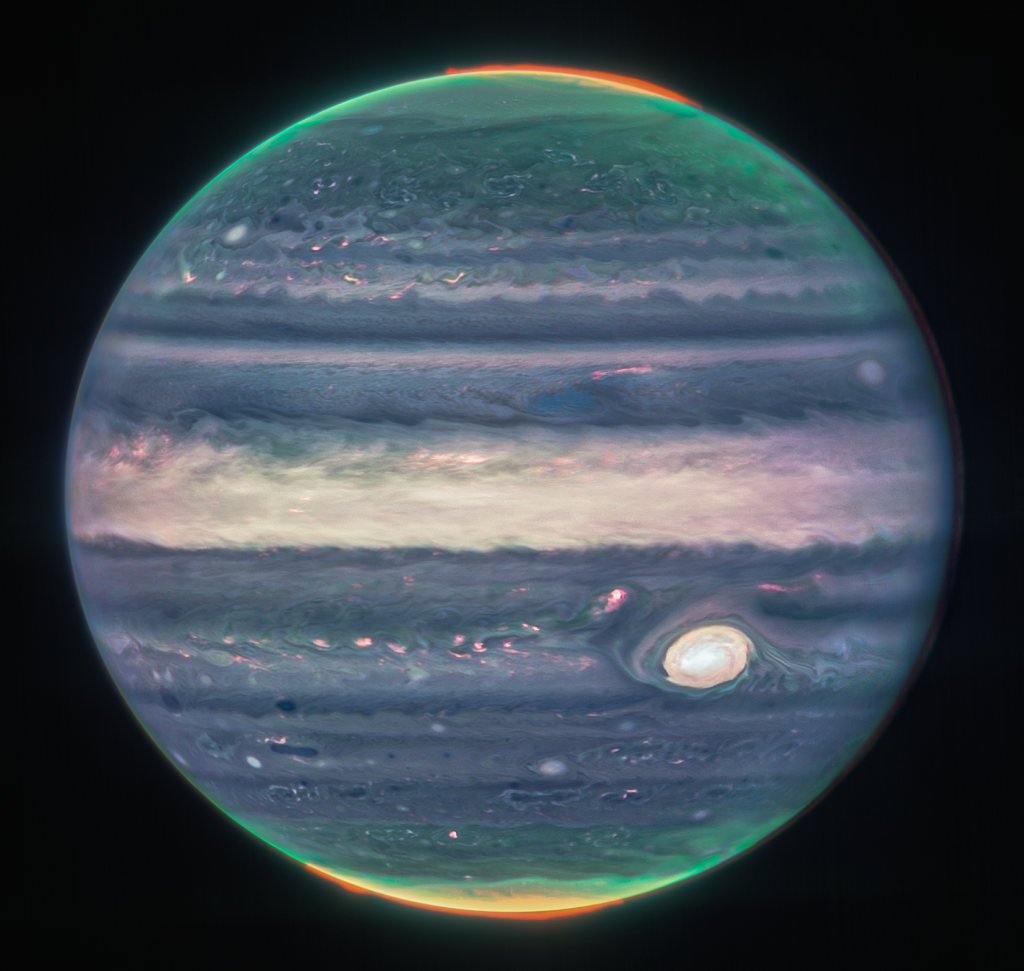
More recently released photographs of Jupiter represent composites from several Webb images, shot by the telescope's Near-Infrared Camera with its infrared filters showcasing details of the planet. The images were artificially coloured to translate them into the visible spectrum, making Jupiter's features stand out because  infrared light is invisible to the human eye.

Jupiter, unlike most other planets in our galaxy, is comprised of gas, mostly hydrogen and helium; basic ingredients of a star, which Jupiter never grew sufficiently massively to become. Unlike Saturn's rings Jupiter's are fainter and comprised of space dust, and not ice. A wide-field view of the new images show faint rings and two tiny moons around Jupiter.

A day on Jupiter is comprised of about ten hours, and there are at least 50 moons. Io, Europa, Ganymede and Callisto were first observed by Italian physicist Galileo Galilei in the year 1610; Jupiter's four largest moons. Jupiter's Great Red Spot appears white in the photographs, a storm larger than Earth, raging over the planet for centuries.

Jupiter dominates the black background of space. The planet is striated with swirling horizontal stripes of neon turquoise, periwinkle, light pink, and cream. The stripes interact and mix at their edges like cream in coffee. Along both of the poles, the planet glows in turquoise. Bright orange auroras glow just above the planet’s surface at both poles.
Webb NIRCam composite image of Jupiter from three filters – F360M (red), F212N (yellow-green), and F150W2 (cyan) – and alignment due to the planet’s rotation. Credit: NASA, ESA, CSA, Jupiter ERS Team; image processing by Judy Schmidt.

Labels: , , ,

Friday, July 22, 2022

The Young Universe and Its Offspring

"We found two very compelling candidates for extremely distant galaxies."
"If these galaxies are at the distance we think they are, the universe is only a few hundred million years old at that point."
Rohan Naidu, graduate student, astronomy department, Harvard and Smithsonian Centre of Astrophysics, Massachusetts
 
"It was dark for a long time until you started to get an accretion and what they call the age of ionization. And, then the first stars started to form."
"So we don't know exactly when that happened, the models show somewhere between 150 million and 300 million years after the Big Bang."
"So we think that looking about 300 million years after the origin of the universe, what we will be seeing is the first stars and the first galaxies forming."
Pam Melroy deputy administrator, NASA/former shuttle commander
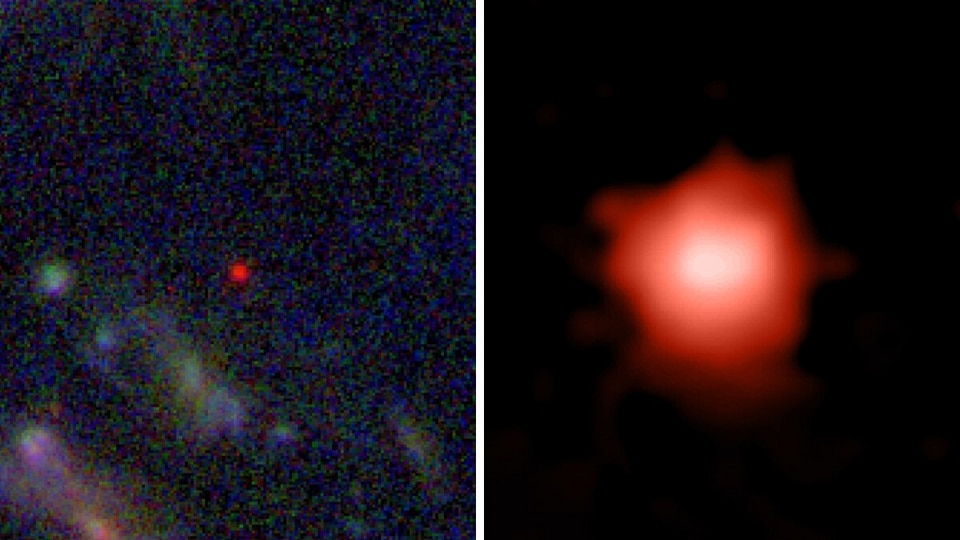
Here is all you need to know about the galaxy GLASS-z13 that was found by the new NASA James Webb Space Telescope.
Dr.James O'Donoughue, Twitter

In just the first week of its operation in sending back extraordinary images of the far reaches of the university the James Webb telescope has revealed undreamt-of leaps of visual acuity from distant space; much further than its predecessor which itself had ushered the world of astronomy and astrophysics into a new era revealing nature's time-distant origins of the universe. The revelations just keep rolling in, astonishing in their breadth, filling knowledge gaps and prompting new questions as scientific enquiry struggles to comprehend the full meaning of the revealing images.

In the initial images, themselves revelations of unimaginable time and space, fainter distant light sources even more intriguing than the closer aspects of those distant stars and their presumed worlds -- unseen specks of probability in the formation of the minute details of the universe where ongoing investigation may yet answer that eternal question: is there anyone out there? -- the suspense of discovery and the analytical minds of scientists are grinding overtime in excited hypotheses.

Now, NASA's James Webb Telescope has captured images of the assumed earliest formation of a galaxy brim with stars -- named GLASS-z13 -- that may date back as far as 13.5 billion years. The hard-working Hubble Space telescope's earliest image was seen to date 100 million years later. "We're potentially looking at the most distant starlight that anyone has ever seen," Rohan Naidu of the Harvard Centre for Astrophysics stated.

NASA
 When the universe formed 13.5 billion years ago everything was dark before matter began to clump in dense formations sufficiently so, to allow stars to burst into life. GLASS-z13's actual age of formation cannot yet be known with confidence, but it is hypothesized by the Harvard team analyzing the data received that it could have formed at any time within the first 300 million years of the existence of the universe.

When the early telescope data was released a week ago from the James Webb Observatory scanning the universe from about a million miles from Earth, its presence was identified. The James Webb telescope incorporates instruments designed to capture light in the infrared spectrum which, since the universe is expanding, sees light emitted by faraway objects as it stretches distantly, increasing in wavelength and becoming more red until finally reaching the infrared spectrum human eyes can no longer discern.

This is known as a cosmological redshift, similar to the Doppler effect where sounds, as they move further away, are heard differently.

Image

Labels: , , , ,

Wednesday, June 29, 2022

So Far Yet So Near

"Surprisingly the crater is actually two craters, an eastern one [18-metre diameter] superimposed on a western one [16-metre diameter]."
"The double crater was unexpected and may indicate that the body had large masses at each end."
"Typically a spent rocket has mass concentrated at the motor end, the rest of the rocket stage mainly consists of an empty fuel tank."
"Since the origin of the rocket body remains uncertain, the double nature of the crater may indicate its identity."
NASA
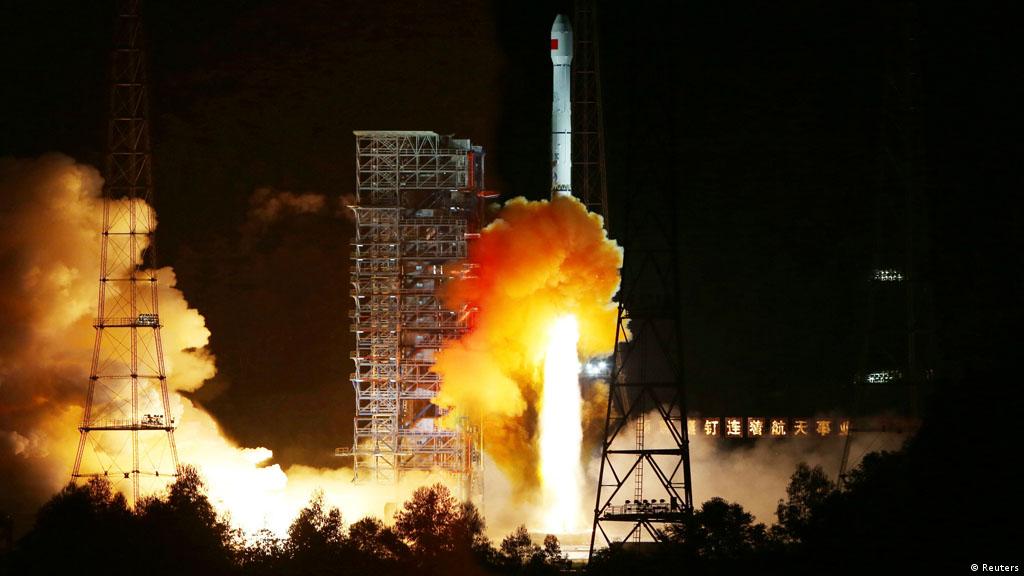
China′s moon orbiter returns to Earth | News | DW | 01.11.2014
China's 2014 orbiter rocket / DW

We gaze on the moon and admire its luminosity in the dark space of night when we're facing away from our life-giving source, the sun. The lunar surface hosts hundreds of pieces of debris. We never think of that; to do so is beyond our ken to begin with, and that lack of awareness retains the romance of the moon that lights our night sky. The moon hosts lunar landers and the waste of astronauts left in zip-lock bags, reminiscent of dog owners carefully picking up the waste, tying the plastic bag and leaving it to (?) decompose in the woods.
 
A number of craters were impressed on the surface of the moon, some of them 40 yards in width, from the Apollo mission. Anywhere humankind lingers there is waste and neglect. In the remote Himalaya, Mount Everest is littered with human waste from high-level expeditions. Having done so to the Earth, our home planet, we now look elsewhere in the universe as potential migrants seeking a new home. And in our search we litter space and on occasion the objects that occupy space.
 
A new mystery has reared its presence of late where NASA scientists feel baffled at the presence of a mysterious spacecraft which had crashed into the moon and created two large craters. No possible source has yet claimed the rocket, though its presence has been known since 2015. It was known to have travelled at 3.3 miles per second when it crashed onto the lunar surface on the fourth of March. Images by NASA's lunar reconnaissance orbiter show an impact unlike any before seen.
\
At first it was suspected by amateur astronomers that SpaceX could be responsible. That was changed when it was speculated that a 2014 Chinese lunar mission (Chang'e 5-1) could be the source. Beijing, however, in denial, stated that its booster had "safely entered the Earth's atmosphere and was completely incinerated". 
 
An approximate orbit had been computed by Bill Gray, an astronomer whose software tracks space objects, and who feels otherwise. He is aware that China does not reveal the routes of its orbiting space objects, only their launches. "I'm 99.9 percent sure it's the China 5-T1", he confided, prepared to discard his previous conviction it was a SpaceX booster.
 
A rocket body struck the moon on March 4 near the Hertzsprung crater, creating a double crater roughly 28 meters wide.
The new double crater was spotted by NASA's Lunar Reconnaissance Orbiter (Image credit: NASA/Goddard/Arizona State University)


Labels: , , , ,

Sunday, June 12, 2022

UFOs, What in the World Are They?!

"We're looking at the Earth in new ways, and we're also looking the other way, at the sky, in new ways."
"[Examining UFO reports could be] high-risk, high-impact kind of research."
"What we're really trying to do here is start an investigation without an outcome in mind."
Dr. Thomas Zurbuchan, head, NASA Science Unit
Deputy Director of Naval Intelligence Scott Bray points to a video display of a UAP during a hearing of the US House Intelligence, Counterterrorism, Counterintelligence, and Counterproliferation Subcommittee hearing on Unidentified Aerial Phenomena
NASA says it wants to provide a 'scientific perspective' on UFOs or unidentified aerial phenomena

Once head of Princeton University astrophysics department, David Spergel is set to spend roughly nine months in the development of a public report on findings with a team of scientists to be assembled for the purpose of examining UFOs. An enterprise that speaks as clearly as any other of the seriousness of Washington's intention to discover illuminating details leading to a closer understanding of exactly what these mysterious airborne objects regularly reported by pilots among others, truly represent.
 
The focus, explains NASA, is to be on the identification of data currently available, optimum ways of gathering future data, and how it can best be used in the advancement of scientific understanding of the strange phenomena whose provenance and purpose has yet to be understood.
 
A year earlier the U.S. government had issued a detailed report on these mysterious observations reported by navy personnel of "unidentified aerial phenomenon" (UAPs), the new preferred nomenclature for what has always been referred to as "unidentified flying objects". That report outlined some of the information that had been gathered, but no revelations as to their origins was forthcoming.
 
The US Defense Department recently declassified evidence of unidentified flying objects
The US Defense Department says it now has reports from military personnel of at least 400 UAP encounters, it released excerpts of footage and pilots' cockpit audio last year

Some videos taken of these enigmatic objects seen to exhibit speed and maneuverability far in excess of any known aviation technology, without any visible means of propulsion had been released by the Pentagon for public view. A month ago two officials from the Pentagon testified at the initial congressional hearing on UFOs to take place, in a half-century.
 
What they clarified was that many such observations remain beyond the capacity of any government agency or any in the legitimate scientific-astrological-astrophysics community to explain beyond conjecture. This new initiative is to be launched in an effort to explicate the situation to the best of the ability of the yet-to-be-assembled team of scientists. 

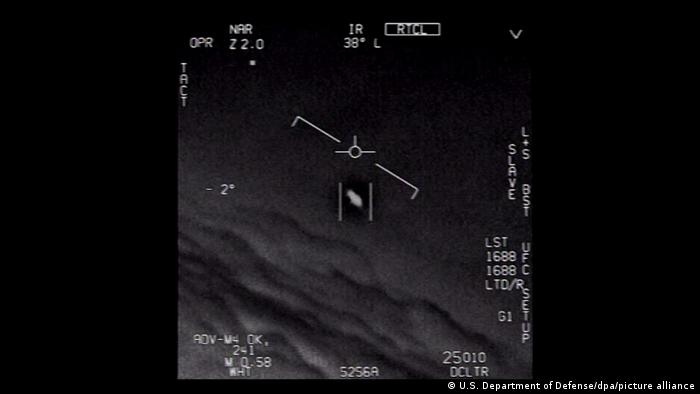
In this photo taken on April 28, 2020 this video grab image courtesy of the US Department of Defense shows part of an unclassified video taken by Navy pilots that have circulated for years showing interactions with "unidentified aerial phenomena.

Labels: , , ,

Sunday, May 15, 2022

Nudging An Asteroid's Trajectory

"[Although some asteroids, like 2008 TZ3 are described as dangerous, according to space.com, that designation references] complex calculation related to size [larger than 150 metres] and the distance at which the object approaches Earth, among other factors."
1,600-Feet Asteroid, Bigger Than Most Buildings, Heading Towards Earth
Asteroid 388945 will pass us from a distance of about 2.5 million miles away

Planet Earth has been hit by asteroids in the past. Some of those impacts have been historically monumental. Asteroids, rocky pieces of space junk hurtle through outer space at amazing speeds. Like planets these space rocks orbit the sun with a predictable schedule. Greater numbers of asteroids have been detected, of late, attributable to more technologically advanced detection of improved upgraded telescopes. 

Telescopes whose function is to probe outer space for the presence of previously unidentified objects, meteors and asteroids among them. Their detection and study are considered to represent prudence in the first line of defence against potential threats of catastrophic impacts. NASA has assembled a list of potentially harmful asteroids it tracks to keep tabs on.

Its records affirm that for the present no threats exist to Earth from any such impact resulting from years of search, with the assurance that chances of impact are seen to be statistically improbable. Should there arise an asteroid threat, one of sufficient size and approaching close enough in its trajectory to Earth to predict a possible crash, there are several solutions to deploy in defensive technologies by NASA.
 
 
NASA developed a planetary defence spacecraft whose function is to crash into an asteroid at a velocity as extreme as its own, aiming to redirect it away from Earth; in the development of the Double Asteroid Redirection Test (DART). Still, the thought is, there is no reason for complacency and vigilance must never be dropped.

May 16 was the expectation date that a half-kilometre-wide rock, known as 388945 (2008 TZ3) travelling at the incredible speed of 37,400 kilometres an hour, is set to make its closest approach to Earth. At its closest approach, according to Live Science, its speed is 30 times faster than that of sound.

What astrophysicists speak of as 'close' in space terms still is 5.6 million kilometres distant from Earth, and as such, bears no cause for alarm. 2008 TZ3 passes Earth every few years in its orbit around the sun. Its appearance this year is to be the closest such pass until May of 2163.
 
NASA Asteroid 388945 (2008 TZ3) Empire State Building Earth
NASA has confirmed that asteroid 388945 (2008 TZ3), which is larger than the Empire State Building in New York City, is hurtling towards Earth. Thankfully, this 1600-foot space rock is expected to pass 3.5-million miles away, but should still be considered a threat. It’s set to make a close approach at 5:18pm ET on May 16th at a speed of just over 18,000 miles per hour   TECHEBLOG


Labels: , , , , ,

Wednesday, April 06, 2022

Hello! Anyone There?

"[The Beacon in the Galaxy is not the first message created to be sent into space; it] contains more information about basic mathematics and science [than its predecessor, Arecibo]."
"The main part of this BITG Message contains a new set of graphical information in the form of images and special 'alphabets' to represent numbers, elements, DNA, land, ocean, and human, etc., starting by an artificial header and footer that consists of prime numbers."
Matthew Chong, physics/math student, Cambridge University
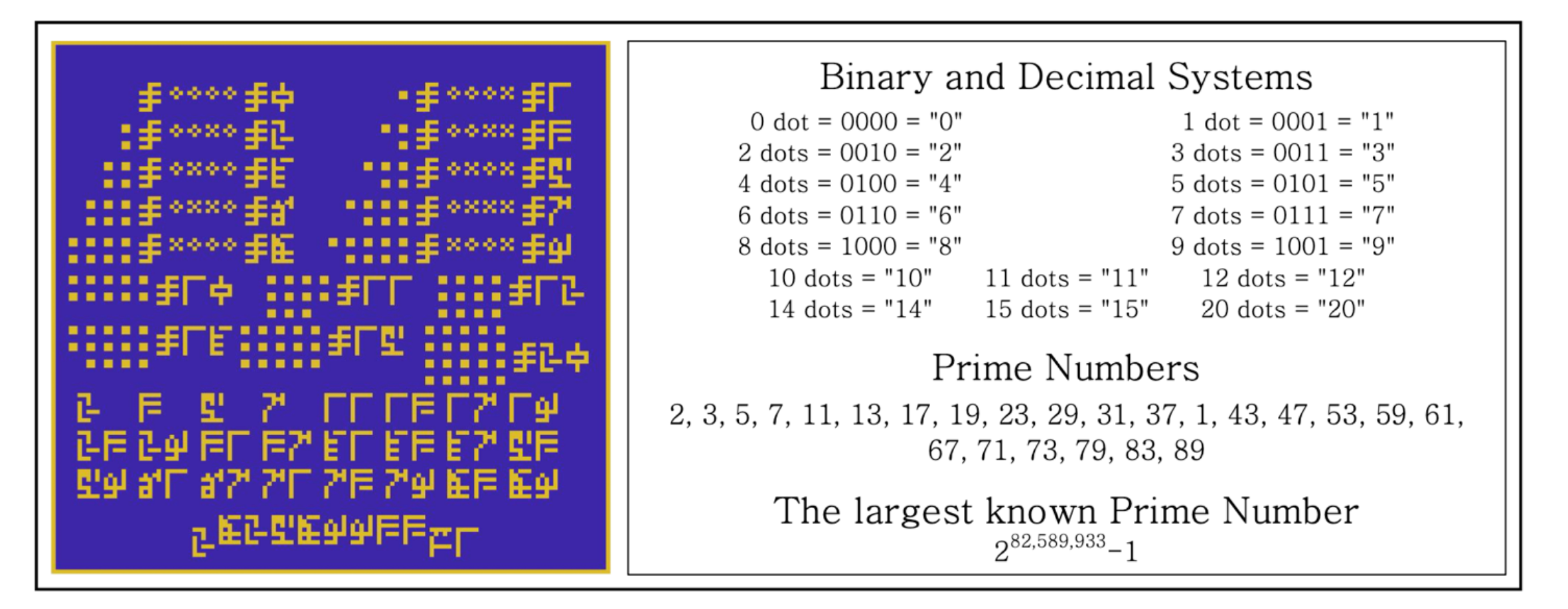
Binary and decimal systems.
A sample from a new message intended to be sent toward potential intelligent extraterrestrials in the galaxy. Credit: “A Beacon in the Galaxy: Updated Arecibo Message for Potential FAST and SETI Projects,” by Jonathan H. Jiang et al. Preprint posted online March 4, 2022 (CC BY-NC-SA 4.0)
"If aliens visit us, the outcome would be much as when Columbus landed in America, which didn't turn out well for the Native Americans."
"[Even if a signal is received from Gliese 832c, an exoplanet that may possibly be habitable], we should be wary of answering back."
Stephen Hawking, British physicist extaordinaire (deceased)
Humanity reaches out to whatever/whoever elevated life form may exist on a planet somewhere in the universe. Science refuses to believe that in the vastness of the universe, and the uncountable array of galaxies, stars and planets only the Milky Way's Planet Earth brought forth the organic life that developed the animals that inhabit the planet, including homo sapiens. Radio telescopes have been attempting for decades to pick up even the faintest signals of life elsewhere in the universe, to no avail.

Now a new initiative, the latest in a long series of outreaches to any intelligent beings assumed to have the capacity to receive and analyze and interpret a message from Earth, has been updated, the radio message to be sent into the cosmos, essentially pinpointing Earth's location to aid an interested intelligence in understanding precisely where this planet is located in the geography of the universe. 

The BITG message is comprised of 13 portions consisting of approximately 204,000 effective binary digits; 25,500 bytes in total. The goal of the scientists involved is to start a dialogue with ETI (extraterrestrial intelligence) "no matter how far in the future that might occur". Should intelligent life exist elsewhere in the universe as astrophysicists believe, it could potentially receive a radio message as a guide to finding Earth.

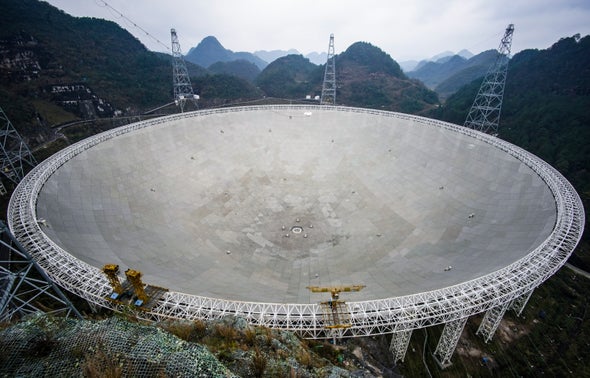
Jonathan Jiang, the lead on the project, a scientist at NASA's Jet Propulsion Laboratory, elaborated that a group of cosmic landmarks are meant to be conveyed as an assist to indicate Earth's position within the Milky Way Galaxy. The intention is for the Five-hundred meter Aperture Spherical Radio Telescope in China and the SETI Institute's Allen Telescope Array in northern California to transmit the message.
 
 General view of the Five-hundred-meter Aperture Spherical radio Telescope (FAST) in Pingtang County, Qiannan Buyei and Miao Autonomous Prefecture, Guizhou Province of China. The 500-meter aperture spherical radio telescope (FAST), also known as China's 'Sky Eye', will open to global scientific community from March 31. (Photo by Li Jin/VCG via Getty Images)

Labels: , , , , , , ,

Sunday, February 20, 2022

Analyzing Deep Space

James Webb Space Telescope   NASA
"It's extremely satisfactory seeing everything coming into place. It's a sense of amazement and happiness."
"[The sensor ... Fine Guidance Sensor ...] is mission critical. There was a lot of pressure on us. Everybody was very happy."
"You would be able to point at a human hair [with the sensor] from a couple kilometres away. It's pretty much pushing the limit of what can be done."
"I can't wait to see the data we'll get."
 Jean Dupuis, senior mission scientist, Canadian Space Agency
Canada's Fine Guidance Sensor (FGS) and the Near-Infrared Imager and Slitless Spectrograph (NIRISS) at NASA's Goddard Space Flight Center. (Credit: NASA)

Canada is an integral part of the massive James Webb Space telescope functioning, joining with NASA with the ambitious to make this space exploration project operational, from the beginning. Up to half of the 600 scientists in the Canadian Astronomical Society are or have been involved with the project. Dozens of Canadian scientists and engineers are involved in the design team that produced vital Canadian technology used in the functioning of the telescope. 
 
The systems meant to give direction to the telescope have been designed and built through the Canadian Space Agency.

The cost of the James Webb, launched in late December, designed to study the nature of planets beyond our solar system, and to enable study of what the oldest galaxies reveal about the birth of the universe, was $13 billion, and represents over two decades of work. Designed and builtt as the successor to the Hubble Space Telescope, the Webb is meant to orbit deeper into space -- about 15 million kilometres out -- with a sensitivity more than a hundred to a million times greater than its predecessor.

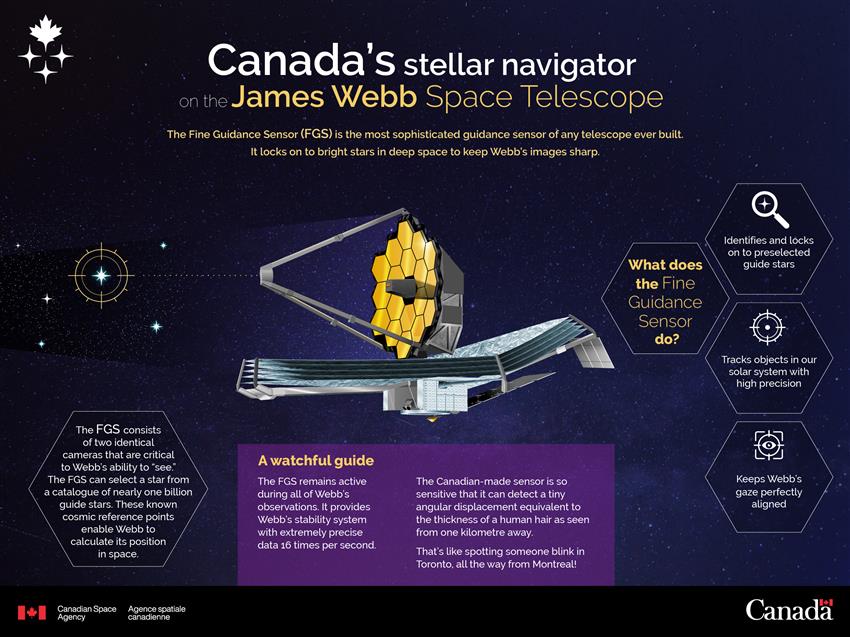
It is deemed to be sensitive enough through the newer technology with which it is outfitted to analyze exoplanetary atmospheres and to gather data from "First Light" galaxies, whose formation extends back 13.6 billion years. Without the installed Fine Guidance Sensor none of these ambitious prospects would be possible. Up and running, the sensor is used to align the telescope's 18 mirrors. It will probably take until summer for the sensor to cool down to below -200C to be fully operative.

Once that happens the sensor will function to aim the James Webb with a precision scarcely believable; down to a few milli-arcseconds. Operational and functional success appears to be the hallmark of the telescope and its launch. In December, NASA announced that the telescope had succeeded in slipping into its orbit so wonderfully well, the fuel savings could operate the telescope for significantly longer a period than the original ten-year lifespan foreseen. 

As well as the sensor, another Canadian contribution is its Near-Infrared Imager and Slitless Spectograph, meant to assist in analyzing light observed by the telescope. As a result of Canadian involvement to the extent and degree that it has been, Canadian astronomers have a special entitlement to five percent of the observation time the telescope offers.

Canadian researchers plan to use the Webb telescope to study asteroids and comets close to Earth as well as the effect that stars have on the space around them in distant regions of the galaxy where new stars are born.
 
Infographic on the Fine Guidance Sensor sophisticated guidance sensor

Labels: , , , ,

Sunday, October 31, 2021

Lucy in the Sky With Diamonds

"That's what we're doing with asteroids ['planetary archaeology']."
"We're excavating the leftovers from the construction site [of the solar system]."
Tom Statler, program scientist, NASA
 
"One of the surprising things about the Trojan population is that they are physically very different from one another but occupy a really small region of space."
"That diversity in that small region is telling us something important about the early evolution of the solar system."
"My hope will be to look at the current models of solar system formation -- including my own work -- and say: 'Nope, this is all wrong. It wasn't that simple, and we have to start again'."
Hal Levison, planetary scientist, principal investigator, Lucy mission, NASA 

NASA launches robotic archaeologist Lucy on 12-year mission to Trojan asteroids

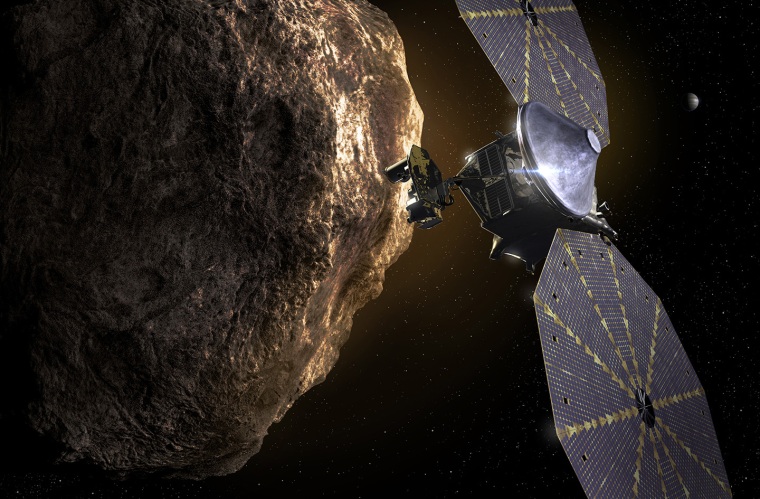
NASA is interested in discovering primordial organic material on asteroids with the prospect that they may have seeded Earth with the chemical ingredients required for life to emerge, billions of years ago. A 12-year mission has been launched, to be powered by two giant solar arrays in the form of a probe to reach clusters of asteroids along the orbital path of Jupiter. The spacecraft has been named Lucy, as has the mission in recognition of the 3.2 million-year-old australopithecine skeleton discovered in 1974 in Ethiopia, a discovery that revealed secrets of human evolution.

NASA launches robotic archaeologist Lucy on ambitious mission to Trojan asteroids
Robotic Lucy's purpose is to reveal to astrophysicists the evolution of the solar system. The cluster of asteroids toward which Lucy is slated to reach in that ambitious project of archaeological revelations about the solar system's origins are called collectively the Trojan swarms, representing the unexplored regions of asteroids in the solar system. Lucy lifted off on her mission on October 16; a deep-space robotic archaeologist seeking to answer such pressing queries on the solar system origins; and how the planets reached their present orbits and how life could have emerged on Earth.

Lucy is slated after cruising through space for six years, to fly close to the seven Trojan asteroids through to 2033, through sun circuits to study the geology, composition, density and structure of the Trojans, small bodies in stable points along the orbit of the sun expressed by Jupiter. The concept of planetary formation thirty years ago was not what it is today. When then it was believed that a star formed in the center of a rotating disc of protoplanetary material to gradually condense and collect into eight planets in simple orbits.

Efforts by planetary scientist Hal Levison and others of his colleagues attempted to simulate the formation of the solar system, discovering repeated problems in their efforts -- finally resulting in the realization it was not possible to build Uranus and Neptune in their present orbits. Which led to the development by Dr. Levison and three other researchers of the Nice model of solar system evolution, suggesting the giant planets formed closer to the sun than current orbits would suggest. The increasingly eccentric orbits of the young Jupiter and Saturn destabilized, rearranging the solar system in the process.
 
NASA launches robotic archaeologist Lucy on ambitious mission to Trojan asteroids
CAPE CANAVERAL, Fla. — NASA's newest asteroid probe, named Lucy, blasted off from Kennedy Space Center here in Florida to embark on a 12-year mission to study two different clusters of asteroids around Jupiter known as Trojans. These swarms represent the final unexplored regions of asteroids in the solar system.
 
The giant planets moved and headed outward, scattering small bodies of the solar system some of which became the Trojan swarms of asteroids about 4.6 billion years ago; a system of planets circling a sun-theory. Lucy's trajectory is meant to carry it further than any solar-powered spacecraft, powered by two giant solar arrays, moving at about 10 kilometers each second. Its sophisticated orbit of loop-the-loops across the solar system, circling the sun, taking gravity from Earth for propulsion to Jupiter's orbital path at the Lagrange 4 point.
 
From there, gravity will point it again around the sun to the Earth whose gravity again will hurl it outward to Lagrange 5 and back, a process designed to repeat itself infinitely; a trajectory driven by planet positions and gravity assists, to enable the spacecraft to continue on for conceivably hundreds of thousands of years. 
 
Lucy has been outfitted with a "time-capsule" of poetry, quotes and song lyrics; presumably inclusive of The Beatles' 'Lucy in the Sky With Diamonds' in celebration of the Ethiopian skull find named Lucy.
The hope and expectation is that at some time in the future, space-farers will come across Lucy, study its revelations and in the process make their own discoveries of life on Earth in the 21st Century.
 
The completed mission is meant to reveal the unexpected -- explaining how the solar system evolved.

Lucy is NASA’s first spacecraft to study Jupiter’s Trojan asteroids. 
Lucy is NASA’s first spacecraft to study Jupiter’s Trojan asteroids. NASA

Labels: , , , , ,

Monday, August 16, 2021

Close Encounters of the Asteroid Kind

"Even though there is no possibility whatsoever of an impact during that encounter, Bennu is going to be fairly close to the Earth."
"Overall the situation has improved. I am not any more concerned about Bennu than I was before; the impact probability remains very small."
"[Although recent findings indicate the odds of impact have increased marginally, from 1-in-2,700 to 1-in-1,750 over the next century, it] does not represent significant change [much less reason for concern]."
Davide Farnocchia, scientist Center for Near Earth Object Studies, NASA
Image credits: NASA/Instagram.

OSIRIS-REx will orbit the sun twice before it is expected to reach Earth in September 2023. Image credits: NASA/Instagram.

Bennu is a rugged, rock-spewing asteroid, its diameter of one-third of a mile substantial enough to raise concerns and it is headed in the direction of our planet with expectations that it will arrive quite close to Earth by September of 2135. NASA scientists however, remain convinced that though Bennu will transit within half the distance of the moon it is highly unlikely that the asteroid might collide with Earth to cause an Armageddon-like destruction.

A study, published in Icarus Journal comes out of the NASA centre, at the Jet Propulsion Laboratory in Southern California which calculates asteroid and comet orbits and the chances of impact occurring. And while researchers believe Earth will not be impacted by the asteroid as it travels close enough to Earth for a mild level of concern, the challenge now is deciphering whether Earth's gravity may alter the asteroid's path around the sun.
 
The asteroid Bennu, showing the paths followed by the OSIRIS-REx mission during its 2-year close encounter NASA/Goddard/SVS
 
A small possibility exists that the asteroid might pass through the "gravitational keyhold" and in so doing potentially could place it en route at a later date in the 22nd century when it approaches Earth again. The tiny region in space where a planet's gravity can potentially impact the trajectory of a passing asteroid and place it on a path to a collision is referred to as a gravitational keyhold.

Despite recent findings showing the odds of impact have increased slightly, Dr.Farnocchia emphasizes little cause exists to worry, explaining that a more refined idea of Bennu's path has enlightened scientists wth the use of data collected by NASA's Origins, Spectral Interpretation, Resource Identification Security-Regolith Explorer (OSIRIS-REx) spacecraft which studied the asteroid for more than two years while in orbit.
 
Image credits: AFP.

A depression is visible where Osiris-Rex penetrated the asteroid’s surface. Boulders were hurled by the pressurized nitrogen gas that was fired at the ground to churn up material for vacuuming.  Photo: AFP

NASA researchers made use of precision-tracking data for their study from the OSIRIS-REx spacecraft to have a better understanding of Bennu's movements through 2300, raising scientists' capacity to determine the probability of impacting Earth and to predict the orbits of other asteroids. With the use of NASA's Deep Space Network of giant radio antennae supporting interplanetary spacecraft missions and computer models, scientists succeeded in determining Bennu's overall probability of striking is about 1 in 1750 (or 0,057 percent).

In addition to which the day with the highest risk of collision was calculated by the research team, and identified as September 24, 2182. The asteroid recognized for its potential hazardous proximity to Earth as it transits, was originally identified in 1999 by the Lincoln Near-Earth Asteroid Research Team which works on detection and tracking with the use of optical and radar telescopes. 
 
Since its discovery, Bennu has been responsible for three close encounters with Earth; in 1999, 2005 and 2011. Bennu remains one of the two most hazardous (known) asteroids in the solar system; it and another called 1950 DA. The most pressing threat for Earth from space objects are hazardous asteroids that remain as yet undetected, according to the researchers.

 NASA's Osirix-Red Spacecraft about to touch Asteroid Bennu. Credits: AFP.
NASA's Osirix-Red Spacecraft about to touch Asteroid Bennu. Credit: AFP.

Labels: , ,

Monday, May 31, 2021

Oh, Those Inconvenient Details

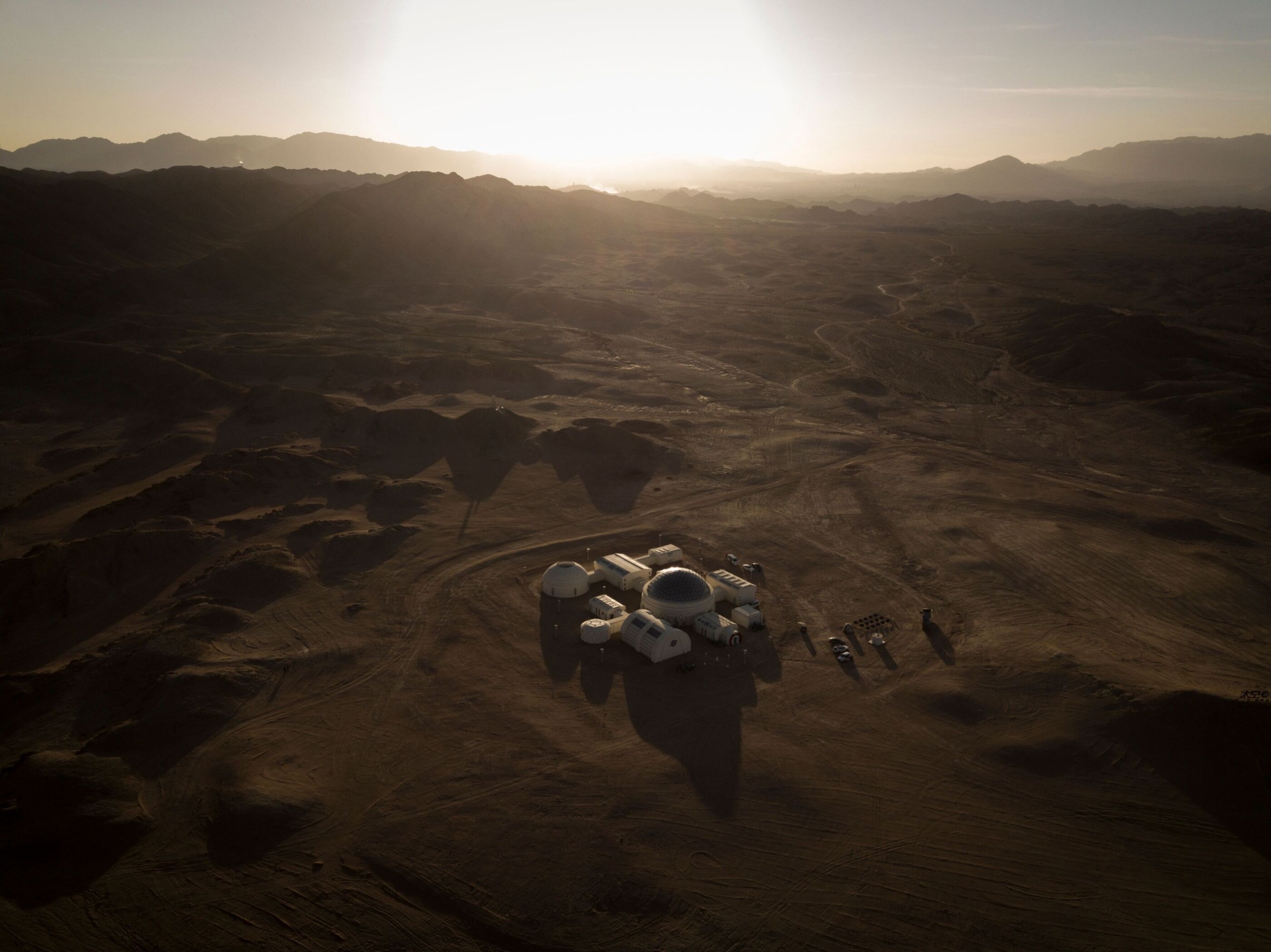
Aerial image of a Mars base simulation surrounded by the empty Gobi desert valleys and mountains
“Mars Base 1” is a Mars simulation center in the Gobi desert. Photographer: Wang Zhao/AFP via Getty Images
"[With lunar exploration], there's always the prospect of rescue or provisioning or supply from Earth or from a midway space station."
"That's not going to be the case for Mars."
Alice Gorman, associate professor, Flinders University, Adelaide, member advisory council Space Industry Association of Australia

"It's a very gruesome way to die [hit by radiation from unpredictable solar flares]."
"We don't have established capacity to observe the Sun from different angles for tracking solar storms."
Lewis Dartnell, professor, astrobiology specialist, Department of Life Sciences, University of Westminster, London

"'During a massive dust storm], it's almost like midnight on the surface of Mars for two months."
"If you are there with solar panels for power, you very likely don't survive."
"You don't have enough energy to keep things warm enough."
Nilton Renno, professor, astrobiology research, University of Michigan

"Today it's definitely a place where we can't live."
"But as we develop science and technologies, the answer might be different in fifty to a  hundred years from now."
Adnan AlRais, Mars 2117 program manager, Mohammed Bin Rashid Space Center, United Arab Emirates
caption
 
There are future plans, ambitious and determined from various sources, to have humans visit Mars and perform preparatory work to form a colony on the Red Planet. NASA plans to send astronauts at some point in the 2030s to Mars. China stated that sending humans to Mars is a long-term goal it holds. The United Arab Emirates promotes a 100-year plan for the creation of a colony; for a starter it has a spacecraft orbiting Mars. For anyone interested in the here-and-now in experiencing what it might feel like to land on the planet, there is a site in the Gobi Desert simulating being there.

And then there's Elon Musk, that forward-looking billionaire, founder of Space Exploration Technologies whose plan is to send humans to Mars within the decade, confident that a crewed mission could occur in 2026. There are risks, he acknowledges, having responded in the face of warning by many scientists that too many unanswered questions confront deep-space travel. "Honestly", remarked the tycoon, "a bunch of people probably will die at the beginning."

It took but a few days for the Apollo astronauts to fly to the moon. Mars, on the other hand, would require between six to nine months for arrival from Earth, the distance between Mars and our planet varying between 35 million miles and 249 million miles taking into account their elliptical orbits, with a small window potentiating when the two would be ideally aligned for space travel; tricky logistics.
 
International Space Station astronauts have been helping to pave the wave for future manned Mars missions. Image via NASA.
 
Exposure during a long flight to one of space travel's terrors, solar flares would await any humans who opted for the experience. Solar flares represent immensely violent hydrogen explosions capable of obliterating everything in their near vicinity, they represent the most powerful explosives in the solar system. A single flare representing the equivalent of 100 million hydrogen bombs. While the Earth's magnetic field can shield orbiting astronauts, a deep-space traveller hit by fierce radiation couldn't survive beyond a few days.

On a multi-month trip to Mars, conceivably shields could be made of water tanks onboard the spacecraft were they to be properly positioned, so in the event of a flare, the spacecraft's version of a panic room surrounded by water tanks could offer a safe retreat to travellers. A bit of a stickler is detecting activity on the Sun, particularly on the side facing away from Earth. So there's the problem of radiation where Mars's thinner atmosphere without a global magnetic shield sees humans risk exposure to solar and cosmic radiation.
 
NASA is developing the capabilities needed to send humans to an asteroid by 2025 and Mars in the 2030s – goals outlined in the bipartisan NASA Authorization Act of 2010 and in the U.S. National Space Policy   vis NASA
 
Then, there's the problem of massive storms that can produce dust clouds to block out the sun, since the Mars surface is itself largely comprised of dust. Humans could conceivably use the dust for protection by lining shelters with sandbags filled with Martian soil to block out radiation, offers associate professor Joseph Michalski, who studies the habitability of Mars at the University of Hong Kong. Cave-dwelling could also be a mode of shelter by exploiting some of Mars's lava tubes, large caverns left over from space antiquity when Mars experienced volcanic activity.

There are experiments taking place in growing algae in low-nutrient environments, in greenhouses as a source of food and the production of oxygen. Survival must include a water source. Mars does contain some sub-surface ice that could be transformed to water. For that purpose the use of radar to map the distribution of sub-surface ice would be invaluable to a future Mars mission. "Once you know where the ice is, those are locations where you might send humans", noted Victoria Hamilton, planetary geologist at the Southwest Research Institute, Boulder, Colorado.

How many people, at a guess, would opt for a one-way trip to Mars, disinterested in returning to Earth? Once on Mars it would take a rocket to return to Earth, and where the fuel would come from to power the spacecraft for a return journey through space remains a huge technological puzzle. "It's not the case that we would bring the rocket fuel with us. It's just too heavy", pointed out Michalski. He offers a potential solution of producing fuel by electrically separating water from sub-surface ice and hydrated rocks, combining the hydrogen and oxygen for rocket fuel. 

TK
An artist’s rendering of SpaceX’s Starship. Source: SpaceX

Labels: , , , , ,

Sunday, January 05, 2020

Getting Close Up And Personal

"All of this brand new information about how the way our star works is going to help us understand how the sun drives change in the space environment throughout our solar system."
Nicola Fox, director, Heliophysics Division, NASA

"[The instrument picked up other powerful waves] kind of like rogue waves in the ocean."
"[Each wave would last seconds to minutes] just as quickly, in seconds, it goes past us, and we're back in the normal solar wind."
"These are very large and energetic events. We're really excited about this, because we think it tells us a possible path to understanding how energy is getting from the sun into the atmosphere and heating it."
Justin C.Kasper, professor, space sciences and engineering, University of Michigan
Image result for parker solar probe images
Parker Solar Probe: close to the sun   NASA
Launched last year, NASA's Parker Solar Probe after three loops toward the sun reaching speeds eclipsing any ever produced by a man-made vehicle, released findings on December 4, hailed as revelations of the sun's dynamics recognized as stranger than science has yet imagined. As the vehicle passed within some 24 million kilometers of the surface of the sun in its first two probes, it sent back observations resulting in the publication of four papers in the journal Nature.

The data collected and avidly studied by astrophysicists may in time lead to the development of processes whereby advance warning of solar storms with the potential to knock out satellites and electrical grids, or post a danger to the health of astronauts in orbit. The sun is comprised of the most space-common elements, making it a huge sphere comprised of hydrogen and helium.

Scientists have puzzled for decades over what and why it is that produces the superheated atmosphere of the sun where its surface is about 5,600 degrees Celsius, and in the thin atmosphere above it, known as the corona, the heat is even more incomparably intense. In a leap of a factor of 300 and over, the corona's temperature soars to over a million degrees, and its heat accelerates solar wind.

Solar wind is a phenomenal 1.5 million kph stream of particles flying away from the sun. Professor Kasper, linked to one of the four experimental instruments aboard the probe, theorized that vibration of the sun's magnetic fields was critical to the corona's heating. The opportunity to discover what such vibrations would appear as, closer to the sun was his goal.

And just as he and his colleagues anticipated the vibrations did increase their momentum but an added bonus was that additional, powerful wave activity was also picked up by the instrument. So that the spacecraft, swept by the speed of the solar wind, in seconds saw a rise by 480,000 kph, with each wave lasting seconds to minutes. The direction of the magnetic field flipped, producing S-shape twists, as a result of the strength of the waves.

imagery from SOHO showing energetic particles from Sun
 Energy particle impact will help scientists understand how these events accelerate
Credits: ESA/NASA/SOHO

Scientists, thanks to the closer view of the sun, now have a firmer grasp of where solar wind originates. Moving at  relatively slow speeds of under 1.6 million kilometers per hour on slow mode, the solar wind emerges from locations linked with sunspots and where hydrogen and helium are colder and less dense, called sun spots, near the sun's Equator.

A picture of the cloud of dust surrounding the sun and the corona comprised of bits shed from comets and asteroids is emerging from the spacecraft. Thinner closer to the sun, the dust matches expectations for a dust-free zone around our star that has long been theorized, and thanks to the probe, finally confirmed.

cosmic dust (illustrated here) — scattered throughout our solar system
Parker Solar Probe saw cosmic dust (illustrated) scattered throughout our solar system

"It's a bit early to say whether these discoveries actually overturn existing models."
"They definitely show that there is a lot more happening close to the sun and that it's absolutely worth going there to explore further."
Daniel Verscharen, Senior Research Fellow. Dept of Space & Climate Physics. Faculty of Maths & Physical Sciences, University College London
animated illustration of solar switchbacks
Parker Solar Probe observed switchbacks — traveling disturbances in the solar wind that caused the magnetic field to bend back on itself — an as-yet unexplained phenomenon that might help scientists uncover more information about how the solar wind is accelerated from the Sun.
Credits: NASA's Goddard Space Flight Center/Conceptual Image Lab/Adriana Manrique Gutierrez


Labels: ,

 
()() Follow @rheytah Tweet