Ruminations

Blog dedicated primarily to randomly selected news items; comments reflecting personal perceptions

Monday, July 21, 2025

The Syrian Druze October 7

"This is our Oct. 7." 
"Life froze. We keep watching the videos that the terrorists took of themselves butchering our families, feeling angry, anxious and completely destabilized."
Sari Halabi, Majdal Shams, Syria
 
"[The Druze attachment to Syria] is an asset to Israel, not a liability."
"This attachment opens the path to many things, which I think the terrible massacre has brought closer, including a Druze autonomy fighting and flourishing alongside Israel [on the Syrian side of the border]."
"The massacre will help settle an internal debate within the Druze community in Syria, and it will lead to more support for autonomy and self-reliance; [autonomy means deepening the alliance with Israel, which is the only major power interested in a Druze buffer zone along its northeastern border]."
"I was just sitting there watching the horror videos, one by one. Just like we all did on Oct. 7 [Hamas atrocities in southern Israel]."
Mr. Halabi, Druze citizen, Majdal Shams, Syria
 
"[The Syrian regime, led by Ahmed al-Sharaa, a former al-Qaeda jihadist terrorist who rose to power in December], sent an army south of Damascus, into the area that should be demilitarized, and it began to massacre the Druze."
"We could not accept this in any way."
Israeli Prime Minister Benjamin Netanyahu  
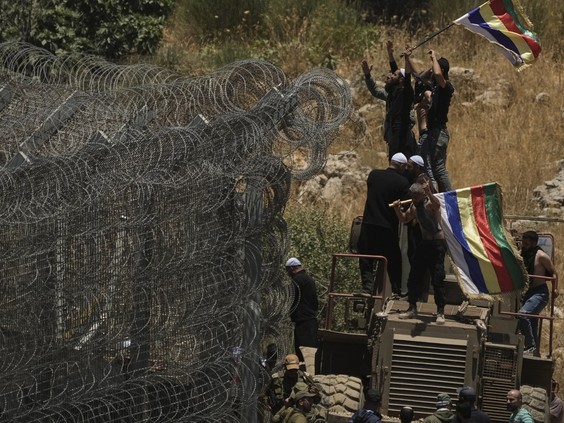
https://smartcdn.gprod.postmedia.digital/nationalpost/wp-content/uploads/2025/07/aptopix-israel-syria-clashes_297711813.jpg?quality=90&strip=all&w=564&type=webp&sig=mLnkp4dL_mo0TlEX1OAwbQ
Syrian Druze protest near the Israeli-Syrian border, as seen from the town of Majdal Shams in the Israeli-controlled Golan Heights on Wednesday amid the ongoing clashes between Syrian government forces and Druze armed groups in the southern Syrian city of Sweida. Photo by Leo Correa /AP
  
"We saw the pictures [massacres, beheadings and rapes, including of women and children allegedly carried out by state-sponsored militias]."
"I think Israel needs to understand: Once a jihadist, always a jihadist [al-Sharaa, a leading figure in Al-Qaeda before founding Hayat Tahrir al-Sham, which led the overthrow of the Assad regime in December 2024]."
"I embrace our Druze brothers—they’re our brothers in every way."
Israeli National Security Minister Itamar Ben-Gvir  
 
"The past few terrible days followed a very difficult year."
"But it led to an act of brotherly courage that, even though it came too late, will be remembered for generations and saved many lives [Israeli strikes in Damascus, including on the Syrian army’s general staff headquarters]."
"[The strikes in Damascus were indeed meant to protect the Druze in Syria, and as such were] an unprecedented act of solidarity that will usher in a new level of integration and fraternity between Jews and Druze." 
"I’m optimistic. Just like Israel emerged from Oct 7. much stronger than it was before, so too will the Druze — and their eternal alliance with Israel." 
Abdulla Rabah, Majdal Shams, Syria 
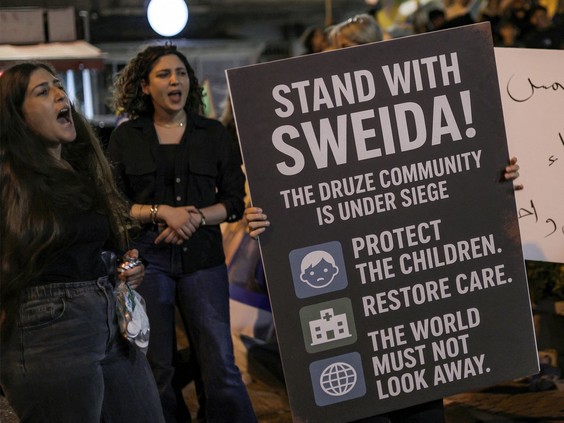
https://smartcdn.gprod.postmedia.digital/nationalpost/wp-content/uploads/2025/07/2225115721_297767311.jpg?quality=90&strip=all&w=564&type=webp&sig=a3PgNrprQEdiEuyXMZqLXQ
Members of the Druze community in the Israel-annexed Golan Heights gather for a rally in solidarity with the Druze community in Syria in the village of Majdal Shams in the Golan on July 19, 2025. Photo by JALAA MAREY /AFP via Getty Images
 
What began a week ago as a disagreement between the Druze and the Bedouin communities over a single incident between a single member of each side, rapidly grew to a hostile event with the eruption of violence between the two communities' militias.  All too soon matters deteriorated to a horrifying degree with a July 13 massacre when hundreds of Druze Syrians were murdered. The government forces of Syria's interim president had been dispatched in the face of the unfolding violence, but rather than a stance of neutral separation of the two belligerents, the Syrian military took up with the Bedouin and joined their sectarian-tribal assaults against the Druze.
 
A massacre ensued, with both the Bedouin militias and the government forces (Sunnis both, as opposed to the Shia-offshoot Druze) in an unrestrained assault against the Druze began butchering civilians. Videos surfaced of men forced to leap from the top of buildings to their deaths. Of rapes, decapitations, mutilations and blood-curdling atrocities where women and children were relentlessly butchered in Sweida, the Druze holy places desecrated, Druze religious figures humiliated, elderly Druze men being forcefully shaved of their beards.
 
Young men from the Israeli Druze community crossed the border into Syria toward Sweida to help their brethren in Syria fend off the savagery. Syrian Druze in a bid to flee the violence threatening their lives, crossed the border into Israel to seek haven there, on July15. And Israel sent its warplanes into Syria to bomb a number of critical regime sites, after Israeli Druze -- some 150,000 of whom are Israeli citizens -- demanded that Israel respond to the situation in support of the Syrian Druze community in southern Syria. 
 
After the December ouster of Alawite Syrian dictatorialPresident Bashar al-Assad who had persecuted the Syrian Sunni majority and turned a protest into a 14-year civil war, where the regime bombed, strafed, used poison gas and artillery and barrel bombs against Sunni Syrian communities, the Syrian regime changed with its head, a former al-Qaeda jihadist terrorist, Ahmed al-Sharaa, taking the helm of government. Under this government, minorities -- Syrian Christians, Druze, Kurds and Alawites, feared for their security. A massacre took place previously, when Sunni militias linked to the al-Sharaa government attacked the Alawite community.
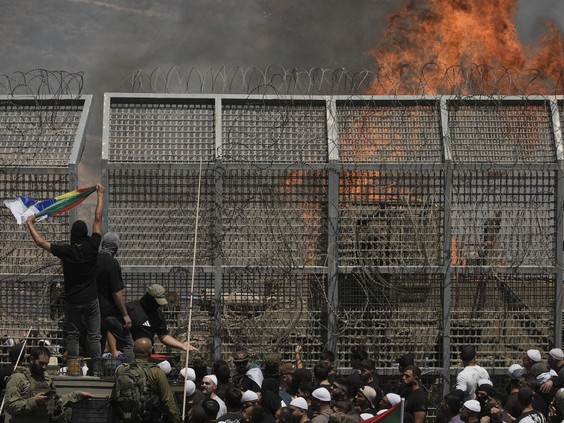
 
https://smartcdn.gprod.postmedia.digital/nationalpost/wp-content/uploads/2025/07/aptopix-israel-syria-clashes_297713133.jpg?quality=90&strip=all&w=564&h=423&type=webp&sig=xbANviBT6Jv4vI1kekVsaQ

Labels: , , , , , , ,

Wednesday, August 12, 2015

Inspired to Fight ISIL

"There was no one event that motivated me. Seeing evil beyond evil, the video of the Canadian guy (John Maguire) joining ISIL, the fact that governments weren't doing anything about it. And then I learned about what the Kurds were doing, and I flew to Iraq."
"It was really tranquil and beautiful [mountain camp] and it reminded me of the Okanagan. There were little caves and little huts, hidden in the trees in the hills. I could spend a lot of time there."
"I had considered joining the Canadian Army, but what I was looking for was exactly what I was doing in Rojava [Syria, with the YPJ, Kurdish women's defence forces]. I didn't want to sit around for years in Edmonton or Ottawa."
"About an hour later, [post night-time firefight] there was all kinds of cheering -- it was impressive. The next day, I found out the village we were in was in shooting distance of (enemy) snipers, only 500 metres from the enemy."
"The air strikes would hit their position [U.S.-led airstrikes against ISIL], and then we'd run in and capture or kill the Daesh [ISIL fighters]. Most of the time, they would run away."
"ISIL fighters would sneak up and we could hear them, but not see them. They had night vision [goggles], but we didn't. They could be just across the street. But it didn't bother me. I thought about why it didn't bother me, and that's just how I am."
"The air strikes are really the terrifying thing. I've seen what it does to bodies. Getting killed in an air strike wouldn't be so bad. But being caught in a collapsed building or buried alive, crushed or suffocated ....
"I saw bodies, and bits of bodies. I helped kill people. But I forget those things. What sticks in my mind are the Kurds. Canadians have a reputation for being friendly, but I don't think they are. They're just polite. But the Kurds are so unbelievably friendly and nice and egalitarian."
Hanna Bohman, Vancouver
Courtesy of Hanna Bohman
Courtesy of Hanna Bohman   Hanna Bohman, from Vancouver, spent five months fighting ISIS with the Kurdish women's defence forces, known as the YPJ, in northern Syria. She has returned to Canada.

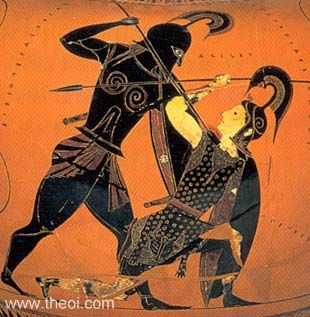
Tough Islamic State fighters rushing off in panic rather than be confronted by fierce Kurdish women fighters of the Kurdish women's defence forces, the YPJ. After all, in ancient history and legend a race of women warriors became famous for their ferocious fighting skills. The Amazons were a fighting force to be reckoned with, said to have come out of Turkey, women whose endurance, strength and capability as fighters were second to none.

Achilles slaying Penthesileia | Athenian black-figure amphora C6th B.C. | British Museum, London Achilles slaying Penthesileia, Athenian black figure
amphora 6th B.C., British Museum, London


During the Trojan war, Achilles met the Amazon Queen Penthesileia in combat. He had almost met his match in combat strength and agile skill in that skirmish. Legend has it that her beauty dazzled him, but in the heat of battle he mastered her fighting capability by his own legendary skill, and killed her. And then mourned her death, returning her body from the battlefield to be buried with respect and honours as a valiant warrior and a women of outstanding physical appeal. Kurdish women carry on the tradition.

Vancouverite Hanna Bohman, who had once earned a living as a fashion model, persuaded herself that travelling to Syria to join the Kurdish women's fighting force was more suited to her temperament and system of values than more pedestrian occupations she viewed as having little value. She spent four months after crossing from Iraq into Northern Syria to fulfill a wish to be of assistance to people fighting a barbarous tide of jihadists.

She, and ten other Westerners were dispatched across a river in a rubber dinghy in the middle of the night, for basic training. Training consisted primarily of disassembling weapons and piecing them together, and before long she was taken to the front "which was a lot more fun", she said. One of several Canadians who decided to throw in their lot, however temporarily, with the courageous Kurdish defenders against Islamic State incursion into Kurdistan, she gave the dangers inherent in her decision short shrift.

Hanna Bohman became known as Hevi Piling to the Kurds. She spent the first month on sentry duty to look out for suicide trucks, a favourite tactic that Islamic State uses, sending in an explosives-laden truck to crash through barricades, driven by an Islamist fanatic prepared to become honourably martyred. She was uniformed as a fighter, in camouflage fatigues, with a Canadian flag sewn on the shoulder of the jacket.

At the front, the first night premiered a firefight outside the women's sleeping quarters. Despite the sound of gunfire nearby, none of the women were fazed and weren't roused by the duty guard. She soon became accustomed to tolerating the proximity of fighting to wherever she happened to be stationed. She saw a man shot twice in the leg, a temporary casualty that medical attention would normally soon remedy. But in Rojava, she said, no medevac exists.

She also witnessed a young boy she judged to be around 14, fighting alongside his father for ISIL, who was hit by an air strike and was killed by a head injury. She remembers things that would shake the mental equilibrium of most people, and it's primarily the reason that people come away from these experiences with post-traumatic stress syndrome, but she shrugs off these events; they happen and you move on. What does stick with her is the generosity and kindness of the Kurds, that she experienced.

Moreover, she was impressed that in a geographic area where women are oppressed, the women's brigade in Rojava is viewed as equal to that of the men's. Men and women fighters are interchangeable in combat positions. Now, the Kurds, who have met the ISIL challenges head on, and who have worked alongside the U.S.-led coalition in a tandem of cooperative strategy to beat back Islamic State, have another enemy to contend with. Turkey has declared war on Kurdish fighters.

The government of President Recep Tayyip Erdogan and his Justice and Development party, has emphasized their classification of Kurdish militias -- particularly the Turkish PKK with whom it has been long at war as separatists -- as terrorists, no less so, as far as Ankara is concerned, than the Islamic State of Iraq and the Levant. And so, under the guise of being a member of NATO fulfilling its obligation to fight Islamic State, Turkey is aiming its guns primarily at the Kurds.

"I think about going back a lot. I miss my friends there and I worry about them and it felt like a real purpose. Here in Canada, I feel like I'm sucking air -- not doing anything that matters", she told an interviewer.
Courtesy of Hanna Bohman

Labels: , , ,

Thursday, May 14, 2015

Mistaken Identity/The Fog of Conflict

"[Kurds at the outpost that night were] legitimately concerned about an additional attack by ISIS, similar to the one they'd experienced the night before."
"Our [Canadian instructors] presence at or near the forward positions remains the exception and definitely not the rule."
"He was looking at Canadians, but he saw what he thought was an ISIS infiltration and attack on his position. [The Kurdish combatant] did not wake up in the morning wanting to kill a Canadian soldier."
Canadian special forces commander Brig.-Gen. Mike Rouleau

"[Two separate investigations held responsible] mistaken identity and a breakdown in communication in a setting characterized by tension, fatigue and confusion."
"[Investigators concluded that Sgt.Andrew Joseph Doiron] performed his job to the highest standards both prior to and throughout the incident [and the Canadians] conducted their operations appropriately and in concert with all pre-approved and accepted protocols."
"It was also determined that no Arabic was spoken by [Doiron's team] on the approach to the final position that night, and that Arabic was only spoken after the accident, during the co-ordination of the medevac."
Investigative report on 'mistaken identity' tragedy
Corporal Levarre McDonald 8 Wing Imaging
Corporal Levarre McDonald 8 Wing Imaging    A repatriation ceremony for Sergeant Andrew Doiron at CFB Trenton on March 10, 2015.
 
When four Canadian soldiers were fired upon by their Kurdish counterparts on March 6, killing their leader, St. Andrew Joseph Doiron and injuring others, shock and dismay ensued on both sides. At the time, a Kurdish commander had been quoted as suggesting that blame for the unfortunate incident was attributable to the fact that the Canadians had approached "the fighting without our co-ordination", and that since the Canadians had spoken in Arabic "leading the peshmerga to believe they were ISIL militants", they were shot.

Dozens of Canadian commandos, specialized in conflict situations were in northern Iraq to help Kurdish fighters in their conflict with the Islamic State. The outpost in question had been under attack the night before, when though several ISIS jihadis were killed, the Kurds also took losses. Early that day the Canadians had been asked by the Kurds to help fortify the position, and they agreed they would return later that night, to do just that.

In the interim the original Kurdish fighters who had requested Canadian help, were withdrawn, with a replacement group moving into the position. The new group, knowing what had occurred the night before with a deadly ISIS attack were nervous, and no one had explained to them the agreement made earlier in the day with the Canadian soldiers. When the Canadian special forces team headed by Sgt. Doiron moved in the dark toward the defended position they noted the presence of a Kurdish fighter on a rooftop.

Simultaneously, the Kurd noted the presence of the four Canadians approaching their position. Sgt. Doiron called out a pre-arranged coded greeting to assure the Kurds that it was the Canadian group coming closer. In response the Canadians could hear the sound of a weapon being cocked: "Wow, wow, wow, Canada!", called out Sgt. Doiron. Whereupon the Kurdish fighter opened fire hitting the sergeant while the others dived for cover.

And then a machine gun was brought into action, bullets flooding from the Kurdish outpost that the Canadians had been approaching as had been pre-arranged earlier that same day. Each time the three Canadian soldiers attempted to retrieve their fallen comrade, the Kurds opened fire again, finally hitting the other three Canadians as well. In the melee that ensued, the Canadians held their fire. And then the Kurds understood that they had fired in error.

They collected Sgt. Doiron and the rest of the team into vehicles and drove to where a helicopter could evacuate them for medical treatment. It was too late, however, to save Sgt. Doiron. Now Canadian military officials have made public the details of exactly what had occurred, releasing a summary of two separate investigations. It was revealed that the Canadian team had encountered a pack of wild dogs as they made their way to the outpost.


The barking that ensued, according to Brig.-Gen. Rouleau "likely further heightened already high Kurdish anxiety levels." Now, in the wake of that unfortunate blight in the co-operation between the Kurdish peshmerga and Canadian instructors, Canadian soldiers in Iraq are permitted to move at night only when escorted by a Kurdish soldier.

That "friendly fire" incident appears to be a standard in all theatres of war; accidents that simply don't seem to be preventable in the confusion that always accompanies such events, when nervous soldiers standing guard occasionally pull the trigger, intimidated by what they are uncertain of, determined to evade facing an enemy, with dire consequences, as a result of not being sufficiently alert.

Labels: , , , ,

 
()() Follow @rheytah Tweet