Ruminations

Blog dedicated primarily to randomly selected news items; comments reflecting personal perceptions

Sunday, December 01, 2024

Yet Another Migrant Tragedy

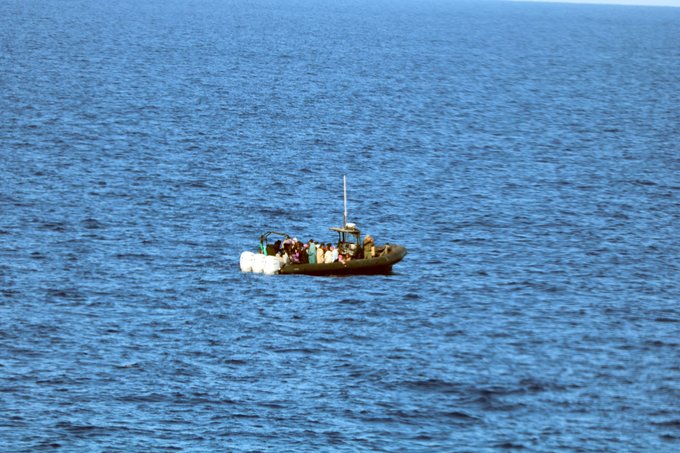
"Many people were on an overcrowded rubber dinghy that was deflating, and they were threatened by armed men, who fired shots.''
"They lived the horror of being separated from their wives and daughters, who were taken away." 
Maria Eliana Tunno, psychologist, Doctors Without Borders

"MSF team witnessed another tragedy this morning while arriving to rescue people in distress on a deflating rubber boat, with armed men on a fast boat in their close vicinity."
"Survivors reported that 29 women and children had been intercepted at gunpoint before our arrival."
"Survivors are anxious and deeply concerned about the fate of their female and underage relatives, who were beaten and taken at gunpoint and will once more face the cycle of violence, detention, abuse and extortion."
MSF social media post
https://pbs.twimg.com/media/GdfGVCIXYAESSXb?format=jpg&name=small
Photo: MSF
 
Over 62,000 migrants so far this year have arrived by sea to Italy. Large as that number appears, it is a large drop from the over 152,000 migrants who made the perilous journey over the same period in 2023.
Despite the hardships and the danger, let alone the news that trickles back to them of the disastrous outcomes that many migrants like themselves have experienced, the migrants seem determined to take their chances and they continue leaving their places of origin on the chance their futures will be assured.
 
So far this  year, 2,124 migrants have died in the attempt they committed to,  in making the crossing this year over the Central Mediterranean, according to reports from the United Nations. One such group recently, engaged in their effort to make a new life for themselves elsewhere than Eritrea, Yemen and Ethiopia were exposed to and became victims of armed marauders. Armed men in two speedboats abducted women and children and no one has any idea what has become of them. 

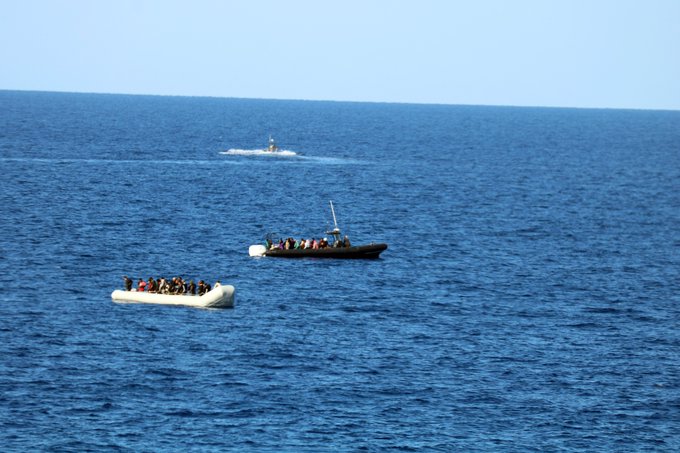
They were with their families when their overloaded rubber dinghy with a total of 112 migrants began deflating just off the Libyan coast, their debarkation point. Although their passage through Libya comes with the very real danger of abuse and violence, and even death, a kind of mass social psychosis appears to convince  would-be migrants that their efforts will be rewarded, that they will be immune from the dreadful experiences of others before them. 
 
They feel compelled to make the effort, and only they know why; or perhaps they really don't. In this instance dozens of men and boys who were aboard the dingy as it deflated leaped into the sea, according to Doctors Without Borders. The Geo Barents, the MSF ship, arrived on scene in international waters where they rescued 83 men and unaccompanied minors, 70 of whom were plucked to safety from the sea.

The people with Medicines sans Frontieres noted two speedboats, both of which claimed to belong to the Libyan Coast Guard, nearby. Some of the rescued men later informed MSF personnel that shots had been fired from the speedboats, although no one had been shot or injured. One of the speedboats had taken 24 women and four children aboard, informing those with the Geo Barents their intention to hand them over following the rescue of the men.

That speedboat, however sped away, according to MSF spokesman Maurizio Debbane. It had not been established who the armed men actually were, and what happened to the abducted women and children has not been established. An appeal went out from MSF to local authorities and organizations to help in the urgency to reunite the families, in the knowledge that Libya is not a safe environment for them, noting that the episode they had witnessed placed people "in danger, the lives of many people, and separated entire families".

According to Ms.Tunno, the rescued men and boys were "very tired, desperate and under shock". Many of them had experienced abuse and inhumane treatment while in Libya.
https://pbs.twimg.com/media/GdfGVCGWkAAjJVI?format=jpg&name=small
Photo: MSF

Labels: , , , , ,

Friday, September 15, 2023

A Disaster of 'Mythic' Proportions, Libya

"The focus of efforts is now on burials, so we don't subject the city to a new disaster."
"The bodies are in the sea water, and under rubble. So we need specialized rescue teams." 
"Cars and dead bodies barged into the house. We opened the doors and the water filled the floor, so we moved to the second floor [and the water continued to rise]."
"[Outside], the corpses were in the hundreds. You open your door and see hundreds; they floated into the buildings from doors, from windows."
Husam Abdel Gawi, 31, Derna rescue volunteer

"There are conflicts in the number ... of deaths, but what matters is that the deaths number in the thousands."
"This disaster is of mythic proportions. A disaster by all measures. Now, the retrieval of the corpses is important, as is burying the copses before they disintegrate ... and cause some environmental issues."
Ahmed Zouiten, Libya representative, World Health Organization

"[Had there been normal public services available in Libya], they could have issued a warning and also the emergency management authorities would have been able to carry out evacuation of the people, and we could have avoided most of the human casualties."
Petteri Taalas, head, UN World Meteorological Organization 
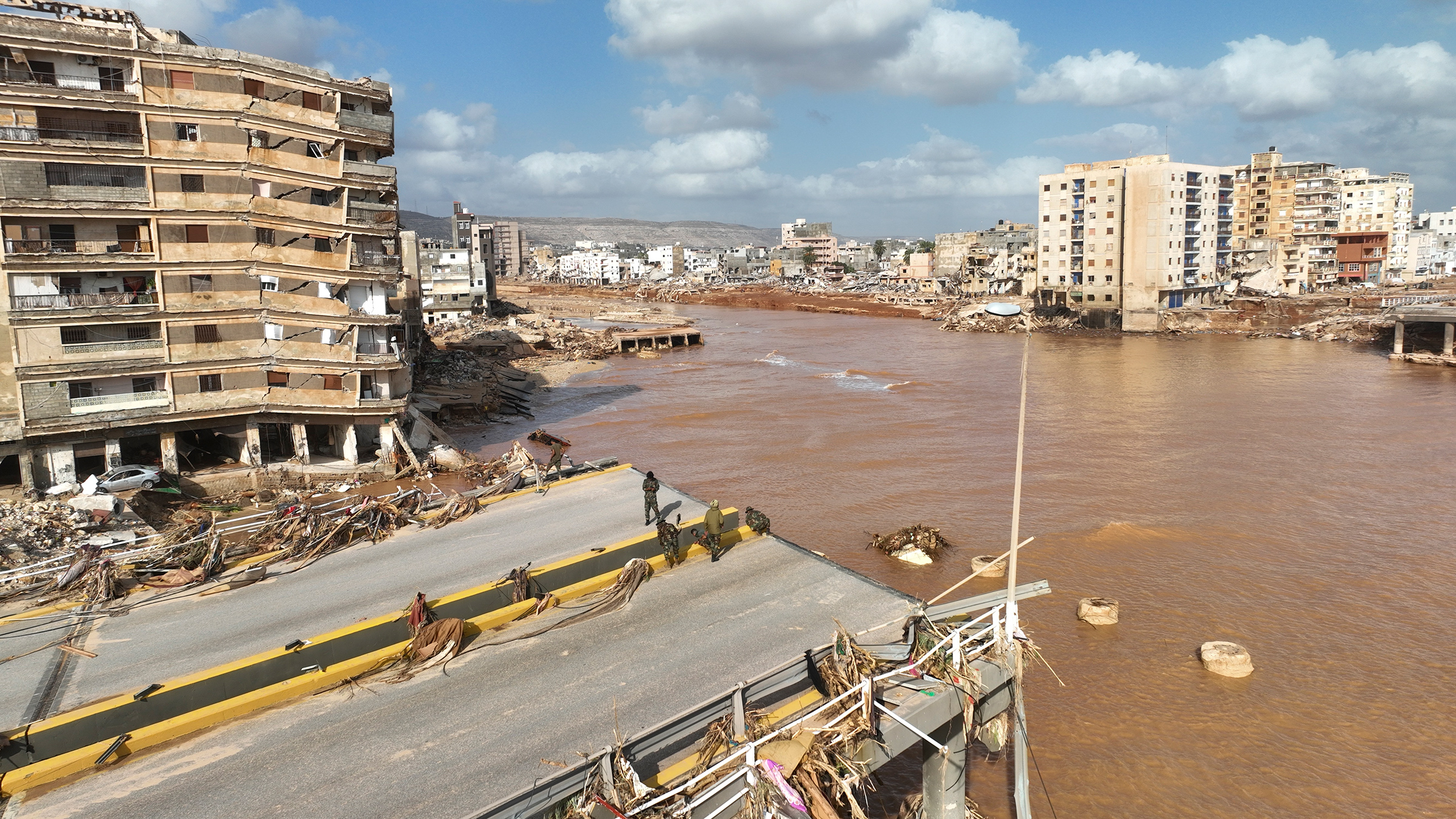
Floodwaters from Storm Daniel are visible in Derna, Libya, on Sept. 12.  (Jamal Alkomaty—AP)
Floodwaters from Storm Daniel are visible in Derna, Libya, on Sept. 12.
Jamal Alkomaty—AP
 
The latest numbers of 20,000 people dead in Libya's flood-devastated east, speaks to the shock of a nation under duress to cope with the tragedy. Search and relief efforts are ongoing in a gigantic effort to try to stem the possibility of an additional disaster striking the area in the wake of the current tragedy caused by Storm Daniel when the coast was pounded, submerging neighbourhoods and drawing numberless residents out to sea, to their death.

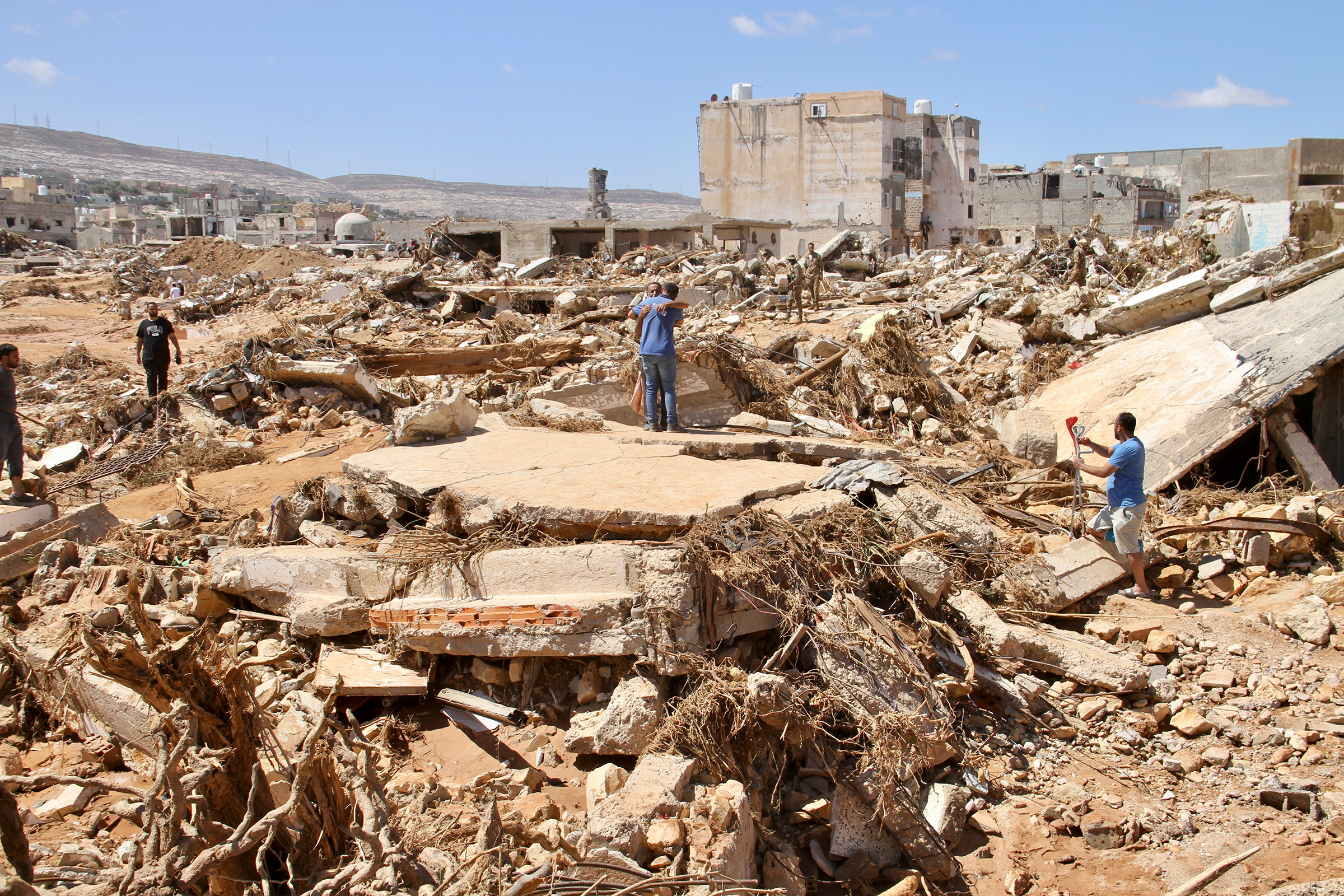
Derna, the city hardest hit by the storm was alone bereft of between 18,000 and 20,00 of its population, "based on the number of neighbourhoods destroyed", explained Abdulmenam al-Ghaithi, its mayor. The focus of current efforts lie now on accounting for the additional thousands of people considered to be missing. Teams were scouring the city for dead, in the fear the bodies could pose environmental and health risks as they decompose.

Abdel Gawi pointed out that only two overseas special rescue teams were on site, to date. Men carried bodies to trucks to be transported to areas outside the city where trenches had been dug and the corpses were to be buried in mass graves, in this emergency situation. Outside of Derna, 3,000 bodies had been interred with another 2,000 yet to be buried, while teams of divers comb the sea for additional victims. 

Three regional hospitals are now completely out of service, although several others remain partially operational. According to Yann Fridez, head of the ICRC's Libya delegation, a wave about seven metres in height "wiped out buildings and washed infrastructure into the sea". Humanitarian efforts to reach the flood-hit east have been hindered by seriously flood-degraded roadways. To complicate matters and add another level of danger, unexploded ordnance and abandoned munition stores in Derna pose another threat.
 
People look for survivors in Derna on Sept.13. Search teams are combing streets, wrecked buildings, and even the sea to look for bodies in Derna. (Yousef Murad—AP)
People look for survivors in Derna on Sept.13. Search teams are combing streets, wrecked buildings, and even the sea to look for bodies in Derna. Yousef Murad—AP
 
Had proper early warning services been in place, the scale of the tragedy could have been avoidable. Since there were none, no evacuation orders had been issued prior to the storm striking the area on Sunday night, irrespective of the fact that Storm Daniel had already left a destructive trail in Greece, Turkey and Bulgaria. 

The city of Derna happened to be particularly vulnerable given its geographic placement -- when floodwaters poured down from the hills the city is surrounded by, then burst through two dams, finally washing away a quarter of the inhabited area. Much of it it remains under water. 
 
The landscape, some 135 kilometres outside Derna, was still marked by stagnant floodwaters clogging fields. Dozens of aid trucks and excavators from across the country headed to the affected region even as cars covered in red silt were leaving the flood zone.

Flooding aftermath is seen in Derna, Libya, Thursday, Sept.14, 2023. Search teams are combing streets, wrecked buildings, and even the sea to look for bodies in Derna, where the collapse of two dams unleashed a massive flash flood that killed thousands of people. (AP Photo/Yousef Murad)
Flooding aftermath is seen in Derna, Libya, Thursday, Sept.14, 2023. (AP Photo/Yousef Murad)

Labels: , , , , ,

Saturday, March 18, 2023

Raw Uranium In The Wrong Possession

"[On Tuesday] agency safeguards inspectors found that ten drums containing approximately 2.5 tons of natural uranium in the form of  uranium ore concentrate wee not present as previously declared at a location in the state of Libya."
"Further activities will be conducted by the agency to clarify the circumstances of the removal of the nuclear material and its current location."
International Atomic Energy Agency
IAEA
The International Atomic Energy Agency had warned that the missing uranium presented 'a radiological risk as well as nuclear security concerns' [File: Nacho Doce/Reuters]
 
Libya is not merely a failed state it is a state in the grip of uncivil war as two groups continue to violently vie for control of the country. In the absence of its former dictator Moammar Gadhafi, rival tribal hatred came unleashed to the fore as clans battled one another for supremacy. The West through NATO members was directly involved in the toppling of Gadhafi by giving air cover to the warlords seeking to unseat the tyrant who died a grisly death rising to the occasion of Bedouin desert clan vengeance.

Moammar Gadhafi had stored thousands of  barrels of 'yellowcake' uranium in anticipation of his plan to build a uranium conversion facility. In the end, that facility was never built as part of his decades-long secret weapons program. One of the sites where the yellowcake was stored was Sabha in the southern reaches of the Sahara Desert, about 660 km southeast of Tripoli, a lawless area. After his death many weapons depots were found and raided/looted by the warlords competing with one another for supremacy.

The enriched uranium that Gadhafi had stockpiled was removed for safety reasons, the yellowcake left in place. Several days after the announcement by the IAEA of the missing barrels, a warlord holding himself to be the replacement for Gadhafi as the new president of Libya and whose forces hold half the country divided with two 'presidents' of opposing clans claimed recovery of the missing material. The UN inspectors remain in the process of confirming it is in their possession.

Although natural uranium (yellowcake) is of no immediate use for energy production of bomb fuel as it must go through an enrichment process to be converted into a gas, then spun in centrifuges to reach levels of purification required for bomb material, that the uranium was not in storage with the rest of the barrels and no one could account for its whereabouts was a matter of grave concern that it would fall into the wrong hands.

Each ton of natural uranium in the hands of a group with access to the required technological means and resources, can be refined to 4.5 kilograms of weapons-grade material over time. Which gave the search to discover the whereabouts of the missing metal its impetus by the IAEA inspectors, for the assurance of non-proliferation. Rafael Mariano Grossi, director-general of the IAEA based in Vienna, alerted member states to the missing uranium.

The site, although not identified in the IAEA report, is not under government control. The Libyan stockpile of raw uranium is considered to be comprised of a thousand metric tons of yellowcake uranium, or it was when Gadhafi declared his nascent nuclear weapons aspirations in 2003, following the U.S.-led invasion of Iraq.
 
A man stands next to a Libyan flag.
Sabha — some 660km south-east of Libya's capital, Tripoli — is located in the country's lawless southern reaches of the Sahara Desert.(ABC News: Tracey Shelton)
 
During the time of the Arab Spring rebels toppled Gadhafi and Sabha became increasingly lawless and violent. It has come under the control of the Libyan National Army headed by Khalifa Hifter. General Hifter is backed by Egypt, the United Arab Emirates, Jordan, Sudan, France and Russia. He is not a political Islamist and has vowed to expunge the presence of the Muslim Brotherhood from Libya. The Muslim Brotherhood is considered a terrorist group in Egypt, Saudi Arabia and the UAE.

This is the same Muslim Brotherhood that has infiltrated and established itself throughout Europe and North America, where in the United States in particular, during President Obama's administration the group had entree to the White House as a respectable group loyal to Islam and America. The terrorist group Hamas is an arm of the Muslim Brotherhood. When MB-affiliated Mohammad Morsi became president of Egypt he had the support of the U.S.

The Islamist Muslim Brotherhood government under President Morsi was eventually brought down by Egypt's top general, who had warned President Morsi that the extremes of political Islamism were ruinous for Egypt. General Abdel Fattah El-Sisi is now the President of Egypt. General Hiftar's forces in Libya assured the IAEA they found the drums five kilometres south of the storage facility. Chadian separatist fighters operating in the region had taken the drums mistaking them for weapons and ammunition.

Employees check a barrel filled with yellowcake.
Uranium ore concentrate is commonly known as "yellowcake", a powder consisting of around 80 per cent uranium oxide.(Reuters: Shamil Zhumatov/File)

Labels: , , , ,

 
()() Follow @rheytah Tweet