Ruminations

Blog dedicated primarily to randomly selected news items; comments reflecting personal perceptions

Tuesday, August 22, 2023

Cautionary Lifestyle Approach to Tinnitus Avoidance

"[Tinnitus is] a condition characterized by experiencing sound in one or both of your ears when there is no external source causing that sound."
"Tinnitus sufferers describe it as ringing, whistling, buzzing, hissing, whooshing or other similar sounds, to varying degrees of intensity."
"It can be temporary or chronic and is typically a symptom of an underlying condition."
Mayo Clinic
https://cfvod.kaltura.com/p/1825021/sp/182502100/thumbnail/entry_id/1_kp1ofa0q/version/100022/width/727/height/409
"As we prepared for a take, the engineer hit the talkback button and inadvertently sent a high pitched tone through my left headphone at a massive volume. It knocked me clean off my seat."
"The sound of chirping birds and light breezes would soon become a distant memory."
"So began my experience with tinnitus, described by professionals as a 'constant ringing clicking, hissing, buzzing, whistling or roaring'."
"...I recently took a giant step and got some hearing aids. The devices are as discreet as a hearing aid could be. They do little to help with the tinnitus, but now I don't have to pretend I understand what people are talking about in restaurants and bars."
Tony Horkins, drummer, musician, band member
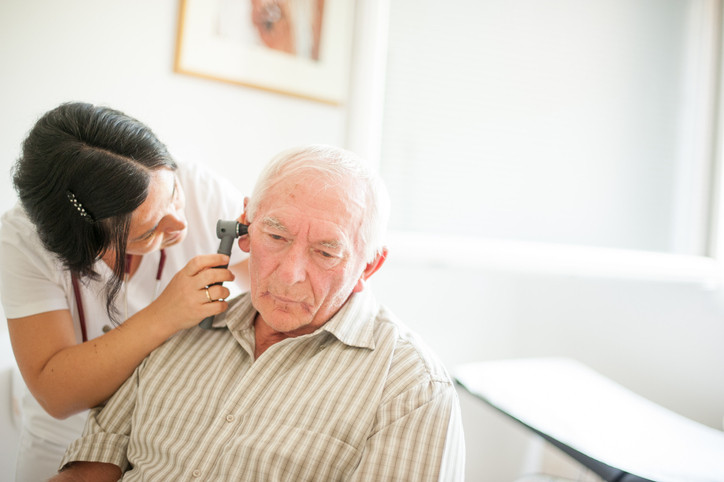
Man receiving an ear exam.
Harvard Health

The condition of tinnitus is held to affect roughly ten to fifteen percent of any population, one or two percent of whom find the condition just about intolerable. For most people the condition arrives gradually, with age. There is no cure for tinnitus, but a team at University of Minnesota recently published a large-scale study for treatment. The trial, headed by professor Hubart Lim, evaluated the efficacy of Lenire, a "non-invasive bimodal neuromodulation approach" using sound combined with electrical stimulation.

After twelve weeks of treatment, up to 80 percent of study participants experienced reduced symptoms of their tinnitus condition. At the Mayo Clinic, experts explain the many ways that tinnitus can become part of daily life; one of the most common introductions to the condition is brought about by exposure to loud sounds. A sudden blast of noise or prolonged exposure to loud sounds; i.e., music concerts, construction equipment, or explosives, can damage the delicate structures of the inner ear.

Age-related hearing loss commonly may lead to tinnitus since sensory cells in the inner ear may deteriorate during a lifetime, causing both hearing loss and tinnitus. Medical conditions also, such as high blood pressure, and medications that include antibiotics and antidepressants, can lead to tinnitus. The elderly are most susceptible to developing tinnitus. Obesity, cardiovascular problems, high blood pressure and a history of arthritis or head injury can increase risk.

If tinnitus is a symptom of a medical condition, according to experts at Johns Hopkins Medicine, treating the condition may help to reduce or eliminate tinnitus effects. Symptoms can be alleviated with sound therapy which aims to mask or distract from the sounds through the introduction of different, external sounds such as white noise machines, fans or specific tinnitus masking devices (sound machines or sleep-focused earbuds). Relief can be found for some sufferers by listening to soft music or nature sounds; streams, wind, rain or birdsong.

There is as well, tinnitus retraining therapy which combines sound therapy with counselling, to aid individuals to acclimatize to the tinnitus sound and reduce its intrusion. People can alter emotional and behavioural responses to tinnitus through cognitive behavioural therapy techniques. Anxiety and stress can be reduced around the problem. No medication has yet been developed specifically to effect a cure of tinnitus, but medications may be prescribed to alleviate specific symptoms such as anxiety or depression.

Avoidance is a good first step to tinnitus awareness in the awareness of loud noises, reduced exposure to implicating foods, medications and chemicals, along with managing stress levels. Regular exercise and adequate sleep are additional lifestyle-quality steps to routinely take with an ear to the future.
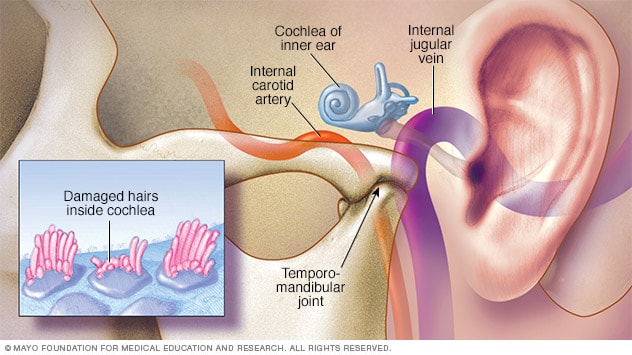
Inside of ear and damaged hairs

Labels: , , , , ,

Sunday, August 20, 2023

Aoh, Those Muscle Cramps!

"Experimental data in healthy college-age men suggests that pickle juice inhibits muscle cramps through a reflex involving a nerve in our threats."
"It's why a tablespoon of pickle brine hitting the back of the throat seemed to bring relief within seconds."
"Pickle juice may also work for cramps that aren't induced by exercise. A randomized controlled trial published last year found that a sip of pickle juice reduced muscle cramp intensity in patients with cirrhosis."
"Researchers believe this improvement is due to a similar reflex that occurs almost immediately, rather than by how pickle juice is metabolized by the gut."
Dr. Trisha Pasricha, Ask a Doctor 
Anyone can suffer from leg cramps, they often occur during night-time sleep with no warning; alternately while exercising, and doctors really have no answers that would satisfy the question why it is they occur at all. Muscle cramps are well known to occur frequently among the elderly population and with athletes, during pregnancy, and dialysis, as well as with people with health conditions such as diabetes, cirrhosis or amyotrophic lateral sclerosis.

Midsummer appears to be peak time for leg cramps, while their occurrence has a tendency to decrease during the winter, one study concluded. Athletes experience cramping which tends to increase in periods of hot weather, even while the cramps are not seen to be related to dehydration and electrolyte imbalances from sweating, a popular misconception.

Calf-plantar fascia stretch
There is no evidence available how best to treat cramps. There are however, two simple solutions that doctors may recommend: to stretch the muscle gently. Or to take a sip of pickle juice. Athletes, it appears, have long sworn by the efficacy and instant relief given them by pickle juice, as bizarre as that may seem. Pickle juice, strained from jars of dill or kosher pickles; alternately other acidic substances like mustard or apple cider vinegar.

"A sip is all it takes. We're not telling people to chug pickle juice", hepatologist at University of Michigan Elliot Tapper said, the 2022's study lead author. Additional research on the effect of pickle juice on muscle cramps is needed. The strategy could be somewhat less helpful for those people with rare leg cramps, or cramps that tend to be of short duration, to justify keeping pickle juice available on short order.

Medical practitioners suggest trial-and-error approaches in the prevention of leg cramps; a few weeks of daily calf and hamstring stretching (reducing the severity, not the frequency of nocturnal leg cramps), magnesium (a recent meta-analysis found this likely produces little effect), or vitamin B complex (which showed some promise in a 1990s small study). Long-acting beta-agonists such as found in Advair or Symbicort and diuretics like spironolactone could be exchanged by a physician for alternate medications.

A double-blind randomized controlled trial published in JAMA Internal Medicine in 2017 found that taking magnesium oxide for a month reduced the number of night leg cramps by about three times weekly, significant enough to go from waking to cramps every night in favour of the same every other night.
  • Stretch and massage. Stretch the cramped muscle and gently rub it. For a calf cramp, keep the leg straight while pulling the top of your foot on the side that's cramped toward your face. Also try standing with your weight on your cramped leg and pressing down firmly. This helps ease a cramp in the back of the thigh too.For a front thigh cramp, try pulling the foot on that leg up toward your buttock. Hold on to a chair to steady yourself.
    Apply heat or cold. Use a warm towel or heating pad on tense or tight muscles. Taking a warm bath or directing the stream of a hot shower onto the cramped muscle also can help. Rubbing the sore muscle with ice also might relieve pain.   Mayo Clinic
  • f25aa7bb-8817-4afe-86f4-8b8598e2756a

Labels: , , , , , , , , ,

 
()() Follow @rheytah Tweet