Ruminations

Blog dedicated primarily to randomly selected news items; comments reflecting personal perceptions

Sunday, April 15, 2018

In An Ideal World....No Death Wishes

"You'd be foolish to use opioids and not grab a naloxone kit."
“All you can think of is getting your next fix [after two of three times receiving naloxone, feeling 'horrible', as in withdrawal]."
Leon "Pops" Alward, Toronto

"Naloxone can't be seen as this wonder drug, that if we had naloxone in everyone's hands all opioid overdoses would go away."
"Right now, the focus is trying to get naloxone in our community and people using it ... so if there is an overdose there's a naloxone kit there to be used."
"If you think of first aid and CPR classes, nobody really tracks who takes that training and because naloxone can't really be harmful, there's no need to monitor it. It's not unusual. It just makes it more challenging to really understand whether naloxone is working."
Tara Gomes, epidemiologist, St.Michael's Hospital, Toronto

"Naloxone is equipping thousands of people in our community to recognize an emergency and respond in an appropriate way when that emergency happens. That's not just a band aid, that's a community-wide change."
"In an ideal world, 100 percent of people who died would have been given something to help."
"Deaths happen when people are alone. We need to get serious about asking, are people dying from being marginalized more than they're dying from an opioid overdose?"
Dr. Aaron Orkin, emergency department physician, Mount Sinai Hospital, Toronto

"They have to be very vigilant and cognizant of the fact that when the naloxone wears off, the chance of the opioid coming back is still there."
"Other people need to be with them to monitor their well-being so if they overdose again someone can call 911 and they can get more definitive treatment."
Adam Thurston, commander, Toronto Paramedic Services


In an ideal world it is not that people dying of narcotic overdoses being helped to survive them would represent a wonderful benefit, rather in an ideal world people would be bypassing entirely the use of such drugs altogether unless prescribed for a definite purpose and even then both prescribing physician and patient would have to be aware of limiting use as well as ensuring that use is carefully structured for a specific purpose for a limited time-frame.

And then there is the larger issue of non-prescription opioids whose popularity has risen monumentally to include fentanyl and now carfentanil, both most frequently used supplementally, mixed in with heroin  and other opioids for greater profitability, both of which are exponentially more powerful than conventional drugs. Education is said to be the key to ensuring that people know the dangers inherent in their use of such drugs.

Information is widely available, including in screaming headlines, about the dangers of street drugs being laced with fentanyl and its even more knock-out cousin carfentanil, but the allure, despite the now-very-well-known dangers lurking behind their use in soaring rates of overdose and death, appears to knock sense out of users. Who also at the back of their minds may rely on the assurance that naloxone is now so widely available, someone will inject it and save them.

Part of an emergency kit includes several containers of naloxone (blue caps).
Part of an emergency kit includes several bottles of Naloxone (blue caps)  Bernard Weil/Toronto Star

In Mr. Alward's case, it was his roommate who used naloxone to revive him when he first overdosed in 2017. Out of that experience he's become a devoted naloxone carrier himself, using it to save others from overdose deaths. Between May and October of 2017, 564 people in Ontario died of opioid overdoses. Of that total number, ninety-six had been administered naloxone by hospital staff, emergency responders or bystanders, representing 17 percent of all opioid-related deaths.

One Toronto paramedic, Jason Benaim, speaks of arriving on scene to find someone in cardiac arrest, injection needle in his arm, no longer breathing. Arriving ten minutes after a patient has stopped breathing, he stresses, negates administering naloxone; nothing will bring that person back to life. "It's frustrating because this (death) is something that could be prevented)".

Even when paramedics are certain an injection is too late to reverse an overdose, the province still requires that naloxone be used.

In the first half of 2017, Toronto Paramedic Services administered on average naloxone 32 times monthly; that number leaped to 54 times in the second half of the year. It is an aid, but no cure, viewed by government, cities and public health units, police, firefighters, paramedics, pharmacists and doctors as the only reactive tool at their disposal in dealing with the opioid crisis across the country.

Four British Columbians die every day; over 1,400 people died of opioid overdoses in 2017 in British Columbia, according to the province's coroner's office. Half that number -- still a substantial number of people -- died of the same cause in Alberta last year. Ontario's Ministry of Health and Long-Term Care ordered naloxone administered by needle to be available free of charge in pharmacies across the province.

Leading 333 Toronto pharmacies to hand out over 12,000 kits to anyone who asks for one. Recently, naloxone administered by nasal spray has been added to the province's distribution program. Toronto Public Health itself distributed 9,000 kits to partner agencies and the public. During an overdose with an opioid like fentanyl difficulty breathing can result and breathing can be stopped altogether, causing cardiac arrest, explained Adam Thurston.
Paramedic Jason Benaim holds a syringe using an intravascular method of administering naloxone to a patient.
Paramedic Jason Benaim holds a syringe using an intravascular method of administering naloxone to a patient. Bernard Weil/Toronto Star

What naloxone does, is reverse the overdose for about 30 minutes, but since opioids remain in the system for a much longer time, the risk of over-dosing after the naloxone has worn off remains. If, explained Mr. Thurston, someone was revived, then used opioids and once again overdosed shortly afterward, naloxone will have failed to succeed.

"People will keep on using their drug even though they've had an overdose and been revived. Naloxone is not enough", explained Dr. Meldon Kahan, substance use director, Women's College Hospital, Toronto. He feels that Suboxone, a prescription drug used to treat opioid addiction, should be more widely available and increased numbers of supervised injection sites established over the four currently in operation in Toronto.

Labels: , , , ,

Friday, March 09, 2018

Coping With a Deadly Public Menace: Opioid Overdoses

"Data imply some saving of auto occupants' lives at the expense of more pedestrian deaths and more nonfatal accidents: 'The Effects of Automobile Safety Regulation'."
Sam Peltzman, economist, University of Chicago, 1975

"We find that broadening Naloxone access led to more opioid-related emergency room visits and more opioid-related theft, with no reduction in opioid-related mortality."
"Our findings do not necessarily imply that we should stop making Naloxone available to individuals suffering from opioid addiction, or those who are at risk of overdose. They do imply that the public health community should acknowledge and prepare for the behavioural effects we find here."
Researchers Jennifer Doleac and Anita Mukherjee, professor, Wisconsin School of Business

"Patients occasionally tell me that having naloxone on hand has served as insurance against overdose. So, in some instances, it enhances risk-taking."
"That said, we must use it to save people in the immediate term."
Sally Satel, psychiatrist, drug-policy scholar, American Enterprise Institute
What is Naloxone?
Naloxone is a medication that quickly reverses the effects of an overdose from opioids such as heroin, methadone, fentanyl and morphine. It is available in without a prescription and often given as an injection into a muscle.

Governments, in the 1960s, appalled by the growing carnage on highways related to drivers' inattention to driving safety coupled with automobile manufacturers' disinterest in building safety features into their products, began to press those same automakers to begin looking at investing in safety technologies to be built into their cars and trucks in an effort to make vehicles safer to drive. It has often been observed that drivers, instead of honing their driving skills with a view to driving more safely, simply became more reckless with the new assurances of safety built into their vehicles.

This had the perverse effect of saving the lives of drivers, but sacrificing the lives of pedestrians. Safety features in vehicles produced the desired result in reducing driver deaths due to the new regulations, but the tendency of drivers to drive with increased recklessness had its unanticipated costs. When locomotives were killing cattle straying onto train tracks, farmers were dismayed and angered by their financial losses. A cage-type device called a cow-catcher was attached to train engines that would scoop up the stray cow, not kill it. Imagine designing a passenger vehicle with a similar device and how popular that would be with consumers.

Drivers who feel it is their entitled right to drink and drive, drive while impaired by drugs, or impair their driving skills by diverting their attention to ubiquitous cellphones don't so much endanger their own lives as they do the lives of other drivers and pedestrians through inexcusable habit unconstrained by either conscience or consequences. In these instances far more severe penalties for flouting the law should be imposed in recognition of the fact that people who behave in this way have no regard whatever for the safety and security of others.

The drug overdose scenario that now haunts North America with the growing use of dangerous opioids, the appearance of powerful drugs like fentany and carfentanil and the penchant of drug dealers using these inexpensive, readily-available more powerful opiates as fillers with other drugs so that people often have no idea what they're using, ending up with drug overdoses, has led public health agencies to recognize the need to have the opioid-antagonist naloxone readily available to reverse a deadly overdose.
 line graphOverdose deaths per day in Alberta ... Source: Alberta Health, Opioids and Substances of Misuse, Alberta Report, 2017 Q4

The very same kind of human reaction has been recognized linked with opioid overdose rescues with naloxone. Users of fentanyl and other similar drugs have developed a degree of confidence in knowing that naloxone is in the possession of a wide range of emergency responders; health workers, firemen, police, even librarians and relatives and friends of those known to be drug-addicted to enable them to respond with an overdose antidote. That confidence has led them to relax their own vigil against overdose; in other words choosing to continue endangering themselves.

Of course, in making that choice it is they alone who after a series of overdoses successfully treated with naloxone, stand a good chance of not surviving another and last one. They are, in the final analysis, harming themselves. They pose no threat to anyone else, other than leaving bereaved relatives suffering, deprived of the presence of a loved one. It simply is not morally feasible to withdraw that support from those reckless enough to keep gambling with their lives, caught in the spiral of their unappeasable addiction.

For a lot of people, it is difficult-to-impossible to ignore the pleas of homeless people, begging for 'spare change'. Some of that 'spare change' will be used for the acquisition of drugs or alcohol. These are people living desperate, dysfunctional and dangerous lives. If a cash pittance from those whose lives are so completely dissimilar can bring a little relief into such dismal lives why not dispense whatever help one can? Moralizing simply results in smoothing balm on one's own conscience.

Until such time as governmental social services are capable of extending useful programs to assist addicts to shed their habits, as well as setting aside the needed funds to provide decent housing to those living rough on the streets in wasted lives, wasted tax dollars on emergency relief, hospital services, police responses, these issues plaguing societies and laying waste to peoples' lives will not be resolved.

A fentanyl overdose will result in several characteristic physical symptoms. These symptoms will be easily observed by those who know what to look for, and include:3,4,5
  • Confusion.
  • Dizziness.
  • Difficulty thinking, speaking, or walking.
  • Pale face.
  • Blue- or purple-colored lips, fingernails, or extremities.
  • Throwing up.
  • Choking sounds.
  • Pinpoint pupils (pupil size reduced to small black circles in middle of eyes).
  • Seizures.
  • Low blood pressure.
  • Slowed heart rate.
  • Excessive drowsiness.
  • Frequent fainting spells (nodding off).
  • Limp body.
  • Unresponsive.
  • Coma.
  • Difficulty breathing.
  • Hypoventilation (slow, shallow breathing).
  • Respiratory arrest.
  • Death.

What’s in a naloxone kit

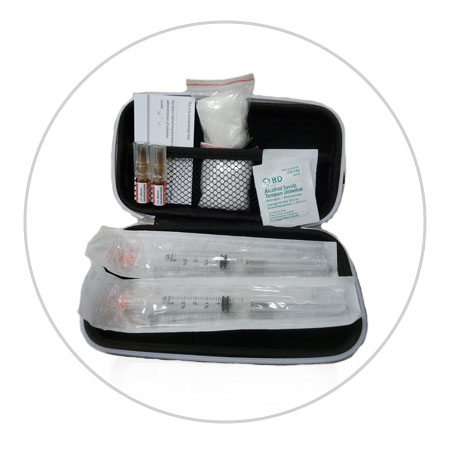
Picture of what is in an injectable naloxone kit: 1 hard case; 2 glass containers of naloxone; 2 syringes; 1 pair of gloves; 1 card that identifies the person who is trained to give the naloxone.
Province of Ontario

Injectable kits    

Each injectable naloxone kit includes:
  • 1 hard case
  • 2 (0.4 mg/1 ml) vials or ampoules (a small glass container) of naloxone
  • 2 safety-engineered syringes with 25g, 1” needles attached
  • 2 devices (known as “breakers,” "snappers,” or “openers”) for opening ampoules safely
  • 1 pair of non-latex gloves
  • 1 card that identifies the person who is trained to give the naloxone


Labels: , , ,

 
()() Follow @rheytah Tweet