Ruminations

Blog dedicated primarily to randomly selected news items; comments reflecting personal perceptions

Sunday, September 01, 2019

Easy on the Selfies...!

"Even when two feeds had similar content, such as depictions of achievement or travel, feelings about the person who posted selfies were negative and feelings about the person who posted posies were positive."
"It shows there are certain visual cues, independent of context, that elicit either a positive or negative response on social media."
"[Several studies found no correlation with selfie posters and narcissistic personality traits in response to affirmative reactions to] 'I like to look in the mirror', 'people like to hear my stories', and 'the world would be better if I ran it'."
"While the findings of this study are just a small piece of the puzzle, they may be important to keep in mind before you make that next post."
Chris Barry, psychology professor, Washington State University

Selfie
Those who post more selfies are seen as less likeable, a new study finds

A new study out of Washington State University led by psychologist Chris Barry, to see publication shortly in the Journal of Research in Personality, points to the personality type of those who take selfies and post them incessantly for the obvious purpose of drawing positive attention to themselves. What the study concludes is that those who tend to post selfies are not quite positive about themselves, they quaver with insecurity. Aside from being afflicted with an unhealthy dose of egotism, presumably,

Even while the selfie-posters are under the illusion that they are making a positive impact with their endless postings they tend in reality to be viewed as somewhat unlikable, less successful, tending more toward insecurity than people who tended to post what are called "posies", photographs of themselves that have the appearance of traditional photos, generally taken by other people. Clearly, the impression being made with the posting of selfies runs counter to what people intend, hoping for plaudits not put-downs.

Professor Barry enlisted WSU students along  with collaborators from the University of Southern Mississippi in the design of a project whose purpose was to measure judgements of photos posted on Instagram. Thirty students at the Mississippi school were asked to complete personality questionnaires, allowing researchers to make use of their 30 most recent Instagram posts. The 900 images that resulted, minus hashtags, captions and user data were then shown to 119 WSU students asked to rate the profiles on 13 attributes.

The study found that the attribute rating including self-absorption, self-esteem, dependability and likability identified those who posted a larger number of selfies to have lower self-esteem, were lonely, less dependable and less successful than their counterparts who posted posies rather than selfies. Pop culture had it that people who took selfies tended to be more narcissistic and self-absorbed than average, and Dr. Barry set out to test this hypothesis, finding no correlation.

While cautioning that people are motivated for various idiosyncratic reasons to post on social media, Dr. Barry felt that the study's findings might prove useful to people as a lesson in how they might be perceived based on their selfie habit and recommends that those without a companion to help snap photos might wish to make use of a self-timer on their cameras to create some physical distance, for the illusion of being photographed rather than being selfied.

That such photographs, irrespective of whether taken by someone else or through the medium of a timer, tend to be more positively received by a viewer who then would be less critical of the presumed personality of the photo-taker as opposed to the selfie-addicted.
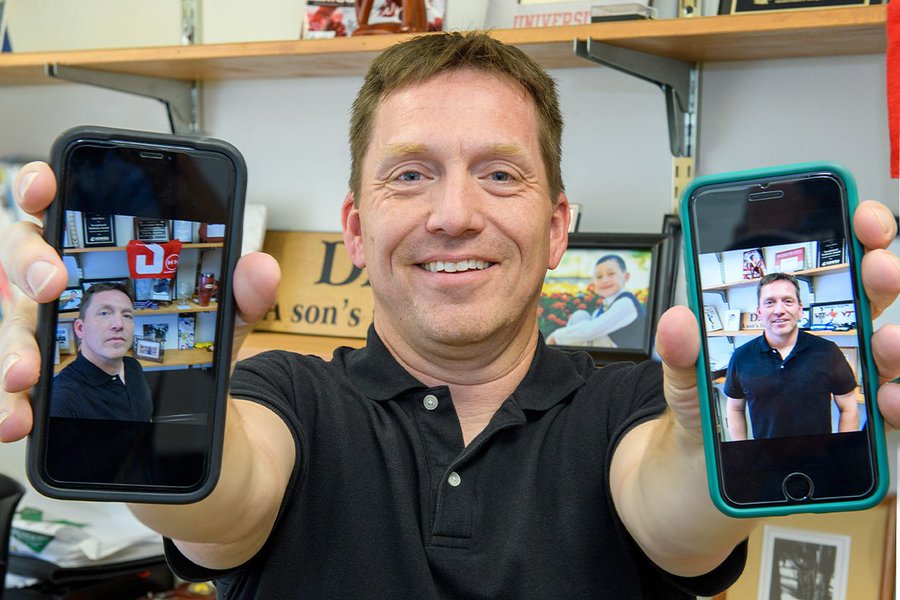
Professor Chris Barry displays a selfie (left) and a posie (right) on two phones. Photo illustration by Bob Hubner/WSU.
WSU News


Labels: , , , ,

Sunday, March 31, 2019

The Study of 'Unequal Parental Investment' in Offspring

"I thought -- and I still think - it's very plausible and intuitive [birth order moulding personality traits]."
"Birth order research is one hundred years old [its roots in Freudian psychoanalytic theory]. We are getting closer and closer to the truth."
"But I wouldn't say yet that we have fully understood the true picture."
Ralph Hertwig, psychologist, Max Planck Institute for Human Development, Berlin

"None of these behavioural measures showed any credible relationship between being a later-born and taking more risks."
"Does birth order shape people’s propensity to take risks? For decades, personality psychologists have believed that birth order influences personality, but recent evidence has accumulated to indicate that this is not the case. The effect of birth order on risk taking is less clear. We searched for evidence in survey, experimental, and real-world data, analyzing self-reports, incentivized risky decisions, and consequential life choices. The findings point unanimously in the same direction: We found no birth-order effects on risk taking in adulthood."
Study, Decision Science Laboratory, University of the Balearic Islands, Spain
Thory that first-borns have  higher IQs questioned     iStock

"Our results indicate that birth order does not influence the propensity to take risks in adults."
"There seems to be a growing consensus that birth order does not influence personality in a way that can be measured in adulthood."
"[The Basel-Berlin Risk Study -- used as an assessment tool in the study -- is one of the most exhaustive attempts to measure risk preference."
Tomas Lejarraga, director, Decision Science Laboratory

"This paper is very clear and it convincingly shows that there are no birth order effects on risk taking."
"Some of the birth order effects that we observe in everyday life are not birth order effects, but actually are age effects."
"It is not surprising that, when you look at differences within families, that first-borns are more conscientious than later-borns. [Take age away and the effect fades]."
Stefan Schmukle, psychologist, University of Leipzig, Germany
The effects of age on the daily life are attributed to the birth order.
The effects of age on daily life is attributed to the birth order.   Credit:Paul Rovere
Conventional wisdom has it, thanks to psychologist Frank Sulloway's influential book on birth order published two decades ago and widely hailed as a breakthrough, that first-born children, lavished with attention by first-time parents grow into intellectual, responsible and conformist adults while their younger siblings must work more diligently for attention from their parents and in so doing take greater risks, in the process ultimately becoming creative rebels.

 As Mr. Sulloway had it in his account of the nuclear family, in his book Born to Rebel, by commanding parents' attention and resources, first-borns leave little for later-borns who must then struggle to find their own niche; attitudes and behaviours that crystallize into adult personas. However convincing the theory sounded and was embraced at the time as solidly reliable, new studies reverse that trend altogether with newer research based on larger data sets and trustworthy statistical methods finding no relationship to birth order and personality.

Dr. Hertwig, one of the co-authors of the new, debunking study published in the Proceedings of the National Academy of Sciences, expected that evidence would be uncovered marking later-borns as daredevils, with this study of risky behaviours. And was surprised when that turned out not to be the case at all. For this study, biographical data of explorers and revolutionaries, along with a survey of 11,000 German households and the Basel-Berlin Risk Study were used to arrive at their conclusion.

The household survey failed to find any relationship between self-reports of riskiness and birth order, and nor did examining birth orders of close to two hundred people who had made a "risky life decision" to be revolutionaries or explorers (mountaineer Edmund Hillary, guerrilla fighter Che Guevara and socialist activist Rosa Luxembourg, for example) validate the theory.

In 2015 a study by Stefan Schmukle at University of Leipzig assessed birth order in about 20,000 people in the U.S., Germany and Great Britain finding that birth order was not a reliable measure of five broad personality traits: the "Big Five" -- openness, conscientiousness, extroversion, agreeableness and neuroticism. And nor did a following study published two years later by Schmukle's team find any effect of birth order.

Using a sample "larger than all of the previous samples from the past hundred years put together", Rodica Damian, a social psychologist at the University of Houston, studied over 370,000 high school students to conclude in 2015 that birth order fails to influence the Big Five. Frank Sulloway, a psychologist at the University of California at Berkley and the originator of the theory, made a distinction between "technical" and "radical" revolutionaries, to uphold his original theory.

He pointed to first-borns having a "slight advantage in IQ" -- as example, Isaac Newton's and Albert Einstein's physics work -- as opposed to later-born radical revolutionaries such as evolutionary theorist Charles Darwin, or astronomer Nicolaus Copernicus, whose unorthodox ideas upset social norms.

Labels: , , , ,

 
()() Follow @rheytah Tweet